


Portal:Spain

The Spain Portal (Bienvenido al portal español)
.svg)
Spain, officially the Kingdom of Spain, is a country in Southern and Western Europe with territories in North Africa. Featuring the southernmost point of continental Europe, it is the largest country in Southern Europe and the fourth-most populous European Union (EU) member state. Spanning the majority of the Iberian Peninsula, its territory also includes the Canary Islands, in the Eastern Atlantic Ocean; the Balearic Islands, in the Western Mediterranean Sea; and the autonomous cities of Ceuta and Melilla, in mainland Africa. Peninsular Spain is bordered to the north by France, Andorra, and the Bay of Biscay; to the east and south by the Mediterranean Sea and Gibraltar and Morocco, through its exclaves in North Africa; and to the west by Portugal and the Atlantic Ocean. Spain's capital and largest city is Madrid; other major urban areas include Barcelona, Valencia, Seville, Zaragoza, Málaga, Murcia, and Palma de Mallorca.
In early antiquity, the Iberian Peninsula was inhabited by Iberians, Celts, and other pre-Roman peoples. The Roman conquest of the Iberian peninsula created the province of Hispania, which became deeply Romanised and later Christianised. After the fall of the Western Roman Empire, the peninsula was conquered by tribes from Central Europe, among them the Visigoths, who established the Visigothic Kingdom centred on Toledo. In the early 8th century, most of the peninsula was conquered by the Umayyad Caliphate, with Al-Andalus centred on Córdoba. The northern Christian kingdoms of Iberia launched the so-called Reconquista, gradually repelling and ultimately expelling Islamic rule from the peninsula, culminating with the fall of the Nasrid Kingdom of Granada. The dynastic union of the Crown of Castile and the Crown of Aragon in 1479 under the Catholic Monarchs is often seen as the de facto unification of Spain as a nation state. (Full article...)
 Featured article –

-

The AMX-30E (E stands for España, Spanish for Spain) is a Spanish main battle tank based on France's AMX-30. Although originally the Spanish government sought to procure the German Leopard 1, the AMX-30 was ultimately awarded the contract due to its lower price and the ability to manufacture it in Spain. 280 units were manufactured by Santa Bárbara Sistemas for the Spanish Army, between 1974 and 1983. (Full article...) -

An M48 Patton tank of the Spanish Army on display at the El Goloso Museum of Armored Vehicles in October 2007.
Tanks in the Spanish Army have over 90 years of history, from the French Renault FTs first delivered in 1919 to the Leopard 2 and B1 Centauro models of the early 21st century. The Spanish FTs took part in combat during the Rif War and participated in the first amphibious landing with tanks in history, at Alhucemas. In 1925, the Spanish Army began to undertake a program to develop and produce a Spanish tank, an upgraded version of the Renault FT, called the Trubia A4. Although the prototype performed well during testing, the tank was never put into mass production. Spain also experimented with the Italian Fiat 3000, acquiring one tank in 1925, and with another indigenous tank program called the Landesa. However, none of these evolved into a major armor program, and as a result the FT remained the most important tank, in numbers, in the Spanish Army until the beginning of the Spanish Civil War. (Full article...) -
Doménikos Theotokópoulos (Greek: Δομήνικος Θεοτοκόπουλος, pronounced [ðoˈminikos θeotoˈkopulos]; 1 October 1541 – 7 April 1614), most widely known as El Greco (Spanish pronunciation: [el ˈɣɾeko]; "The Greek"), was a Greek painter, sculptor and architect of the Spanish Renaissance, regarded as one of the greatest artists of all time. El Greco was a nickname, and the artist normally signed his paintings with his full birth name in Greek letters often adding the word Κρής (Krḗs), which means "Cretan" in Ancient Greek. (Full article...) -
Abu Abdullah Muhammad ibn Yusuf ibn Nasr (Arabic: أبو عبد الله محمد بن يوسف بن نصر, romanized: Muḥammad ibn Yūsuf ibn Naṣr; c. 1195 – 22 January 1273), also known as Ibn al-Ahmar (ابن الأحمر, lit. 'Son of the Red') and by his honorific al-Ghalib billah (الغالب بالله, lit. 'The Victor by the Grace of God'), was the first ruler of the Emirate of Granada, the last independent Muslim state on the Iberian Peninsula, and the founder of its ruling Nasrid dynasty. He lived during a time when Iberia's Christian kingdoms—especially Portugal, Castile and Aragon—were expanding at the expense of the Islamic territory in Iberia, called Al-Andalus. Muhammad ibn Yusuf took power in his native Arjona in 1232 when he rebelled against the de facto leader of Al-Andalus, Ibn Hud. During this rebellion, he was able to take control of Córdoba and Seville briefly, before he lost both cities to Ibn Hud. Forced to acknowledge Ibn Hud's suzerainty, Muhammad was able to retain Arjona and Jaén. In 1236, he betrayed Ibn Hud by helping Ferdinand III of Castile take Córdoba. In the years that followed, Muhammad was able to gain control over southern cities, including Granada (1237), Almería (1238), and Málaga (1239). In 1244, he lost Arjona to Castile. Two years later, in 1246, he agreed to surrender Jaén and accept Ferdinand's overlordship in exchange for a 20-year truce. (Full article...) -

North View of Gibraltar from Spanish Lines by John Mace (1782)
The history of Gibraltar, a small peninsula on the southern Iberian coast near the entrance of the Mediterranean Sea, spans over 2,900 years. The peninsula was a place of reverence in ancient times, and it later became "one of the most densely fortified and fought-over places in Europe", as one historian has put it. Gibraltar's location has given it an outsized role in the history of Europe. Its fortified town, established in the Middle Ages, has hosted garrisons that have fought in numerous sieges and battles over the centuries. The Rock of Gibraltar is a limestone monolith and fortress in Gibraltar that has held historical and military significance and has become a tourist attraction. (Full article...) -
Nasr (1 November 1287 – 16 November 1322), full name Abu al-Juyush Nasr ibn Muhammad (Arabic: أبو الجيوش نصر بن محمد), was the fourth Nasrid ruler of the Emirate of Granada from 14 March 1309 until his abdication on 8 February 1314. He was the son of Muhammad II al-Faqih and Shams al-Duha. He ascended the throne after his brother Muhammad III was dethroned in a palace revolution. At the time of his accession, Granada faced a three-front war against Castile, Aragon and the Marinid Sultanate, triggered by his predecessor's foreign policy. He made peace with the Marinids in September 1309, ceding to them the African port of Ceuta, which had already been captured, as well as Algeciras and Ronda in Europe. Granada lost Gibraltar to a Castilian siege in September, but successfully defended Algeciras until it was given to the Marinids, who continued its defense until the siege was abandoned in January 1310. James II of Aragon sued for peace after Granadan defenders defeated the Aragonese siege of Almería in December 1309, withdrawing his forces and leaving the Emirate's territories by January. In the ensuing treaty, Nasr agreed to pay tributes and indemnities to Ferdinand IV of Castile and yield some border towns in exchange for seven years of peace. (Full article...)
-
The Punic Wars were a series of wars fought between the Roman Republic and the Carthaginian Empire during the period 264 to 146 BC. Three such wars took place, involving a total of forty-three years of warfare on both land and sea across the western Mediterranean region, and a four-year-long revolt against Carthage. (Full article...) -
The Leopardo 2E or Leopard 2A6E (E stands for España (Spanish for 'Spain')) is a variant of the German Leopard 2 main battle tank (specifically the Leopard 2A6 variant), tailored to the requirements of the Spanish army, which acquired it as part of an armament modernization program named Programa Coraza, or Program Cuirass. The acquisition program for the Leopard 2E began in 1994, five years after the cancellation of the Lince tank program that culminated in an agreement to transfer 108 Leopard 2A4s to the Spanish army in 1998 and started the local production of the Leopard 2E in December 2002. Despite postponement of production owing to the 2003 merger between Santa Bárbara Sistemas and General Dynamics, and continued manufacturing issues between 2006 and 2007, 219 Leopard 2Es have been delivered to the Spanish army. (Full article...) -
The Italian War of 1542–1546 was a conflict late in the Italian Wars, pitting Francis I of France and Suleiman I of the Ottoman Empire against the Holy Roman Emperor Charles V and Henry VIII of England. The course of the war saw extensive fighting in Italy, France, and the Low Countries, as well as attempted invasions of Spain and England. The conflict was inconclusive and ruinously expensive for the major participants. (Full article...) -
Europejara is a genus of tapejarid pterosaur that lived during the Barremian age of the Early Cretaceous epoch in what is now Spain. The only known specimen was found at the Las Hoyas site of Cuenca, a location noted for its exceptional Konservat-Lagerstätte preservation. In 2012, the new genus and species Europejara olcadesorum was named based on it. The generic name refers to Europe, where it was found, and the related genus Tapejara, while the specific name refers to the Olcades, an ancient people that lived in the region. The holotype specimen consists of an incomplete, crushed skull; the bones of the postorbital region are displaced while the mandible is almost complete. (Full article...) -
The Oran fatwa was a responsum fatwa, or an Islamic legal opinion, issued in 1502 to address the crisis that occurred when Muslims in the Crown of Castile, in present-day Spain, were forced to convert to Christianity in 1500–1502. It was authored by a maliki mufti Ahmad ibn Abi Jum'ah, an Algerian scholar of Islamic law of the Maliki school; the term "Oran fatwa" was applied by modern scholars, due to the word "Al-Wahrani" ("of Oran") that appears in the text as part of the author's name. (Full article...)
-
The black stork (Ciconia nigra) is a large bird in the stork family Ciconiidae. It was first described by Carl Linnaeus in the 10th edition of his Systema Naturae. Measuring on average 95 to 100 cm (37 to 39 in) from beak tip to end of tail with a 145-to-155 cm (57-to-61 in) wingspan, the adult black stork has mainly black plumage, with white underparts, long red legs and a long pointed red beak. A widespread but uncommon species, it breeds in scattered locations across Europe (predominantly in Portugal and Spain, and central and eastern parts), and east across the Palearctic to the Pacific Ocean. It is a long-distance migrant, with European populations wintering in tropical Sub-Saharan Africa, and Asian populations in the Indian subcontinent. When migrating between Europe and Africa, it avoids crossing broad expanses of the Mediterranean Sea and detours via the Levant in the east, the Strait of Sicily in the center, or the Strait of Gibraltar in the west. An isolated non-migratory population lives in Southern Africa. (Full article...) -
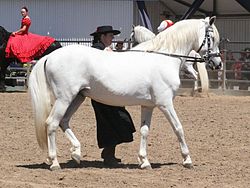
The Andalusian or Pura Raza Española, also known as the Pure Spanish Horse or PRE, is a Spanish breed of riding horse from the Iberian Peninsula, where its ancestors have lived for thousands of years. The Andalusian has been recognized as a distinct breed since the 15th century, and its conformation has changed very little over the centuries. Throughout its history, it has been known for its prowess as a war horse, and was prized by the nobility. The breed was used as a tool of diplomacy by the Spanish government, and kings across Europe rode and owned Spanish horses. During the 19th century, warfare, disease, and crossbreeding reduced herd numbers dramatically, and despite some recovery in the late 19th century, the trend continued into the early 20th century. Exports of Andalusians from Spain were restricted until the 1960s, but the breed has since spread throughout the world, despite its low population. In 2010, more than 185,000 registered Andalusians existed worldwide. (Full article...) -
El Alma al Aire (transl. The Bared Soul) is the sixth studio album by Spanish singer-songwriter Alejandro Sanz. It was released on 25 September 2000 by Warner Music Spain, following the success of Más (1997) and his hiatus from the music scene in 1999. El Alma al Aire is a pop album, which in comparison to its predecessor, leans more towards ballads. The album was produced by Sanz's frequent collaborator Emanuele Ruffinengo, while other musicians, including Vicente Amigo, returned to collaborate with him following Más. (Full article...)
-
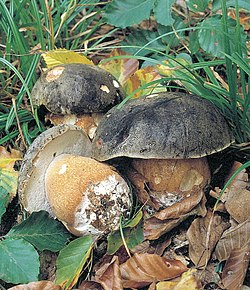
Boletus aereus, commonly known as the queen bolete, dark cep, or bronze bolete, is a species of fungus in the family Boletaceae. Described in 1789 by French mycologist Pierre Bulliard, it is closely related to several other European boletes, including B. reticulatus, B. pinophilus, and the popular B. edulis. Some populations in North Africa have in the past been classified as a separate species, B. mamorensis, which has been shown to be phylogenically conspecific to B. aereus and is now regarded as a synonym. (Full article...) -
The 2015 Vuelta a España was a three-week Grand Tour cycling race. The race was the 70th edition of the Vuelta a España and took place principally in Spain, although two stages took place partly or wholly in Andorra, and was the 22nd race in the 2015 UCI World Tour. The 3,358.1-kilometre (2,086.6 mi) race included 21 stages, beginning in Marbella on 22 August 2015 and finishing in Madrid on 13 September. It was won by Fabio Aru (Astana Pro Team), with Joaquim Rodríguez (Team Katusha) second and Rafał Majka (Tinkoff–Saxo) third. (Full article...) -

Hieronymus Bosch, The Garden of Earthly Delights, oil on oak panels, 205.5 cm × 384.9 cm (81 in × 152 in), Museo del Prado, Madrid
The Garden of Earthly Delights (Dutch: De tuin der lusten, lit. 'The garden of lusts') is the modern title given to a five-panel triptych (three oil-painted panels when open, two oak panels when closed) by the Early Netherlandish master Hieronymus Bosch, between 1490 and 1510, when Bosch was between 40 and 60 years old. Because of Bosch's religious beliefs, interpretations of the work typically assume it is a warning against the perils of temptation. The outer panels place the work on the Third Day of Creation. The intricacy of its symbolism, particularly that of the central panel, has led to a wide range of scholarly interpretations over the centuries. (Full article...) -
Hurricane Leslie (known as Storm Leslie or Cyclone Leslie while extratropical) was the strongest cyclone of tropical origin to strike the Iberian Peninsula since 1842. A large, long-lived, and very erratic tropical cyclone, Leslie was the twelfth named storm and sixth hurricane of the 2018 Atlantic hurricane season.[1] The storm had a non-tropical origin, developing from an extratropical cyclone that was situated over the northern Atlantic on 22 September. The low quickly acquired subtropical characteristics and was classified as Subtropical Storm Leslie on the following day. The cyclone meandered over the northern Atlantic and gradually weakened, before merging with a frontal system on 25 September, which later intensified into a powerful hurricane-force extratropical low over the northern Atlantic. (Full article...) -
Abu Abdullah Muhammad ibn Ismail also known as Muhammad IV (14 April 1315 – 25 August 1333), was the ruler of the Emirate of Granada on the Iberian Peninsula from 1325 to 1333. He was the sixth Sultan of the Nasrid dynasty, succeeding to the throne at ten years old when his father, Ismail I (r. 1314–1325), was assassinated. (Full article...) -
The First Punic War (264–241 BC) was the first of three wars fought between Rome and Carthage, the two main powers of the western Mediterranean in the early 3rd century BC. For 23 years, in the longest continuous conflict and greatest naval war of antiquity, the two powers struggled for supremacy. The war was fought primarily on the Mediterranean island of Sicily and its surrounding waters, and also in North Africa. After immense losses on both sides, the Carthaginians were defeated and Rome gained territory from Carthage. (Full article...) -
Abu'l-Walid Ismail I ibn Faraj (3 March 1279 – 8 July 1325) was the fifth Nasrid ruler of the Emirate of Granada on the Iberian Peninsula from 1314 to 1325. A grandson of Muhammad II on the side of his mother Fatima, he was the first of the lineage of sultans now known as the al-dawla al-isma'iliyya al-nasriyya (lit. 'the Nasrid dynasty of Ismail'). Historians characterise him as an effective ruler who improved the emirate's position with military victories during his reign. (Full article...)
-
The Mercenary War, also known as the Truceless War, was a mutiny by troops that were employed by Carthage at the end of the First Punic War (264–241 BC), supported by uprisings of African settlements revolting against Carthaginian control. It lasted from 241 to late 238 or early 237 BC and ended with Carthage suppressing both the mutiny and the revolt. (Full article...) -
The European rabbit (Oryctolagus cuniculus) or coney is a species of rabbit native to the Iberian Peninsula and southwestern France. It has been introduced to hundreds of locations around the world. Wild and domesticated European rabbits around the world can vary widely in size, shape, and colour. The average adult European rabbit is smaller than the European hare, though size and weight vary with habitat and diet. (Full article...) -
Abu al-Hajjaj Yusuf ibn Ismail (29 June 1318 – 19 October 1354), known by the regnal name al-Muayyad billah (lit. 'He who is aided by God'), was the seventh Nasrid ruler of the Emirate of Granada on the Iberian Peninsula. The third son of Ismail I (r. 1314–1322), he was Sultan between 1333 and 1354, after his brother Muhammad IV (r. 1325–1333) was assassinated. (Full article...) -
The battle of New Carthage took place in early 209 BC when a Roman army under Publius Cornelius Scipio successfully assaulted New Carthage, the capital of Carthaginian Iberia, which was defended by a garrison under Mago. The battle was part of the Second Punic War. (Full article...)


_2.jpg)


.jpeg)

Selected biography

Luis Carrero Blanco, 1st Duke of Carrero-Blanco (March 4, 1903, Santoña, Cantabria – December 20, 1973, Madrid) was a Spanish admiral and statesman. In July 1936, when the Spanish Civil War erupted, Carrero Blanco found himself behind the coalescing Republican line. Taking refuge in the embassy of Mexico and later that of France, he was able to sneak across the front and reach the Nationalist side in June of 1937. Carrero Blanco then served in the Nationalist navy. After the Nationalist victory and subsequent installation of Generalísimo Francisco Franco as military dictator (Caudillo) of Spain, Carrero Blanco became one of his closest collaborators as well a chief of naval operations.
He was said to be in opposition to Spain entering World War II on the side of the Axis powers, a notably different political position compared to some other Falangists. Carrero Blanco himself was a monarchist. Devoted to the Roman Catholic Church, he was close to Opus Dei. After as political career of many positions, he reached its zenith in June 1973 upon being named Prime Minister of Spain and made a top deputy to Franco. It seemed as though it was only a matter of time before he would succeed the ailing dictator. Blanco was assassinated in 1973 in Madrid by four members of the ETA.
Selected picture
-
 Artist: UnknownFerdinand I, Holy Roman Emperor, is represented in this anonymous portrait as a young archduke in his native Spain. He left Spain in his early twenties, to start his life as future King of the Romans and successor to his grandfather, Maximilian I. His older brother Charles eventually succeeded as Holy Roman Emperor, but Ferdinand was elected after Charles's abdication. Philip, Charles's son, inherited Spain and became King Philip II of Spain. Ferdinand ruled between 1558 and 1564, for nearly six years.
 -
 Photograph credit: Biblioteca Nacional de EspañaAna Santos Aramburo (born 1957) has been the director of the National Library of Spain since February 2013. Having received a degree in geography and history from the University of Zaragoza in Spain, she has spent much of her career working at the Complutense University of Madrid, first at the library of the Faculty of Economics and Business Sciences, and later serving as deputy director of the university library. Later she served as Director of the Historical Library Marquis of Valdecilla, General Director of Libraries and Archives of the City of Madrid, and Director of Cultural Action at the National Library. This photograph of Santos shows her at the headquarters of the National Library of Spain in Madrid.
 -
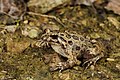 Photograph: Benny TrappThe Spanish painted frog (Discoglossus jeanneae) is a species of frog in the family Alytidae. Endemic to Spain, it mostly lives in open areas, pine groves and shrublands. It feeds mostly on insects and worms.
 -
 Photograph: Diego DelsoMoros is a municipality in the province of Zaragoza, Spain. Located in the Sistema Ibérico mountain range, the village lies on a hill, with the church and former town hall at the top, the residences in the middle, and the sheep pens at the bottom. The population of Moros has been steadily decreasing in recent decades, and was 478 in 2006.
 -
 Photograph: J.Ligero & I.BarriosA three-month old Spanish ibex (Capra pyrenaica) in Sierra de Gredos, Spain. These ibexes are strong mountain animals characterized by their large and flexible hooves and short legs.
The two sexes of adults form separate social groups; juveniles stay with the female groups from birth until the following birth season, when they leave. Yearling males then join male groups, while females eventually return to their mothers' groups and stay several years. -
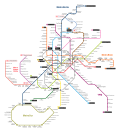 The Madrid Metro is a rapid transit system serving the Spanish capital, Madrid. It was inaugurated in 1919 by King Alfonso, with a single line which ran for 3.48 km (2.16 mi) between Puerta del Sol and Cuatro Caminos, with eight stops. The present system has 301 stations on 13 lines plus one branch line, totalling 294 km (183 mi).
 -
 Photo credit: David IliffThe Tagus River, seen here passing through the World Heritage listed city of Toledo, Spain. It is the longest river on the Iberian Peninsula at 1,038 kilometres (645 mi). It begins its journey in the Albarracín mountains in Spain, and follows a very constricted course for much of its length before reaching the Atlantic Ocean in Portugal.
 -

A statue showing Christopher Columbus Credit: Luis GarcíaA statue showing Christopher Columbus and Queen Isabella, the statue was made in 1885. -
 Photo credit: DiliffThe Torre Agbar is a landmark skyscraper and the third tallest building in Barcelona, Spain. It was designed by French architect Jean Nouvel, who stated that the shape of the Torre Agbar was inspired by the mountains of Montserrat that surround Barcelona, and by the shape of a geyser of water rising into the air. Its design combines a number of different architectural concepts, resulting in a striking structure built with reinforced concrete, covered with a facade of glass, and over 4,500 window openings cut out of the structural concrete.
 -
 The peaks of the Central Massif overlook the village of Sotres in Cabrales, located in the Picos de Europa, a mountain range in northern Spain forming part of the Cantabrian Mountains. The name (literally: "Peaks of Europe") is believed to derive from being the first European landforms visible to mariners arriving from the Americas.
 -

Aneto Peak Credit: BrugesFR
Aneto is a mountain located in Benasque municipality, Aragon, area of the Pyreenes. The mountain is the highest mountain in the Pyrenees, and Spain's third-highest mountain. -
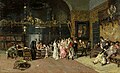 Painting: Marià FortunyThe Spanish Wedding is an oil on panel painting by Marià Fortuny completed over a two-year period ending in 1870. It depicts the signing of a wedding contract in 18th century Spain and was influenced heavily by the works of Francisco Goya, whom the artist admired. It is currently exhibited at the National Art Museum of Catalonia.
 -
-
 Painting credit: Federico de Madrazo y KuntzAmalia de Llano (April 29, 1822 – July 6, 1874) was a Spanish countess and writer. This 1853 oil-on-canvas portrait by Federico de Madrazo y Kuntz shows her seated in a fine armchair wearing sumptuous clothes, with her youth and beauty accentuated by the dark background, and is quite unlike a traditional Spanish portrait of the period.
 -
 Gaspar de Guzmán, Count-Duke of Olivares (1587–1645) was a Spanish royal favourite of Philip IV and minister. As prime minister from 1621 to 1643, he over-exerted Spain in foreign affairs and unsuccessfully attempted domestic reform. His policies of committing Spain to recapture the Dutch Republic led to his major involvement in the Thirty Years War. This portrait was completed in 1634, with its composition referring to Olivares' military leadership in the service of King Philip.
 -
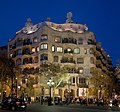 Photo credit: David IliffThe Casa Milà, a 1912 work by Catalán architect Antoni Gaudi, in the Eixample district of Barcelona, Spain. Gaudí's fascination with trencadís-influenced decoration and curves (predating biomorphism by almost 20 years) can be seen here.
 -

Alcántara bridge Credit:
The Roman bridge of Alcántara, located in the province of Cáceres, Extremadura. -
 Painting credit: Francisco GoyaCharles IV of Spain and His Family is a portrait of the royal family of Spain painted by Francisco Goya in 1800 and 1801. King Charles IV, his wife Maria Luisa of Parma, and his children and relatives are dressed in the height of contemporary fashion, lavishly adorned with jewelry and the sashes of the order of Charles III. The artist does not attempt to flatter the family; instead the group portrait is unflinchingly realist, both in detail and tone. The artist, seated at his easel, is visible in the background. The painting is in the collection of the Museo del Prado in Madrid.
 -

A light metro train Credit: FDV
A metro light train currently in operation with Madrid Metro. This train is pictured on line ML2 at Aravaca metro station. -
 Architecture credit: José Grases Riera; photographed by Carlos DelgadoThe Monument to Alfonso XII is located in Buen Retiro Park (El Retiro) in Madrid, Spain. Measuring 30 m (98 ft) high, 86 m (282 ft) long, and 58 m (190 ft) wide, it has at its center an equestrian statue of King Alfonso XII, cast in bronze by the Spanish sculptor Mariano Benlliure in 1904. The monument is situated on the eastern edge of an artificial lake near the center of the park and was inaugurated on 6 June 1922.
 -

An exterior view of the Museo del Prado. Credit: FanghongThe Museo del Prado is a museum and art gallery located in Madrid; the capital of Spain. It features one of the world's finest collections of European art, from the 12th century through the early 19th century, based on the former Spanish Royal Collection. -

Cala Figuera Credit: BuzzWoof
The harbor entrance to Cala Figuera, a district of Mallorca in the Balearic Islands. The town is located approximately 60 kilometers north of Palma de Mallorca. The earliest records of the town date back to 1306, although houses were not built on the land until the early 19th century.

.jpg)
_jeannaea.jpg)


_02b.jpg)


.jpg)

.jpg)


Did you know...
- ... that the surname Baena was popular among Spanish Jews forced to convert to Catholicism during the Reconquista, even though few Jews in Baena had Jewish surnames in the first place?
- ... that lemon trees inspired a Spanish tourist train?
- ... that Lourdes Ambriz, singing voice of Belle in the Spanish version of Beauty and the Beast, became the artistic director of the Mexican national opera?
- ... that when the COVID-19 pandemic began, Masyita Crystallin was instructed by the Indonesian finance minister to study the Spanish flu to help formulate unconventional economic policies?
- ... that the May 1995 Pale air strikes during the Bosnian War were the first offensive operations carried out by the Spanish Air Force since 1957?
- ... that France beat Spain 2–1 in 1955, after which a British journalist nicknamed Raymond Kopa the "Napoleon of football"?
 Good article –

-
The Cagots (pronounced [ka.ɡo]) were a persecuted minority who lived in the west of France and northern Spain: the Navarrese Pyrenees, Basque provinces, Béarn, Aragón, Gascony and Brittany. Evidence of the group exists as far back as 1000 CE. The name they were known by varied across the regions where they lived. (Full article...) -

José María Gil Tamayo (born 5 June 1957) is a Spanish prelate of the Roman Catholic Church. He has been serving as archbishop of Granada since his installation on 1 February 2023. He previously served as coadjutor archbishop of that archdiocese and as bishop of Ávila. (Full article...) -

Catalan separatists held a general strike on 3 October 2017 following Catalonia's referendum on independence two days earlier. The referendum, which was held in defiance of Spanish national court orders, resulted in over 900 people injured as the national police attempted to prevent Catalans from voting. The violence galvanized separatist support for the strike, whose planning predated the crackdown, and led to endorsements from the Catalan government, the Catalan branches of the country's two largest labor unions, and pro-independence cultural groups. (Full article...) -
The Battle of Orbetello, also known as the Battle of Isola del Giglio, was a major naval engagement of the Franco-Spanish War of 1635. It was fought on 14 June 1646 off the Spanish-ruled town of Orbetello, on the coast of Tuscany, Italy, between a French fleet led by Admiral Armand de Maillé, Marquis of Brézé, and a Spanish fleet commanded by Miguel de Noronha, 4th Count of Linhares sent to break the blockade of Orbetello and relieve the town, besieged since 12 May by a French army commanded by Prince Thomas of Savoy. The Battle of Orbetello was tactically very unusual, since it was fought by sailing ships towed by galleys in a light breeze. (Full article...) -
Onneca Fortúnez or Iñiga Fortúnez (c. 848 – after 890) was a Basque princess from the Kingdom of Pamplona, later known as the Kingdom of Navarre. She was the daughter of Fortún Garcés of Pamplona and his wife Auria. At the time of Onneca's birth, which occurred between 848 and 850, the Iberian Peninsula was largely under the domination of the Muslim Umayyad dynasty. Only the northern kingdoms of Asturias, Pamplona and the Pyrenean threshold remained under control of Roman Catholic rulers. Onneca was a member of the Íñiguez dynasty, named after her great-grandfather Íñigo Arista, who founded the Kingdom of Pamplona. (Full article...)
-
Shambhala: Expedición al Himalaya is a steel hypercoaster located at PortAventura Park in Salou and Vila-seca, Spain. Manufactured by Bolliger & Mabillard, it was the tallest (76 metres (249 ft)) and second fastest (134 kilometres per hour (83 mph)) roller coaster in Europe at the time of its opening. The height and speed records were beaten in April 2017 by Red Force (with a height of 112 metres (367 ft)), which was also opened in PortAventura World in its new theme park Ferrari Land. Among coasters with a lift hill, the height and speed records were beaten in July 2018, when Hyperion opened at Energylandia in Poland. Shambhala is named and themed after the inaccessible land in the Himalayas: Shambhala. The coaster was announced on 24 October 2011, and opened to the public on 12 May 2012. (Full article...) -
Pablo Ibáñez Tébar (born 3 August 1981), sometimes known as just Pablo, is a Spanish former professional footballer who played as a centre back. (Full article...) -
"Si Tú Te Vas" (English: "If You Go Away") is a song by Spanish singer Enrique Iglesias from his 1995 eponymous debut studio album. The song was co-written by Iglesias when he was 16 and his friend Roberto Morales with Rafael Pérez-Botija handling its production. It was released as the lead single from the album in October 1995. Iglesias recorded a demo of the song which was accepted by Guillermo Santiso, the president of Fonovisa Records, which led to Iglesias signing on with the company. A pop ballad, the song is about a man inspired by love and is afraid of a farewell. A music video for the song was filmed in New York and led to Iglesias being nominated for Best New Artist at the 1996 MTV Latino Awards. (Full article...)
-
The Mediterranean campaign of 1798 was a series of major naval operations surrounding a French expeditionary force sent to Egypt under Napoleon Bonaparte during the French Revolutionary Wars. The French Republic sought to capture Egypt as the first stage in an effort to threaten British India and support Tipu Sultan, and thus force Great Britain to make peace. Departing Toulon in May 1798 with over 40,000 troops and hundreds of ships, Bonaparte's fleet sailed southeastwards across the Mediterranean Sea. They were followed by a small British squadron under Rear-Admiral Sir Horatio Nelson, later reinforced to 13 ships of the line, whose pursuit was hampered by a lack of scouting frigates and reliable information. Bonaparte's first target was the island of Malta, which was under the government of the Knights of St. John and theoretically granted its owner control of the Central Mediterranean. Bonaparte's forces landed on the island and rapidly overwhelmed the defenders, securing the port city of Valletta before continuing to Egypt. When Nelson learned of the French capture of the island, he guessed the French target to be Egypt and sailed for Alexandria, but passed the French during the night of 22 June without discovering them and arrived off Egypt first. (Full article...) -
Juan "Juanito" José Astorquia Landabaso (June 1876 – 23 October 1905) was a Spanish footballer who played as a forward for Athletic Bilbao. He is widely regarded as one of the most important figures in the amateur beginnings of Athletic Club from Bilbao, having been the fundamental driving force behind the foundation of the club in 1898 and its official establishment in 1901, and then serving as the club's first captain until 1904 and as its second president between 1902 and 1903. (Full article...) -
On 22 February 2019 at the Embassy of North Korea in Madrid, the political group Free Joseon, which is opposed to Kim Jong Un and the current government of North Korea, is alleged by Spanish and American authorities to have attacked the embassy. Free Joseon maintains that they were invited in to facilitate a high-level defection. A group of individuals stole mobile telephones, two USB flash drives and a hard drive from the embassy and handed them over to the Federal Bureau of Investigation (FBI) in the United States. The event took place after the Singapore summit between North Korea (DPRK) and the United States and prior to the Hanoi summit. As of early April 2019, one person had been arrested in connection with the incident and two international arrest warrants had been issued by the Spanish Audiencia Nacional. The suspected perpetrators are citizens of Mexico, the US and South Korea, although the latter two governments denied any connection with the incident. (Full article...) -

Political map of the Emirate of Granada
Abu al-Hajjaj Yusuf ibn Muhammad (Arabic: أبو الحجاج يوسف بن محمد; c. 1356 – 5 October 1392) was sultan of the Emirate of Granada, the last Muslim state in the Iberian Peninsula, from January 1391 until his death. He was the 11th sultan of the Nasrid dynasty and the first son of his predecessor, Muhammad V (r. 1354–1359, 1362–1391). (Full article...) -
The Reina Victoria Eugenia class was a class of three battleships of the Spanish Navy authorized as the Plan de la Segunda Escuadra under the Navy Law of 1913. The class, as well as the lead ship, were named for King Alfonso XIII's English queen consort, Victoria Eugenie of Battenberg. The other two ships were classified as "B" and "C". It was supposed to be designed by Vickers-Armstrongs, and built by John Brown. The ships were never built due to Britain's involvement in World War I, which halted all foreign projects being constructed in British yards. (Full article...)
-
The 2010 FIFA World Cup final was the final match of the 2010 World Cup, the 19th edition of FIFA's competition for national football teams. The match was played at Soccer City in Johannesburg, South Africa, on 11 July 2010, and was contested by the Netherlands and Spain, the first, and as of June 2026, the only time two European teams contested a World Cup final held outside of Europe (all other finals held outside of Europe featured a South American side). The tournament comprised hosts South Africa and 31 other teams who emerged from the qualification phase, organised by the six FIFA confederations. The 32 teams competed in a group stage, from which 16 teams qualified for the knockout stage. En route to the final, the Netherlands finished first in Group E, with three wins, after which they defeated Slovakia in the round of 16, Brazil in the quarter-final and Uruguay in the semi-final. Spain finished top of Group H with two wins and one loss, before defeating Portugal in the round of 16, Paraguay in the quarter-final and Germany in the semi-final. The final took place in front of 84,490 supporters, with more than 909 million watching on television, and was refereed by Howard Webb from England. (Full article...) -
"Te Lo Agradezco, Pero No" (English: "I thank you, but no") is a song recorded by Spanish singer Alejandro Sanz and Colombian singer Shakira, for Sanz's eighth studio album El Tren de los Momentos (2006). It was released as the second single from the record in December 2006 by Warner Music Latina. The track was written by Sanz, while production was handled by him along with Lulo Pérez. "Te Lo Agradezco, Pero No" is the second duet recorded by the two singers, following "La Tortura" for Shakira's album Fijación Oral Vol. 1 (2005). The song came about after she approached Sanz, telling him that she wanted to collaborate on something different from her own material. (Full article...)
-

Illustration of the dreadnought España in 1912
In the latter half of the 19th century, the Spanish Navy had built a series of ironclad warships that culminated in the barbette ship Pelayo in the 1880s. Following the destruction of much of the Spanish fleet in the Spanish–American War in 1898, Spain slowly began to rebuild its navy. In the early 20th century, the Spanish Navy built three battleships and planned several more; the three ships that were completed were the vessels of the España class. These ships were the smallest dreadnought-type battleships ever built. A further three ships of the Reina Victoria Eugenia class were authorized by the Navy Law of 1913, but the outbreak of World War I prevented these ships from being built, as Spain was heavily dependent on Great Britain for material and technical expertise. The three completed battleships all served in the Rif War in North Africa, where the lead ship, España, ran aground and was wrecked. (Full article...) -
Celebrity Number Six (sometimes abbreviated C6) is the name given to a previously unidentified face on a fabric print, the subject of a years-long online search. In 2020, Redditor (Reddit user) TontsaH posted to the subreddit r/TipOfMyTongue asking for help in identifying eight faces depicted on a set of curtains. While seven were quickly identified as actors and models prominent in the mid-2000s, one – the sixth, as numbered by TontsaH – proved far more difficult to identify, leading to the creation of a dedicated subreddit, r/CelebrityNumberSix. (Full article...)
-

The current Basque coat of arms (Euskal autonomi erkidegoaren armarria) is the official coat of arms of the Basque Country, an autonomous community of Spain. It consists of a party per cross representing the three historical territories of Álava, Gipuzkoa and Biscay, as well as a fourth, void quarter. The arms are ringed by a regal wreath of oak leaves, symbolic of the Gernikako Arbola. The fourth quarter constituted since the late 19th century the linked chains of Navarre; however, following a legal suit by the Navarre Government claiming that the usage of the arms of a region on the flag of another was illegal, the Constitutional Court of Spain ordered the removal of the chains of Navarre in a judgement of 1986. (Full article...) -
The siege of Almería was an unsuccessful attempt by Aragon to capture the city of Almería from the Emirate of Granada in 1309. Almería, a Mediterranean port in the southeast of the emirate, was the initial Aragonese target in a joint Aragonese-Castilian campaign aimed at conquering Granada. The Aragonese troops led by their King James II arrived on 11 August, blockading the city and employing siege engines. The city, led by governor Abu Maydan Shuayb and naval commander Abu al-Hasan al-Randahi, prepared for the siege by strengthening its defenses and stockpiling food. Throughout the siege, both sides exchanged shots from siege engines and engaged in fields battles and skirmishes with varying results. James ordered multiple unsuccessful assaults. A Granadan relief column under Uthman ibn Abi al-Ula arrived nearby in September and harassed the besiegers. (Full article...)
-
Eugenio Lascorz y Labastida (26 March 1886 – 1 June 1962) was a Spanish lawyer who claimed to be a descendant of the medieval Laskaris family, which had ruled the Byzantine Empire in Nicaea from 1204 to 1261. In 1917 he legally changed his paternal surname from Lascorz to Láscaris, alleging that the former was a Hispanicization of the latter. Later he began styling himself as Príncipe Eugenio Láscaris Comneno (Prince Eugene Laskaris Komnenos). As the supposed titular Emperor of Constantinople,' Eugenio used the regnal name Eugene II Lascaris Comnenus. In addition to his royal and imperial claims, which he supported with fabricated and contradictory genealogies, Lascorz also claimed the titles "Prince Porphyrogenitus", Duke of Athens and Grand Master of the self-proclaimed "Sovereign and Imperial Order of Constantine the Great" (not to be confused with the Constantinian Order of Saint George) and the "Order of Saint Eugene of Trebizond".' (Full article...)
-

Natalija Gros deep-water soloing at Kamenjak, Croatia (from the 2009 climbing film, Le Tango Vertical)
Deep-water soloing (DWS), also known as psicobloc (from "psycho-bouldering"), is a form of free solo climbing where a fall should result in the climber landing safely in deep water below the route. DWS is considered safer than normal free solo climbing but riskier than normal bouldering, because of several risks of its own, including trauma from uncontrolled high-speed water entry, injury from hitting hazards above and below the water while falling, and drowning in rough or tidal seas. (Full article...) -
Es Pontàs is a 20-metre (66 ft) long limestone deep-water soloing (DWS) climbing route on the Es Pontàs sea-arch in Mallorca, Spain. After it was first free soloed in September 2006 by American climber Chris Sharma, it became graded at 9a+ (5.15a) – the world's first-ever DWS route at that grade, and one of the earliest 9a+ graded rock climbs of any type in history. Es Pontàs was credited with promoting the emerging sport of DWS, and further enhancing Sharma's reputation and legacy as a pioneer in rock climbing. Sharma's first ascent was featured in the award-winning 2007 climbing film, King Lines. (Full article...) -
The Mudéjar revolt of 1264–1266 was a rebellion by the Muslim populations (Mudéjares) in the Lower Andalusia and Murcia regions of the Crown of Castile. The rebellion was in response to Castile's policy of relocating Muslim populations from these regions and was partially instigated by Muhammad I of Granada. The rebels were aided by the independent Emirate of Granada, while the Castilians were allied with Aragon. Early in the uprising, the rebels managed to capture Murcia and Jerez, as well as several smaller towns, but were eventually defeated by the royal forces. Subsequently, Castile expelled the Muslim populations of the reconquered territories and encouraged Christians from elsewhere to settle their lands. Granada became a vassal of Castile and paid an annual tribute. (Full article...) -
Juan Manuel López Mella (12 April 1965 – 10 May 1995) was a Spanish professional motorcycle racer at Grand Prix and Superbike levels. After coming second in the national championships in 1985, he entered international competitions for the first time in 1987. He was the first person from Galicia to enter the competition. He came third in the 1991 Spanish Superbike race at Jarama, the first person from Spain to gain a podium position in the competition, and was named Spanish Superbike champion in both 1991 and 1992, becoming the highest placed private rider overall in 1993. In 1995, he started riding in the Thunderbike tournament but was killed in a road accident early in the season. Lugo, his city of birth, has named a park that teaches road safety in his honour and hosts a museum in his memory. (Full article...) -
The open water swimming team event at the 2013 World Aquatics Championships was held on 25 July 2013 at the Moll de la Fusta harbour in Port Vell, Barcelona, Spain. (Full article...)


.jpg)

General images
-

-
 Plaza Mayor built in 1619 during the reign of Philip III. (from Spanish Golden Age)
 -
 Recognition of the Duke of Anjou as King of Spain, under the name of Philip V, November 16, 1700 (from History of Spain)
 -
 The Defence of Cádiz Against the English oil on canvas by Francisco de Zurbarán (from Spanish Golden Age)
 -
 Visigothic church, San Pedro de la Nave. Zamora. Spain (from History of Spain)
 -
 El paseo de las Delicias, a 1784–1785 painting by Ramón Bayeu depicting a meeting of members of the aristocracy in the aforementioned location. (from History of Spain)
 -
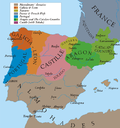 The Christian kingdoms of Hispania and the Islamic Almohad empire c. 1210
 -
-
 The Port of Seville in the late 16th century. Seville became one of the most populous and cosmopolitan European cities after the expeditions to the New World. (from History of Spain)
 -
 Felipe González signing the treaty of accession to the European Economic Community on 12 June 1985. (from History of Spain)
 -
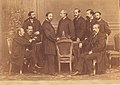 Members of the provisional government after the 1868 Glorious Revolution, by Jean Laurent. (from History of Spain)
 -
 The promulgation of the Constitution of 1812, oil painting by Salvador Viniegra. (from History of Spain)
 -
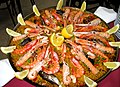 Paella mixta (from Culture of Spain)
 -

-
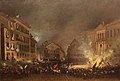 Episode of the 1854 Spanish Revolution in the Puerta del Sol, by Eugenio Lucas Velázquez. (from History of Spain)
 -
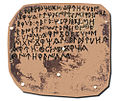 Illustration depicting the (now lost) Luzaga's Bronze, an example of the Celtiberian script. (from History of Spain)
 -
 The realms of Philip II of Spain (from Spanish Golden Age)
 -

-
 Roman Empire, 3rd century (from History of Spain)
 -
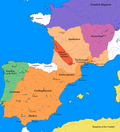 The greatest extent of the Visigothic Kingdom of Toulouse, c. 500, showing Territory lost after Vouillé in light orange (from History of Spain)
 -
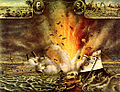 The explosion of the USS Maine launched the Spanish–American War in April 1898 (from History of Spain)
 -
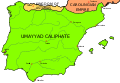 al-Andalus at its greatest extent, 720 (from History of Spain)
 -
 Taking of Oran by Francisco Jiménez de Cisneros in 1509. (from History of Spain)
 -

-
-
![Image 26Detail of the votive crown of Recceswinth from the Treasure of Guarrazar, (Toledo-Spain) hanging in Madrid. The hanging letters spell [R]ECCESVINTHVS REX OFFERET [King R. offers this]. (from History of Spain)](//upload.wikimedia.org/wikipedia/commons/thumb/f/f2/Corona_de_%2829049230050%29.jpg/60px-Corona_de_%2829049230050%29.jpg) Detail of the votive crown of Recceswinth from the Treasure of Guarrazar, (Toledo-Spain) hanging in Madrid. The hanging letters spell [R]ECCESVINTHVS REX OFFERET [King R. offers this]. (from History of Spain)
Detail of the votive crown of Recceswinth from the Treasure of Guarrazar, (Toledo-Spain) hanging in Madrid. The hanging letters spell [R]ECCESVINTHVS REX OFFERET [King R. offers this]. (from History of Spain) -
 Jamón ibérico (from Culture of Spain)
 -
 1894 satirical cartoon depicting the tacit accord for seamless government change (turnismo) between the leaders of two dynastic parties (Sagasta and Cánovas del Castillo), with the country being lied in an allegorical fashion. (from History of Spain)
 -
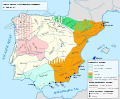 The Iberian Peninsula in the 3rd century BC (from History of Spain)
 -
 The successful 1925 Alhucemas landing turned the luck in the Rif War towards Spain's favour. (from History of Spain)
 -
 Charles I of Spain (better known in the English-speaking world as the Holy Roman Emperor Charles V) was the most powerful European monarch of his day. (from History of Spain)
 -
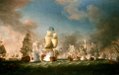 The Battle of Cape Passaro, 11 August 1718 (from History of Spain)
 -

-
 Ethnology of the Iberian Peninsula c. 200 BC (from History of Spain)
 -
 Celebrations of the proclamation of the 2nd Republic in Barcelona. (from History of Spain)
 -

-
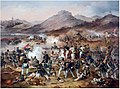 Battle of the First Carlist War, by Francisco de Paula Van Halen (from History of Spain)
 -
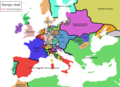 A map of Europe in 1648, after the Peace of Westphalia (from History of Spain)
 -
 Panoramic view of the lower level patio of the Palace (from Spanish Golden Age)
 -
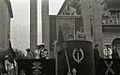 Franco visiting Tolosa in 1948 (from History of Spain)
 -

-
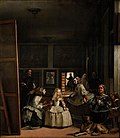
-
 Execution of Torrijos and his men in 1831. Ferdinand VII took repressive measures against the liberal forces in his country. (from History of Spain)
 -
 Visigothic King Roderic haranguing his troops before the Battle of Guadalete (from History of Spain)
 -
 Royal Site of San Lorenzo de El Escorial. Built between 1563 and 1584 by order of King Philip II, it is the largest Renaissance building in the world. (from Spanish Golden Age)
 -
 The Conquest of Tenochtitlán (from History of Spain)
 -
 An 18th-century map of the Iberian Peninsula (from History of Spain)
 -

-
 The Third of May 1808, Napoleon's troops shoot hostages. Goya (from History of Spain)
 -
 People's militias attacking on a Rebel position in Somosierra in the early stages of the war. (from History of Spain)
 -
 Cabeza de Luis Buñuel, sculptor's work by Iñaki, in the center Buñuel Calanda. (from Culture of Spain)
 -

-
 Two women and a man during the siege of the Alcázar (from History of Spain)
 -

-
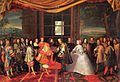 Louis XIV of France and Philip IV of Spain at the Meeting on the Isle of Pheasants in June 1660, part of the process to put an end to the Franco-Spanish War (1635–59). (from History of Spain)
 -

-
 The Second of May 1808 was the beginning of the popular Spanish resistance against Napoleon. (from History of Spain)
 -
 Wedding portrait of the Catholic Monarchs (from History of Spain)
 -
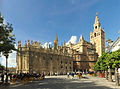 Cathedral of Saint Mary of the See in Sevilla. (from Culture of Spain)
 -
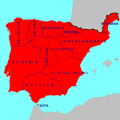 Visigothic Hispania and its regional divisions in 700, prior to the Muslim conquest (from History of Spain)
 -
 Landing of Columbus by John Vanderlyn, 1847. Christopher Columbus leads expedition to the New World, 1492, sponsored by Spanish crown (from History of Spain)
 -
 Façade of the Cathedral of Valladolid (from Spanish Golden Age)
 -
 The Virgin of the Rosary (1675–80) by Bartolomé Esteban Murillo (from Spanish Golden Age)
 -

-
 Map of territories that were once part of the Spanish Empire (from History of Spain)
 -
 Inner view of Granada Cathedral (from Spanish Golden Age)
 -
 The title page of the Gramática de la lengua castellana (1492), the first grammar of a modern European language to be published. (from History of Spain)
 -
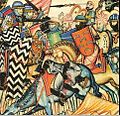 A battle of the Reconquista from the Cantigas de Santa Maria (from History of Spain)
 -
 Ruins of Guernica (from History of Spain)
 -
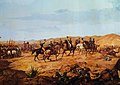 The pro-independence forces delivered a crushing defeat to the royalists and secured the independence of Peru in the 1824 battle of Ayacucho. (from History of Spain)
 -
 Proclamation of the Spanish Republic in Madrid (from History of Spain)


.jpg)


.jpg)


.JPG)


.jpeg)


![Image 26Detail of the votive crown of Recceswinth from the Treasure of Guarrazar, (Toledo-Spain) hanging in Madrid. The hanging letters spell [R]ECCESVINTHVS REX OFFERET [King R. offers this]. (from History of Spain)](/proxy/https://en.wikipedia.org/wiki/File:Corona_de_(29049230050).jpg)
.jpg)


_en_Prins_Juan_Carlos,_Bestanddeelnr_254-9762.jpg)


_-_Fondo_Car-Kutxa_Fototeka.jpg)


.jpg)
.jpg)


.jpg)


_(cropped).jpg)


.svg)


.jpg)

In the news
- 22 June 2026 – Koldo Case
- A Spanish court sentences former transport minister José Luis Ábalos to 24 years in prison for taking bribes in connection with public contracts for face masks during the COVID-19 pandemic. His advisor Koldo García is sentenced to 19 years and businessman Víctor de Aldama to four and a half years. (The Guardian)
- 20 June 2026 – Koldo Case
- A Spanish court orders Begoña Gómez, the wife of prime minister Pedro Sánchez, to stand trial on corruption-related charges, confiscates her passport, and restricts her international travel pending proceedings. (Reuters)
- 15 June 2026 – 2026 FIFA World Cup
- In association football, debutants Cape Verde earn their first-ever World Cup point after drawing 0–0 with Spain. (BBC Sport) (CAF)
- 11 June 2026 –
- Two people are killed and several others are injured in a fire at a home in Magaluf, Mallorca, Spain. (AP)
No recent news
Spain topics
Categories

WikiProjects
- Main project

- Related projects
WikiProject Basque • WikiProject Catalan-speaking Countries • WikiProject Galicia • Spanish Translation of the Week
Things you can do

- Add {{WikiProject Spain}} to article talk pages which have some relation to Spain
- Help write new Spain-related articles and improve and expand existent ones
- Assess: unassessed Spain-related articles
- Suggest: selected articles, biographies, pictures, did you knows? and quotes for this Portal
Related portals


.svg)

Associated Wikimedia
The following Wikimedia Foundation sister projects provide more on this subject:
-
 Commons
Free media repository -
 Wikidata
Free knowledge base -
 Wikiquote
Collection of quotations -
 Wikisource
Free-content library -
 Wikiversity
Free learning tools -
 Wikivoyage
Free travel guide -
 Wiktionary
Dictionary and thesaurus


- ^ "Atlantic hurricane best track (HURDAT version 2)" (Database). United States National Hurricane Center. April 4, 2025.
 This article incorporates text from this source, which is in the public domain.
- Landsea, Chris (April 2022). "The revised Atlantic hurricane database (HURDAT2) - Chris Landsea – April 2022" (PDF). Hurricane Research Division – NOAA/AOML. Miami, Florida: Hurricane Research Division – via Atlantic Oceanographic and Meteorological Laboratory.
