


Portal:France

| Main Page | Gazetteer |
Welcome to the France Portal!
Bienvenue sur le Portail France !

|

|
 | |
France, officially the French Republic, is a country primarily located in Western Europe. Its overseas regions and territories include French Guiana in South America, Saint Pierre and Miquelon in the North Atlantic, the French West Indies, and many islands in Oceania and the Indian Ocean. Metropolitan France shares borders with Belgium and Luxembourg to the north; Germany to the northeast; Switzerland to the east; Italy and Monaco to the southeast; Andorra and Spain to the south; and a maritime border with the United Kingdom to the northwest. Its metropolitan area extends from the Rhine to the Atlantic Ocean and from the Mediterranean Sea to the English Channel and the North Sea. Its 18 integral regions—five of which are overseas—span a combined area of 632,702 km2 (244,288 sq mi), with a total population estimated at over 69.1 million in 2026. Its capital, largest city and main cultural and economic centre is Paris.
Metropolitan France was settled during the Iron Age by Celtic tribes known as Gauls before Rome annexed the area in 51 BC, leading to a distinct Gallo-Roman culture. In the Early Middle Ages, the Franks formed the kingdom of Francia, which became the heartland of the Carolingian Empire. The Treaty of Verdun of 843 partitioned the empire, with West Francia evolving into the Kingdom of France. In the High Middle Ages, France was a powerful but decentralised feudal kingdom, but from the mid-14th to the mid-15th centuries, France was plunged into a dynastic conflict with England known as the Hundred Years' War. In the 16th century, French culture flourished during the French Renaissance, and a French colonial empire emerged. Internally, France was dominated by the conflict with the House of Habsburg and the French Wars of Religion between Catholics and Huguenots. France was successful in the Thirty Years' War and further increased its influence during the reign of Louis XIV.
The French Revolution of 1789 overthrew the Ancien Régime and produced the Declaration of the Rights of Man, which expresses the nation's ideals to this day. France reached its political and military zenith in the early 19th century under Napoleon Bonaparte, subjugating much of continental Europe and establishing the First French Empire. Its collapse initiated a period of relative decline during which France endured the Bourbon Restoration until the founding of the French Second Republic, which was succeeded by the Second French Empire upon Napoleon III's takeover. His empire collapsed during the Franco-Prussian War in 1870. This led to the establishment of the French Third Republic, and a period of economic prosperity and cultural and scientific flourishing known as the Belle Époque. France was one of the major participants of World War I, from which it emerged victorious at great human and economic cost. It was among the Allies of World War II, but it surrendered and was occupied by Germany in 1940. Following its liberation in 1944, the short-lived Fourth Republic was established and later dissolved over the course of the Algerian War. The current Fifth Republic, a semi-presidential system, was formed in 1958 by Charles de Gaulle. Algeria and most French colonies became independent in the 1960s, with the majority retaining close economic and military ties with France.
France retains its centuries-long status as a global centre of art, science, cuisine and philosophy. It hosts the fourth-largest number of UNESCO World Heritage Sites, with 54 in total, and is the world's leading tourist destination, having received 102 million foreign visitors in 2025. A developed country, France has a high nominal per capita income globally, and its economy ranks among the largest in the world by both nominal GDP and PPP-adjusted GDP. It is a great power, being one of the five permanent members of the United Nations Security Council and an official nuclear-weapon state. The country is part of multiple international organisations and forums. (Full article...)
 Featured article –


The Second Crusade (1147–1149) was the second major crusade launched from Europe. The Second Crusade was started in response to the fall of the County of Edessa in 1144 to the Seljuk forces of Zengi. The county had been founded during the First Crusade (1096–1099) by Baldwin in 1098. While it was the first Crusader state to be founded, it was also the first to fall.
The Second Crusade was announced by Pope Eugene III and was led in the east by European kings Louis VII of France and Conrad III of Germany, with help from other European nobles. The armies of the two kings marched separately across Europe. After crossing Byzantine territory into Anatolia, both armies were separately defeated by the Seljuk Turks. The main Western Christian source, Odo of Deuil, and Syriac Christian sources claim that the Byzantine Emperor Manuel I Komnenos secretly hindered the Crusaders' progress, particularly in Anatolia, where he is alleged to have deliberately ordered Turks to attack them. However, this alleged sabotage was likely fabricated by Odo, who saw the empire as an obstacle; moreover, Emperor Manuel had no political reason to do so. Louis and Conrad reached Jerusalem in 1148, where the remnants of their armies participated in an ill-advised attack on Damascus that ended in their retreat. Crusader efforts were successful in Iberia, where several territories—including Lisbon, the future capital of the Portuguese Empire—were conquered. (Full article...)
Featured biography –
Olivier Messiaen was a French composer, organist and ornithologist, one of the major composers of the 20th century. His music is rhythmically complex (he was interested in rhythms from ancient Greek and from Hindu sources); harmonically and melodically it is based on modes of limited transposition, which he abstracted from his early compositions and improvisations. Many of his compositions depict what he termed "the marvellous aspects of the faith", and drew on his deeply held Roman Catholicism.
Messiaen entered the Paris Conservatoire at the age of 11 and was taught by Paul Dukas, Maurice Emmanuel, Charles-Marie Widor and Marcel Dupré, among others. He was appointed organist at the Église de la Sainte-Trinité in Paris in 1931, a post held until his death. He taught at the Schola Cantorum de Paris during the 1930s. On the fall of France in 1940, Messiaen was made a prisoner of war, during which time he composed his Quatuor pour la fin du temps ("Quartet for the end of time") for the four available instruments—piano, violin, cello and clarinet. He was appointed professor of harmony soon after his release in 1941, and professor of composition in 1966 at the Paris Conservatoire, positions he held until his retirement in 1978. His many distinguished pupils included Pierre Boulez and Yvonne Loriod, who became his second wife.
He found birdsong fascinating, believed birds to be the greatest musicians, and considered himself as much an ornithologist as a composer. He notated bird songs worldwide and incorporated birdsong transcriptions into most of his music. His innovative use of colour, his conception of the relationship between time and music, his use of birdsong and his desire to express religious ideas are among features that make Messiaen's music distinctive.
Selected fare or cuisine –

Beef bourguignon (/ˌbʊər.ɡɪn.ˈjɒ̃/) or bœuf bourguignon (UK: /ˌbɜːf ˈbɔːrɡɪn.jɒ̃/, US: /ˌbʊf ˌbərɡɪnˈjɑːn/; French: [bœf buʁɡiɲɔ̃]), also called beef Burgundy, and bœuf à la Bourguignonne, is a French stew of beef braised in red wine, often red Burgundy, and beef stock, typically flavored with carrots, onions, garlic, and a bouquet garni, and garnished with pearl onions and mushrooms.
"Bourguignon" is, since the mid-nineteenth century, a culinary term applied to various dishes prepared with wine or with a mushroom and onion garnish. It is probably not a regional recipe from Burgundy. (Full article...)
 Good article –


The national rugby union teams of France and New Zealand (the All Blacks) have been playing each other for over a century. The first encounter, during the historic 1905–1906 All Blacks tour of Europe and North America, which was also France's first test, took place in Paris in January 1906 and was won by New Zealand 38–8. It was not until their third meeting, in 1954, that France secured their first win over New Zealand 3–0.
France first toured New Zealand in 1961, before any of the Home Nations, with the All Blacks winning all three tests. The All Blacks' first full tour of France was in 1977,[i] when they won one of the two tests. France first defeated the All Blacks in New Zealand on Bastille Day 1979. France achieved a first series win in New Zealand in 1994, when they won both tests. The two teams have contested the Dave Gallaher Trophy since 2000. (Full article...)
Featured pictures
-
 Map credit: Louis Bretez and Claude LucasThe Turgot map of Paris is a highly accurate and detailed map of the city of Paris, France, as it existed in the 1730s. It was published in 1739 as an atlas of twenty non-overlapping sectional bird's-eye-view maps, each approximately 50 cm × 80 cm (20 in × 31 in), in isometric perspective toward the southeast, as well as one simplified overview map with a four-by-five grid showing the layout of the twenty sectional maps. It has been described as "the first all-comprising graphical inventory of the capital, down to the last orchard and tree, detailing every house and naming even the most modest cul-de-sac". The complete map is shown here in its assembled form.
Other sheets:
'"`UNIQ--templatestyles-00000033-QINU`"' -
 Photograph: Łukasz GolowanowThe Patrouille de France, a precision aerobatic demonstration team, in full formation at the Radom Air Show. The team was established as part of the French Air Force in 1947, although aerobatic teams had existed in the country since 1931. The Patrouille fly Dassault/Dornier Alpha Jets.
 -
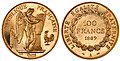 Coin credit: Monnaie de Paris; photographed by the National Numismatic CollectionThe French franc is a former currency of France and Monaco and, alongside the Spanish peseta, a former de facto currency in Andorra. The first franc was a gold coin introduced in 1360, which showed King John II of France on a richly decorated horse, earning it the name franc à cheval. A later coin, showing Charles VII on foot, under a canopy, was named the franc à pied. The decimal franc was established by the French Revolutionary Convention in 1795 as a decimal unit, and became the official currency of France in 1799. France joined the euro in 1999, and the franc was replaced by euro notes and coins in 2002.
This picture shows a 100-franc gold coin, dated 1889, with a "winged genius" designed by Augustin Dupré on the obverse. Only a hundred proof coins of this design were minted. -
 Photo credit: David IliffChamp de Mars (Paris, France), as seen from the observation deck of the Eiffel Tower. In the distance is Tour Montparnasse and the dome on the left is Les Invalides. The École Militaire is at the end of the Champ de Mars. In English the name means "Field of Mars", from Mars the Roman god of war, from its original use for military training. During the French Revolution, the Champ de Mars was the setting of the Fête de la Fédération, on 14 July 1790.
 -
 Paris Street; Rainy Day (1877) is the best known painting by the French artist Gustave Caillebotte. This large oil painting shows a number of figures walking through the Carrefour de Moscou, a road intersection to the east of the Gare Saint-Lazare in north Paris. It was first shown at the Third Impressionist Exhibition of 1877, and is currently owned by the Art Institute of Chicago.
 -
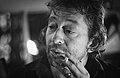 Photograph credit: Claude Truong-NgocSerge Gainsbourg (1928–1991) was a French musician, singer-songwriter, actor, author and filmmaker. Regarded as one of the most important figures in French pop music, he was renowned for often provocative and scandalous releases which caused uproar in France, dividing its public opinion, as well as his diverse artistic output, which ranged from his early work in jazz, chanson, and yé-yé to later efforts in rock, zouk, funk, reggae, and electronica. He is often regarded as one of the world's most influential popular musicians. His lyrical works incorporated wordplay, with humorous, bizarre, provocative, sexual, satirical or subversive overtones. Gainsbourg's music has reached legendary stature in France, and he has become one of the country's best-loved public figures. He has also gained a cult following all over the world with chart success in the United Kingdom and Belgium with "Je t'aime... moi non plus" and "Bonnie and Clyde", respectively. This photo of Gainsbourg was taken in 1981.
 -
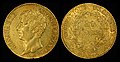 Coin: Monnaie de Paris, Republic of France; Image: National Numismatic Collection, National Museum of American HistoryThe French franc is a former currency of France and Monaco and, alongside the Spanish peseta, a former de facto currency in Andorra. The first franc was a gold coin introduced in 1360, which showed King John II of France on a richly decorated horse, earning it the name franc à cheval. A later coin, showing Charles VII on foot, under a canopy, was named the franc à pied. The decimal franc was established by the French Revolutionary Convention in 1795 as a decimal unit, and became the official currency of France in 1799. France joined the euro in 1999, and the franc was replaced by euro notes and coins in 2002.
This picture shows a 20-franc coin, dated 1803. The obverse shows an image of Napoleon.
See also: 1807 40-franc coin -
 Painting credit: Charles-André van LooMarie Leszczyńska (23 June 1703 – 24 June 1768) was a Polish noblewoman and French queen consort. The daughter of King Stanisław I Leszczyński of Poland and Catherine Opalińska, she married King Louis XV= in 1725 and became queen consort of France, serving in that role for 42 years until her death, the longest of any French queen. Marie was popular due to her generosity and piety. She was the grandmother of future French kings Louis XVI=, Louis XVIII, and Charles X.
This picture is an oil-on-canvas portrait of Marie by French painter Charles-André van Loo, commissioned by Louis XV in 1747. She is depicted wearing the Sancy diamond, part of the French Crown Jewels. The painting now hangs in the Palace of Versailles. -
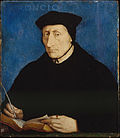 Painting credit: Jean ClouetGuillaume Budé (26 January 1467 – 23 August 1540) was a French scholar and humanist. He was involved in the founding of Collegium Trilingue, which later became the Collège de France. Budé was also the first keeper of the royal library at the Palace of Fontainebleau, which was later moved to Paris, where it became the Bibliothèque nationale de France. He was an ambassador to Rome and held several important judicial and civil administrative posts.
This picture is an oil-on-panel portrait of Budé, produced around 1536 by Jean Clouet, a painter at the court of King Francis I of France. He was a very skilful painter and many fine portraits are attributed to him, but his picture of Budé is his only documented work, being mentioned in Budé's handwritten notes. The painting is now held by the Metropolitan Museum of Art in New York City. -
 Woman with a Parasol - Madame Monet and Her Son is an oil-on-canvas painting by Claude Monet from 1875. The Impressionist work depicts his wife Camille and their son Jean during a stroll on a windy summer's day in Argenteuil. It has been held by the National Gallery of Art in Washington, D.C., since 1983.
 -
 Painting credit: Jules Joseph LefebvreGraziella is an 1852 novel by the French author Alphonse de Lamartine. It tells of a young French man who falls in love with the eponymous character, a fisherman's granddaughter, during a trip to Naples, Italy; they are separated when he must return to France, and Graziella dies soon afterwards. The novel received popular acclaim; an operatic adaptation had been completed by the end of the year, and the work influenced paintings, poems, novels, and films. This 1878 oil-on-canvas painting by the French artist Jules Joseph Lefebvre shows Graziella sitting on a rock, fishing net in hand, gazing over her shoulder at a smoking Mount Vesuvius in the distance. The painting is now in the collection of the Metropolitan Museum of Art in New York.
 -
 Les raboteurs de parquet (The Floor Scrapers) is an 1875 oil on canvas painting by French impressionist Gustave Caillebotte. Measuring 102 by 146.5 centimetres (40 in × 57.7 in), it depicts three men scraping the floor of what is thought to be Caillebotte's own studio, apparently engaged in conversation. According to the Musée d'Orsay, where the painting is held, this is one of the first paintings to feature the urban working class, and indeed the subject matter proved scandalous at the time.
 -
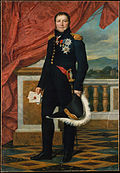 Painting credit: Jacques-Louis DavidÉtienne Maurice Gérard (4 April 1773 – 17 April 1852) was a French general, statesman and marshal of France. He served under a succession of French governments, including the monarchy of the Ancien Régime, the First Republic, the First Empire, the Bourbon Restoration, the July Monarchy, the Second Republic, and arguably the Second Empire, becoming prime minister briefly in 1834. This 1816 portrait of Gérard by Jacques-Louis David is in the collection of the Metropolitan Museum of Art in New York City.
 -
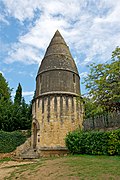 Photograph: JebulonA Lantern of the Dead in Sarlat-la-Canéda, Dordogne, France. Such small stone towers are found chiefly in the centre and west of France. They are often thought to have indicated cemeteries through lights exhibited at the top of the structures.
 -
 Photograph: DXRLes Invalides is a complex of buildings in the 7th arrondissement of Paris, France, containing museums and monuments relating to the military history of France, as well as a hospital and a retirement home for war veterans. The buildings house the Musée de l'Armée, the Musée des Plans-Reliefs, and the Musée d'Histoire Contemporaine. It is also home to the Dôme des Invalides, a large church where some of France's war heroes, including Napoleon, are buried.


_-_Google_Art_Project.jpg)


In the news

- 23 June 2026 – 2026 European heatwaves
- French sports minister Marina Ferrari reports that at least 40 people have drowned in France while swimming in unsupervised areas over the weekend during a heat wave. (AFP and Reuters via Al Jazeera)
- 22 June 2026 – 2030 Winter Olympics
- The International Olympic Committee approves revisions to the venue plan for the 2030 Winter Olympics in the French Alps, including the proposed use of Thialf in the Netherlands for speed skating, as France lacks a suitable venue for the event. (AP via Toronto Star)
- 20 June 2026 – 2026 European heatwaves
- Météo-France places 35 departments, including Paris, under red heat wave alert as high temperatures persist nationwide. Authorities also prohibit public alcohol consumption during Fête de la Musique events in affected areas and implement measures to reduce pressure on emergency services. (AFP via Oman Observer)
- 17 June 2026 – Middle Eastern crisis
- Iran foreign ministry spokesperson Esmail Baghaei tells Iranian state media that president Masoud Pezeshkian and U.S. president Donald Trump remotely signed the deal to end the war, extend the ceasefire by 60-days, and reopen the Strait of Hormuz. Trump reportedly signed the agreement while at the G7 summit during a dinner with French president Emmanuel Macron. (Axios) (Arab Times Kuwait) (The Hill)
Did you know –

- ...that the construction of Basilica Cathedral St. Peter and St. Patern, Vannes (pictured) took seven centuries and featured styles from Romanesque to Neo Gothic?
- ...that the French admiral Dupetit Thouars took possession of the Tahiti archipelago against his government's will?
- ...that Claude Aveline met Jean Vigo in a health clinic and 28 years later founded an award in his honor?
Topics
-
Main Category - France, List of basic France topics
- Historic Periods - Prehistoric France - Celtic Gaul - Roman Gaul - Frankish Empire - Medieval France - Early Modern France - Nineteenth century France - Twentieth century France
- Major Events - Hundred Years' War - French Renaissance - Wars of Religion - French Revolution - Franco-Prussian War - Dreyfus Affair - World War I - World War II - Vichy France - Algerian War - Military history
- Dynasties and Regimes - Merovingians - Carolingians - Capetian Dynasty - Valois Dynasty - Bourbon Dynasty - Ancien Régime in France - First Empire - Second Empire - Third Republic - Fourth Republic - Fifth Republic
- Monarchs of France - List of French monarchs - Charlemagne - Louis I the Pious - Charles II the Bald - Louis II the Stammerer - Louis III - Carloman - Charles III the Fat - Eudes (Odo) - Charles III the Simple - Robert I - Raoul (Rudolph) of Burgundy - Louis IV d'outremer - Lothair - Louis V the Indolent - Hugh Capet - Robert II the Pious - Henri I - Philippe I - Louis VI the Fat - Louis VII the Young - Philippe II Augustus - Louis VIII the Lion - Louis IX Saint Louis - Philippe III the Bold - Philippe IV the Fair - Louis X the Quarreller - Jean I the Posthumous - Philippe V the Tall - Charles IV the Fair - Philip VI of Valois - Jean II the Good - Charles V - Charles VI - Charles VII - Louis XI - Charles VIII - Louis XII - François I - Henri II - François II - Charles IX - Henri III - Henri IV - Louis XIII - Louis XIV - Louis XV - Louis XVI - Napoleon I - Napoleon II - Louis XVIII - Charles X - Louis-Philippe - Napoleon III
- Other Major Historical Figures - Catherine de Medicis - Cardinal Richelieu - Mazarin - Jean-Baptiste Colbert - Jacques Necker - Jean Jaurès
- Heads of State of France since 1871 - President of the French Republic
- Third Republic: Adolphe Thiers • Patrice MacMahon, duc de Magenta • Jules Grévy • Marie François Sadi Carnot • Jean Casimir-Perier • Félix Faure • Émile Loubet • Armand Fallières • Raymond Poincaré • Paul Deschanel • Alexandre Millerand • Gaston Doumergue • Paul Doumer • Albert Lebrun
- Vichy France: Philippe Pétain
- Free France: Charles de Gaulle
- Provisional Government: Charles de Gaulle • Félix Gouin • Georges Bidault • Léon Blum
- Fourth Republic: Vincent Auriol • René Coty
- Fifth Republic: Charles de Gaulle • Georges Pompidou • Valéry Giscard d'Estaing • François Mitterrand • Jacques Chirac • Nicolas Sarkozy • François Hollande • Emmanuel Macron
- Heads of Government of France since 1871 - Prime Minister of France
- Third Republic: Dufaure • de Broglie • de Cissey • Buffet • Dufaure • Simon • de Broglie • de Rochebouët • Dufaure • Waddington • de Freycinet • Ferry • Gambetta • de Freycinet • Duclerc • Fallières • Ferry • Brisson • de Freycinet • Goblet • Rouvier • Tirard • Floquet • Tirard • de Freycinet • Loubet • Ribot • Dupuy • Casimir-Perier • Dupuy • Ribot • Bourgeois • Méline • Brisson • Dupuy • Waldeck-Rousseau • Combes • Rouvier • Sarrien • Clemenceau • Briand • Monis • Caillaux • Poincaré • Briand • Barthou • Doumergue • Ribot • Viviani • Briand • Ribot • Painlevé • Clemenceau • Millerand • Leygues • Briand • Poincaré • François-Marsal • Herriot • Painlevé • Briand • Herriot • Poincaré • Briand • Tardieu • Chautemps • Tardieu • Steeg • Laval • Tardieu • Herriot • Paul-Boncour • Daladier • Sarraut • Chautemps • Daladier • Doumergue • Flandin • Bouisson • Laval • Sarraut • Blum • Chautemps • Blum • Daladier • Reynaud • Pétain
- Vichy France: Pétain • Laval
- Provisional Government: de Gaulle • Gouin • Bidault • Blum
- Fourth Republic: Ramadier • Schuman • Marie • Schuman • Queuille • Bidault • Queuille • Pleven • Queuille • Pleven • Faure • Pinay • Mayer • Laniel • Mendès-France • Faure • Mollet • Bourgès-Maunoury • Gaillard • Pflimlin • de Gaulle
- Fifth Republic: Debré • Pompidou • Couve de Murville • Chaban-Delmas • Messmer • Chirac • Barre • Mauroy • Fabius • Chirac • Rocard • Cresson • Bérégovoy • Balladur • Juppé • Jospin • Raffarin • de Villepin • Fillon • Ayrault • Valls • Cazeneuve • Philippe • Castex
- Third Republic: Dufaure • de Broglie • de Cissey • Buffet • Dufaure • Simon • de Broglie • de Rochebouët • Dufaure • Waddington • de Freycinet • Ferry • Gambetta • de Freycinet • Duclerc • Fallières • Ferry • Brisson • de Freycinet • Goblet • Rouvier • Tirard • Floquet • Tirard • de Freycinet • Loubet • Ribot • Dupuy • Casimir-Perier • Dupuy • Ribot • Bourgeois • Méline • Brisson • Dupuy • Waldeck-Rousseau • Combes • Rouvier • Sarrien • Clemenceau • Briand • Monis • Caillaux • Poincaré • Briand • Barthou • Doumergue • Ribot • Viviani • Briand • Ribot • Painlevé • Clemenceau • Millerand • Leygues • Briand • Poincaré • François-Marsal • Herriot • Painlevé • Briand • Herriot • Poincaré • Briand • Tardieu • Chautemps • Tardieu • Steeg • Laval • Tardieu • Herriot • Paul-Boncour • Daladier • Sarraut • Chautemps • Daladier • Doumergue • Flandin • Bouisson • Laval • Sarraut • Blum • Chautemps • Blum • Daladier • Reynaud • Pétain
- Historic periods: French Renaissance - French Baroque and Classicism - French Rococo and Neoclassicism - French art of the 19th century - French art of the 20th century
- Artistic Schools: Impressionism - Cubism - Surrealism
- Art museums and galleries: Louvre - Palace of Versailles - Musée d'Orsay - Centre Georges Pompidou - Musée Picasso - Musée Rodin
- Historic periods: Medieval French literature - French Renaissance literature - French literature of the 17th century - French literature of the 18th century - French literature of the 19th century - French literature of the 20th century
- Football (Soccer): French football clubs - French footballers - Football in France
- Rugby (union): Clubs in France - French rugbymen - Rugby union in France
- Tennis: French Open
- Cycling: Tour de France
- Motorsport: 24 Hours of Le Mans - French Grand Prix
- Ski resorts: Chamonix - Tignes - Val Thorens - Les Trois Vallées - La Plagne - Les Arcs - Courchevel - Méribel - Val d'Isère - Les Deux Alpes - Megève
History of France - History of France
Culture and People - Culture of France - Culture of France - Museums in France - French people - Health in France - Education in France - Education in France - Religion in France - Languages of France - Languages of France - French language - French cuisine - French cuisine - French wine - Archaeology of France - Basque culture - Culture of Brittany
Politics and Government - Government of France - Government of France - French National Assembly - French Senate - Law of France - French politics - Politics of France - Military of France - Foreign relations of France - Flags of France
Economy, Industry and Media - Economy of France - Economy of France - Economic history of France - French businesspeople - Companies of France - French trade unions - Communications in France - Mass media in France - French space program - French airlines
Visual and Plastic Arts - French art - French artists - French architecture - French art
Literature - French literature - French writers - French literature - French poetry
Music - French music - French composers - French musicians - Music of France - French folk music - French rock - French hip hop and rap
Cinema - Cinema of France - Cinema of France - French actors - French film directors - French film producers - César Award winners - Cannes Film Festival
Theater - French theatre - French dramatists and playwrights - Theatres in France - Avignon Festival - Comédie française
Sports- Sport in France - French sportspeople - France at the Olympics -
Geographic topics
-
Main Category - France
- Coastlines: Atlantic Ocean - Bay of Biscay ("Golfe de Gascogne") – Mediterranean Sea (Golfe du Lion) - Côte d'Azur ("French Riviera") – English Channel
- Islands: Belle Île – Corsica – Île d'Oléron – Ouessant – Île de Ré – Île d'Yeu - Réunion - Martinique - Guadeloupe - Saint Barthélemy - Saint Martin - Saint Pierre and Miquelon
- Rivers and streams:
- Major rivers: Loire – Rhine – Rhône – Seine – Garonne - Gironde estuary - Dordogne – Meuse – Escaut – Saône – Marne – Moselle
- Other rivers: Adour – Charente - Aulne – Blavet – Erdre – Hérault – Odet – Orb – Orne – Rance – Sèvre Nantaise – Sèvre Niortaise – Var - Aisne – Allier – Ariège – Aube – Cher – Doubs – Durance – Indre – Ill – Isère – Lot – Maine – Mayenne – Meurthe – Oise - Somme - Tarn – Verdon – Vienne – Vire – Yonne
- Canals: Canal du Midi – Canal de Nantes à Brest – Canal Saint-Martin – Briare Canal – Canal of Burgundy – Grand Canal d'Alsace – Sambre–Oise Canal
- Lakes: Lake Annecy – Lac du Bourget – Lake Geneva (Lac Léman) – Étang de Thau – Étang de Berre
- Mountains:
- Major Mountain ranges: Alps – French Prealps – Pyrénées – Massif Central – Jura – Vosges
- Other Mountain ranges: Aravis Range – Bauges – Belledonne – Chartreuse Mountains – Massif des Écrins – Vercors
- Mountain peaks: Mont Blanc – Aiguille du Midi – Barre des Écrins – Ballon d'Alsace – Crêt de la Neige – Grandes Jorasses – Meije – Mont Aigoual – Mont Ventoux – Pic du Midi - Mont Pelvoux – Puy de Dôme – Puy de Sancy
- Forests: Forest of Fontainebleau – Forest of Compiègne – Paimpont forest – Forest of Saint-Germain-en-Laye
- National parks and natural regions: Cévennes National Park – Écrins National Park – Mercantour National Park – Port-Cros National Park – Pyrénées National Park – Vanoise National Park – Boulonnais – Bresse – Beaujolais – Camargue – Pays de Bray – Sundgau – Vexin
- Major cities: Paris (Paris) – Marseille – Lyon – Lille – Toulouse – Nice – Nantes – Strasbourg – Montpellier – Bordeaux – Rennes – Douai – Le Havre – Reims – Lens – Saint-Étienne – Toulon – Grenoble – Angers – Brest – Le Mans – Dijon – Clermont-Ferrand – Aix-en-Provence – Amiens – Nîmes – Tours – Limoges – Metz – Besançon – Caen – Orléans - Mulhouse – Perpignan - Boulogne-Billancourt – Rouen – Dunkirk – Nancy – Villeneuve-d'Ascq – Saint-Denis, Réunion
- Other: Gardens in France - Cemeteries in France - Transport in France - Tourism in France - Nature conservation in France
- Ski resorts: Chamonix - Tignes - Val Thorens - Les Trois Vallées - La Plagne - Les Arcs - Courchevel - Méribel - Val-d'Isère - Les Deux Alpes - Megève
Geography - Geography of France - Geography of France - Regions of France - Provinces of France - Subdivisions of France - Subdivisions of France - Overseas France

Categories

Related portals


Things you can do

French Wikipedia
 |
There is a French version of Wikipedia, the free encyclopedia. |
Wikiproject
| Project pages | |
|---|---|
| Departments | |
| Announcements | |

Associated Wikimedia
The following Wikimedia Foundation sister projects provide more on this subject:
-
 Commons
Free media repository -
 Wikidata
Free knowledge base -
 Wikiquote
Collection of quotations -
 Wikisource
Free-content library -
 Wikiversity
Free learning tools -
 Wikivoyage
Free travel guide -
 Wiktionary
Dictionary and thesaurus


More portals


Parent portals: Europe | European Union