


Portal:Myanmar

ကြိုဆိုပါတယ်။ / Welcome to the Myanmar Portal 


Myanmar, officially the Republic of the Union of Myanmar and also referred to as Burma (the official English name until 1989), is a country in northwest Southeast Asia. It is the largest country by area in Mainland Southeast Asia and has a population of about 55 million. It is bordered by India and Bangladesh to the northwest, China to the northeast, Laos and Thailand to the east and southeast, and the Andaman Sea and the Bay of Bengal to the south and southwest. The country's capital city is Naypyidaw, while its largest city is Yangon (formerly Rangoon).
Myanmar is a member of the East Asia Summit, Non-Aligned Movement, ASEAN, and BIMSTEC. Myanmar is a Dialogue Partner of the Shanghai Cooperation Organization. The country is very rich in natural resources, such as jade, gems, oil, natural gas, teak and other minerals, as well as endowed with renewable energy, having the highest solar power potential compared to other countries of the Great Mekong Subregion. However, Myanmar has long suffered from instability, factional violence, corruption, poor infrastructure, colonial exploitation, and issues with human development. In 2013, its GDP (nominal) stood at US$56.7 billion and its GDP (PPP) at US$221.5 billion. The income gap in Myanmar is among the widest in the world, as a large proportion of the economy is controlled by cronies of the military junta. Myanmar is one of the least developed countries in the world.
The country remains riven by ethnic strife among its myriad ethnic groups, and has one of the world's longest-running ongoing civil wars. The United Nations and several other organisations have reported consistent and systemic human rights violations in the country. Since 2021, more than 600,000 people have been displaced across Myanmar due to the civil war post-coup, with more than three million people in dire need of humanitarian assistance. According to the United Nations High Commissioner for Refugees (UNHCR), there are over 1.3 million people counted as refugees and asylum seekers, and 3.5 million people displaced internally as of December 2024. (Full article...)
Selected articles -
-

The Burmese cat (Burmese: ဗမာကြောင်, Băma kyaung, Thai: แมวพม่า or Suphalak, RTGS: Thongdaeng or Supphalak, meaning copper colour) is a pedigreed breed of domestic cat, originating in Burma, believed to have its roots near the Thai–Burma border, and developed by selective breeding in the United States and Britain.
Most modern Burmese are descendants of one female cat called Wong Mau, which was brought from Burma to the United States in 1930 and bred with American Siamese. From there, American and British breeders developed distinctly different Burmese breed standards, which is unusual among pedigreed domestic cats. Most modern cat registries do not formally recognise the two as separate breeds, but those that do refer to the British type as the European Burmese. (Full article...) -
Aung San Suu Kyi (born 19 June 1945) is a Burmese politician, diplomat and author who served as State Counsellor of Myanmar and Minister of Foreign Affairs from 2016 to 2021. She has served as the general secretary of the National League for Democracy (NLD) since the party's founding in 1988 and was registered as its chairperson while it was a legal party from 2011 to 2023. She played a vital role in Myanmar's transition from military junta to partial democracy in the 2010s. She has been widely described as the de facto leader of Myanmar from 2016 to 2021. She was awarded the 1991 Nobel Peace Prize.
The youngest daughter of Aung San, Father of the Nation of modern-day Myanmar, and Khin Kyi, Aung San Suu Kyi was born in Rangoon, British Burma. After graduating from the University of Delhi in 1964 and St Hugh's College, Oxford in 1968, she worked at the United Nations for three years. She married Michael Aris in 1972, with whom she had two children. Aung San Suu Kyi rose to prominence in the 8888 Uprising of 8 August 1988 and became the General Secretary of the NLD, which she had newly formed with the help of several retired army officials who criticised the military junta. In the 1990 general election, NLD won 81% of the seats in Parliament, but the results were nullified, as the State Peace and Development Council (SPDC), the military government, refused to hand over power, resulting in an international outcry. She had been detained before the elections and remained under house arrest for almost 15 of the 21 years from 1989 to 2010, becoming one of the world's most prominent political prisoners. In 1999, Time magazine named her one of the "Children of Gandhi" and his spiritual heir to nonviolence. She survived an assassination attempt in the 2003 Depayin massacre when at least 70 people associated with the NLD were killed. (Full article...) -
The Lisu people (Lisu: ꓡꓲ‐ꓢꓴ ꓫꓵꓽ; Burmese: လီဆူလူမျိုး, [lìsʰù]; Chinese: 傈僳族; pinyin: Lìsùzú; Thai: ลีสู่) are a Tibeto-Burman ethnic group who inhabit mountainous regions of Myanmar (Burma), southwest China, Thailand, and the Indian state of Arunachal Pradesh.
About 730,000 Lisu live in Lijiang, Baoshan, Nujiang, Dêqên, and Dehong prefectures in Yunnan Province and Sichuan Province, China. The Lisu form one of the 56 ethnic groups officially recognized by China. In Myanmar, the Lisu are recognized as one of 135 ethnic groups and an estimated population of 600,000. Lisu live in the north of the country; Kachin State (Putao, Myitkyina, Danai, Waingmaw, Bhamo), Shan State (Momeik, Namhsan, Lashio, Hopang, and Kokang), and southern Shan State (Namsang, Loilem, Mongton), and Sagaing Division (Katha and Khamti), Mandalay Division (Mogok and Pyin Oo Lwin). About 55,000 live in Thailand, where they are one of the six main hill tribes. They mainly inhabit remote mountainous areas. (Full article...) -

The Royal Armed Forces (Burmese: တပ်မတော်, [taʔmədɔ̀]) were the armed forces of the Burmese monarchy from the 9th to 19th centuries. It refers to the military forces of the Pagan Kingdom, the Kingdom of Ava, the Hanthawaddy kingdom, the Toungoo dynasty and the Konbaung dynasty in chronological order. It was one of the major armed forces of Southeast Asia until it was defeated by the British over a six-decade span in the 19th century.
The army was organised into a small standing army of a few thousand, which defended the capital and the palace, and a much larger conscript-based wartime army. Conscription was based on the ahmudan system, which required local chiefs to supply their predetermined quota of men from their jurisdiction on the basis of population in times of war. The wartime army also consisted of elephantry, cavalry, artillery and naval units. (Full article...) -
Myanmar has been in armed conflict since 1948, when the country, then known as Burma, gained independence from the United Kingdom. The conflict has largely been ethnic-based, with ethnic armed organisations fighting Myanmar's armed forces, the Tatmadaw, for self-determination. Despite numerous ceasefires and the creation of autonomous self-administered zones in 2008, armed groups continue to call for independence, increased autonomy, or the federalisation of Myanmar. It is the world's longest ongoing civil war, spanning almost eight decades.
In 1940, during World War II, Burmese intellectuals formed the Thirty Comrades, who established the Burma Independence Army (BIA) to fight against the Allies. Aung San led the Axis-puppet State of Burma, before switching sides to the Allies in mid-1944. Post-war negotiations led to Burma's independence in 1948, but ethnic tensions arose after the Burmese government refused to honour the 1947 Panglong Agreement, which promised autonomy for some of the country's ethnic minorities. The immediate post-independence period saw the rise of the Communist Party of Burma (CPB) and Karen National Union (KNU) in particular as major rebel forces. (Full article...) -
Mandalay is the second-largest city in Myanmar, after Yangon. It is located on the east bank of the Irrawaddy River, 631 km (392 mi) north of Yangon. In 2014, the city had a population of 1,225,553.
Mandalay was founded in 1857 by King Mindon, replacing Amarapura as the new royal capital of the Konbaung dynasty. It was Burma's final royal capital before the kingdom's annexation by the British Empire in 1885. Under British rule, Mandalay remained commercially and culturally important despite the rise of Yangon, the new capital of British Burma. The city suffered extensive destruction during the Japanese conquest of Burma in the Second World War. In 1948, Mandalay became part of the newly independent Union of Burma. (Full article...) -
Myanmar is divided into 21 administrative divisions, which include seven regions, seven states, one union territory, one self-administered division, and five self-administered zones. (Full article...)
-
Atula Thiri Maha Yaza Dewi (Burmese: အတုလသီရိ မဟာရာဇ ဒေဝီ [ʔətṵla̰ θìɹḭ məhà jàza̰ dèwì]; Pali: Atulasīrimahārājadevī; c. 1518–1568), more commonly known as Khin Khin Jee (ခင်ခင်ကြီး), was the chief queen consort of King Bayinnaung of Burma (Myanmar) from 1550 to 1568. The queen was of Toungoo royalty, daughter of King Mingyi Nyo and younger half-sister of King Tabinshwehti. She was the mother of King Nanda. Her 1534 marriage to Bayinnaung, a commoner, solidified an unfailing alliance between Tabinshwehti and Bayinnaung who together would go on to found the Toungoo Empire (or the Second Burmese Empire). (Full article...)
-
Hkakaborazi National Park is a national park in northern Myanmar with an area of 1,472 mi2 (3,810 km2). It was established in 1998.
It surrounds Hkakabo Razi, the highest mountain in the country.
It ranges in elevation from 2,950 to 18,730 ft (900 to 5,710 m) comprising evergreen forest and mixed deciduous forests in Nogmung Township, Kachin State. It is managed by the Nature and Wildlife Conservation Division.
It is contiguous with Bumhpa Bum Wildlife Sanctuary and Hukaung Valley Wildlife Sanctuary. These protected areas together with Hponkanrazi Wildlife Sanctuary comprise the largest continuous expanse of natural forest called the Northern Forest Complex stretching over an area of 11,624 mi2 (30,110 km2). Its objective is to conserve the biodiversity of the Ayeyarwady and Chindwin river basins. (Full article...) -
Indawgyi Lake Wildlife Sanctuary is a biosphere reserve in Myanmar, covering 814.99 km2 (314.67 sq mi). It ranges in elevation from 105–1,400 m (344–4,593 ft) encompassing the surroundings of Indawgyi Lake in Mohnyin Township, Kachin State. It was gazetted in 2004, is recognized as an Important Bird Area and as one of the ASEAN Heritage Parks.
An area of 478.84 km2 (184.88 sq mi) comprising the lake and the surrounding lowland is a Ramsar site since February 2016.
During a survey in the winter of 2004, both resident and migratory birds were sighted on the lake and along Indawgyi River, including white-rumped vulture (Gyps bengalensis), slender-billed vulture (G. tenuirostris), Himalayan vulture (G. himalayensis), lesser whistling duck (Dendrocygna javanica), tufted duck (Aythya fuligula), ferruginous pochard (A. nyroca), gadwall (Mareca strepera), ruddy shelduck (Tadorna ferruginea), Eurasian teal (Anas crecca), northern pintail (A. acuta), greylag goose (Anser anser), Eurasian coot (Fulica atra), little grebe (Tachybaptus ruficollis), great crested grebe (Podiceps cristatus), little cormorant (Microcarbo niger), purple heron (Ardea purpurea), brown-headed gull (Chroicocephalus brunnicephalus), black-headed gull (C. ridibundus), wood sandpiper (Tringa glareola), Temminck's stint (Calidris temminckii), black-winged stilt (Himantopus himantopus), grey-headed lapwing (Vanellus cinereus) and glossy ibis (Plegadis falcinellus). (Full article...)


.jpg)


Did you know (auto-generated) -

- ... that the Myanmar Photo Archive (example photograph shown) revealed "a side of modern Myanmar that, until very recently, remained hidden in dusty attics"?
- ... that Setkya Dewi, chief queen of Burma, studied Western astronomy and English and was once gifted a telescope by a British envoy because of her interest in science?
- ... that plans for Myanmar's space programme began under an elected civilian government in 2017, but the Myanmar Space Agency was ultimately formed in 2025 under military rule?
- ... that the government's Visit Myanmar Year initiative caused Aung San Suu Kyi to encourage a tourism boycott?
- ... that Burmese poet Ko Lay Inwa Gonyi, later a winner of the Lifetime Award for Myanmar Literature, was restricted from publishing for 45 years under the military government?
- ... that the DI MA-1 Mk. III rifle was made in Myanmar as a reverse-engineered copy of the Chinese QBZ-97?
- ... that Molly Burman resumed releasing music three years later after finding that "Happy Things" had accrued a million streams on Spotify?
- ... that one academic described the introduction of femboys to Myanmar as a tactic to achieve an "ideological revolution"?
Related portals and projects


.svg)

.svg)


General images -
-
 Mountains near Pindaya on the Shan Plateau (from Geography of Myanmar)
 -
 Saint Mary's Cathedral in Downtown Yangon is the largest Roman Catholic cathedral in Burma. (from Culture of Myanmar)
 -
 The restored Taungoo or Nyaungyan dynasty, c. 1650 CE (from History of Myanmar)
 -
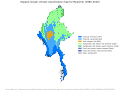 Myanmar (Burma) map of Köppen climate classification (from Geography of Myanmar)
 -
 Boxing match, 19th-century watercolour (from Culture of Myanmar)
 -
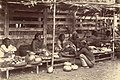 Vegetable stall on the roadside at the Madras Lancer Lines, Mandalay, January 1886. Photographer: Hooper, Willoughby Wallace (1837–1912). (from History of Myanmar)
 -
 Jade Mine in Hpakant (from Geography of Myanmar)
 -
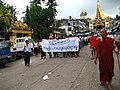 Protesters in Yangon with a banner that reads "non-violence: national movement" in Burmese. In the background is Shwedagon Pagoda. (from History of Myanmar)
 -
-
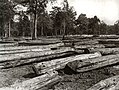
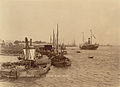 The paddle steamer Ramapoora (right) of the British India Steam Navigation Company on the Rangoon river, having just arrived from Moulmein. 1895. Photographers: Watts and Skeen. (from History of Myanmar)
 -
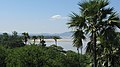 The shores of Irrawaddy River at Nyaung-U, Bagan (from Geography of Myanmar)
 -
 A theatrical performance of the Mon dance (from Culture of Myanmar)
 -
![Image 13Military situation in Myanmar as of 2024[update]. Areas controlled by the Tatmadaw are highlighted in red. (from History of Myanmar)](//upload.wikimedia.org/wikipedia/commons/thumb/c/c1/Myanmar_civil_war.svg/120px-Myanmar_civil_war.svg.png) Military situation in Myanmar as of 2024[update]. Areas controlled by the Tatmadaw are highlighted in red. (from History of Myanmar)
Military situation in Myanmar as of 2024[update]. Areas controlled by the Tatmadaw are highlighted in red. (from History of Myanmar) -
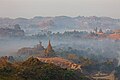 Temples at Mrauk U, the capital of the Mrauk U Kingdom, which ruled over what is now Rakhine State (from History of Myanmar)
 -

-
 British soldiers dismantling cannons belonging to King Thibaw's forces, Third Anglo-Burmese War, Ava, 27 November 1885. Photographer: Hooper, Willoughby Wallace (1837–1912). (from History of Myanmar)
 -
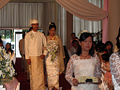 A wedding procession, with the groom and bride dressed in traditional Burmese wedding clothes, reminiscent of royal attire (from Culture of Myanmar)
 -

-
 Hlei pyaingbwè - a Burmese regatta (from Culture of Myanmar)
 -
 Myinhkin thabin - equestrian sport (from Culture of Myanmar)
 -
 British soldiers on patrol in the ruins of the Burmese town of Bahe during the advance on Mandalay, January 1945 (from History of Myanmar)
 -
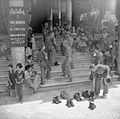 British soldiers remove their shoes at the entrance of Shwedagon Pagoda. To the left, a sign reads "Foot wearing is strictly prohibited" in Burmese, English, Tamil, and Urdu. (from Culture of Myanmar)
 -
 Recorder's Court on Sule Pagoda Road, with the Sule Pagoda at the far end, Rangoon, 1868. Photographer: J. Jackson. (from History of Myanmar)
 -
 Portuguese ruler and soldiers mounting an elephant. Jan Caspar Philips (draughtsman and engraver). (from History of Myanmar)
 -
 Political map of Burma (Myanmar) c. 1450 CE. (from History of Myanmar)
 -
 First Anglo-Burmese War in 1824 (from History of Myanmar)
 -
 Aerial view of a burned Rohingya village in Rakhine state, September 2017 (from History of Myanmar)
 -
 Former US President Barack Obama poses barefoot on the grounds of Shwedagon Pagoda, one of Myanmar's major Buddhist pilgrimage sites. (from Culture of Myanmar)
 -
 Mount Popa, a dormant volcano in the Central Lowlands (from Geography of Myanmar)
 -

-
 Two female musicians play the saung at a performance in Mandalay. (from Culture of Myanmar)
 -
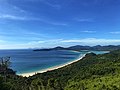 Grandfather Island, Dawei (from Geography of Myanmar)
 -
 Salween river at Mae Sam Laep on the Thai-Myanmar border (from Geography of Myanmar)
 -
 A large fracture on the Mingun Pahtodawgyi caused by the 1839 Ava earthquake. (from Geography of Myanmar)
 -
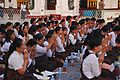 A group of Buddhist worshipers at Shwedagon Pagoda, an important religious site for Burmese Buddhists (from Culture of Myanmar)
 -
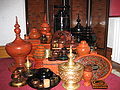 A wide range of Burmese lacquerware from Bagan (from Culture of Myanmar)
 -
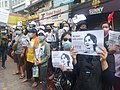 Protesters in Yangon carrying signs reading "Free Daw Aung San Suu Kyi" on 8 February 2021 (from History of Myanmar)
 -
 Sculpture of Myanmar mythical lion (from Culture of Myanmar)
 -
 Pagan Kingdom during Narapatisithu's reign. Burmese chronicles also claim Kengtung and Chiang Mai. Core areas shown in darker yellow. Peripheral areas in light yellow. Pagan incorporated key ports of Lower Burma into its core administration by the 13th century. (from History of Myanmar)
 -
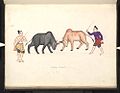 A bull fight, 19th-century watercolour (from Culture of Myanmar)
 -
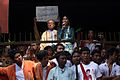 Aung San Suu Kyi addresses crowds at the NLD headquarters shortly after her release. (from History of Myanmar)
 -
 19th-century funeral cart and spire, which would form part of the procession from the home to the place of cremation (from Culture of Myanmar)


.jpg)


.jpg)


_headquarter.jpg)

Major topics
Categories

More topics


Associated Wikimedia
The following Wikimedia Foundation sister projects provide more on this subject:
-
 Commons
Free media repository -
 Wikidata
Free knowledge base -
 Wikiquote
Collection of quotations -
 Wikisource
Free-content library -
 Wikiversity
Free learning tools -
 Wikivoyage
Free travel guide -
 Wiktionary
Dictionary and thesaurus


