


Portal:India


Introduction

.svg)
India, officially the Republic of India, is a country in South Asia. It is the seventh-largest country by area, the most populous country in the world and, since its independence in 1947, the world's most populous democracy. Bounded by the Indian Ocean on the south, the Arabian Sea on the southwest, and the Bay of Bengal on the southeast, it shares land borders with Pakistan to the west; China, Nepal and Bhutan to the north; Bangladesh and Myanmar to the east. In the Indian Ocean, India is near Sri Lanka and the Maldives. Its Andaman and Nicobar Islands share a maritime border with Myanmar, Thailand and Indonesia. (Full article...)

 Featured article –

-


Profile of a Hoysala temple at Somanathapura
Hoysala architecture is the building style in Hindu temple architecture developed under the rule of the Hoysala Empire between the 11th and 14th centuries, in the region known today as Karnataka, a state of India. Hoysala influence was at its peak in the 13th century, when it dominated the Southern Deccan Plateau region. Large and small temples built during this era remain as examples of the Hoysala architectural style, including the Chennakesava Temple at Belur, the Hoysaleswara Temple at Halebidu, and the Kesava Temple at Somanathapura. These three temples were accorded UNESCO world heritage site status in 2023. Other examples of Hoysala craftsmanship are the temples at Belavadi, Amruthapura, Hosaholalu, Mosale, Arasikere, Basaralu, Kikkeri and Nuggehalli. Study of the Hoysala architectural style has revealed a negligible North Indian influence while the impact of Southern Indian style is more distinct.
Temples built prior to Hoysala independence in the mid-12th century reflect significant Western Chalukya influences, while later temples retain some features salient to Western Chalukya architecture but have additional inventive decoration and ornamentation, features unique to Hoysala artisans. Some three hundred temples are known to survive in present-day Karnataka state and many more are mentioned in inscriptions, though only about seventy have been documented. The greatest concentration of these are in the Malnad (hill) districts, the native home of the Hoysala kings. (Full article...) -
Mughal-e-Azam (transl. The Great Mughal) is a 1960 Indian epic historical drama film produced and directed by K. Asif. Starring Prithviraj Kapoor, Dilip Kumar, Madhubala, and Durga Khote, it follows the love affair between Mughal Prince Salim (who went on to become Emperor Jahangir) and Anarkali, a court dancer. Salim's father, Emperor Akbar, disapproves of the relationship, which leads to a war between father and son.
The development of Mughal-e-Azam began in 1944, when Asif read a 1922 play called Anarkali, by the playwright Imtiaz Ali Taj, which is set in the reign of Emperor Akbar (1556–1605). Production was plagued by delays and financial uncertainty. Before its principal photography began in the early 1950s, the project had lost a financier and undergone a complete change of cast. Mughal-e-Azam cost more to produce than any previous Indian motion picture; the budget for a single song sequence exceeded that typical for an entire film of the period. The soundtrack, inspired by Indian classical and folk music, comprises 12 songs voiced by playback singer Lata Mangeshkar along with Mohammed Rafi, Shamshad Begum, and classical singer Bade Ghulam Ali Khan, and is often cited among the finest in the history of Hindi cinema. (Full article...) -
Hritik Rakesh Nagrath (born 10 January 1974), known professionally as Hrithik Roshan (Hindi: [ˈɾɪt̪ɪk ɾoːʃən]), is an Indian actor and producer who works in Hindi cinema. Referred to as the millennial superstar, he has portrayed a variety of characters and is known for his dancing skills. One of the highest-paid actors in India, he has won many awards, including six Filmfare Awards, of which four were for Best Actor. Starting from 2012, he has appeared in Forbes India's Celebrity 100 several times based on his income and popularity.
Roshan has frequently collaborated with his father, Rakesh Roshan. He made brief appearances as a child actor in several films in the 1980s and later worked as an assistant director on four of his father's films. His first leading role was in the box-office success Kaho Naa... Pyaar Hai (2000), for which he received several awards. Performances in the 2000 terrorism drama Fiza and the 2001 ensemble family drama Kabhi Khushi Kabhie Gham consolidated his reputation but were followed by several poorly received films. (Full article...) -
Preity G. Zinta (pronounced [ˈpɾiːt̪i ˈzɪɳʈɑː]; born 31 January 1975) is an Indian actress and entrepreneur primarily known for her work in Hindi films. After graduating with degrees in English honours and criminal psychology, Zinta made her acting debut in Dil Se.. in 1998, followed by a role in Soldier in the same year. These performances earned her the Filmfare Award for Best Female Debut, and she was later recognised for her role as a teenage single mother in Kya Kehna (2000). She established a career as a leading Hindi film actress of the decade with a variety of character types. Her roles, often deemed culturally defiant, along with her unconventional screen persona won her recognition and several accolades.
Following critically appreciated roles in Chori Chori Chupke Chupke (2001), Dil Chahta Hai (2001), Dil Hai Tumhaara (2002), and Armaan (2003), Zinta received the Filmfare Award for Best Actress for her performance in Kal Ho Naa Ho (2003). She starred in two consecutive annual top-grossing films in India, Koi... Mil Gaya (2003) and Veer-Zaara (2004), and was noted for her portrayal of independent, modern Indian women in Salaam Namaste (2005) and Kabhi Alvida Naa Kehna (2006), top-grossing productions in domestic and overseas markets. For her first international role in the Canadian drama Heaven on Earth (2008) she was awarded the Silver Hugo Award for Best Actress and nominated for the Genie Award. She followed this with a hiatus from acting work for several years, with intermittent appearances such as in her self-produced comeback film, Ishkq in Paris (2013), which failed to leave a mark. (Full article...) -
Waiting is a 2015 Indian Hindi-language drama film directed by Anu Menon. Produced by Priti Gupta and Manish Mundra under the banner of Ishka Films and Drishyam Films respectively, the film was co-written by Menon and James Ruzicka, and stars Naseeruddin Shah and Kalki Koechlin. Waiting focuses on the relationship between two people from different walks of life who befriend each other in a hospital, while nursing their respective comatose spouses. Rajat Kapoor, Suhasini Maniratnam, Arjun Mathur, Ratnabali Bhattacharjee and Rajeev Ravindranathan play supporting roles in the film.
The development of the film began in June 2014, when Menon signed Koechlin and Shah for an untitled project. Principal photography started in November 2014 in the South Indian coastal city of Kochi; Neha Parti served as the cinematographer for the film. New Zealand-based singer-songwriter Mikey McCleary composed the film's score. Nitin Baid and Apurva Asrani edited the film, and Atika Chohan wrote the dialogue. Waiting also marked the Hindi film debut of the prominent South Indian actress-director Suhasini Maniratnam. Koechlin also made her debut as a lyricist with the film's soundtrack, writing the song "Waiting for You". (Full article...) -
The black stork (Ciconia nigra) is a large bird in the stork family Ciconiidae. It was first described by Carl Linnaeus in the 10th edition of his Systema Naturae. Measuring on average 95 to 100 cm (37 to 39 in) from beak tip to end of tail with a 145-to-155 cm (57-to-61 in) wingspan, the adult black stork has mainly black plumage, with white underparts, long red legs and a long pointed red beak. A widespread but uncommon species, it breeds in scattered locations across Europe (predominantly in Portugal and Spain, and central and eastern parts), and east across the Palearctic to the Pacific Ocean. It is a long-distance migrant, with European populations wintering in tropical Sub-Saharan Africa, and Asian populations in the Indian subcontinent. When migrating between Europe and Africa, it avoids crossing broad expanses of the Mediterranean Sea and detours via the Levant in the east, the Strait of Sicily in the center, or the Strait of Gibraltar in the west. An isolated non-migratory population lives in Southern Africa.
Unlike the closely related white stork, the black stork is a shy and wary species. It is seen singly or in pairs, usually in marshy areas, rivers or inland waters. It feeds on amphibians, small fish and insects, generally wading slowly in shallow water stalking its prey. Breeding pairs usually build nests in large forest trees—most commonly deciduous but also coniferous—which can be seen from long distances, as well as on large boulders, or under overhanging ledges in mountainous areas. The female lays two to five greyish-white eggs, which become soiled over time in the nest. Incubation takes 32 to 38 days, with both sexes sharing duties, and fledging takes 60 to 71 days. (Full article...) -

Darjeeling (/dɑːr.ˈdʒiː.lɪŋ/, Nepali: [ˈdard͡ziliŋ], Bengali: [ˈdarˌdʒiliŋ]) is a city in the northernmost region of the Indian state of West Bengal. Located in the Eastern Himalayas, it has an average elevation of 2,045 metres (6,709 ft). To the west of Darjeeling lies the easternmost province of Nepal, to the east the Kingdom of Bhutan, to the north the Indian state of Sikkim, and farther north the Tibet Autonomous Region of China. Bangladesh lies to the south and southeast, and most of the state of West Bengal lies to the south and southwest, connected to the Darjeeling region by a narrow tract. Kangchenjunga, the world's third-highest mountain, rises to the north and is prominently visible on clear days.
In the early 19th century, during East India Company rule in India, Darjeeling was identified as a potential summer retreat for British officials, soldiers, and their families. The narrow mountain ridge was leased from the Kingdom of Sikkim, and eventually annexed to British India. Experimentation with growing tea on the slopes below Darjeeling was highly successful. Thousands of labourers were recruited chiefly from Nepal to clear the forests, build European-style cottages and work in the tea plantations. The widespread deforestation displaced the indigenous peoples. Residential schools were established in and around Darjeeling for the education of children of the domiciled British in India. By the late-19th century, a novel narrow-gauge mountain railway, the Darjeeling Himalayan Railway, was bringing summer residents into the town and carrying a freight of tea out for export to the world. After India's independence in 1947, as the British left Darjeeling, its cottages were purchased by wealthy Indians from the plains and its tea plantations by out-of-town Indian business owners and conglomerates. (Full article...) -
Kahaani (IPA: [kəˈɦaːni]; transl. Story) is a 2012 Indian Hindi-language vigilante action thriller film co-written, co-produced, and directed by Sujoy Ghosh. It stars Vidya Balan as Vidya Bagchi, a pregnant woman looking for her missing husband in Kolkata during the festival of Durga Puja, assisted by Assist Sub-Inspector Satyoki "Rana" Sinha (Parambrata Chatterjee) and Inspector General A. Khan (Nawazuddin Siddiqui).
Made on a budget of ₹80 million (US$830,000), Kahaani was conceived and developed by Ghosh, who co-wrote the film with Advaita Kala. The crew often employed guerrilla-filmmaking techniques on Kolkata's streets to avoid attracting attention. Its creative portrayal of the city and its use of local crew and cast made it a notable film. Kahaani explores themes of feminism and motherhood in a male-dominated Indian society. The film also makes several allusions to Satyajit Ray's films, such as Charulata (1964), Aranyer Din Ratri (1970), and Joi Baba Felunath (1979). The film's musical score and soundtrack were composed by Clinton Cerejo and Vishal–Shekhar respectively, with cinematography handled by Setu and editing done by Namrata Rao. (Full article...) -
Sir Robert Eric Mortimer Wheeler (10 September 1890 – 22 July 1976) was a British archaeologist and officer in the British Army. Over the course of his career, he served as Director of both the National Museum of Wales and London Museum, Director-General of the Archaeological Survey of India, and the founder and Honorary Director of the Institute of Archaeology in London, in addition to writing twenty-four books on archaeological subjects.
Born in Glasgow to a middle-class family, Wheeler was raised largely in Yorkshire before moving to London in his teenage years. After studying classics at University College London (UCL), he began working professionally in archaeology, specialising in the Romano-British period. During World War I he volunteered for service in the Royal Artillery, being stationed on the Western Front, where he rose to the rank of major and was awarded the Military Cross. Returning to Britain, he obtained his doctorate from UCL before taking on a position at the National Museum of Wales, first as Keeper of Archaeology and then as Director, during which time he oversaw excavation at the Roman forts of Segontium, Y Gaer, and Isca Augusta with the aid of his first wife, Tessa Wheeler. Influenced by the archaeologist Augustus Pitt Rivers, Wheeler argued that excavation and the recording of stratigraphic context required an increasingly scientific and methodical approach, developing the "Wheeler method". In 1926, he was appointed Keeper of the London Museum; there, he oversaw a reorganisation of the collection, successfully lobbied for increased funding, and began lecturing at UCL. (Full article...) -
Margarita with a Straw is a 2014 Indian Hindi-language drama film directed by Shonali Bose. It stars Kalki Koechlin as an Indian teenager with cerebral palsy who relocates to the United States for her undergraduate education and comes of age following her complex relationship with a blind girl, played by Sayani Gupta. Revathi, Kuljeet Singh, and William Moseley play supporting roles. Produced by Bose in partnership with Viacom18 Motion Pictures, Margarita with a Straw was co-written by Bose and Nilesh Maniyar. The film deals with themes of sexuality, inclusion, self-love, and self-acceptance.
Bose conceived the idea for the film in January 2011 during a conversation with her cousin Malini Chib, a disability rights activist, about the latter's desire to have a normal sex life. Inspired by Chib's story, Bose wrote the first draft of a script. After winning a Sundance Mahindra Global Filmmaker Award for the draft, she modified the script to reflect her own perspective, incorporating several personal experiences into the narrative. Bose completed the screenplay with co-writer Maniyar and the advisory council of the Sundance Institute. (Full article...) -

Virupaksha temple at Hampi, the sacred centre at Vijayanagara, the royal capital
Vijayanagara literature in Kannada is the body of literature composed in the Kannada language of South India during the ascendancy of the Vijayanagara Empire which lasted from the 14th through the 16th century. The Vijayanagara empire was established in 1336 by Harihara I and his brother Bukka Raya I. Although it lasted until 1664, its power declined after a major military defeat by the Shahi Sultanates in the battle of Talikota in 1565. The empire is named after its capital city Vijayanagara, whose ruins surround modern Hampi, now a World Heritage Site in Karnataka.
Kannada literature during this period consisted of writings relating to the socio-religious developments of the Veerashaiva and Vaishnava faiths, and to a lesser extent to that of Jainism. Writing on secular topics was popular throughout this period. Authorship of these writings was not limited to poets and scholars alone. Significant literary contributions were made by members of the royal family, their ministers, army commanders of rank, nobility and the various subordinate rulers. In addition, a vast body of devotional folk literature was written by musical bards, mystics and saint-poets, influencing society in the empire. Writers of this period popularised use of the native metres: shatpadi (six-line verse), sangatya (compositions meant to be sung to the accompaniment of a musical instrument), and tripadi (three-line verse). (Full article...) -
Arthur Edward Jeune Collins (18 August 1885 – 11 November 1914) was an English cricketer and soldier. He held, for 116 years, the record of highest score in cricket: as a 13-year-old schoolboy, he scored 628 not out over four afternoons in June 1899. Collins's record-making innings drew a large crowd and increasing media interest; spectators at the Old Cliftonian match being played nearby were drawn away to watch the junior school house cricket match in which Collins was playing. Despite this achievement, Collins never played first-class cricket. Collins's 628 not out stood as the record score until January 2016 when an Indian boy, Pranav Dhanawade, scored 1009 in a single innings.
Collins joined the British Army in 1902 and studied at the Royal Military Academy, Woolwich, before becoming an officer in the Royal Engineers. He served in France during the First World War, where he was killed in action in 1914 during the First Battle of Ypres. Collins had been mentioned in despatches and also represented the Royal Military Academy at cricket and rugby union. (Full article...) -
Lage Raho Munna Bhai (pronounced [ləˈɡeː rəˈɦoː mʊnːaːˈbʱaːi] ⓘ; translation: Keep Going, Munna Bhai) is a 2006 Indian Hindi-language satirical comedy drama film written, edited and directed by Rajkumar Hirani, who also co-wrote the screenplay with Abhijat Joshi, and produced by Vidhu Vinod Chopra under the banner Vinod Chopra Films. A sequel to Munna Bhai M.B.B.S. (2003), the film is the second installment of the Munna Bhai series. Sanjay Dutt and Arshad Warsi reprised their roles as the titular Munna Bhai and Circuit, respectively. New additions to the cast include Vidya Balan, Dilip Prabhavalkar and Dia Mirza, while several actors from the original, notably Jimmy Sheirgill and Boman Irani, appear in new roles.
In this film, the eponymous lead character, a crime boss in Mumbai, begins to see visions of Mahatma Gandhi. Through his interactions with Gandhi, he begins to practice what he refers to as "Gandhigiri" (a neologism for "Gandhism") to help ordinary people solve their problems. (Full article...) -
In Hindu mythology, Ahalya (Sanskrit: अहल्या, IAST: Ahalyā) also spelt as Ahilya, is the wife of the sage Gautama Maharishi. Many Hindu scriptures describe her legend of seduction by the king of the gods Indra, her husband's curse for her infidelity, and her liberation from the curse by the god Rama.
Created by the god Brahma as the most beautiful woman, Ahalya was married to the much older Gautama. In the earliest full narrative, when Indra comes disguised as her husband, Ahalya sees through his disguise but nevertheless accepts his advances. Later sources often absolve her of all guilt, describing how she falls prey to Indra's trickery. In all narratives, Ahalya and Indra are cursed by Gautama. The curse varies from text to text, but almost all versions describe Rama as the eventual agent of her liberation and redemption. Although early texts describe how Ahalya must atone by undergoing severe penance while remaining invisible to the world and how she is purified by offering Rama hospitality, in the popular retelling developed over time, Ahalya is cursed to become a stone and regains her human form after she is brushed by Rama's foot. (Full article...) -
The Bengali language movement was a political movement in East Bengal in 1952, advocating the recognition of the Bengali language as a co-lingua franca of the Dominion of Pakistan. The movement wanted to allow its use in government affairs, the continuation of its use as a medium of education, its use in media, currency and stamps, and to maintain its writing in the Bengali alphabet and Bengali script.
When the Dominion of Pakistan was formed after the separation of the Indian subcontinent in 1947, when the British left, it was composed of various ethnic and linguistic groups, with the geographically non-contiguous East Bengal province having a mainly ethnic Bengali population. In 1948, the Government of the Dominion of Pakistan ordained as part of Islamization of East Pakistan or East Bengal that Urdu will be the sole federal language, alternately Bengali writing in the Perso-Arabic script or Roman script (Romanisation of Bengali) or Arabic as the state language of the whole of Pakistan was also proposed, sparking extensive protests among the Bengali-speaking majority of East Bengal. Facing rising sectarian tensions and mass discontent with the new law, the government outlawed public meetings and rallies. The students of the University of Dhaka and other political activists defied the law and organised a protest on 21 February 1952. The movement reached its climax when police killed student demonstrators on that day. The deaths provoked widespread civil unrest. After years of conflict, the central government relented and granted official status to the Bengali language in 1956. (Full article...) -
The Rani of Jhansi (Hindi: Jhānsi Ki Rāni; born Manikarnika Tambe; 1827–30, or 1835 – 18 June 1858), also known as Rani Lakshmibai, was one of the leading figures of the Indian Rebellion of 1857. The queen consort of the princely state of Jhansi from 1843 to 1853, she assumed its leadership after the outbreak of the conflict and fought several battles against the British. Her life and deeds are celebrated in modern India and she remains a potent symbol of Indian nationalism.
Born into a Marathi family in Varanasi, Manikarnika Tambe was married to the raja of Jhansi, Gangadhar Rao, at a young age, taking the name Rani Lakshmibai. The couple had one son but he died young, and so when Gangadhar Rao was on his deathbed in 1853, he adopted Damodar Rao, a young relative, to be his successor. The British East India Company, which by then had subjugated much of India, including Jhansi, refused to recognise this succession and annexed Jhansi under the Doctrine of Lapse, ignoring the Rani's vigorous protests to the Governor-General Lord Dalhousie. (Full article...) -
Deepika Prakash Padukone (pronounced [d̪iːpɪkaː pəɖʊkoːɳeː]; born 5 January 1986) is an Indian actress who works predominantly in Hindi films. Her accolades include three Filmfare Awards. Time named her one of the 100 most influential people in the world in 2018 and awarded her the Time100 Impact Award in 2022.
Padukone, the daughter of the badminton player Prakash Padukone, was born in Copenhagen and raised in Bangalore. As a teenager, she played badminton in national level championships but left her career in the sport to become a fashion model. She soon received offers for film roles and made her acting debut in 2006 as the title character of the Kannada film Aishwarya. Padukone then played a dual role opposite Shah Rukh Khan in her first Bollywood release, the romance Om Shanti Om (2007), which won her the Filmfare Award for Best Female Debut. Padukone received praise for her starring role in the romance Love Aaj Kal (2009), but this was followed by a brief setback. (Full article...) -
Dilwale Dulhania Le Jayenge (transl. The Brave-Hearted Will Take the Bride), also known by the initialism DDLJ, is a 1995 Indian Hindi-language romantic musical film written and directed by Aditya Chopra in his directorial debut and produced by his father Yash Chopra. The film stars Shah Rukh Khan and Kajol as Raj and Simran, two young non-resident Indians, who fall in love during a vacation through Europe with their friends. Raj tries to win over Simran's family so the couple can marry, but Simran's father has long since promised her hand to his friend's son.
The film was shot in India, London, and Switzerland, from September 1994 to August 1995. (Full article...) -
Parinda (transl. Bird) is a 1989 Indian Hindi-language crime thriller film directed, produced and distributed by Vidhu Vinod Chopra. The film stars Jackie Shroff, Anil Kapoor, Nana Patekar and Madhuri Dixit. The story and scenario were written by Chopra, while Shiv Kumar Subramaniam and Imtiyaz Husain wrote the screenplay and dialogues, respectively. R. D. Burman composed the music and Khurshid Hallauri wrote the lyrics. Binod Pradhan served as the film's cinematographer and Renu Saluja was its editor.
Parinda's story is loosely inspired by Marlon Brando starrer On the Waterfront. Parinda follows Kishan (Shroff), who works for the underworld chieftain Anna (Patekar). Kishan's brother Karan (Kapoor) returns home after completing his studies in the United States. The two brothers are caught on different sides of a gang war after Karan decides to avenge his friend's death by Anna. (Full article...) -
The Marwari, also known as the Malani is a rare breed of horse from the Marwar region of Rajasthan, in north-west India. It is closely related to the Kathiawari breed of the Kathiawar peninsula of Gujarat, with which it shares the distinctive inward-curving ears. Marwari horses are found in all equine colours, including piebald and skewbald. It is a hardy riding horse and may exhibit a natural ambling gait.
The Rathores, traditional rulers of the Marwar region of western India, were the first to breed the Marwari. Beginning in the 12th century, they espoused strict breeding that promoted purity and hardiness. Used throughout history as a cavalry horse by the people of the Marwar region, the Marwari was noted for its loyalty and bravery in battle. The breed deteriorated in the 1930s, when poor management practices resulted in a reduction of the breeding stock, but today has regained some of its popularity. The Marwari is used for light draught and agricultural work, as well as riding and packing. In 1995, a breed society was formed for the Marwari horse in India. The exportation of Marwari horses was banned for decades, but between 2000 and 2006, a small number of exports were allowed. Since 2008, visas allowing temporary travel of Marwari horses outside India have been available in small numbers. Though they are rare they are becoming more popular outside of India due to their unique looks. (Full article...) -
Gemini (/dʒɛminɪ/) is a 2002 Indian Tamil-language crime action film written and directed by Saran with Pon Elango as assistant director. This film was produced by AVM Productions. The film stars Vikram in the main lead role, while Kiran Rathod, Murali, Kalabhavan Mani, Vinu Chakravarthy, Manorama and Thennavan portray significant roles. Based on gang wars in Chennai, the film delves into the lives of outlaws and the roles the police and society play in their rehabilitation and acceptance.
In early 2001, rival gangsters "Vellai" Ravi and Chera reformed themselves with the patronage of a police officer. Saran was inspired by this incident and scripted a story based on it. Production began shortly afterwards in December the same year and was completed by March 2002. The film was shot mainly at the AVM Studios in Chennai, while two song sequences were filmed in Switzerland. The film had cinematography by A. Venkatesh and editing by Suresh Urs while the soundtrack was scored by Bharadwaj. (Full article...) -
Muhammad Ali Jinnah (born Mahomedali Jinnahbhai; 25 December 1876 – 11 September 1948) was a barrister, statesman, and the founder of Pakistan. Jinnah served as the leader of the All-India Muslim League from 1913 until the inception of Pakistan on 14 August 1947, and then as Pakistan's first governor-general until his death a year later in 1948.
Born at Wazir Mansion in Karachi, Jinnah was trained as a barrister at Lincoln's Inn in London, England. Upon his return to India, he enrolled at the Bombay High Court, and took an interest in national politics, which eventually replaced his legal practice. Jinnah rose to prominence in the Indian National Congress in the first two decades of the 20th century. In these early years of his political career, Jinnah advocated for Hindu–Muslim unity, helping to shape the 1916 Lucknow Pact between the Congress and the All-India Muslim League, in which Jinnah had also become prominent. Jinnah became a key leader in the All-India Home Rule League, and proposed a fourteen-point constitutional reform plan to safeguard the political rights of Muslims in the Indian subcontinent. In 1920, however, Jinnah resigned from the Congress when it agreed to follow a campaign of satyagraha, which he regarded as political anarchy. (Full article...) -
Mayabazar (transl. Market of Illusions) is a 1957 Indian Hindu mythological film directed by K. V. Reddy. The epic was produced by Nagi Reddi and Chakrapani under their banner, Vijaya Productions. Produced by Telugu cinema, it was shot simultaneously in Telugu and Tamil, with a few differences in the cast. The story is an adaptation of the folk tale Sasirekha Parinayam, which is based on the characters of the Sanskrit epic Mahabharata. It revolves around the roles of Krishna (N. T. Rama Rao) and Ghatotkacha (S. V. Ranga Rao), as they try to reunite Arjuna's son Abhimanyu (Telugu: Akkineni Nageswara Rao, Tamil: Gemini Ganesan) with his love, Balarama's daughter Sasirekha (Savitri). The Telugu version features Gummadi, Mukkamala, Ramana Reddy, and Relangi in supporting roles, with D. Balasubramaniam, R. Balasubramaniam, V. M. Ezhumalai, and K. A. Thangavelu playing those respective parts in the Tamil version.
The first mythological film produced by their studio, Mayabazar marked a milestone for Nagi Reddi and Chakrapani. In addition to the technical crew, 400 studio workers – including light men, carpenters, and painters – participated in the development of the film. Director Reddy was meticulous with the pre-production and casting phases, which took nearly a year to complete. Though Rama Rao was initially reluctant to play the lead role, his portrayal of Krishna received acclaim and yielded more offers to reprise the same role in several unrelated films. The soundtrack features twelve songs, with most of the musical score composed by Ghantasala. Telugu lyrics were written by Pingali Nagendrarao and Tamil lyrics were written by Thanjai N. Ramaiah Dass. One of those songs, Lahiri Lahiri, was accompanied by the first illusion of moonlight in Indian cinema, shot by cinematographer Marcus Bartley. (Full article...) -
INS Vikrant (from Sanskrit vikrānta, "courageous") was a Majestic-class aircraft carrier of the Indian Navy. The ship was laid down as HMS Hercules for the British Royal Navy during World War II, but was put on hold when the war ended. India purchased the incomplete carrier in 1957, and construction was completed in 1961. Vikrant was commissioned as the first aircraft carrier of the Indian Navy and played a key role in enforcing the naval blockade of East Pakistan during the Indo-Pakistani War of 1971.
In its later years, the ship underwent major refits to embark modern aircraft, before being decommissioned in January 1997. She was preserved as a museum ship in the Naval Docks in Mumbai until 2012. In January 2014, the ship was sold through an online auction and scrapped in November 2014 after final clearance from the Supreme Court. (Full article...) -
Snooker (pronounced UK: /ˈsnuːkər/ SNOO-kər, US: /ˈsnʊkər/ SNUUK-ər) is a cue sport played on a rectangular billiards table covered with a green cloth called baize, with six pockets: one at each corner and one in the middle of each long side. First played by British Army officers stationed in India in the second half of the 19th century, the game is played with 22 balls: a white cue ball, 15 reds and six colours — yellow, green, brown, blue, pink and black. Using a snooker cue, players take turns to strike the cue ball to pot other balls in a defined sequence, scoring points for each pot and for fouls committed by the opposing player. An individual frame of snooker is won by the player who has scored the most points, and a snooker match ends when a player wins a predetermined number of frames.
In 1875, army officer Neville Chamberlain, stationed in India, devised a set of rules that combined black pool and pyramids. The word snooker was a well-established derogatory term used to describe inexperienced or first-year military personnel. In the early 20th century, snooker was predominantly played in the United Kingdom, where it was considered a "gentleman's sport" until the early 1960s before growing in popularity as a national pastime and eventually spreading overseas. The standard rules of the game were first established in 1919 when the Billiards Association and Control Club was formed. As a professional sport, snooker is now governed by the World Professional Billiards and Snooker Association. (Full article...)


.png)


Selected pictures
-
 Photograph: Dey.sandipTwo Indian-style coracles on the Tungabhadra River. This river starts and flows through the Indian state of Karnataka during most of its course, before flowing along the border between Karnataka and Andhra Pradesh and ultimately joining the Krishna River. In the epic Ramayana, it was known by the name of Pampa.
 -
 Photograph credit: duncid, retouched by UnpetitproleX and AristeasThe Palace of Assembly in Chandigarh, India, is a legislative assembly building designed by modernist architect Le Corbusier forming part of the Chandigarh Capitol Complex – a larger government compound including several other buildings such as the Secretariat Building and the Palace of Justice. Constructed to serve as the administrative capital for the eastern half of the historic British Indian Punjab province that remained in India after the 1947 partition of India, the compound, along with sixteen other globally scattered buildings designed by Le Corbusier, was designated a World Heritage Site by UNESCO in 2016. The Palace of Assembly houses the legislatures of the present-day northern Indian states of Punjab and Haryana.
 -
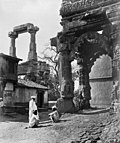 Photograph credit: Bourne & Shepherd; retouched by Yann ForgetThe Rudra Mahalaya Temple is an ancient temple complex at Siddhpur in the Patan district of Gujarat, India. The temple was completed in 1140 by Jayasimha Siddharaja, but in 1296, Alauddin Khalji sent an army under Ulugh Khan and Nusrat Khan, who dismantled the structure. In 1414 or 1415, the temple was further destroyed and the western part was converted into a congregational mosque by Muslim ruler Ahmad Shah I of the Muzaffarid dynasty. Apart from the mosque, the surviving fragments consist of two porches, a torana (ornamental gateway) and a few pillars.
 -
 Photograph: Muhammad Mahdi KarimAn Indian palm squirrel (Funambulus palmarum) photographed in Bangalore, India. In India these squirrels are associated with the Hindu deity Rama, an avatar of Vishnu, and as such are not to be harmed. However, in Western Australia they are considered pests and at times targeted for eradication.
 -
 Photograph: Augustus BinuOdissi is an ancient classical dance that originated in the Hindu temples of Odisha, India. Historically, it has been performed predominantly by women, and expressed religious stories and spiritual ideas, particularly of Vaishnavism (Vishnu as Jagannath), but also of other traditions such as those related to Hindu gods Shiva and Surya, as well as Hindu goddesses (Shaktism). Modern Odissi productions by Indian artists have presented a diverse range of experimental ideas, culture fusion, themes and plays.
Odissi is learnt and performed as a composite of a basic dance motif called the Bhangas (symmetric body bends, stance). It involves the lower, mid, and upper body as three sources of perfecting expression and audience engagement with geometric symmetry and rhythmic musical resonance. -
 Papilio demoleus matingPhotograph: JkadavoorA mating pair of Papilio demoleus, a common and widespread Swallowtail butterfly, photographed at Kadavoor, Kerala, India. After successful mating the female goes from plant to plant, laying a single egg at a time on top of a leaf, and flies off as soon as the egg is laid.
 -
 Photograph: Muhammad Mahdi KarimThe Chota Imambara in Lucknow, Uttar Pradesh, India, is a mausoleum constructed by and for Muhammad Ali Shah, the third Nawab of Awadh, beginning in 1838.
 -
 A potter at work in Jaura, Madhya Pradesh, India. Pottery, defined by ASTM International as "all fired ceramic wares that contain clay when formed, except technical, structural, and refractory products", originated during the Neolithic period.
 -
 Al-Ameen College of PharmacyPhoto: Muhammad Mahdi KarimAl-Ameen College of Pharmacy is a pharmacy college in Bangalore, India. Established in 1983, it is under the purview of the Al-Ameen Educational Society.
 -
 Photograph credit: Charles James SharpThe pied bush chat (Saxicola caprata) is a small passerine bird widely distributed in Asia. The males are black with white shoulder and vent patches, while the females are predominantly brownish. This species is insectivorous, and like other chats hunts from a prominent low perch. This female pied bush chat was photographed in Pench National Park, India.
 -
 Photograph credit: Timothy GonsalvesShinku La is a mountain pass in the Himalayas of northern India. The pass is traversed by the Darcha–Padum road, connecting the high-altitude region of Zanskar in Ladakh with the rest of India. The pass becomes snowbound in the winter, leading to the closure of the road. The construction of a tunnel under the pass, to ensure all-weather connectivity, began in 2024. This photograph shows Shinku La covered in snow, with a frozen lake in the foreground.
 -
 Photograph: Arthur Chapman; edit: Papa Lima Whiskey and Ryan KaldariBrahmaea wallichii, also known as the owl moth, is a moth from the family Brahmaeidae. With a wingspan of about 90–160 mm (3.5–6.3 in), it is one of the largest species of Brahmin moth. This nocturnal species is found in India, Bhutan, Myanmar, China, Taiwan and Japan.
 -
 Photograph: Augustus BinuArundhati Roy (b. 1961) is an Indian author and political activist who won the 1997 Man Booker Prize with her debut novel The God of Small Things. Born in Shillong, Meghalaya, Roy wrote several screenplays in the late 1980s after meeting (and later marrying) director Pradip Krishen. She wrote The God of Small Things over a four-year period ending in 1996; it was published the following year and received positive international reviews, although in India the work was controversial. She has continued to write essays and articles, but has yet to publish another novel.
 -
 Photograph: Muhammad Mahdi KarimBangles on display in Bangalore, India. These rigid bracelets are usually made from metal, wood, or plastic and are traditionally worn by women in India, Nepal, Pakistan, and Bangladesh. In India, it is a common tradition to see a new bride wearing glass bangles at her wedding and the honeymoon will end when the last bangle breaks.
 -
 Photograph credit: Jeevan JosePapilio polymnestor, the blue Mormon, is a species of swallowtail butterfly found in southern India and Sri Lanka. It is a woodland species, often seen on forest paths and near streams. The larvae feed on trees in the family Rutaceae, such as citrus. Young larvae are green with white markings and position themselves on the upper surface of leaves, relying on their cryptic colouring, which resembles bird droppings, for protection. Older larvae seek less conspicuous locations, and have a unique habit of securing their balance by weaving silk on the substratum. This adult male P. polymnestor butterfly was photographed in the Indian state of Kerala.


.jpg)


_female.jpg)

_wb_edit.jpg)


Featured list –
-
Velaiilla Pattadhari (transl. Unemployed graduate) is a 2014 Indian Tamil-language comedy drama film written and filmed by Velraj while also making his directorial debut. The film featured Dhanush, who produced the film under his production company Wunderbar Films, and Amala Paul in the lead roles. Saranya Ponvannan, Samuthirakani, Vivek, Surbhi and Amitash Pradhan played supporting roles. The film's story focuses on Raghuvaran (Dhanush), a civil engineering graduate who is unemployed for four years, and his search for a job. As soon as he finds employment, he faces competition from Arun Subramaniam (Amitash), the head of a rival engineering company, for a government project contract. The rest of the film shows how Raghuvaran overcomes the obstacles set by Arun. The soundtrack and score were composed by Anirudh Ravichander while the editing was handled by M. V. Rajesh Kumar.
Produced on a budget of ₹80 million, Velaiilla Pattadhari was released on 18 July 2014 and received positive reviews. It was commercially successful, grossing ₹530 million worldwide. The film won 19 awards from 31 nominations; its direction, performances of the cast members and music have received the most attention from award groups. (Full article...) -
Test cricket is the longest form of cricket. The women's variant of the game includes four innings to be completed over four days of play with eleven players in each side. The first women's Test was played between England and Australia in 1934. However, India did not play Test cricket until 1973 when the Women's Cricket Association of India was formed. The Indian women's team played their first Test match in 1976, against the West Indies. The Women's Cricket Association of India was merged with the Board of Control for Cricket in India in 2006 as part of the International Cricket Council's initiative to develop women's cricket.
India have played 41 Tests, starting with their first Test in 1976. They first won a Test in Patna (1976), in front of over 25,000 spectators, against the West Indies but did not win again until 2002, when they won against South Africa. The team has remained unbeaten since 2006, over the course of three Test matches. (Full article...) -

The Padma Bhushan is the third-highest civilian award of the Republic of India. Instituted on 2 January 1954, the award is given for "distinguished service of a high order", without distinction of race, occupation, position, or sex. The recipients receive a Sanad, a certificate signed by the President of India and a circular-shaped medallion with no monetary association. The recipients are announced every year on Republic Day (26 January) and registered in The Gazette of India—a publication used for official government notices and released weekly by the Department of Publication, under the Ministry of Urban Development. The conferral of the award is not considered official without its publication in the Gazette. The name of recipient, whose award have been revoked or restored, both of which require the authority of the President, is archived and they are required to surrender their medal when their name is struck from the register; none of the conferments of Padma Bhushan during 1960–1969 have been revoked or restored. The recommendations are received from all the state and the union territory governments, as well as from Ministries of the Government of India, the Bharat Ratna and the Padma Vibhushan awardees, the Institutes of Excellence, the Ministers, the Chief Ministers and the Governors of State, and the Members of Parliament including private individuals.
When instituted in 1954, the Padma Bhushan was classified as "Dusra Varg" (Class II) under the three-tier Padma Vibhushan awards, which were preceded by the Bharat Ratna in hierarchy. On 15 January 1955, the Padma Vibhushan was reclassified into three different awards as the Padma Vibhushan, the Padma Bhushan and the Padma Shri. The criteria included "distinguished service of a high order in any field including service rendered by Government servants", but excluded those working with the public sector undertakings with the exception of doctors and scientists. The 1954 statutes did not allow posthumous awards; this was subsequently modified in the January 1955 statute. The design was also changed to the form that is currently in use; it portrays a circular-shaped toned bronze medallion 1+3⁄4 inches (44 mm) in diameter and 1⁄8 inch (3.2 mm) thick. The centrally placed pattern made of outer lines of a square of 1+3⁄16 inches (30 mm) side is embossed with a knob carved within each of the outer angles of the pattern. A raised circular space of diameter 1+1⁄16 inches (27 mm) is placed at the centre of the decoration. A centrally located lotus flower is embossed on the obverse side of the medal and the text "Padma" is placed above and the text "Bhushan" is placed below the lotus written in Devanagari script. The State Emblem of India is displayed in the centre of the reverse side, together with the national motto of India, "Satyameva Jayate" (Truth alone triumphs) in Devanagari script, which is inscribed on the lower edge. The rim, the edges and all embossing on either side is of standard gold with the text "Padma Bhushan" of gold gilt. The medal is suspended by a pink riband 1+1⁄4 inches (32 mm) in width with a broad white stripe in the middle. It is ranked fifth in the order of precedence of wearing of medals and decorations of the Indian civilian and military awards. (Full article...) -

The Goa Legislative Assembly is the unicameral legislature of the state of Goa on the west coast of India. Its seat is at Porvorim, and it sits for a term of five years unless it is dissolved early. Goa is India's smallest state by area and fourth-smallest by population. The Goa Legislative Assembly has existed since 1963. As of the 2022 election, it comprises 40 constituencies.
The Constitution of India lays down the general principles of positive discrimination for the Scheduled Castes (SC) and Scheduled Tribes (ST). Since the transition of India from a United Kingdom dominion to an independent republic in 1950, the SCs and STs have been given reservation status—guaranteeing political representation—and after Goa was annexed from Portugal in 1961, the same principles applied to it as well. The 2011 census of India found that, within Goa, the population of the Scheduled Castes was 1.74% of the total. Accordingly, one constituency (Pernem) in the assembly is reserved for candidates of the Scheduled Castes. (Full article...) -

Shahid Kapoor and Priyanka Chopra received several nominations for their respective performances in Kaminey.
Kaminey (English: Rascal) is a 2009 Indian action thriller film directed by Vishal Bhardwaj and produced by Ronnie Screwvala. Shahid Kapoor, Priyanka Chopra, and Amol Gupte star in the lead roles. The film's screenplay was written by Bhardwaj, Abhishek Chaubey, Sabrina Dhawan, and Supratik Sen. Bhardwaj also composed the soundtrack of the film, with lyrics written by Gulzar. Kaminey was edited by A. Sreekar Prasad, and Meghna Manchanda Sen, and the cinematography was provided by Tassaduq Hussain. Set against the backdrop of the Mumbai underworld, the film focuses on the rivalry between identical twin brothers both played by Kapoor, one with a lisp and the other with a stutter, over the course of a single day.
Made on a budget of ₹350 million (US$3.7 million), Kaminey released on 14 August 2009 to critical acclaim and was a commercial success, grossing over ₹710 million (US$7.4 million). The film's soundtrack was also a critical and commercial success, with the song "Dhan Te Nan" topping the charts. Over the years, Kaminey achieved cult status. The film garnered awards and nominations in several categories, with praise for its direction, performance of the cast, screenplay, musical score, cinematography, editing and sound design. (Full article...) -

Sanjay Dutt at Mumbai Airport
Sanjay Dutt is an Indian actor known for his work in Hindi films as well as a few Telugu, Kannada, Tamil, Marathi and Punjabi films. He made his acting debut in 1981, opposite Tina Ambani, in his father Sunil Dutt's romantic action film Rocky (1981). Rocky was ranked at tenth highest-grossing Bollywood films of 1981. In 1991, Dutt appeared in Lawrence D'Souza's Indian romantic drama film Saajan (1991), starring alongside Madhuri Dixit and Salman Khan. For his performance, Dutt was nominated for the Filmfare Award for Best Actor. He was nominated again for the same award for his performance in Khalnayak (1993). Dutt won the Filmfare Award for Best Actor—for portraying a young man who later becomes a gangster in Vaastav: The Reality (1999). He also received critical acclaim for his performance. Dutt next appeared in Vidhu Vinod Chopra's crime thriller film Mission Kashmir (2000).
In 2003, Dutt appeared in Rajkumar Hirani's directorial debut: comedy-drama film Munna Bhai M.B.B.S. (2003). He played Munna Bhai, who attends medical school to obtain an MBBS degree. The film was successful at the box office, grossing ₹230 million (equivalent to ₹850 million or US$8.8 million in 2023) in India and ₹360 million (equivalent to ₹1.3 billion or US$14 million in 2023) worldwide. Dutt won Filmfare Award for Best Performance in a Comic Role. (Full article...) -
Enthiran (transl. Robot) is a 2010 Indian Tamil-language science fiction film directed by S. Shankar and produced by Kalanithi Maran. Shankar wrote the screenplay and co-wrote the dialogues with Sujatha and Madhan Karky. The film stars Rajinikanth and Aishwarya Rai with Danny Denzongpa, Santhanam, and Karunas playing supporting roles. The musical score was composed by A. R. Rahman while the cinematography, visual effects, editing, and art direction were handled by R. Rathnavelu, V. Srinivas Mohan, Anthony, and Sabu Cyril respectively. The film's story revolves around a scientist's struggle to control his creation, an android robot whose software is upgraded to give it the ability to comprehend and generate human emotions. The plan backfires when the robot falls in love with the scientist's fiancée and is further manipulated by a rival scientist to bring destruction to all who stand in its way. The film was dubbed into Hindi as Robot.
Produced on an estimated budget of ₹1.32 billion, Enthiran was released on 1 October 2010 and yielded a revenue of ₹1.79 billion according to a report by the Sun TV Network. The film garnered awards and nominations in several categories, with particular praise for its cinematography, visual effects, art direction, costume design, and Rajinikanth's performance. The film has won 25 awards from 38 nominations. (Full article...) -

Kapoor at the 2017 IIFA Awards
Indian actor Shahid Kapoor began his career as a background dancer, making uncredited appearances in the films Dil To Pagal Hai (1997) and Taal (1999). He also appeared in several music videos, including one for the singer Kumar Sanu, before making his acting debut with a lead role in Ken Ghosh's romantic comedy Ishq Vishk (2003). The film was a sleeper hit, and Kapoor's portrayal of a teenage student earned him the Filmfare Award for Best Male Debut. He found little success in the next two years; all five of his releases, including the thriller Fida (2004) and the drama Shikhar (2005), were commercial failures.
In 2006, Kapoor starred opposite Kareena Kapoor in 36 China Town and Chup Chup Ke, and played a prospective groom opposite Amrita Rao in Vivah, a commercially successful family drama from director Sooraj Barjatya. In the following year, he reunited with Kareena Kapoor in the romantic comedy Jab We Met, for which he received his first Best Actor nomination at Filmfare. In 2009, Kapoor portrayed twin brothers, one with a lisp and the other with a stutter, in Vishal Bhardwaj's critically acclaimed thriller Kaminey. He then appeared in a series of films which performed poorly at the box-office, including Mausam (2011) and Teri Meri Kahaani (2012). The 2013 action-drama R... Rajkumar proved to be his first commercial success in four years. (Full article...) -
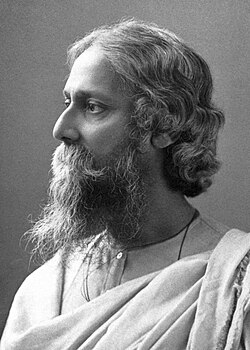
Rabindranath Tagore was the first Indian and also the first non-European and the first Asian to be awarded with the Nobel Prize. He received the prize for Literature in 1913.
The Nobel Prize is a set of annual international awards bestowed on "those who conferred the greatest benefit on humankind" in the fields of Physics, Chemistry, Physiology or Medicine, Literature, Peace and Economic Sciences, instituted by Alfred Nobel's last will, which specified that a part of his fortune be used to create the prizes. Each laureate (recipient) receives a gold medal, a diploma and a sum of money, which is decided annually by the Nobel Foundation. The Royal Swedish Academy of Sciences awards the Nobel Prize in Physics, the Nobel Prize in Chemistry and the Sveriges Riksbank Prize in Economic Sciences in Memory of Alfred Nobel; the Nobel Assembly at the Karolinska Institute awards the Nobel Prize in Physiology or Medicine; the Swedish Academy awards the Nobel Prize in Literature; and the Norwegian Nobel Committee awards the Nobel Peace Prize. They are widely recognised as one of the most prestigious honours awarded in the aforementioned fields.
First instituted in 1901, the Nobel Prize has been awarded to a total of 989 individuals (930 men and 59 women) and 30 organisations as of 2022[update]. Among the recipients, 12 are Indians of which 5 are Indian citizens and 7 are of Indian ancestry or residency. Rabindranath Tagore was the first Indian citizen to be awarded and also the first non-European and the first Asian to be awarded in 1913. Mother Teresa is the only woman among the list of recipients. Sri Aurobindo, the Indian poet, philosopher, nationalist and developer of Integral yoga, was nominated unsuccessfully for the Nobel Prize in Literature in 1943 and for the Nobel Peace Prize in 1950. (Full article...) -

Virat Kohli is one of only two players to score 4 IPL centuries in a single season. He is also one of four players to score IPL centuries in back-to-back innings, and has the most IPL centuries with 9.
In cricket, a batter reaches a century when he scores 100 runs or more in a single innings. A century is regarded as a landmark score for a batter, and his number of centuries is generally recorded in his career statistics. The Indian Premier League (IPL) is a professional league for Twenty20 cricket in India, which has been held annually since its first edition in 2008. Till date, 124 centuries have been scored by 63 different batsmen, out of which 32 are Indian players and 31 are overseas players. Players from 12 of the 15 franchises have scored centuries, with the three franchises that have not had a player score a century for them being Pune Warriors India, Kochi Tuskers Kerala and Gujarat Lions.
The first century in the league's history was scored in the inaugural match itself on 18 April 2008 at M. Chinnaswamy Stadium, Bangalore by Brendon McCullum for Kolkata Knight Riders against Royal Challengers Bangalore, scoring 158*, which is also one of the only three 150+ scores by individual batsmen in the league's history till date. The highest score in the competition was made by Chris Gayle, who scored 175* for Royal Challengers Bangalore against Pune Warriors India. In the same game, he scored the fastest century in terms of number of balls faced, scoring 100 runs in 30 deliveries. The slowest century was jointly scored by Manish Pandey and Virat Kohli, both for Royal Challengers Bengaluru, reaching the milestone in 67 deliveries. (Full article...) -
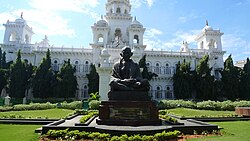
The Telangana Legislative Assembly is the lower house of the bicameral state legislature of Telangana state in India. It is housed in the Assembly Building, in Hyderabad, the capital of the state. The term of the assembly is five years, unless it is dissolved early.
Telangana was formed on 2 June 2014, after the passage of the Andhra Pradesh Reorganisation Act. It comprised 10 districts of Andhra Pradesh. The unified Legislative Assembly was also apportioned and 119 constituencies were assigned to the Legislative Assembly of the new state. The representatives of those constituencies, elected in the 2014 Andhra Pradesh Legislative Assembly election, became the members of the new assembly. Telangana has continued to have the same number of constituencies in the subsequent elections of 2018 and 2023. (Full article...) -
The 2025 Indian Premier League was the 18th edition of the Indian Premier League (IPL), a professional Twenty20 (T20) cricket league held in India, organized by the Board of Control for Cricket in India (BCCI). It has been held annually since the first edition in 2008. In July 2024, the IPL Governing Council held a meeting with the owners of the franchises and announced that a mega auction would be conducted ahead of the 2025 season. It was the sixth mega auction after 2008, 2011, 2014, 2018 and 2022.
The franchises were required to submit their retention lists before 31 October 2024, and a total of 46 players were retained ahead of the auction. The auction was held on 24 and 25 November 2024 in Jeddah, Saudi Arabia, with the auction purse for each franchise set at ₹120 crore (US$13 million), the highest in the history of the IPL. A total of 1,574 players registered for the auction, of which 574 players were shortlisted to feature in the auction and 182 were sold in the auction. Rishabh Pant became the most expensive player in the history of IPL when he was bought by the Lucknow Super Giants for ₹27 crore (US$2.8 million), surpassing ₹26.75 crore (US$2.8 million) paid by the Punjab Kings for Shreyas Iyer earlier in the same auction, and ₹24.75 crore (US$2.6 million) paid by the Kolkata Knight Riders for Mitchell Starc in the 2024 auction. Vaibhav Sooryavanshi became the youngest player sold in the IPL history at the age of 13 years, being bought by the Rajasthan Royals for ₹1.1 crore (US$110,000). (Full article...) -

Anushka Shetty TeachAIDS Recording Session 4.
Anushka Shetty is an Indian actress who appears in Telugu and Tamil films. She is often considered as one of the most influential actresses in history of Telugu cinema industry. With a cinematic career spanning over two decades, she has played pivotal roles in over 50 films. She made her acting debut in Puri Jagannadh's 2005 Telugu film Super, and appeared in Mahanandi, released later the same year. The following year, she had four releases, the first being S. S. Rajamouli's Vikramarkudu, which helped her gain recognition, followed by Astram (a remake of the 1999 Hindi film Sarfarosh), the Sundar C-directed Rendu, (which marked her debut in Tamil cinema), and a special appearance in AR Murugadoss' Telugu film Stalin. She had two releases in 2007: Lakshyam and Don. In 2008, she appeared in six films, including Okka Magaadu, Swagatam and Souryam. In 2009, Shetty played two roles in the fantasy Arundhati. She went on to win the Nandi Special Jury Award and the Filmfare Best Telugu Actress Award for this film. Her next release that year was Billa, a Telugu remake of the 1978 Hindi film of the same name. Her final release in 2009 was her second Tamil feature film, the masala film Vettaikaaran, where she appeared as a medical student.
Shetty had a string of releases in 2010. She portrayed a prostitute in Krish's Vedam, which won her the Filmfare Award for Best Telugu Actress. Despite critical acclaim, the film failed at the box office. None of her other releases in 2010 succeeded commercially, except for her sole Tamil release of the year, the masala Singam. The following year, Anushka had two releases, both in Tamil. She reprised her Vedam role in its remake Vaanam, then appeared as an advocate in the A. L. Vijay-directed Deiva Thirumagal, a loose adaptation of the American film I Am Sam (2001). The following year, she also had two releases: Thaandavam in Tamil, and Damarukam in Telugu. Her first release in 2013 was Suraj's Tamil masala Alex Pandian, a critical and commercial failure. This was followed by Mirchi in Telugu, Singam II (where she reprised her role from Singam), and Selvaraghavan's Tamil romantic fantasy Irandaam Ulagam where she played three distinct roles. Her sole release of 2014 was K. S. Ravikumar's Lingaa. (Full article...) -
The Padma Bhushan is the third-highest civilian award of the Republic of India. Instituted on 2 January 1954, the award is given for "distinguished service of a high order", without distinction of race, occupation, position, or sex. The recipients receive a Sanad, a certificate signed by the President of India and a circular-shaped medallion with no monetary association. The recipients are announced every year on Republic Day (26 January) and registered in The Gazette of India—a publication used for official government notices and released weekly by the Department of Publication, under the Ministry of Urban Development. The conferral of the award is not considered official without its publication in the Gazette. The name of a recipient, whose award has been revoked or restored, both of which require the authority of the President, is archived and they are required to surrender their medal when their name is struck from the register. As of 2019[update], none of the conferments of Padma Bhushan during the 2010s have been revoked or restored. The recommendations are received from all the state and the union territory governments, as well as from Ministries of the Government of India, the Bharat Ratna and the Padma Vibhushan awardees, the Institutes of Excellence, the Ministers, the Chief Ministers and the Governors of State, and the Members of Parliament including private individuals.
When instituted in 1954, the Padma Bhushan was classified as "Dusra Varg" (Class II) under the three-tier Padma Vibhushan awards, which were preceded by the Bharat Ratna in hierarchy. On 15 January 1955, the Padma Vibhushan was reclassified into three different awards as the Padma Vibhushan, the Padma Bhushan and the Padma Shri. The criteria included "distinguished service of a high order in any field including service rendered by Government servants", but excluded those working with the public sector undertakings with the exception of doctors and scientists. The 1954 statutes did not allow posthumous awards; this was subsequently modified in the January 1955 statute. The design was also changed to the form that is currently in use; it portrays a circular-shaped toned bronze medallion 1+3⁄4 inches (44 mm) in diameter and 1⁄8 inch (3.2 mm) thick. The centrally placed pattern made of outer lines of a square of 1+3⁄16 inches (30 mm) side is embossed with a knob carved within each of the outer angles of the pattern. A raised circular space of diameter 1+1⁄16 inches (27 mm) is placed at the centre of the decoration. A centrally located lotus flower is embossed on the obverse side of the medal and the text "Padma" is placed above and the text "Bhushan" is placed below the lotus written in Devanagari script. The State Emblem of India is displayed in the centre of the reverse side, together with the national motto of India, "Satyameva Jayate" (Truth alone triumphs) in Devanagari script, which is inscribed on the lower edge. The rim, the edges and all embossing on either side is of standard gold with the text "Padma Bhushan" of gold gilt. The medal is suspended by a pink riband 1+1⁄4 inches (32 mm) in width with a broad white stripe in the middle. It is ranked fifth in the order of precedence of wearing of medals and decorations of the Indian civilian and military awards. (Full article...) -

Bajirao Mastani won a total of seven National Film Awards at the 63rd National Film Awards including the National Film Award for Best Direction for Sanjay Leela Bhansali.
Bajirao Mastani is a 2015 Indian epic historical romance film directed and scored by Sanjay Leela Bhansali. It was a co-production between Bhansali Productions and Eros International. The film stars Ranveer Singh as Bajirao I, Deepika Padukone as Mastani, and Priyanka Chopra as Kashibai. Tanvi Azmi, Aditya Pancholi, Vaibbhav Tatwawdi and Milind Soman playing supporting roles. The screenplay was written by Prakash R. Kapadia, and the cinematography provided by Sudeep Chatterjee. Based on the Marathi novel Raau by Nagnath S. Inamdar, the film narrates the story of the Maratha Peshwa Bajirao and his second wife Mastani.
Made on a budget of ₹1.25 billion (US$13 million), the film was released on 18 December 2015 to positive reviews from critics. As of May 2016, Bajirao Mastani has grossed over ₹3.6 billion (US$38 million) at the box-office, becoming one of the highest-grossing Indian films of all time. The film garnered awards and nominations in a variety of categories with particular praise for Bhansali's direction and music, the performances of Chopra and Singh, its cinematography, art direction, and costume design. (Full article...) -

Members of the Indian cricket team before a Women's World Twenty20 game in Sydney, 2009.
A women's Twenty20 International (WT20I) is a 20 overs-per-side cricket match played in a maximum of 150 minutes between two ICC member sides, and is played under the rules of Twenty20 cricket. The first such match was held in August 2004 between England and New Zealand. The India women's national cricket team played its first WT20I against England in August 2006; India won the match by eight wickets.
Since the team made its first WT20I appearance in 2006, 73 players—including five different captains—have represented India in the format. The list is arranged in the order in which each player won her first Twenty20 cap. Where more than one player won her first Twenty20 cap in the same match, those players are listed alphabetically by surname. (Full article...) -
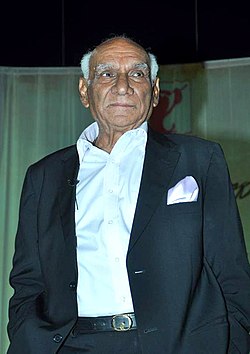
Chopra in 2012
Yash Chopra (1932–2012) was an Indian film director and producer known for his works in Bollywood. Acknowledged as one of the country's greatest filmmakers, he was credited by the media for "changing the face of romance to become a brand" in the industry. He made his directorial debut with the family drama Dhool Ka Phool, which was produced by his elder brother B. R. Chopra. The film, released in 1959, became a commercial success worldwide and gave him critical acclaim. Chopra's next film, Dharmputra (1961), failed to perform well at the box office but won the National Film Award for Best Feature Film in Hindi. In 1965, he directed the drama Waqt about a family who are separated due to a natural disaster. A commercial success, it was one of the earliest Indian films to star an ensemble cast and won a first Best Director trophy for him at the Filmfare Awards.
The 1980s was the most unsuccessful period of his career. Following the failure of his romantic drama Silsila (1981), which he co-wrote, directed and produced, Chopra's popularity began to wane. According to his biographer, the British academic Rachel Dwyer, this was because action and crime films were more popular at the time while most of his films were romances. Chopra experimented with making two action films, Mashaal (1984) and Vijay (1988), which underperformed financially but were well received by critics. Chandni was his only box-office success of the decade. Starring Sridevi in the title role, the film tells the story of a young woman who is accused of being responsible for her lover's accident. Chopra's career began to revive since its premiere in 1989; the film was named the Best Popular Film Providing Wholesome Entertainment at the 37th National Film Awards and considered one of his best films. (Full article...) -
My Name Is Khan is a 2010 drama film directed by Karan Johar. The film features Shah Rukh Khan and Kajol in the lead roles with Jimmy Sheirgill, Zarina Wahab, Sonya Jehan, Vinay Pathak and Parvin Dabas playing supporting roles. Set in the United States, the film's story focuses on Rizwan Khan (Khan), a non-resident Indian with Asperger syndrome whose wife, Mandira (Kajol), has a child, Sameer, from a previous relationship. During the aftermath of the September 11 attacks, Sameer dies as a result of a racist assault by school bullies. Mandira blames Sameer's death on Rizwan due to his religion, and tells him not to come back until he can convince the President of the United States that he is not a terrorist. Rizwan takes Mandira's words literally and tries to meet the President so as to win her back. My Name Is Khan was co-produced by Johar's brother, Hiroo Yash Johar, and Khan's wife, Gauri Khan, under the Dharma Productions and Red Chillies Entertainment banners respectively. Shankar–Ehsaan–Loy composed the soundtrack while Niranjan Iyengar and Javed Akhtar wrote the lyrics for its songs. Ravi K. Chandran, Deepa Bhatia and Sharmishta Roy handled the cinematography, editing and production design respectively.
Produced on a budget of ₹850 million (about US$19 million in 2010), My Name Is Khan was released on 12 February 2010 and received positive reviews. It was commercially successful, grossing ₹2.048 billion (about US$45 million in 2010) worldwide. The film won 25 awards from 84 nominations; its direction, story, screenplay, performances of the cast members and music have received the most attention from award groups. (Full article...) -
Preity Zinta is an Indian actress, who has received several awards for her acting in Hindi films. Her career began in 1998 with Mani Ratnam's acclaimed drama Dil Se.. and the box office hit Soldier. Both films won her the award for Best Female Debut at the 44th Filmfare Awards. Her performance in Dil Se.. also earned her a Best Supporting Actress nomination at the same ceremony, while Soldier won her three more Best Debut awards at other major ceremonies. Zinta received her first Filmfare nomination for Best Actress for her portrayal of a teenage single mother in Kya Kehna. She followed these films with several critically and commercially successful films, such as Mission Kashmir (2000) and Dil Chahta Hai (2001), and her performances in Chori Chori Chupke Chupke (2001), Dil Hai Tumhaara (2002) and Armaan (2003) were praised.
Zinta won several awards for her performance in the romantic comedy-drama Kal Ho Naa Ho, including her first and only Filmfare Award for Best Actress. She went on to star in top-grossing productions in India and abroad, including Koi... Mil Gaya (2003), Veer-Zaara (2004), Salaam Namaste (2005) and Kabhi Alvida Naa Kehna (2006), all of which earned her different nominations at major award ceremonies, which, in addition to Filmfare, include such organisations as Screen, Zee Cine, the International Indian Film Academy (IIFA), and Stardust, among others. After a relatively low phase, she started appearing in arthouse films, known in India as parallel cinema. She played her first international film role in Deepa Mehta's Canadian drama Heaven on Earth (2008, titled Videsh in India). Her portrayal in the film won her the Silver Hugo Award for Best Actress at the Chicago International Film Festival, and she was a Best Actress nominee at several award functions in Canada, including the Genie Awards by the Academy of Canadian Cinema & Television, and the Vancouver Film Critics Circle. (Full article...) -
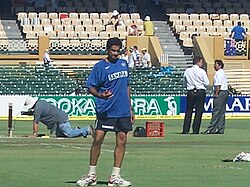
Anil Kumble, India's leading wicket-taker in Tests and ODIs
In cricket, a five-wicket haul (also known as a "five–for" or "fifer") refers to a bowler taking five or more wickets in a single innings. This is regarded as a notable achievement, as of October 2024[update] only 54 bowlers have taken 15 or more five-wicket hauls at an international level in their cricketing careers.
Anil Kumble is a former Test and One Day International (ODI) cricketer who represented India. He is a right-arm leg spin (legbreak googly) bowler. Kumble has taken 619 wickets in Test cricket and 337 wickets in ODI cricket. With 37 five-wicket hauls, Kumble has the highest number of Test and combined international five-wicket hauls among Indian cricketers and fourth highest among all players, after Muttiah Muralitharan, Richard Hadlee, and Shane Warne.
Kumble made his ODI debut against Sri Lanka and his Test debut against England, both in 1990. His first five-wicket haul was against South Africa at Johannesburg (November 1992) in the second Test of India's tour. He has claimed the most of his five-wicket hauls against Australia, ten of them, all in Test matches. His best performance was against Pakistan at the Feroz Shah Kotla in 1999; Kumble took all ten wickets during the second innings, just the second person to do so, after Jim Laker, and in the process ensured India of their first Test victory against Pakistan in twenty years. The feat also ranks as the second-best bowling figure in Test history. Twenty of Kumble's Test cricket five-wicket hauls have come in victory for India, while five have been in defeats. Kumble has also taken two five-wicket hauls in ODIs. His first ODI five-wicket haul was against the West Indies during the final of the 1993 Hero Cup at Eden Gardens, Calcutta when he took six wickets for twelve runs, a record for India in One Day Internationals. The performance ensured India's victory and Kumble was adjudged man of the match. His other ODI five-wicket haul was against New Zealand at the Basin Reserve in 1994. (Full article...) -

Kashyap attending the Rome Film Festival in 2007.
Anurag Kashyap is an Indian filmmaker and actor, known for his work in Hindi cinema. After writing a television series Kabhie Kabhie (1997), Kashyap co-wrote Ram Gopal Varma's crime drama Satya (1998). He later wrote and directed a short television film, Last Train to Mahakali (1999), and made his feature film debut with the yet-unreleased film Paanch. He next directed Black Friday (2007), a film on the 1993 Bombay bombings. Its release was barred by India's Censor Board for two years, but was eventually released in 2007 to positive reviews. The same year, he directed the critical and commercial failure No Smoking. Return of Hanuman (2007), an animated film, was Kashyap's next directorial venture. In 2009, he directed Dev.D, a modern-day take on Sarat Chandra Chattopadhyay's Bengali novel Devdas, along with the political drama Gulaal. Despite positive reviews, the latter was a box-office failure.
Kashyap's production company Anurag Kashyap Films released its first film Udaan (2010)—a critical success that earned him the Filmfare Award for Best Story and Best Screenplay. He then directed one of the short films in the anthology film Mumbai Cutting. After directing the thriller That Girl in Yellow Boots (2011), the two-part crime film Gangs of Wasseypur (2012) was his next release, which garnered him the Filmfare Award for Best Dialogue. In 2013, he directed a short film on eve teasing titled That Day After Everyday, and directed one segment of the anthology film Bombay Talkies (2013). In 2013, he co-produced The Lunchbox, a film that was nominated for the BAFTA Award for Best Film Not in the English Language, and the biographical drama Shahid. In 2011, Kashyap started another production company Phantom Films, whose first feature was the period drama Lootera (2013). (Full article...) -

Trisha Krishnan in 2022
Trisha Krishnan[a] is an Indian actress known for her work primarily in Tamil and Telugu cinema. She is the only South Indian actress to have sustained a successful career as a leading actress for over two decades in Tamil cinema. She was first seen in 1999 in a minor supporting role in Jodi and later appeared in 2000 in the music video of Falguni Pathak's song 'Meri Chunar Udd Udd Jaye'.
The first project she accepted as a lead actress was Priyadarshan's Lesa Lesa but a delay in the film's release meant that her first appearance in a lead role was in Ameer's directorial debut Mounam Pesiyadhe in 2002, which was a commercial success. The following year, Trisha portrayed a woman battling a terminal illness in Manasellam (2003). Her next release was Hari's action film, Saamy (2003) in which she played a soft-spoken Brahmin girl and attracted praise for her performance, and the film became a major commercial and critical success, resulting in Trisha receiving new offers, including those from several high-budget productions. Lesa Lesa, which was to have been her debut as a lead actress, was released next, earned her the ITFA Best New Actress Award. She starred in Alai (2003) and the Tamil-Telugu bilingual film Enakku 20 Unakku 18 (2003) (Nee Manasu Naaku Telusu) were commercially unsuccessful. Trisha's next Telugu release, Varsham (2004), was a major commercial and critical success, earning her the first Filmfare Award for Best Actress-Telugu and more Telugu film offers. Trisha starred in Ghilli (2004) as a damsel in distress, and the film became a major critical and commercial success. She starred in Mani Ratnam's political drama Aayutha Ezhuthu (2004). She starred in Thirupaachi (2005), which became a major commercial success. Trisha played a village girl in the romantic comedy Nuvvostanante Nenoddantana (2005), a commercial and critical success that earned her a second Filmfare Award for Best Actress and a Nandi Award for Best Actress. Athadu (2005), Aaru (2005), Stalin (2006), were major commercial successes. She reprised the role in the Tamil remake Unakkum Enakkum (2006) which was also successful. She played the titular role in Pournami (2006). Aadavari Matalaku Arthale Verule (2007) was a critical and commercial success, earning Trisha her third Filmfare Award for Best Actress and the same year Kireedam (2007) was a commercial success. Krishna (2008) and King (2008) became blockbusters, while Bheema (2008) was commercially unsuccessful, and Kuruvi (2008) and Bujjigadu (2008) emerged as hits. In Abhiyum Naanum (2008), Trisha's performance was widely praised,' and earned her Tamil Nadu State Film Award and a Filmfare nomination for Best Actress. Her 2009 films Sarvam and Sankham did not do well and became average grossers. The following year, Vinnaithaandi Varuvaayaa (2010) was a major success and a career breakthrough for Trisha, earning her a Filmfare nomination for Best Actress. She made her debut in Hindi cinema with the film Khatta Meetha (2010) Upon release, the film received mixed reviews from critics and box office India declared it an average performer at the box office. However, it earned her nomination for a Filmfare Award for Best Female Debut. Her sole Telugu release that year was Namo Venkatesa. Both her 2011 releases –Teen Maar and Mankatha were successful. She had two releases in 2012, Bodyguard and Dammu were successful. Her two Tamil films in 2013 the mystery thriller Samar, and Endrendrum Punnagai (2013), which earned her a Filmfare nomination for Best Actress. Her sole release in 2014 was Power, which marked her debut in Kannada cinema was a commercial success. (Full article...) -

Bhatt at an event for RRR in 2021
Alia Bhatt is a British actress of Indian descent who predominantly works in Hindi films. As a child, she played a minor role in her father Mahesh Bhatt's production Sangharsh (1999), as the younger version of star Preity Zinta's character. In 2012, Bhatt had her first lead role in Karan Johar's teen film Student of the Year, but her performance in it was not well received. Two years later, she gained praise for playing a kidnapping victim in the drama Highway (2014), winning the Filmfare Critics Award for Best Actress. In the same year, her starring roles in the commercially successful romances 2 States and Humpty Sharma Ki Dulhania, both produced under Johar's studio Dharma Productions, established her as a leading actress. She also sang the single "Samjhawan Unplugged" for the latter film's soundtrack.
In Bhatt's three film releases of 2016—Kapoor & Sons, Dear Zindagi, and Udta Punjab—she played young women in troubling circumstances. Her performance in the last of these won her the Filmfare Award for Best Actress. Following another romantic role in Badrinath Ki Dulhania (2017), she played a spy in the thriller Raazi (2018) and a volatile girlfriend in the musical drama Gully Boy (2019). She won two more Best Actress awards at Filmfare for the latter two. This was followed by two poorly received films, Kalank (2019) and Sadak 2 (2020). Bhatt gained further success in 2022 with a brief role in the Telugu period film RRR, and starring roles in the fantasy film Brahmāstra: Part One – Shiva and biopic Gangubai Kathiawadi, in which she starred as the titular prostitute; all three rank among the highest-grossing Indian films of the year. She won the National Film Award for Best Actress and her fourth Best Actress award at Filmfare for the last of these. She also produced and starred in the Netflix black comedy Darlings under her company Eternal Sunshine Productions, for which she received a Filmfare OTT Award. (Full article...) -

Chopra in 2016
Priyanka Chopra is an Indian actress who has received several awards and nominations including two National Film Award, five Filmfare Awards, eight Producers Guild Film Awards, eight Screen Awards, six IIFA Awards, and two People's Choice Awards. In 2000, she participated in the Femina Miss India contest, where she finished second, winning the Femina Miss India World title. She then entered the Miss World pageant and was crowned Miss World 2000, becoming the fifth Indian to win the contest. Chopra made her Bollywood film debut with a supporting role in the 2003 spy thriller The Hero, which earned her the Stardust Award for Best Supporting Actress. The same year, her performance in the romantic musical Andaaz won her the Filmfare Award for Best Female Debut and a nomination for Best Supporting Actress at the same ceremony. For her portrayal of a seductress in the romantic thriller Aitraaz, Chopra won the Filmfare Award for Best Performance in a Negative Role and received her second nomination for Best Supporting Actress. The same year, she was nominated for the IIFA Award for Best Actress for the romantic comedy Mujhse Shaadi Karogi.
Chopra starred as a troubled model in the drama Fashion (2008), for which she won many Best Actress awards in India including the National Film Award for Best Actress and the Filmfare Award in the same category. In 2010, she received several Best Actress nominations for playing a feisty Marathi woman in the caper thriller Kaminey, winning her second consecutive Producers Guild Film Award for Best Actress in a Leading Role after Fashion. The same year, she was nominated for the Screen Award for Best Actress for playing twelve distinct roles in the social comedy film What's Your Raashee?. For her portrayal of a serial killer, in the 2011 neo-noir 7 Khoon Maaf, she won the Filmfare Award for Best Actress (Critics), in addition to a Best Actress nomination at the same ceremony. (Full article...) -

Warsi in 2010
Arshad Warsi started his career as an assistant director to Mahesh Bhatt in Kaash (1987). Warsi choreographed the title song of Roop Ki Rani Choron Ka Raja (1993), before making his acting debut in the Amitabh Bachchan-produced Tere Mere Sapne (1996). It was followed by Betaabi (1997), Hero Hindustani (1998), Hogi Pyaar Ki Jeet and Trishakti (both 1999), among others, but most of these films failed to do well at the box office. In 2003, he had his breakthrough by playing the comic sidekick Circuit in Rajkumar Hirani's comedy-drama Munna Bhai M.B.B.S. His performance garnered him the Zee Cine Award for Best Actor in a Comic Role and received nominations for the Filmfare, IIFA, Screen and Apsara Film Producers Guild Award for Best Supporting Actor. Warsi won the GIFA Best Comedian Award for his role in the comedy Hulchul (2004), and garnered critical acclaim for portraying a police officer in the crime drama Sehar (2005). He received his second Filmfare Award for Best Supporting Actor nomination for his role in the romantic comedy Salaam Namaste (2005).
In 2006, Warsi starred in the Rohit Shetty-directed comedy Golmaal: Fun Unlimited, and reprised his role of Circuit in the sequel Lage Raho Munna Bhai. His performance in the latter won him the Filmfare Award for Best Performance in a Comic Role, among other awards. That same year, he played lead roles in the mystery Anthony Kaun Hai? and the counter-terrorism drama Kabul Express. Warsi also hosted the first season of the reality television show Bigg Boss for which he earned the Indian Television Academy Award for Best Anchor – Game/Quiz Show. In 2007, he played a footballer in the sports film Dhan Dhana Dhan Goal. The following year, he reteamed with Shetty for Golmaal Returns (2008), and played an intermittent explosive disorder patient in the comedy Krazzy 4 (2008). He won the Screen Award for Best Supporting Actor and received several nominations for playing a con man in the black comedy Ishqiya (2010). Also in 2010, Warsi co-produced and starred in the supernatural comedy-drama Hum Tum Aur Ghost, which performed poorly at the box office. Golmaal 3, the year's second-highest grossing Hindi film also featured him in a primary role. His first negative role came in 2013 with the action thriller Zila Ghaziabad, a critical and commercial failure. Warsi's portrayal of a lawyer in the comedy-drama Jolly LLB (2013), directed by Subhash Kapoor, garnered him several awards, including the IIFA Award for Best Performance in a Comic Role. His portrayal of a thief in Dedh Ishqiya (2014) attracted critical praise. (Full article...)


.jpg)
.jpg)

.jpg)


_2.jpg)


.jpg)


 Good article –

-
Maheshinte Prathikaaram (transl. Mahesh's Revenge) is a 2016 Indian Malayalam-language comedy drama film directed by Dileesh Pothan, in his directorial debut, and produced by Aashiq Abu. The film stars Fahadh Faasil in the title role alongside a supporting cast including Aparna Balamurali, Anusree, Alencier Ley Lopez and Soubin Shahir. Written by Syam Pushkaran, the story is based on an incident in the life of Thampan Purushan from Thuravoor, Cherthala. Shyju Khalid was the film's cinematographer, and Bijibal composed the music.
Maheshinte Prathikaaram's development began in 2013 when Pothan was working as an associate director for Abu on Idukki Gold, co-written by Syam. Syam suggested a story idea to Pothan based on an incident in his native village. At Pothan's insistence, Syam wrote the screenplay that year and Abu later became interested in producing the film. Production was scheduled to commence from December 2014 after completing the casting process but, scheduling conflicts led to its postponement to August 2015. Principal photography began in early August in Idukki at nearby locations, where it was predominantly filmed. Shooting was completed in late October. (Full article...) -

Durian fruit cut open to show the edible flesh
The durian (/ˈdʊəriən/ ⓘ) is the edible fruit of several tree species belonging to the genus Durio. There are 30 recognised species, at least nine of which produce edible fruit. Durio zibethinus, native to Borneo, Sumatra, and the Malay Peninsula, is the only species available on the international market. It has over 300 named varieties in Thailand and over 200 in Malaysia as of 2021. Other species are sold in their local regions.
Known in some regions as the "king of fruits", the durian is distinctive for its large size, strong odour, and thorn-covered rind. The fruit can grow as large as 30 cm (12 in) long and 15 cm (6 in) in diameter, and it typically weighs 1 to 3 kg (2 to 7 lb). Its shape ranges from oblong to round, the colour of its husk from green to brown, and its flesh from pale yellow to red, depending on the species. The flavour of the flesh is complex with savoury notes. The texture is creamy and pudding-like. (Full article...) -
Paratha (IPA: [pəˈɾaːʈʰaː, pəˈɾãːʈʰaː], also known by other spellings) is a flatbread from the Indian subcontinent, consisting of a wheat dough, typically whole wheat, that is folded and rolled with ghee, forming multiple layers, and shallow fried. Paratha may be stuffed with various fillings, the most common being potato. Paratha is one of the most popular flatbreads in India. The folded, whole-wheat version is prevalent in the Northern Indian subcontinent, and is distinct from South Indian parotta, which uses refined flour. Variations also exist in the cuisines of Myanmar, Mauritius, Malaysia (where it is known as roti canai), and the Caribbean (where it is known as buss-up-shut).
Although paratha is sometimes said to have originated in Punjabi cuisine, it may have evolved from similar flatbreads from regions connected to India via the Silk Road. Possible origins include the Persian flatbread waraki or from breads introduced by Arabs in India. Sanskrit recipes for versions of paratha appeared in the 12th century. The popularity of paratha increased during the Mughal Empire, which introduced it across the region. During the British imperial era, indentured workers from India introduced paratha to Southeast Asia, the Caribbean, and Mauritius. In India, several versions of paratha were popularised after the 1947 partition. (Full article...) -
Network18 Media & Investments Limited (d/b/a Network18 Group) is an Indian media conglomerate owned by the Reliance Industries with 56.89% share headed by Mukesh Ambani and rest of 43.11% is equity holding. Rahul Joshi is the managing director, chief executive officer and group editor-in-chief, and Adil Zainulbhai is the chairman of its board of directors.
Incorporated in 1996 by Geeta and Rakesh Gupta, the company was acquired by Ritu Kapur and Raghav Bahl to be converted into a conglomerate holding company between 2003 and 2006. It oversaw one of the largest collections of media properties in India following its conversion but became encumbered with debt due to aggressive expansions. In 2012, the company entered into a debt agreement with Reliance Industries, through which it was granted a number of channels from the ETV Network. The agreement eventually enabled a hostile takeover of the company in 2014. (Full article...) -
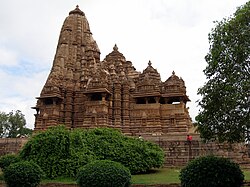
The Kandariya Mahadeva Temple (Devanagari: कंदारिया महादेव मंदिर, Kandāriyā Mahādeva Mandir), meaning "the Great God of the Cave", is the largest and most ornate Hindu temple in the medieval temple group found at Khajuraho in Madhya Pradesh, India. It is considered as one of the best examples of temples preserved from the medieval period in India. Because of its outstanding preservation and testimony to the Chandela culture, the temple was inscribed on the UNESCO World Heritage List in 1986. (Full article...) -
Mandodari (Sanskrit: मंदोदरी, Mandodarī, lit. "soft-bellied";) was the queen consort of Ravana, the king of Lanka, according to the Hindu epic Ramayana. The Ramayana describes her as beautiful, pious, and righteous. She is extolled as one of the Panchakanya, the recital of whose names is believed to dispel sin.
Mandodari was the daughter of Mayasura, the King of the Asuras (demons), and the apsara (celestial nymphs) Hema. She marries Ravana and bears three sons: Meghanada (Indrajit), Atikaya and Akshayakumara. Despite her husband's faults, Mandodari loves him and advises him to follow the path of righteousness. She repeatedly advises Ravana to return Sita to Rama, but her advice falls on deaf ears. Her love and loyalty to Rāvana are praised in the Rāmāyana. (Full article...) -
Mangalorean Catholics (Konkani: Kōdiyālcheñ Kathōlikā) are an ethno-religious community of Latin Christians from the Diocese of Mangalore and the erstwhile South Canara area; by the southern coast of present-day Karnataka, India.
Contemporary Mangalorean Catholics descend mainly from the New Christians of Portuguese Goa, who migrated to the Keladi Kingdom 1560-1763, throughout the courses of the Goan Inquisition, the Portuguese–Adil Shahi Wars & the Mahratta Invasions of Goa and Bombay. They learned Tulu and Kanarese whilst in Canara, but retained the Konkani language and preserved much of their Konkani way of life, which had undergone Christianisation in Goa. The "Canara Christians" suffered a 15-year-long captivity at Seringapatam, that was imposed by Tippu Sultan. Following Tippu's defeat and death at the Siege of Seringapatam (1799) by the English East India Company, the Nizam of Hyderabad & other allies; most of them resettled in and around South Canara; also in areas such as Chikmagalur (Chickmangalore) & Coorg (Kodagu) during the Company rule in India. A lesser number was shipped to the Seven Islands of Bombay & the Bombay metropolitan area in the northern Konkan region. (Full article...) -
The Oath of the Vayuputras is the third book of Amish Tripathi, third book of Amishverse, and also the third book of Shiva Trilogy. The book was released on 27 February 2013, through Westland Press and completes the mythical story about an imaginary land Meluha and how its inhabitants were saved by a barbarian named Shiva. Starting from where the previous installment left off, Shiva discovers what is the true evil in The Oath of the Vayuputras. Shiva then declares a holy war on those who seek to continue to use it, mainly the Emperors Daksha and Dilipa, who are being controlled by the sage Bhrigu. The battle rages on and Shiva travels to the land of Pariha to consult with Vayuputras, a legendary tribe. By the time he returns, the war has ended with Sati, his wife, being murdered. An enraged Shiva destroys the capital of Meluha and Somras is wiped out of history. The story concludes with Shiva and his associates being popularized as Gods for their deeds and accomplishments.
Tripathi had confirmed in September 2011 that he was writing The Oath of the Vayuputras, with Westland announcing the release date as 27 February 2013. The book was longer than the previous installments of the series and Tripathi clarified that all the loose ends left out in the previous book would be addressed, with the death of certain characters. Following the release of the cover art, it was announced that the publication rights of the books have been bought by both US and UK publisher houses. Like The Immortals of Meluha and The Secret of the Nagas, the book contained innovative marketing techniques, including launching interactive apps, merchandise and a music album titled Vayuputras, containing music inspired by different events in the series. (Full article...) -
Imsai Arasan 23rd Pulikecei (transl. Pulikesi XXIII, the king of nuisance) is a 2006 Indian Tamil-language historical-comedy film written and directed by Chimbu Deven in his directoral debut. The film stars Vadivelu in his debut as a solo lead actor. Monica and Tejashree play the female leads, while Manorama, Nassar, Ilavarasu, Sreeman and Nagesh play supporting roles. Sabesh–Murali composed the soundtrack album and background score. S. Shankar produced and distributed the film under his production banner S Pictures.
Set in the late 18th century during the early stages of the British Raj, the film tells the story of twin brothers separated at birth. Pulikesi XXIII, the foolish elder brother, becomes a puppet of his uncle, the Chief Minister, while Ukraputhan, the wise younger brother, becomes a patriot intent on saving his land and his brother. (Full article...) -
Paava Mannippu (transl. Forgiveness of sins) is a 1961 Indian Tamil-language drama film directed and edited by A. Bhimsingh, who co-produced it under his banner Buddha Pictures, with AVM Productions. The film features an ensemble cast of Sivaji Ganesan, Gemini Ganesan, Savitri, Devika and M. R. Radha. M. V. Rajamma, V. Nagayya, S. V. Subbaiah and T. S. Balaiah play supporting roles. It revolves around four children who are separated from their parents in childhood, then found and raised by foster parents of different religious backgrounds.
Bhimsingh initially began work on a film titled Abdullah, starring J. P. Chandrababu who narrated the story to him. Though some scenes were filmed, Bhimsingh was unconvinced with the results; after AVM volunteered to co-produce the film, Bhimsingh redeveloped the script as Paava Mannippu, with Chandrababu replaced by Sivaji Ganesan. The soundtrack and score were composed by Viswanathan–Ramamoorthy while Kannadasan was the lyricist. (Full article...) -
Jamiat Ulama-i-Hind or Jamiat Ulema-e-Hind (Urdu: جمعیۃ علماءِ ہند transl. Council of Indian Muslim Theologians) is one of the leading organisations of Islamic scholars belonging to the Deobandi school of thought in India. It was founded in November 1919 by a group of Muslim scholars including Abdul Bari Firangi Mahali, Kifayatullah Dehlawi, Muhammad Ibrahim Mir Sialkoti and Sanaullah Amritsari.
The Jamiat was an active participant in the Khilafat Movement in collaboration with the Indian National Congress. It also opposed the partition of India, taking the position of composite nationalism: that Muslims and non-Muslims form one nation. As a result, this organisation had a small break-away faction known as the Jamiat Ulema-e-Islam, which decided to support the Pakistan movement. (Full article...) -
Vishal Bhardwaj (born 4 August 1965) is an Indian filmmaker, music composer, and playback singer. He is known for his work in Hindi cinema, and is the recipient of nine National Film Awards and a Filmfare Award.
Bhardwaj made his debut as a music composer with the children's film Abhay (1995), and received wider recognition with his compositions in Gulzar's Maachis (1996). He received the Filmfare R. D. Burman Award for New Music Talent for the latter. He went on to compose music for the films Satya (1998) and Godmother (1999). For the latter, he won the National Film Award for Best Music Direction. (Full article...) -
Loham (transl. Metal) is a 2015 Indian Malayalam-language action thriller film written and directed by Ranjith, and produced by Antony Perumbavoor for the production company Aashirvad Cinemas. The film, starring Mohanlal, Renji Panicker, Siddique, Andrea Jeremiah and Ajmal Ameer is about an elusive smuggling operation and the mysterious disappearance of 100 kilograms (220 lb) of gold. Sreevalsan J. Menon and C. Rajamani composed the soundtrack and film score, respectively.
Loham opened on 20 August 2015 in over 250 theatres across India. Its release in the United Arab Emirates and the United Kingdom followed on 28 August. The film was a commercial success at the box office, upon release, it set a record for the highest opening day gross for a Malayalam film at the time. Loham received mixed reactions from critics, some of whom praised the lead actors' performances and the film's technical aspects but criticised the screenplay. The film's gross in 2015 following its release was approximately ₹14 crore (US$1.5 million) worldwide. (Full article...) -
Karthik Sivakumar (born 25 May 1977), known professionally as Karthi, is an Indian actor who works in Tamil cinema. He is the son of veteran actor Sivakumar, and began his career as an assistant director in his elder brother Suriya's
film Aayutha Ezhuthu (2004). He debuted as a lead actor with Paruthiveeran (2007). Karthi is a recipient of four Filmfare Awards South and three Tamil Nadu State Film Awards.
After a three-year hiatus from acting, he then returned to star in films such as Aayirathil Orvuan, Paiyaa and Naan Mahaan Alla, all three of which were released in 2010. He then continued to star in films such as Siruthai (2011), Saguni (2012), Alex Pandian (2013), All In All Azhagu Raja (2013) and Biriyani (2013). (Full article...) -
Manoj Bajpayee (born 23 April 1969), also transliterated as Manoj Bajpai, is an Indian actor who predominantly works in Hindi cinema. He has appeared in over 70 films. A prolific actor of Indian cinema, he is the recipient of numerous accolades including four National Film Awards, four Filmfare Awards, and two Asia Pacific Screen Awards. In 2019, he was awarded the Padma Shri by the Government of India.
Born in a small village in Bihar, Bajpayee aspired to become an actor since childhood. He relocated to Delhi at the age of seventeen, and applied for the National School of Drama, was rejected four times. He continued to do theatre while studying in college. Bajpayee made his feature film debut with minor roles in Drohkaal (1994) and Bandit Queen (both 1994). He had his breakthrough playing a gangster in Ram Gopal Varma's 1998 crime drama Satya, for which he won the National Film Award for Best Supporting Actor and Filmfare Critics Award for Best Actor. He then acted in films such as Kaun? (1999) and Shool (1999). For the latter, he won his second Filmfare Critics Award for Best Actor. (Full article...) -
Mozaffar-Hosayn Mirza (Persian: مظفر حسین میرزا; 1563–1600) was an Iranian nobleman from the Safavid dynasty that held the governorship of Qandahar from 1578 until his defection to India in 1595. His rule was characterized by his constant conflict with his younger brother, Rustam Mirza, and his regent, Kur Hamza Beg. In 1593, he killed Hamza Beg and captured Rustam's lands. He was then faced with raids from the Uzbek of Bukhara and the Mughal emperor Akbar wanting to conquer Qandahar. Unable to drive the Uzbeks away, he surrendered Qandahar to Akbar and defected to India. He was honoured greatly by Akbar and his daughter, Kandahari Begum, was married to Akbar's grandson, the future Shah Jahan. His son and grandson became high-ranking officials in the Mughal bureaucracy. (Full article...)
-
The 2008 attacks on Christians in southern Karnataka were the wave of attacks directed against Christian churches and prayer halls in the Indian city of Mangalore and the surrounding area of southern Karnataka in September and October 2008 by Hindu nationalist organisations such as Bajrang Dal and Sri Ram Sena. The attacks were widely perceived by Christians in southern Karnataka to be revenge from right-wing Hindu nationalist organisations, because Mangalorean Christians had been outspoken about the 2008 anti-Christian attacks in Orissa.
On 29 August, many groups across India participated in a "prayer for peace and communal harmony" in response to ongoing anti-Christian violence in Orissa. St Aloysius College and around 2,000 Christian schools in Karnataka went on strike on 29 August, protesting against the attacks in Orissa. This was in defiance of orders of the government that 29 August was to be a regular work day. The BJP administration of Karnataka denounced local Christian institutions for disobeying the orders, and a Bajrang Dal demonstration was held outside St Aloysius College. Strikes and protests continued for the next two weeks. The main attacks began on 14 September, when a group of youths from the Bajrang Dal went inside the chapel of Adoration Monastery of the Sisters of St Clare near the Milagres Church in Hampankatta and desecrated it. Some 20 churches, temples, and halls belonging to Catholic, Protestant, Jehovah's Witness, and independent Christians were attacked. Christian buildings were damaged across Mangalore taluk, Dakshina Kannada, Udupi and Chikkamagaluru districts. A few Christian institutions were later attacked in Bangalore district and Kasaragod district. (Full article...) -
Kaksparsh is a 2012 Indian Marathi period drama film directed by Mahesh Manjrekar and produced by Aniruddha Deshpande and Medha Manjrekar. The film stars Sachin Khedekar, Priya Bapat, Medha Manjrekar, Savita Malpekar and Ketaki Mategaonkar. Based on a short story by Usha Datar by the same name, the film depicts the tumultuous events in a Chitpavan Brahmin family, set around 1930–1950 in Konkan. The film was a commercial success and got critical acclaim for its direction, screenplay by Girish Joshi and also for the performances by its actors, especially Khedekar for his portrayal of Hari Damle as a head of the family.
In 1989, the short story was adapted into a Marathi play Janmagaath with actor-director Vinay Apte playing the lead. Apte had desires to make a film based on it. However, his attempts were not successful. Sachin Khedekar, who went to play the lead in the cinematic adaptation of the story, had seen the play and came across the story again in 2007. Khedekar requested Girish Joshi to complete the adapted screenplay and together approached Manjrekar in 2009 to make a film on the story. Kaksparsh's shooting was completed in 26 days – from 5 to 30 December 2011 and was released on 4 May 2012, on the occasion of centenary of Indian cinema. (Full article...) -
The Tala tank, also spelled Tallah tank (Bengali pronunciation: [ˈʈala tæŋk]), is a water tower in Kolkata, West Bengal, India. Construction started in 1909 and it was inaugurated in May 1911 by Edward Norman Baker, the Lieutenant Governor of Bengal. The tank, which is owned by Kolkata Municipal Corporation, is fed by Palta Water Works near Barrackpore. More than 110 years after construction, the tower remains the major water supplier to the city of Kolkata.
The water tower, which is claimed to be the world's largest overhead water reservoir, covers 3–4 acres (12,000–16,000 m2), has a capacity of 9.9 million imperial gallons (45,000 cubic metres), stands 110 ft (34 m) off the ground and weighs 44 thousand tonnes – including water – at maximum capacity. The tank has four individually isolated chambers and a single pipeline for the water source from Palta and to send the water supply to the city. (Full article...) -
Vijender Singh Beniwal (born 29 October 1985) is an Indian professional boxer and politician of Bharatiya Janata Party. As an amateur, he won a bronze medal at the 2008 Beijing Olympics, becoming the first Indian boxer to win an Olympic medal. He also won bronze medals at the 2009 World Championships and the 2010 Commonwealth Games, as well as silver medals at the 2006 and 2014 Commonwealth Games, all in the middleweight division.
In June 2015, Vijender Singh turned professional and signed a multi-year agreement with Queensberry Promotions through IOS Sports and Entertainment. This ruled him out of 2016 Olympics which would have been his fourth. (Full article...) -
Air India Express Flight 812 was a scheduled international flight from Dubai International Airport, Dubai, to Mangalore International Airport, Mangalore. On 22 May 2010, the Boeing 737-800 passenger jet operating the flight crashed on landing at Mangalore. The captain had continued an unstabilised approach, despite three calls from the first officer to initiate a "go-around", resulting in the aircraft overshooting the runway, falling down a hillside, and bursting into flames. Of the 166 passengers and crew on board, 158 were killed (all 6 crew members and 152 passengers); only eight survived. This was the first fatal accident involving Air India Express. (Full article...) -
The 1995 India cyclone was a tropical cyclone that struck southeastern India which later spawned a rare snowstorm in Nepal, triggering the deadliest mountain trekking incident in the country's history in November 1995. The storm originated from the monsoon trough on November 7 in the Bay of Bengal, east of India, becoming the penultimate storm of the 1995 North Indian Ocean cyclone season. Moving northwestward, the system gradually intensified while moving toward land, eventually developing an eye in the middle of the convection. Reaching peak winds of at least 120 km/h (75 mph), the India Meteorological Department (IMD) classified the system as a very severe cyclonic storm on November 8, in line with intensity estimates from the American-based Joint Typhoon Warning Center (JTWC). On November 9, the cyclone made landfall near the border of Andhra Pradesh and Orissa. A typical for most November storms, the system continued to the north and dissipated over Nepal on November 11.
In India, the cyclone's strong winds were accompanied by heavy rainfall and a storm surge of 1.5 m (4.9 ft) that inundated the coastline several hundred feet inland. Power lines, crops, and houses were damaged, and many boats were damaged, causing several nautical fatalities. The cyclone killed at least 128 people in India, with hundreds remaining unaccounted for, and damage was estimated at RS$1.1 billion (US$32.2 million). In neighboring Bangladesh, high waves killed 45 people after sinking or sweeping away four ships. The cyclone later spawned a rare November snowstorm across eastern Nepal, with depths reaching 2,000 mm (79 in). The snowfall occurred without warning amid the busy mountain trekking season, and there were several avalanches and landslides across the country. One such incident killed 24 people at a lodge near Gokyo, and there were 63 deaths related to the cyclone in the country. The Nepal government launched the largest search and rescue mission in the country's history, rescuing 450 people, some of whom trapped for days in the snow. (Full article...) -
Mr. and Mrs. Iyer is a 2002 Indian drama film written and directed by Aparna Sen and produced by N. Venkatesan. The film features Sen's daughter Konkona Sen Sharma as Meenakshi Iyer, a Tamil Iyer Brahmin who is a Hindu. Rahul Bose portrays the character of Raja Chowdhury, a Bengali Muslim wildlife photographer. The story revolves around these two lead characters during a fateful bus journey amidst the carnages of a communal strife in India. Zakir Hussain composed the background score and music for the film and Goutam Ghose was the cinematographer. The film had English as its dominant language with a sporadic use of Hindi, Tamil, and Bengali.
Mr. and Mrs. Iyer premiered at the Locarno International Film Festival in Switzerland and was showcased at other prominent film festivals. The film opened to Indian audiences on 19 July 2002. It was met with critical acclaim upon release, and won several national and international awards, including the Golden Maile award at the Hawaii International Film Festival and the Nargis Dutt Award for Best Feature Film on National Integration in India. (Full article...) -
Subroto Mukerjee (Bengali: সুব্রত মুখোপাধ্যায়) (5 March 1911 – 8 November 1960) was an Indian military officer who was the first Indian Commander-in-Chief (C-in-C) of the Indian Air Force. He was awarded several honours during the course of a three-decade-long career, ended by his untimely demise in 1960. Mukerjee has been called the "Father of the Indian Air Force."
Born in a Bengali family of repute, he was educated both in India and in the United Kingdom. He joined the Royal Air Force and later was one of the first recruits of the Indian Air Force (IAF) in 1933. He flew with the No. 1 Squadron IAF from 1933 to 1941. He saw extensive action in the North-West Frontier Province during this stint and was mentioned in dispatches. He attended the Staff College, Quetta in 1941 before returning to command No. 1 Squadron in 1942. He commanded the RAF Station Kohat from 1943 to 1944 before moving to Air HQ as director of flying training. He was awarded the OBE in 1945. (Full article...) -
Oppam (transl. Along) is a 2016 Indian Malayalam-language neo-noir crime thriller film directed by Priyadarshan from a story by Govind Vijayan. The film, produced Antony Perumbavoor for Aashirvad Cinemas, stars Mohanlal, Samuthirakani and Anusree in lead roles.The songs were composed by the group 4 Musics, while the score was composed by Ron Ethan Yohann. The cinematography and editing were handled by N. K. Ekambaram and M. S. Ayyappan Nair.
Regular collaborators Mohanlal and Priyadarshan were expected to work on a film in 2015, but it was postponed before principal photography began until the following year. Priyadarshan decided to make another film with Mohanlal, and began looking at screenplays. They wanted a break from their usual comedy films. Priyadarshan agreed on a short story by Govind Vijayan which was suggested by Mohanlal. The director developed a plot and screenplay, which was on its final draft in February 2016. The film began principal photography in March and ended in June; it was filmed in Kochi, Ooty, Vagamon, Thiruvananthapuram, and Idukki. (Full article...)

.JPG)


.jpg)


.jpg)


.jpg)

.jpg)


News
- 22 June 2026 – 2026 Iran war
- The Indian government confirms that four India-bound fertilizer cargo ships carrying urea, diammonium phosphate, and sulfur have successfully transited through the Strait of Hormuz. (Reuters)
- 22 June 2026 –
- At least 15 people are killed, including children, and several others are injured in a fire at a commercial building in Lucknow, Uttar Pradesh, India. (India Today)
- 21 June 2026 –
- Six people are killed and 29 people are injured as a bus crashes into a parked truck in Jalpaiguri, West Bengal, India. (The New Indian Express)
- 20 June 2026 – Middle Eastern crisis
- Indian shipping minister Sarbananda Sonowal says that three Indian oil tankers, the Desh Vaibhav, Desh Vibhor, and Sanmar Herald, have safely transited through the Strait of Hormuz and are on their way to India. (Hindustan Times) (Reuters)
- 15 June 2026 – Middle Eastern crisis
- Indian Petronet liquefied natural gas tanker Disha crosses the Strait of Hormuz, the only known ship to pass since the announcement of the peace deal. (Al Jazeera)
Did you know...
- ... that Indian anti-colonial activist and anti-fascist soldier Gopal Mukund Huddar engaged in palm reading with his fellow inmates while imprisoned in a Francoist concentration camp?
- ... that a judge is threatening to shut down Wikipedia in India over a defamation lawsuit?
- ... that in the 2024 tournament, India became the first team to win the T20 World Cup without losing a game?
- ... that after becoming a religious leader of the Upper Skagit Indian Tribe, Slaybebtikud united the tribes and established himself as their sole leader?
- ... that Winter Renouf, a British member of the Indian Civil Service, thought that farmers in the Punjab should grow Canadian wheat varieties?
- ... that a viral video by an Indian influencer resulted in the sugar content of Bournvita being cut by almost 15 percent?
Topics related to India
Timeline of Indian history, Indus Valley Civilisation, Dholavira, Science and technology in ancient India, Meluhha, Aryan invasion theory, Out of India theory, Greek conquests in India, Indian maritime history, Maurya Empire, Ashoka, Shunga Empire, Hoysala Empire, Vijayanagara, Satavahana dynasty, Indo-Greek Kingdom, Indo-Scythians, Indo-Parthian Kingdom, Kushan Empire, Western Satraps, Gupta Empire, Chola dynasty, Pala Empire, Islamic incursions in India, Mughal Empire, Maratha Empire, British Raj, East India Company, Governor-General, Viceroy, War of Independence, 1857, Indian independence movement, Indian National Army, Azad Hind, Quit India Movement, Partition of India, History of Republic of India, Non-Aligned Movement, Sino-Indian War, Indo-Pakistani War of 1947–1948, Indo-Pakistani War of 1965, Indo-Pakistani War of 1971, Kargil War, 2001–02 India–Pakistan standoff, Military, Demographic
Law, Hindu law, Constitution, Political parties (Indian National Congress, Bharatiya Janata Party), Foreign relations, Elections, Political divisions, Reservation in India
Government agencies, Legislative branch (Lok Sabha, Rajya Sabha) Executive branch (President & Vice President, Prime Minister & Deputy Prime Minister, Cabinet Ministers, Cabinet Secretary, Election Commission, Foreign Minister; Law enforcement: CBI, CID, Intelligence: IB, RAW), Directorate General of Income Tax Investigation Judicial branch (Supreme Court), Armed Forces (Army, Navy, Air Force, Border Security Force, Coast Guard)
Himalayas, Western Ghats, Eastern Ghats, Indo-Gangetic Plain, Deccan Plateau, Thar Desert, Ganges, Rann of Kutch, Brahmaputra River, Northeast India; Mountains, Valleys, Islands, Rivers; States and union territories, Cities, Districts, Regions, Fauna, Flora
Rupee, Bombay Stock Exchange, National Stock Exchange, Standard of living, Companies, Reserve Bank of India, Energy policy (Solar, Wind, Nuclear), Tourism, Transport (Expressways, Rail transport, Auto rickshaw),
Languages, Standard of living, Religion
Music (Carnatic, Hindustani, Indi-pop), Dance, Languages, Literature, Architecture, Film & TV, Cuisine, Holidays, Folklore, Education, Media, Indian martial arts
Indian Council of Agricultural Research (ICAR), Indian Institute of Astrophysics, National Centre for Software Technology, AIIMS, IISc, IIT, NIT, BITS-Pilani, INRegistry, Indian numbering system, Indian Space Research Organisation, National Internet Exchange of India, ICRISAT, International Institute of Information Technology, Hyderabad
Indian English, Indian nationality law, Numbering system, Indian Space Research Organisation, Telecommunications, National Highways Development Project, Flag, Vehicle registration plates, Indian nationalism, Metrication in India
Categories

Related portals


.svg)
Religions in India


.svg)

Regions


_in_Amritsar,_India.jpg)
Cities


Other topics


.svg)

Indian Subcontinent


Other countries


Wikipedias in Indian languages
- অসমীয়া (Assamese)
- বাংলা (Bengali)
- भोजपुरी (Bhojpuri)
- বিষ্ণুপ্রিয়া মণিপুরী (Bishnupriya Manipuri)
- गोंयची कोंकणी / Gõychi Konknni (Konkani)
- ગુજરાતી (Gujarati)
- हिन्दी (Hindi)
- ಕನ್ನಡ (Kannada)
- कॉशुर/كشميري (Kashmiri)
- मैथिली (Maithili)
- മലയാളം (Malayalam)
- मराठी (Marathi)
- नेपाली (Nepali)
- नेपाल भाषा
- (Newari)
- ଓଡ଼ିଆ (Odiya)
- ਪੰਜਾਬੀ (Punjabi)
- पालि (Pali)
- संस्कृत (Sanskrit)
- ᱥᱟᱱᱛᱟᱲᱤ (Santali)
- سنڌي (Sindhi)
- தமிழ் (Tamil)
- తెలుగు (Telugu)
- ತುಳು (Tulu)
- اردو (Urdu)
Associated Wikimedia
The following Wikimedia Foundation sister projects provide more on this subject:
-
 Commons
Free media repository -
 Wikidata
Free knowledge base -
 Wikiquote
Collection of quotations -
 Wikisource
Free-content library -
 Wikiversity
Free learning tools -
 Wikivoyage
Free travel guide -
 Wiktionary
Dictionary and thesaurus


- ^ In this Indian name, the name Krishnan is a patronymic, and the person should be referred to by the given name, Trisha.