


Portal:England

The England portal
 |
 |

| |
England is a country that is part of the United Kingdom. It is located on the island of Great Britain, of which it covers about 62%, and more than 100 smaller adjacent islands. England shares a land border with Scotland to the north and another land border with Wales to the west, and is surrounded by the North Sea to the east, the English Channel to the south, the Celtic Sea to the south-west, and the Irish Sea to the west. Continental Europe lies to the south-east, and Ireland to the west. In the 2021 census, the population was 56,490,048. London is both the largest city and the capital.
The area now called England was first inhabited by modern humans during the Upper Paleolithic. It takes its name from the Angles, a Germanic tribe who settled during the 5th and 6th centuries. England became a unified state in the 10th century and has had extensive cultural and legal impact on the wider world since the Age of Discovery, which began during the 15th century. The Kingdom of England, which included Wales after 1535, ceased to be a separate sovereign state on 1 May 1707, when the Acts of Union brought into effect a political union with the Kingdom of Scotland, forming the Kingdom of Great Britain.
England is the origin of the English language, the English legal system (which served as the basis for the common law systems of many other countries), association football, and the Anglican branch of Christianity; its parliamentary system of government has been widely adopted by other nations. The Industrial Revolution began in 18th-century England, transforming its society into the world's first industrialised nation. England is home to the two oldest universities in the English-speaking world: the University of Oxford, founded in 1096, and the University of Cambridge, founded in 1209. Both universities are ranked amongst the most prestigious in the world.
England's terrain chiefly consists of low hills and plains, especially in the centre and south. Upland and mountainous terrain is mostly found in the north and west, including Dartmoor, the Lake District, the Pennines, and the Shropshire Hills. The London metropolitan area has a population of over 15 million as of 2025, representing the United Kingdom's largest metropolitan area. England's population of 56.3 million comprises 84% of the population of the United Kingdom, largely concentrated around London, the South East, and conurbations in the Midlands, the North West, the North East, and Yorkshire, which each developed as major industrial regions during the 19th century. (Full article...)
 Featured article -

The Premier League is a professional association football league in England and the highest level of the English football league system. Contested by 20 clubs, it operates on a system of promotion and relegation with the English Football League (EFL). Seasons usually run from August to May, with each team playing 38 matches: two against each other team, one home and one away. Most games are played on weekend afternoons, with occasional weekday evening fixtures.
The competition was founded as the FA Premier League on 20 February 1992, following the decision of clubs from the First Division (the top tier since 1888) to break away from the English Football League. Teams are still promoted from and relegated to the EFL Championship each season. The Premier League is a corporation managed by a chief executive, with member clubs as shareholders. The Premier League takes advantage of a £5 billion domestic television rights deal, with Sky and BT Group broadcasting 128 and 32 games, respectively. This will rise to £6.7 billion from 2025 to 2029. In the 2022–2025 cycle, the Premier League earned a record £5.6 billion from international rights. As of 2023–24, Premier League clubs received central payments totalling £2.8 billion, with additional solidarity payments made to relegated EFL clubs. (Full article...)
Selected article -
.jpg)
Florence Nightingale (/ˈnaɪtɪŋɡeɪl/; 12 May 1820 – 13 August 1910) was an English social reformer, statistician and the founder of modern nursing. Nightingale came to prominence while serving as a manager and trainer of nurses during the Crimean War, in which she organised care for wounded soldiers at Constantinople. She significantly reduced death rates by improving hygiene and living standards. Nightingale gave nursing a favourable reputation and became an icon of Victorian culture, especially in the persona of "The Lady with the Lamp" making ward rounds for wounded soldiers at night.
Recent commentators have asserted that Nightingale's Crimean War achievements were exaggerated by the media at the time, but critics agree on the importance of her later work in professionalising nursing roles for women. In 1860, she laid the foundation of professional nursing with the establishment of her nursing school at St Thomas' Hospital in London. It was the first secular nursing school in the world and is now part of King's College London. In recognition of her pioneering work in nursing, the Nightingale Pledge taken by new nurses, and the Florence Nightingale Medal, the highest international distinction a nurse can achieve, were named in her honour, and the annual International Nurses Day is celebrated on her birthday. Her social reforms included improving healthcare for all sections of British society, advocating better hunger relief in India, helping to abolish prostitution laws that were harsh for women, and expanding the acceptable forms of female participation in the workforce. (Full article...)
General images
-
 First played in 1877, the Wimbledon Championships is the oldest tennis tournament in the world. (from Culture of England)
 -
 Anglo-Saxon helmet from the Sutton Hoo ship burial, 625 AD (replica) (from History of England)
 -
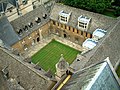
-
 Artefacts from Bush Barrow at Stonehenge. Wessex culture, Early Bronze Age, c. 1900 BC (from History of England)
 -

-
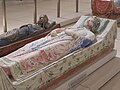 Tomb of Richard I of England and Isabella of Angoulême (from History of England)
 -
 Francis Bacon led the advancement of both natural philosophy and the scientific method and his works remained deeply influential in the Scientific Revolution. (from Culture of England)
 -
 Durham Cathedral. The Norman cathedral was built 1093–1133 (from History of England)
 -
 Shoulder clasp from Sutton Hoo, 625 AD (from History of England)
 -
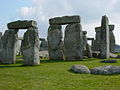 Stonehenge, erected in several stages from c.3000–2500 BC (from History of England)
 -
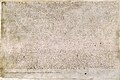 One of only four surviving exemplifications of the 1215 text, Cotton MS. Augustus II. 106, property of the British Library (from History of England)
 -
 King Charles I, who was beheaded in 1649 (from History of England)
 -
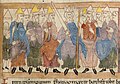 Anglo-Saxon king with his Witan. Biblical scene in the Old English Hexateuch (11th century) (from History of England)
 -
 King Alfred the Great statue in Winchester, Hampshire. The 9th-century English king encouraged education in his kingdom. (from Culture of England)
 -

-
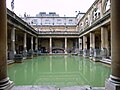 Remains of the Roman baths at Bath, England. (from History of England)
 -
 Kingdoms and tribes in Britain, c. AD 600 (from History of England)
 -
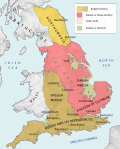 England in 878 (from History of England)
 -
 Durham Cathedral, dating from 1093 (from Culture of England)
 -

-

-
-
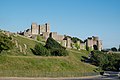 Dover Castle, 12th–13th century (from History of England)
 -
 A pint of real ale (from Culture of England)
 -
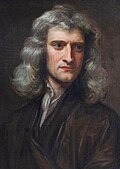 Sir Isaac Newton is regarded as one of the most influential scientists of all time and as a key figure in the Scientific Revolution. (from Culture of England)
 -
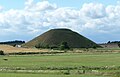 Silbury Hill, c. 2400 BC (from History of England)
 -
 England playing Australia at Lord's Cricket Ground in the 2009 Ashes series. After winning the 2019 Cricket World Cup, England became the first country to win the World Cups in football, rugby union and cricket. (from Culture of England)
 -

-
 Folio 27r from the Lindisfarne Gospels, c. 720 AD (from History of England)
 -
 Procession of characters from Shakespeare's plays (from Culture of England)
 -
 The Procession Picture, c. 1600, showing Elizabeth I borne along by her courtiers (from History of England)
 -
 Canterbury Cathedral is the seat of the Primate of All England, the Archbishop of Canterbury, the most senior bishop of the Church of England. (It was the property of the Roman Catholic Church before the English Reformation.) (from Culture of England)
 -
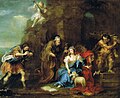 William Hogarth's depiction of a scene from Shakespeare's The Tempest is an example of how English literature influenced English painting in the 18th century. (from Culture of England)
 -
 Remains of Hadrian's Wall (from History of England)
 -
-
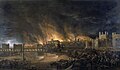 The Great Fire London, 1666. (from History of England)
 -
 The first general laws against child labour, the Factory Acts, were passed in Britain in the first half of the 19th century. Children younger than nine were not allowed to work and the work day of youth under the age of 18 was limited to twelve hours. (from History of England)
 -
 Victory in Europe Day celebrations in London, 8 May 1945 (from History of England)
 -
 Morris dancing (from Culture of England)
 -
 Elizabeth I (from History of England)
 -
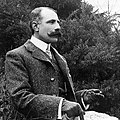 Edward Elgar is one of England's most celebrated classical composers. (from Culture of England)
 -
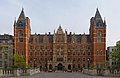 The Royal College of Music is the oldest conservatoire in the UK, established by royal charter in 1882. (from Culture of England)
 -
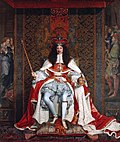
 King Charles II, a patron of the arts and sciences, supported the Royal Society, a scientific group whose early members included Robert Hooke, Robert Boyle and Sir Isaac Newton. (from Culture of England)
 -
 The Ruthwell Cross, 8th century AD (from History of England)
 -
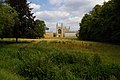 King's College in Cambridge is regarded as one of the greatest examples of late English Gothic architecture. It has the world's largest fan vault, while the chapel's stained-glass windows and wooden chancel screen are considered some of the finest from their era. (from Culture of England)
 -
 National performing arts are held annually at the Royal Albert Hall, as well as The Proms during the summer. (from Culture of England)
 -
 Sir Francis Drake's voyage 1585–86 (from History of England)
 -
 Portrait of the Royal Tudors. At left, Henry VII, with Prince Arthur behind him, then Prince Henry (later Henry VIII), and Prince Edmund, who did not survive early childhood. To the right is Elizabeth of York, with Princess Margaret, then Princess Elizabeth who didn't survive childhood, Princess Mary, and Princess Katherine, who died shortly after her birth. (from History of England)
 -
 Alfred Hitchcock is often regarded as the greatest British filmmaker, and was described as "a straightforward middle-class Englishman who just happened to be an artistic genius." (from Culture of England)
 -
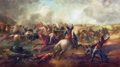 First English Civil War at the Battle of Marston Moor, 1644 (from History of England)
 -
 The epic poem Beowulf, set in 6th century Scandinavia, composed c. 700–1000 AD. (from History of England)
 -
 Bronze coins of Cunobelin, called "King of the Britons" by Suetonius. 1–42 AD. (from History of England)
 -
 The Spanish Armada and English ships in August 1588, (unknown, 16th-century, English School) (from History of England)
 -
 King Henry VIII (from History of England)
 -
 The English landscape garden at Stourhead, described as a 'living work of art' when first opened in the 1750s (from Culture of England)
 -
 The Battersea Shield (detail), 350 BC. (from History of England)
 -
 Frontispiece of Bede's Life of St Cuthbert, showing King Æthelstan presenting a copy of the book to the saint himself. c. 930 (from History of England)
 -
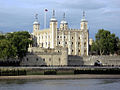
-
 Charles Dickens' 1843 novella A Christmas Carol played a major role in reviving the "spirit" of Christmas and seasonal goodwill. (from Culture of England)
 -
 The Lady Chapel of Wells Cathedral (from Culture of England)
 -
 The wizard Merlin features as a character in many works of fiction, including the BBC series Merlin. (from Culture of England)
 -
 Countries where English is natively spoken or has official status (from Culture of England)
 -
The Lindisfarne Gospels (from Culture of England)
-
 The Alfred Jewel, late 9th century (from History of England)
 -
 Interior of Christ Church Cathedral in Oxford (from Culture of England)
 -
-

-
 View of the ramparts of the hillfort of Maiden Castle (450 BC), as they look today (from History of England)
 -
 Jack In the Green, a traditional English folk custom being celebrated in Hastings Old Town, known for its many pre-Victorian buildings. (from Culture of England)
 -
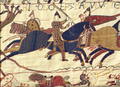
-
 A traditional Punch and Judy booth, at Swanage, Dorset, England (from Culture of England)
 -
![Image 72The Staffordshire Hoard is the largest hoard of Anglo-Saxon gold and silver metalwork yet found[update]. It consists of almost 4,600 items and metal fragments. (from Culture of England)](//upload.wikimedia.org/wikipedia/commons/thumb/6/60/Staffordshire_hoard_annotated.jpg/120px-Staffordshire_hoard_annotated.jpg) The Staffordshire Hoard is the largest hoard of Anglo-Saxon gold and silver metalwork yet found[update]. It consists of almost 4,600 items and metal fragments. (from Culture of England)
The Staffordshire Hoard is the largest hoard of Anglo-Saxon gold and silver metalwork yet found[update]. It consists of almost 4,600 items and metal fragments. (from Culture of England) -

-
 The Fairy Ring by William Holmes Sullivan, c.1908 (from Culture of England)
 -
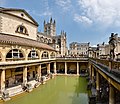 The Roman Baths in Bath; a temple was constructed on the site between 60–70CE in the first few decades of Roman Britain. (from Culture of England)
 -
 Canterbury Cathedral nave, 1377 (from History of England)
 -
 Maps of territory held by Royalists (red) and Parliamentarians (green) during the English Civil War (1642–1645) (from History of England)
 -
 The Billingsgate Fish Market in London in the early 19th century (from History of England)
 -
 Christopher Lee (seen here as Dracula in 1958) starred in many of Hammer's British horror films. (from Culture of England)


.jpg)


.jpg)


.jpg)


.png)


.jpg)
.jpg)


.svg)


![Image 72The Staffordshire Hoard is the largest hoard of Anglo-Saxon gold and silver metalwork yet found[update]. It consists of almost 4,600 items and metal fragments. (from Culture of England)](/proxy/https://en.wikipedia.org/wiki/File:Staffordshire_hoard_annotated.jpg)


.jpg)

 Good article -


The National Gallery is an art museum in Trafalgar Square in the City of Westminster, in Central London, England. Founded in 1824, it houses a collection of more than 2,300 paintings dating from the mid-13th century to 1900. The current director of the National Gallery is Gabriele Finaldi.
The National Gallery is an exempt charity, and a non-departmental public body of the Department for Culture, Media and Sport. Its collection is held in trust by the charity on behalf of the British public, and entry to the main collection is free of charge. (Full article...)
Did you know?

- ...that the Mendip Hills (commonly called The Mendips) are a range of limestone hills situated to the south of Bristol and Bath in Somerset?
- ...the England and Wales Cricket Board was created on 1 January 1997 combining the roles of the Test and County Cricket Board (TCCB), the National Cricket Association (NCA) and the Cricket Council?
- ...that the Flag of England is the St George's Cross?
- ...that the Tudor rose (pictured) is a traditional heraldic emblem of England and takes its name and origins from the Tudor dynasty?
In the news

- 22 June 2026 – 2026 Labour Party leadership crisis
- Keir Starmer announces his resignation as British prime minister and leader of the Labour Party in an address to the nation outside 10 Downing Street, London. He will remain as caretaker prime minister until a new party leader is elected. (AP) (BBC News)
- 20 June 2026 –
- Three people are killed in a fire at a single-story pavilion in West London, London, England. (Sky News)
- 19 June 2026 – 2026 Bedford train collision
- One person is killed and 89 others are injured, including 33 seriously with nine in critical condition, after two passenger trains collide near Bedford, Bedfordshire, England. (BBC News) (The Daily Telegraph) (BBC News)
- 18 June 2026 –
- A study published in the The Lancet medical journal, led by the Queen Mary University of London and funded by Cancer Research UK, estimates that the HPV vaccine has prevented around 200 deaths from cervical cancer in England. Additionally, the study also finds that no women aged 20–24 have died from the disease between 2020 and 2024. (Sky News)
- Scientists confirm that Major Oak, a 1,000-year-old oak tree in Sherwood Forest, Nottinghamshire, England, has died. The tree failed to produce any new leaves this year after becoming "stressed" by a series of hot, dry summers over the last decade. (The Guardian)
- 12 June 2026 – 2026 Kent meningitis outbreak
- Health authorities in the United Kingdom launch a vaccination program against the Meningitis B virus in the wake of an outbreak that occurred at the University of Kent in Kent, England, killed two people. (Reuters)
Selected featured content
Categories

Selected quotes
| “ | England... is a nation of shopkeepers | ” |
- — Napoleon
Related WikiProjects
England • Bedfordshire • Brighton • Cheshire • Cornwall • Derbyshire • Dorset • Greater Manchester • Hampshire • Lincolnshire • London • Merseyside • Northamptonshire • North East England • Sheffield • Surrey. Warwickshire • West Midlands • Worcestershire • Yorkshire
Topics
Things you can do

- Please visit the English Wikipedians' notice board and help to write new England-related articles, and expand and improve existing ones.
- Visit Wikipedia:WikiProject England/Assessment, and help out by assessing unrated English articles.
- Add the Project Banner to English articles around Wikipedia.
- Check for announcements and open tasks for ways to improve English related articles.
- Help nominate and select new content for the England portal.
- Requested articles: Charterhouse Lane • Renewable energy in England • Ealing Village
- Expand: Dorothy Boyd • David Troughton
Related Portals
 |
 |
 |
 |
 |
 |
 |
 |
| East Midlands | London | North East | North West | South East | South West | West Midlands | Yorkshire and the Humber |

.svg)


|

|

|

|

|
| Ireland | Northern Ireland | Scotland | United Kingdom | Wales |
Associated Wikimedia
The following Wikimedia Foundation sister projects provide more on this subject:
-
 Commons
Free media repository -
 Wikidata
Free knowledge base -
 Wikiquote
Collection of quotations -
 Wikisource
Free-content library -
 Wikiversity
Free learning tools -
 Wikivoyage
Free travel guide -
 Wiktionary
Dictionary and thesaurus


