


Portal:Costa Rica


Introduction
Republic of Costa Rica República de Costa Rica (Spanish) | |
|---|---|
| Anthem: "Himno Nacional de Costa Rica" (Spanish) "National Anthem of Costa Rica" | |
| ISO 3166 code | CR |
.svg)

Costa Rica, officially the Republic of Costa Rica, is a country in Central America. It borders Nicaragua to the north, the Caribbean Sea to the northeast, Panama to the southeast, and the Pacific Ocean to the southwest, sharing a maritime border with Ecuador to the south of Cocos Island. It has a population of around five million0 in a land area of nearly 51,180 km2 (19,760 sq mi); the capital and largest city is San José, home to around 350,000 residents and two million people in the surrounding metropolitan area.
Humans have been present in Costa Rica since between 7,000 and 10,000 BC. Various indigenous peoples lived in the territory before it was colonized by Spain in the 16th century. Costa Rica was a peripheral colony of the Spanish Empire until independence in 1821 as part of the First Mexican Empire, followed by membership in the Federal Republic of Central America in 1823, from which it formally declared independence in 1847. The country underwent gradual modernization under relatively stable authoritarian rule until the late 19th century, when it promulgated a liberal constitution and held the first free and fair national election in Central America.
Following a brief civil war in 1948, Costa Rica adopted its current constitution in 1949, which granted universal suffrage, provided various social, economic, and educational guarantees for all citizens, and permanently abolished the army, becoming one of the few sovereign nations without a standing military. Costa Rica is a presidential republic with a robust and stable democracy. About one-fourth of the national budget is spent on education—which has been free and compulsory since 1886—equal to about 6.2% of the country's GDP, compared to a global average of 3.8%; the economy, once heavily dependent on agriculture, has diversified to include finance, corporate services for foreign companies, pharmaceuticals, and ecotourism. (Full article...)
The Costa Rica Quiz
 Same-sex sexual relations have been legal in Costa Rica since what year?
 (or just refresh the page)

Selected article -

Juan Santamaría International Airport (IATA: SJO, ICAO: MROC) is the primary international airport serving San José, the capital of Costa Rica. The airport is located in Alajuela Province, 20 kilometres (12 mi; 11 nmi) northwest of downtown San José. It is named after Costa Rica's national hero, Juan Santamaría, a drummer boy who died in 1856 defending his country against forces led by William Walker, an American filibuster. It is the biggest and busiest airport in Costa Rica and second in Central America, transiting more than 5 million passengers per year before COVID.
The airport is a hub for Avianca Costa Rica, Costa Rica Green Airways, Sansa Airlines, and Volaris Costa Rica, and a focus city for Avianca El Salvador and Copa Airlines. It was the country's only international gateway for many years, before the opening of the international airport in Liberia, Guanacaste. Both airports have direct flights to North and Central America and Europe, but Juan Santamaría International Airport also serves cities in South America and the Caribbean. (Full article...)
Did you know (auto-generated)

- ... that Costa Rica's most famous bull killed two men and loved mangos?
- ... that in August 2021 Sheika Scott became the youngest player to score in the Costa Rican Women's Premier Division, at just 14 years old?
- ... that footballer Alexandra Pinell scored the Costa Rica U20 team's only goal at the FIFA tournament hosted by their country?
- ... that goalkeeper Daniela Solera had the most touches of any Costa Rican player in their opening match of the 2023 World Cup?
More Did you know -
...that Pancha Carrasco became Costa Rica's first woman in the military by joining the defending forces at the Battle of Rivas in 1856 with a rifle and a pocketful of bullets?
Related portals


.svg)


Selected image -
-
 José María Castro Madriz formally declared Costa Rica as independent from the Federal Republic of Central America in 1848. (from History of Costa Rica)
 -

-
 Costa Rican kids. (from Culture of Costa Rica)
 -
 1849 national coat of arms was featured in the first postal stamp issued in 1862. (from Costa Rica)
 -
 Las Carretas (oxcarts) are a national symbol. (from Costa Rica)
 -
![Image 6The University of Costa Rica is the largest university in the country and one of the most recognizable[why?] across Central America. (from Costa Rica)](//upload.wikimedia.org/wikipedia/commons/thumb/e/eb/Estudios_Generales.jpg/120px-Estudios_Generales.jpg) The University of Costa Rica is the largest university in the country and one of the most recognizable[why?] across Central America. (from Costa Rica)
The University of Costa Rica is the largest university in the country and one of the most recognizable[why?] across Central America. (from Costa Rica) -
 Costa Rican school children (from Costa Rica)
 -
 The scarlet macaw is native to Costa Rica. (from Wildlife of Costa Rica)
 -
 Provinces 1 Alajuela, 2 Cartago, 3 Guanacaste, 4 Heredia, 5 Limón, 6 Puntarenas, 7 San José (from Costa Rica)
 -
 The Rio Celeste (sky blue river) at Tenorio Volcano National Park in Costa Rica. (from Water resources management in Costa Rica)
 -
 The golden toad, an amphibian once endemic to Costa Rica, is now extinct. (from Wildlife of Costa Rica)
 -
 Chatham beach on Cocos Island. (from Water resources management in Costa Rica)
 -
 A red-eyed tree frog (Agalychnis callidryas) (from Wildlife of Costa Rica)
 -
 Costa Rica's tropical landscape (from Water resources management in Costa Rica)
 -
 Population pyramid of Costa Rica for 2024 (from Costa Rica)
 -
 Development of life expectancy in Costa Rica (from Costa Rica)
 -
 Hospital Calderón Guardia, named after the president who instituted universal health care across the country in 1941 (from Costa Rica)
 -
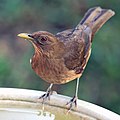 Yigüirro, Costa Rica's national bird (from Wildlife of Costa Rica)
 -
 The mangrove hummingbird is endemic to Costa Rica and specializes in feeding from the tea mangrove plant with its uniquely shaped beak. (from Wildlife of Costa Rica)
 -
 Hospital CIMA in Escazú (from Costa Rica)
 -
 Waterfall in the Tenorio Volcano National Park (from Costa Rica)
 -
 The Ujarrás historical site in the Orosí Valley, Cartago province. The church was built between 1686 and 1693. (from Costa Rica)
 -
 Mantled howler monkey, male (from Wildlife of Costa Rica)
 -
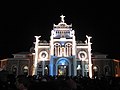 Basílica de Nuestra Señora de los Ángeles (Basilica of Our Lady of the Angels, Cartago), during the 2007 pilgrimage (from Costa Rica)
 -
 The Heliconius doris butterfly (from Wildlife of Costa Rica)
 -
 Stone spheres created by the Diquis culture at the National Museum of Costa Rica. The sphere is the icon of the country's cultural identity. (from Costa Rica)
 -
The scarlet macaw is native to Costa Rica. (from Costa Rica)
-
 Epiphytes near Santa Elena (from Wildlife of Costa Rica)
 -

-
 Countries (in blue) which have signed Free Trade Agreements with Costa Rica (from Costa Rica)
 -
 Gallo Pinto (from Culture of Costa Rica)
 -
 Costa Rica supporters at the 2014 FIFA World Cup in Brazil (from Costa Rica)
 -
 Real GDP per capita development in Costa Rica (from Costa Rica)
 -
 The zebra longwing butterfly (from Wildlife of Costa Rica)
 -

-
 Gregorio José Ramírez was the most notable political chief of the province of Costa Rica, leading republican forces victorious in the Battle of Ochomogo. (from History of Costa Rica)
 -
 Costa Rica map of Köppen climate classification (from Costa Rica)
 -
 Costa Rican Women in traditional dress (from Culture of Costa Rica)
 -
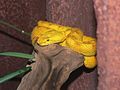 Eyelash viper (Bothriechis schlegelii) (from Wildlife of Costa Rica)
 -
 An Intel microprocessor facility in Costa Rica that was, at one time, responsible for 20% of Costa Rican exports and 5% of the country's GDP (from Costa Rica)
 -
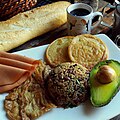 Costa Rican breakfast with gallo pinto (from Costa Rica)
 -
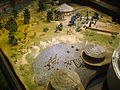 Typical settlement of the Diquis indigenous people before the arrival of Columbus. (from History of Costa Rica)
 -
The 1849 national coat of arms was featured in the first postal stamp issued in 1862. (from History of Costa Rica)


![Image 6The University of Costa Rica is the largest university in the country and one of the most recognizable[why?] across Central America. (from Costa Rica)](/proxy/https://en.wikipedia.org/wiki/File:Estudios_Generales.jpg)


.jpg)


.jpg)


Costa Rica news
- 19 June 2026 –
- Costa Rican police arrest a man in connection with an alleged threat against president Laura Fernández Delgado. The president is evacuated during a visit to northern Costa Rica after an explosion was reported nearby. (Reuters)
- 8 May 2026 – 2026 Costa Rican general election
- Laura Fernández Delgado is sworn in as president of Costa Rica, succeeding Rodrigo Chaves Robles. (Reuters) (AP)
- 1 February 2026 – 2026 Costa Rican general election
- Costa Ricans vote to elect the president and all 57 members of the Legislative Assembly. From a field of 20 candidates, Laura Fernández of the Sovereign People's Party (PPSO) wins the presidency with 48% of the vote. (BBC News)
WikiProjects

History

Geography and environment


Politics and government

.svg)


UNESCO World Heritage Sites


Economy and society
 |
Economics
|


 |
National Identity
|
Categories

Things you can do

Here are some things you can do for WikiProject Costa Rica:
- Create requested articles:
- Expand "stub" and "start" articles:
- Assess the importance of articles:
Associated Wikimedia
The following Wikimedia Foundation sister projects provide more on this subject:
-
 Commons
Free media repository -
 Wikidata
Free knowledge base -
 Wikiquote
Collection of quotations -
 Wikisource
Free-content library -
 Wikiversity
Free learning tools -
 Wikivoyage
Free travel guide -
 Wiktionary
Dictionary and thesaurus


External media
- News
- The Costa Rica Star – Costa Rica news
- The Tico Times
- Q Costa Rica


.svg)

References
- ^ "Biodiversity in Costa Rica". Archived from the original on 2011-11-18. Retrieved 2007-04-18.
- ^ "Compulsory Voting". Internateal IDEA. Retrieved 9 Dec 2023.
- ^ State-sponsored Homophobia A world survey of laws prohibiting same sex activity between consenting adults[dead link] Archived 17 October 2012 at the Wayback Machine
- ^ Trejos, Alonso (1991). Geografía Ilustrada Costa Rica (in Spanish). San José, Costa Rica: Trejos Editores. p. 128. ISBN 9977-54-029-2.