Portal:Dominican Republic

Introduction
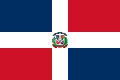
The Dominican Republic is an island country on the eastern part of the Caribbean island of Hispaniola in the Greater Antilles of the Caribbean Sea in the North Atlantic Ocean. It shares a maritime border with Puerto Rico to the east and a land border with Haiti to the west, occupying the eastern five-eighths of Hispaniola which, along with Saint Martin, is one of only two islands in the Caribbean shared by two sovereign states. In the Antilles, the country is the second-largest country by area after Cuba at 48,671 square kilometers (18,792 sq mi) and the second most populous country after Haiti with approximately 11.4 million people in 2024, of whom 3.6 million reside in the metropolitan area of Santo Domingo, the capital city. Dominican Republic has the largest economy in the Caribbean and the seventh-largest in Latin America. Over the last 25 years, the Dominican Republic has had the fastest-growing economy in the Western Hemisphere – with an average real GDP growth rate of 5.3% between 1992 and 2018. GDP growth in 2014 and 2015 reached 7.3 and 7.0%, respectively, the highest in the Western Hemisphere. Recent growth has been driven by construction, manufacturing, tourism, and mining. The country is the site of the world's third largest gold mine in terms of production, the Pueblo Viejo mine. The gold production of the country was 31 metric tonnes in 2015. Dominican Republic is the most visited destination in the Caribbean. A geographically diverse nation, the Dominican Republic is home to both the Caribbean's tallest mountain peak, Pico Duarte, and the Caribbean's largest lake and lowest point, Lake Enriquillo. The island has an average temperature of 26 °C (78.8 °F) and great climatic and biological diversity. The country is also the site of the first cathedral, palace, monastery, and fortress built in the Americas, located in Santo Domingo's Colonial Zone, a World Heritage Site. (Full article...) Selected article -Santo Domingo, formerly known as Santo Domingo de Guzmán, is the capital and largest city of the Dominican Republic and the largest metropolitan area in the Caribbean by population. As of 2022,[update] the city center had a population of 1,029,110 while its metropolitan area, Greater Santo Domingo, had a population of 4,274,651. The city is coterminous with the boundaries of the Distrito Nacional (D.N.), itself bordered on three sides by Santo Domingo Province. Santo Domingo was founded in 1496 by the Spanish Empire and is the oldest continuously inhabited European settlement in the Americas. It was the first seat of Spanish colonial rule in the New World, the Captaincy General of Santo Domingo. Santo Domingo is the site of the first university, cathedral, castle, monastery, and fortress in the New World. The city's Colonial Zone was declared as a World Heritage Site by UNESCO. Santo Domingo was called Ciudad Trujillo (Spanish pronunciation: [sjuˈðað tɾuˈxiʝo]), from 1936 to 1961, after the Dominican Republic's dictator, Rafael Trujillo, named the capital after himself. Following his assassination, the city resumed its original designation. (Full article...) General images -The following are images from various Dominican Republic-related articles on Wikipedia.
Selected picture -A view of the coastline at Monte Cristi Province
Selected biography -Luguelín Miguel Santos Aquino (born 12 November 1992) is a Dominican sprinter, who specialises in the 400 m. He was the silver medallist in the event at the 2012 London Olympics at the age of nineteen. His personal best is 44.11 seconds. Santos emerged with two gold medals at the 2010 Summer Youth Olympics and made his senior breakthrough at the 2011 Pan American Games, taking individual and relay silver medals with Dominican national record times. He belongs to the Dominican olympic program CRESO. (Full article...) Related portalsTopics
Categories Select [►] to view subcategories
WikiProjects
Things to do
Associated WikimediaThe following Wikimedia Foundation sister projects provide more on this subject:
SourcesDiscover Wikipedia using portals | ||||||||||||||||||||||||||||||||||||||||||||||||||||||||||||||||||


.jpg)

.jpg)


.jpg)
.jpg)


.jpg)


.jpg)


.jpg)


.jpg)

.jpg)


.svg)