


Portal:Ukraine

The Ukraine Portal - Портал України
Ukraine Україна (Ukrainian) | |
|---|---|
| ISO 3166 code | UA |


Ukraine is a country in Eastern Europe. It is the second-largest country in Europe after Russia, which borders it to the east and northeast. Ukraine also borders Belarus to the north; Poland and Slovakia to the west; Hungary, Romania and Moldova to the southwest; and the Black Sea and the Sea of Azov to the south and southeast. Kyiv is Ukraine's capital and largest city, followed by Kharkiv, Odesa, and Dnipro. The official language of the country is Ukrainian. Ukraine covers an area of 603,628 km2 (233,062 sq mi) with an estimated total population of 32.3 million in 2026.
Humans have inhabited Ukraine since 32,000 BC. During the Middle Ages, it was the site of early Slavic expansion and later became a key centre of East Slavic culture under the state of Kievan Rus', which emerged in the 9th century. Kievan Rus' became the largest and most powerful realm in Europe in the 10th and 11th centuries, but gradually disintegrated into rival regional powers before being destroyed by the Mongols in the 13th century. For the next 600 years the area was contested, divided, and ruled by a variety of external powers, including the Grand Duchy of Lithuania, the Kingdom of Poland, the Polish–Lithuanian Commonwealth, the Austrian Empire, the Ottoman Empire, and the Tsardom of Russia.
The Cossack Hetmanate emerged in central Ukraine in the 17th century but was partitioned between Russia and Poland before being gradually absorbed by the Russian Empire in the 18th century. Ukrainian nationalism developed and, following the Russian Revolution in 1917, the short-lived Ukrainian People's Republic was formed. The Bolsheviks consolidated control over much of the former empire and established the Ukrainian Soviet Socialist Republic, which became a constituent republic of the Soviet Union in 1922. In the early 1930s, millions of Ukrainians died in the Holodomor, a human-made famine. During World War II, Ukraine was occupied by Germany and endured major battles and atrocities, resulting in 7 million civilians killed, including most Ukrainian Jews.
Ukraine gained independence in 1991 as the Soviet Union dissolved, declaring itself neutral. A new constitution was adopted in 1996 as the country transitioned to a free market liberal democracy amid endemic corruption and a legacy of state control. The Orange Revolution of 2004–2005 ushered electoral and constitutional reforms. Resurgent political crises prompted a series of mass demonstrations in 2014 known as the Euromaidan, leading to a revolution, at the end of which Russia unilaterally occupied and annexed Ukraine's Crimean Peninsula, and pro-Russian unrest culminated in a war in Donbas with Russia and Russian-backed separatists. The 2022 Russian invasion of Ukraine began the current phase of the war. (Full article...)
In the news
- 26 June 2026 – Russo-Ukrainian war
- Crimea attacks
- A state of emergency is declared in Russian-occupied Crimea in response to an increasing number of airstrikes by Ukrainian forces. (The New York Times)
- Attacks in Russia during the Russo-Ukrainian war
- Ukraine launches its largest drone attack on Russia since the start of the war, with over 660 drones launched at multiple regions, including Moscow Oblast, as Ukrainian president Volodymyr Zelenskyy says he has approved a "40-day campaign" aimed at "compelling Russia to end the war". (AP)
- 24 June 2026 – Russo-Ukrainian war
- Attacks in Russia during the Russo-Ukrainian war
- Ukrainian forces launch long-range drone strikes inside Russia, striking the Orenburg Gas Processing Plant, which also houses the only helium plant in Russia, and also striking two Russian Satellite Communications Company facilities, including one in Moscow Oblast and another in Vladimir Oblast. Russia says its forces have shot down 323 Ukrainian drones overnight. (AP)
- Crimea attacks
- Ukrainian missiles strike two Russian military airfields and several air defence systems in Crimea. (AP)
- 24 June 2026 – Protests against the Russo-Ukrainian war
- Anti-war protests in Russia
- Yabloko deputy leader Maxim Kruglov is convicted and will face seven years in prison over his anti-war stance on social media, including remarks about the Russian Army. (Reuters)
 Recognized content -


-


A national school of opera in Ukraine first emerged during the last third of the 19th century, and was based on the traditions of European theatre and Ukrainian folk music. The first opera by a Ukrainian composer was Maxim Berezovsky's Demofont, based on an Italian libretto, which premiered in 1773. The oldest opera in the Ukrainian musical repertoire, A Zaporozhye Cossack on the Danube by Semen Hulak-Artemovsky, was written in 1863. The composer Mykola Lysenko, the founder of Ukrainian opera, composed a number of works, including Natalka Poltavka, Taras Bulba, Nocturne, and two operas for children, Koza-dereza and Mr Kotsky.
Ukrainian opera flourished and developed after the creation of the first professional opera houses in the 1920s, with Borys Lyatoshynsky's The Golden Ring (1929) being one of the most notable works produced there during the first half of the 20th century. From 1930 until the dissolution of the Soviet Union at the end of the 1980s, operatic performances and the creation of new works occurred under the dominance of Soviet socialist realism. During this period, Ukrainian opera was modelled on such works as The Young Guard by Yuliy Meitus, premiered in 1947. Ukrainian opera was able to develop once more during the Khrushchev Thaw from the mid-1950s to the mid-1960s. Works by Vitaly Kyreiko (Forest Song (1957)), Vitaliy Hubarenko (Love Letters (1971)), or Yevhen Stankovych's folk opera When the Fern Blooms (1979) adopted more modern themes and musical expressions that were used during the Stalinist period. Of works written during the 21st century, Moses by Myroslav Skoryk is alone in retaining its place in the local repertoire. (Full article...) -
Metro Exodus is a first-person shooter video game developed by 4A Games and published by Deep Silver in 2019. The game is the third installment in the Metro video game series, which is based on Dmitry Glukhovsky's novels. It is a sequel to Metro: Last Light and the book Metro 2035, and follows protagonist Artyom and his allies as they flee the Moscow Metro and set off on an intercontinental journey through Russia and parts of Kazakhstan on a locomotive called Aurora. The story takes place over a year, during which Artyom visits locations such as the Volga River and the Caspian Sea. The game improves on the gameplay mechanics of Last Light; it includes both several miniature open world locations and more linear levels like earlier games in the series.
Starting in 2014, the game was developed by a team of around 150 based in Kyiv and Malta. The Exodus studio's main objective was to combine the core gameplay pillars of the Metro series with elements from S.T.A.L.K.E.R.: Shadow of Chernobyl (2007), which prioritizes emergent gameplay and features a large, explorable space. The team experimented with open-world gameplay and excluded mission markers so that players can explore naturally. To keep the game immersive, the game had a minimalistic head-up display, as in-game information was physicalized through Artyom's gears and equipment. 4A collaborated with Glukhovsky on the game's story, which focuses more on Artyom's personal story and relationships, forgoing some of the supernatural elements found in previous games for a more grounded story. (Full article...) -
Kateryna Mykolayivna Skarzhynska née von Reiser (Ukrainian: Катерина Миколаївна Скаржинська, 7 February 1852 O.S./19 February 1852 (N.S.) – 1932) was a Ukrainian noblewoman, philanthropist, and collector of folklore. She established the first private museum in Ukraine to house her collection of artifacts and was particularly known for her collection of pysanky, Easter eggs decorated with Ukrainian folk art. Born in Lubny to the von Reiser family, which had a long history of military service to the Russian Tsars, she was educated at home, studying in her parents' library and with select tutors. After her father died in 1859, together with her mother, brother, and maternal grandmother she moved to the Lodygyn/Lodigine family estates in the Tver province of the Russian Empire, near Moscow. There at the age of 14, von Reiser established a school for the former serfs of the estate and a public hospital.
In 1869, von Reiser became acquainted with Nikolai Georgievich Skarzhynsky, a Ukrainian nobleman and soldier. Through his circle of friends, she decided to continue her education and passed her gymnasium studies, entering the Bestuzhev Courses. They married in 1874 and later would have five children together. Five years later, he was transferred from St. Petersburg back to Ukraine. Though she did not finish her studies, Skarzhynska had developed an interest in culture and moving back to her father's estate, Kruglik, inspired her to begin collecting folk art and other artifacts. Consulting with ethnographers, archaeologists and historians, she financed archaeological excavations and amassed a large collection of items. Failing to interest local authorities in establishing a museum to house them, she created the first private museum in Ukraine in 1880. Hiring professional curators, Skarzhynska assisted in developing the collection until 1905. One of the curators, Sergiy Kulzhynskiy, would become her partner, father of her youngest child, and her companion and caretaker in her old age. In 1906, she transferred her materials to the Museum of Natural History of Poltava Provincial Zemstvo. (Full article...) -

Cultural heritage plaque of the medieval hillfort in Putyvl
There are 81 monuments of national significance in Sumy Oblast, Ukraine. The State Register of Immovable Monuments of Ukraine classifies cultural heritage monuments as either of local or national signficance. To be classified as nationally significant, a monument must have had a substantial impact on the country's culture, be associated with major historical events or individuals who shaped national culture, represent a masterpiece of creative genius, or embody a disappeared civilisation or artistic style. Monuments of national significance are inscribed on the register by the Cabinet of Ministers and are protected and maintained by the Ministry of Culture. All listed monuments fall into at least one of the following categories: archaeology, history, monumental art, architecture, urban planning, garden and park art, landscape, or science and technology.
The first attempts to establish registers of protected buildings were undertaken in 1917 and 1918 by the Ukrainian People's Republic. These efforts continued in the 1920s in Soviet Ukraine but were halted in the 1930s with the dissolution of relevant institutions and the active destruction of cultural—particularly religious—heritage. The listing of cultural heritage monuments in the region was renewed in 1956. A list of architectural monuments was approved in 1963, followed by a separate list of artistic, historic, and archaeological monuments in 1965. Both lists remained in use after Ukraine declared independence in 1991. On 8 June 2000, with the adoption of the law "On the Protection of Cultural Heritage", the State Register of Immovable Monuments was established. All entries from the Soviet-era list of artistic, historic, and archaeological monuments were transferred to the new register on 14 September 2009. The transfer of monuments from the Soviet architectural register, however, has proceeded more slowly and remains incomplete as of April 2026, although the process has accelerated in recent years. At the same time, a number of sites have been stripped of their protected status to comply with the decommunisation and derussification laws in effect since 2015 and 2023, respectively. (Full article...) -
Sofia Grigorievna Kropotkina (née Ananieva-Rabinovich; 1856–1941), commonly known by her anglicised name Sophie Kropotkin, was a Ukrainian teacher, writer, lecturer and museum director. Born into a Ukrainian Jewish family, she grew up in Tomsk, where her father ran a gold mine. After coming of age, she moved to Switzerland, where she pursued a degree in biology at the University of Bern and met Peter Kropotkin, whom she married. When her husband was arrested and imprisoned by the French government, she actively campaigned for his release, drawing sympathy from much of the Western press. She then moved to the United Kingdom, where she took up a career in teaching and went on lecture tours of the country, discussing the political issues of the Russian Empire and its revolutionary movement. After the Russian Revolution, she and her family moved to Moscow, where her husband died in 1921. She worked as the director of a museum about his life and work, which she managed up until her death. (Full article...) -
Stanisław Marcin Ulam (Polish: [sta'ɲiswaf 'mart͡ɕin 'ulam]; 13 April 1909 – 13 May 1984) was a Polish and, later an American mathematician who made important contributions in advancing the understanding of nuclear physics and computer science. He participated in the Manhattan Project, originated the Teller–Ulam design of thermonuclear weapons, discovered the concept of the cellular automaton, invented the Monte Carlo method of computation, and championed nuclear pulse propulsion. In pure and applied mathematics, he proved a number of theorems and proposed several conjectures.
Born into a wealthy Polish Jewish family in Lemberg, Austria-Hungary, Ulam studied mathematics at the Lwów Polytechnic Institute, where he earned his PhD in 1933 under the supervision of Kazimierz Kuratowski and Włodzimierz Stożek. In 1935, John von Neumann, whom Ulam had met in Warsaw, invited him to come to the Institute for Advanced Study in Princeton, New Jersey, for a few months. From 1936 to 1939, he spent summers in Poland and academic years at Harvard University in Cambridge, Massachusetts, where he worked to establish important results regarding ergodic theory. On 20 August 1939, he sailed for the United States for the last time with his 17-year-old brother Adam Ulam. He became an assistant professor at the University of Wisconsin–Madison in 1940, and a United States citizen in 1941. (Full article...) -
There are 52 populated places in Donetsk Oblast, Ukraine, that have been officially granted city status (Ukrainian: місто, romanized: misto) by the Verkhovna Rada, the country's parliament. Settlements with more than 10,000 people are eligible for city status, although the status is typically also granted to settlements of historical or regional importance. As of 5 December 2001, the date of the first and only official census in the country since independence, the most populous city in the oblast was the regional capital, Donetsk, with a population of 1,016,194 people, while the least populous city was Sviatohirsk, with 5,136 people. The most recent settlement to receive city status is Mykolaivka, which was granted the status by the Verkhovna Rada on 18 November 2003.
From independence in 1991 to 2020, 28 cities in the oblast were designated as cities of regional significance (municipalities), which had self-government under city councils, while the oblast's remaining 24 cities were located in 18 raions (districts) as cities of district significance, which are subordinated to the governments of the raions. On 18 July 2020, an administrative reform abolished and merged the oblast's raions and cities of regional significance into eight new, expanded raions. The eight raions that make up the oblast are Bakhmut, Donetsk, Horlivka, Kalmiuske, Kramatorsk, Mariupol, Pokrovsk, and Volnovakha. After the enactment of decommunization laws, ten cities within the oblast were renamed in 2016 for their former names' connection to people, places, events, and organizations associated with the Soviet Union. The renamed cities are Bakhmut, Bunhe, Chystiakove, Kalmiuske, Khrestivka, Lyman, Myrnohrad, Pokrovsk, Toretsk, and Zalizne, which were previously named Artemivsk, Yunokomunarivsk, Torez, Komsomolske, Kirovske, Krasnyi Lyman, Dymytrov, Krasnoarmiisk, Dzerzhynsk, and Artemove, respectively. (Full article...) -
Triangulopteris (from Latin triangulus 'triangular' and Greek πτερόν 'wing') is a genus of centrohelids, single-celled amoebae that are generally covered with scales or spicules. It contains one species, Triangulopteris lacunata (from Latin lacuna 'hole'), which was described in 2021 from soil samples obtained across geographically distant Ukrainian and Russian territories. This species is one of the few representatives of centrohelids in poorly studied soil microbial ecosystems. The type strain, HF-25, was isolated from permafrost.
Triangulopteris lacunata cells are usually covered by two kinds of silica scales: plates cales and spine scales. The organism is distinguished from other centrohelids by the appearance of its spine scales, which are composed of a basal plate from which a thin shaft emerges, surrounded by two lateral wings. Their unique characteristic consists of two 'pockets' formed between the wings and the basal plate, which has not been observed in any other centrohelid. After several years, the type strain was reported to lose its normal scales and developed thin organic spicules instead, a phenomenon reported in a few other centrohelids. (Full article...) -
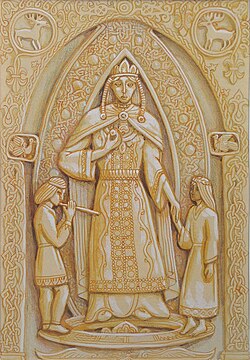
Maximilian Presnyakov: "Lada" ("Slav cycle"), 1998.
Lada and Lado are alleged Slavic deities. Lada was first mentioned around 1405–1412 in the sermons of Lucas of Wielki Koźmin, which warned against worshipping Lada and other gods during spring ceremonies and folk performances.
The deities owe their popularity to Polish priest Jan Długosz, who described Lada as a goddess and a god of war in his works and compared her to the Roman Mars, to Aleksandr Faminstyn, who recognized the name Lada in Russian songs as attributed to the goddess of marriage, and to scholar Boris Rybakov, who insisted on recognizing her historicity. However, the vast majority of religious scholars and Slavists reject the historicity of these deities, believing that they owe their divine status to a misunderstanding of the song refrains by medieval scribes. (Full article...) -
Ivan Konstantinovich Aivazovsky (Russian: Иван Константинович Айвазовский; 29 July [O.S. 17 July] 1817 – 2 May [O.S. 19 April] 1900) was a Russian Romantic painter who is considered one of the greatest masters of marine art. Baptized as Hovhannes Aivazian, he was born to Armenian parents in the Black Sea port of Feodosia in Crimea and was mostly based there.
Following his education at the Imperial Academy of Arts in Saint Petersburg, Aivazovsky traveled to Europe and lived briefly in Italy in the early 1840s. He then returned to Russia and was appointed the main painter of the Russian Navy. Aivazovsky had close ties with the military and political elite of the Russian Empire and often attended military maneuvers. He was sponsored by the state and was well-regarded during his lifetime. The saying "worthy of Aivazovsky's brush", popularized by Anton Chekhov, was used in Russia for describing something lovely. He remains highly popular in Russia in the 21st century. (Full article...) -
Elena Nestorovna Mikhnenko (Russian: Елена Несторовна Михненко; 1922–1993) was the daughter of the Ukrainian anarchist revolutionaries Nestor Makhno and Halyna Kuzmenko. Born in exile, she spent her early life in France, where she was living at the outbreak of World War II. Following the occupation of France, Mikhnenko was captured and conscripted into forced labour in Nazi Germany. She was subsequently arrested by Soviet state security, which first imprisoned her for "anti-Soviet agitation" and then exiled her to the Kazakh Soviet Socialist Republic. She lived and worked in Kazakhstan for the rest of her life. (Full article...)
-
Milica Bogdanovna Jovović (born December 17, 1975), known professionally as Milla Jovovich (/ˈmiːlə ˈjoʊvəvɪtʃ/ MEE-lə YOH-və-vitch), is an American actress, singer, and former model. Her starring roles in numerous science fiction and action films led the music channel VH1 to deem her the "reigning queen of kick-butt" in 2006. In 2004, Forbes determined that she was the highest-paid model in the world.
Born in Kyiv and raised in Los Angeles, Jovovich began modeling when Herb Ritts photographed her for the cover of the Italian magazine Lei in 1987. Richard Avedon featured her in Revlon's "Most Unforgettable Women in the World" advertisements. In 1988, she made her screen debut in the television film The Night Train to Kathmandu and appeared in her first feature film, Two Moon Junction. (Full article...) -
During the Sürgünlik ("exile"), at least 191,044 Crimean Tatars were subjected to ethnic cleansing and cultural genocide through deportation carried out by Soviet Union authorities from 18 to 20 May 1944. The deportation was supervised by Lavrentiy Beria, chief of Soviet state security and the secret police, and ordered by the Soviet leader Joseph Stalin. Within those three days, the NKVD used cattle trains to deport the Crimean Tatars, even Soviet Communist Party members and Red Army soldiers, from Crimea to the Uzbek SSR, several thousand kilometres away. They were one of several ethnicities that were subjected to Stalin's policy of population transfer in the Soviet Union.
Officially, the Soviet government presented the deportation as a policy of collective punishment, based on its claim that some Crimean Tatars collaborated with Nazi Germany in World War II, despite the fact that the 20,000 who collaborated with the Axis powers were half the 40,000 who served in the Soviet Red Army. However, several modern scholars believe that the government deported them as a part of its plan to gain access to the Dardanelles and acquire territory in Turkey, where the Turkic ethnic kin of the Tatars lived, or to remove minorities from the Soviet Union's border regions. By the end of the deportation, not a single Crimean Tatar lived in Crimea, and 80,000 houses and 360,000 acres of land were left abandoned. Nearly 8,000 Crimean Tatars died during the deportation, and tens of thousands subsequently perished due to the harsh living conditions in which they were forced to live during their exile. After the deportation, the Soviet government launched an intense detatarization campaign in an attempt to erase the remaining traces of Crimean Tatar existence. (Full article...) -
Borscht (English: /ˈbɔːrʃt/ ⓘ) is a sour soup, made with meat stock, vegetables and seasonings, common in Eastern Europe, Central Europe and Northern Asia. In English, the word borscht, borrowed via Yiddish, is most often associated with the variant of the soup originating in Ukraine, made with red beetroots as one of the main ingredients, which give the dish its distinctive red color. The same name, however, is also used for a wide selection of sour-tasting soups without beetroots, such as sorrel-based green borscht, rye-based white borscht, and cabbage borscht.
Borscht derives from an ancient soup originally cooked from pickled stems, leaves and umbels of common hogweed (Heracleum sphondylium), an herbaceous plant growing in damp meadows, which lent the dish its Slavic name. With time, it evolved into a diverse array of tart soups, among which the Ukrainian beet-based red borscht has become the most popular. It is typically made by combining meat or bone stock with sautéed vegetables, which—as well as beetroots—usually include cabbage, carrots, onions, potatoes, and tomatoes. Depending on the recipe, borscht may include meat or fish, or be purely vegetarian; it may be served either hot or cold, and it may range from a hearty one-pot meal to a clear broth or a smooth drink. It is often served with smetana or sour cream, hard-boiled eggs or potatoes, but there exists an ample choice of more involved garnishes and side dishes, such as uszka or pampushky, that can be served with the soup. (Full article...) -


.1998%D0%B3.29,6%D1%8520,2.jpg)
.jpg)


Chornovil was born in the village of Yerky, in central Ukraine, then under the Soviet Union. A member of the Komsomol from his time in university, he was affiliated with the counter-cultural Sixtiers movement, and was removed from the Komsomol after speaking out against communism. His samvydav, which investigated abuses against intellectuals arrested during the 1965–1966 Soviet crackdown, earned him Western acclaim, as well as a three-year prison sentence in Yakutia. Upon his release, he returned to samvydav and began publishing The Ukrainian Herald, a predecessor to the modern Ukrainian independent press. (Full article...)
Featured pictures
-
 Photograph: George ChernilevskyThe ChS8 is an electric mainline passenger locomotive used in Russia and Ukraine. Built between 1983 and 1989, it was developed for pulling long passenger trains (28–32 carriages) at speeds of 100 kilometres per hour (60 mph) or faster. Since 2010 Russia has switched to more energy-efficient designs, such as the EP10 and EP20.
 -
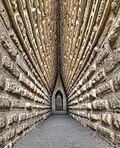 Photograph: Anatoly ShcherbakThe Royal Kurgan is a 4th century BC kurgan (burial barrow) located near present-day Kerch, Crimea. The mound is almost 20 metres high and its base perimeter is about 250 metres. It holds a burial chamber with a square floor plan which gradually merges into the circular shape of a corbelled dome ("false vault"). It is assumed that the Royal Kurgan was the final resting place of a ruler of the Bosporan Kingdom.
 -
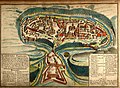 Map credit: Nicolas de FerA 1691 French map of Kamianets-Podilskyi, Ukraine, depicting the city's old town neighborhood and castle, surrounded by the winding Smotrych River. It was originally part of Kievan Rus' and annexed into the First Polish Republic, but at the time of the map's creation, the city was part of the Ottoman Empire. It shortly returned to Poland and later became part of the Russian Empire with the Second Partition of Poland in 1793.
 -
 Photo credit: Peter DuhonUkrainian fashion model Nataliya Gotsiy modeling for Cynthia Rowley, Spring 2007 New York Fashion Week. She was the winner of the Ford Supermodel of the World 2004 search. She has appeared on the cover of French Elle and Italian Marie Claire and modeled for Behnaz Sarafpour, Christian Lacroix, Diane von Furstenberg, Dior, Dolce & Gabbana, Dries van Noten, Gucci, Oscar de la Renta, Valentino, and Vivienne Westwood, among others.
 -
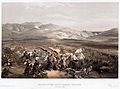 Artist: William Simpson; Restoration: NativeForeignerThe 6th (Inniskilling) Dragoons and 5th Dragoon Guards engage the Russians in this lithograph of the "Charge of the Heavy Brigade", a short engagement during the Battle of Balaclava during the Crimean War. Russian cavalry had attacked the British camp, but in roughly ten minutes of fighting, they suffered 40 to 50 killed and more than 200 wounded and were forced to retreat.
 -
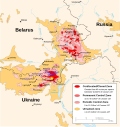 A map showing caesium-137 contamination in Belarus, Russia, and Ukraine (in curies per square kilometer) in 1996, ten years after the Chernobyl disaster struck the Chernobyl Nuclear Power Plant. The disaster contaminated 162,160 square kilometres (62,610 sq mi) of land and is widely considered the worst nuclear power plant accident in history.
 -
 Artist: William Simpson; Lithographer: Edmond Morin; Restoration: NativeForeignerA tinted lithograph, titled "Embarkation of the sick at Balaklava", shows injured and ill soldiers in the Crimean War boarding boats to take them to hospital facilities. Modern nursing had its roots in the war, as war correspondents for newspapers reported the scandalous treatment of wounded soldiers in the first desperate winter, prompting the pioneering work of women such as Florence Nightingale, Mary Seacole, Frances Margaret Taylor and others.
 -
 Photograph credit: Max AlpertKombat (Russian for 'battalion commander') is a black-and-white photograph by Soviet photographer Max Alpert. It depicts a Soviet military officer, armed with a TT pistol, raising his unit for an attack during World War II. This work is regarded as one of the most iconic Soviet World War II photographs, yet neither the date nor the subject is known with certainty. According to the most widely accepted version, it depicts junior politruk Aleksei Gordeyevich Yeryomenko, minutes before his death on 12 July 1942, in Voroshilovgrad Oblast, now part of Ukraine. The photograph is in the archives of RIA Novosti, a Russian state-owned news agency.
 -
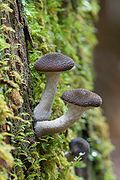 Photo: Noodle snacksMushrooms of Armillaria hinnulea, a species of honey fungus (or "pidpenky", from Ukrainian). Honey fungi are parasitic fungi that live on trees and woody shrubs. As a forest pathogen, it can be very destructive because unlike most parasites, it does not need to moderate its growth in order to avoid killing its host, since it will continue to thrive on the dead material. Honey fungi are long lived and form some of the largest living organisms in the world, including one that covers more than 3.4 sq mi (8.8 km2) and is thousands of years old. The mushrooms are edible, but can be easily confused with poisonous Galerina species, which can grow side-by-side with Armillaria.
 -
 Winston Churchill, Franklin D. Roosevelt, and Joseph Stalin sitting together at the Yalta Conference, which took place February 4–11, 1945. The so-called "Big Three" met to discuss the re-establishment of the nations of Europe following World War II. Although a number of agreements were reached, Stalin broke his promises regarding Poland, and the Soviet Union annexed the regions of Eastern Europe it controlled, or converted them to satellite states.
 -
 Painting: UnknownThe Adoration of the Shepherds is a common subject in the Nativity of Jesus in art. The scene, based on the Biblical account in Luke 2, depicts shepherds as near witnesses to the birth of Jesus in Bethlehem, arriving soon after the actual birth. It is often combined in art with the Adoration of the Magi, in which case it is typically just referred to by the latter title. The example here comes from 17th-century Ukraine and is currently held at the Ivan Honchar Museum.
 -
 Photograph: AmakuhaThe burning of the Trade Unions Building—used as the headquarters of the Euromaidan movement—during the 2014 Ukrainian revolution, following a failed attempt by the Ukrainian police to capture the building. After the fire, the damaged building was covered with large canvas screens on two sides with the words "Glory to Ukraine" printed on them in large letters.


_(B%26W).jpg)


Did you know (auto-generated)

- ... that, on the fourth anniversary of the 2022 Russian invasion of Ukraine, Volodymyr Zelenskyy gave a video address showing the bunker in which he told the US that he needed ammunition, not a ride?
- ... that in 1939 the Ukrainian National Union's newspaper waited for the rise of a Ukrainian Mussolini or Hitler?
- ... that the Communist Party of Transcarpathian Ukraine lasted just over a year?
- ... that Ukrainian president Volodymyr Zelenskyy jumped to kiss his best friend on the head as he walked to his inauguration in 2019?
- ... that following the energy price shock caused by the Russian invasion of Ukraine, the Turkish government intervened to have the country's renewable energy subsidise coal and gas?
- ... that 24-year-old Mahasweta Chakraborty of Operation Ganga helped around 800 students return to India during the Russian invasion of Ukraine?
More did you know -
- ... that the Privat Group is one of the few Ukrainian companies that own industries in the United States?
- ... that the neo-classical Verkhovna Rada building in Kyiv features a hundred-tonne glass dome over the chamber where the Verkhovna Rada of Ukraine convenes to enact legislation?
- ... that the Kryvbas economic region in Ukraine is one of the largest iron ore and steel industry centers in Europe?
- ... that at its first years Kiev Zoo had to move its animals into the food storage of the main Kiev railway station for the winter?
- ... that the married Western Ukrainian Clergy became a hereditary caste that dominated western Ukrainian society?
- ... that the longest of the Kiev bridges, the 1,543 metres long Paton Bridge over the Dnieper River, constructed in 1953 was the first fully welded steel construction of such length at that time?
Selected article -
Ukrainians (Ukrainian: українці, romanised: ukraintsi, pronounced [ʊkrɐˈjin⁽ʲ⁾ts⁽ʲ⁾i]) are an East Slavic ethnic group native to Ukraine. Their native tongue is Ukrainian, and the majority adhere to Eastern Orthodoxy. At around 46 million worldwide, Ukrainians are the second largest Slavic ethnic group after Russians.
Ukrainians have been given various names by foreign rulers, which have included Polish–Lithuanian Commonwealth, the Habsburg monarchy, the Austrian Empire, and then Austria-Hungary. The East Slavic population inhabiting the territories of modern-day Ukraine were known as Ruthenians, referring to the territory of Ruthenia; the Ukrainians living under the Russian Empire were known as Little Russians, named after the territory of Little Russia. (Full article...)
In the news
- 26 June 2026 – Russo-Ukrainian war
- Crimea attacks
- A state of emergency is declared in Russian-occupied Crimea in response to an increasing number of airstrikes by Ukrainian forces. (The New York Times)
- Attacks in Russia during the Russo-Ukrainian war
- Ukraine launches its largest drone attack on Russia since the start of the war, with over 660 drones launched at multiple regions, including Moscow Oblast, as Ukrainian president Volodymyr Zelenskyy says he has approved a "40-day campaign" aimed at "compelling Russia to end the war". (AP)
- 24 June 2026 – Russo-Ukrainian war
- Attacks in Russia during the Russo-Ukrainian war
- Ukrainian forces launch long-range drone strikes inside Russia, striking the Orenburg Gas Processing Plant, which also houses the only helium plant in Russia, and also striking two Russian Satellite Communications Company facilities, including one in Moscow Oblast and another in Vladimir Oblast. Russia says its forces have shot down 323 Ukrainian drones overnight. (AP)
- Crimea attacks
- Ukrainian missiles strike two Russian military airfields and several air defence systems in Crimea. (AP)
- 24 June 2026 – Protests against the Russo-Ukrainian war
- Anti-war protests in Russia
- Yabloko deputy leader Maxim Kruglov is convicted and will face seven years in prison over his anti-war stance on social media, including remarks about the Russian Army. (Reuters)
Selected anniversaries for June

- June 4, 1920 — Treaty of Trianon was signed between the Allied and Associated Powers and Hungary signed at the Grand Trianon Palace at Versailles, France.
- June 28, 1996 - is a public holiday honoring the adoption of the Constitution in Ukraine by the Verkhovna Rada
Photo gallery
-
 Interiour view of the Pochayiv Lavra in Ukraine.
 -

-
 The square in front of the theater in Chernivtsi.
 -
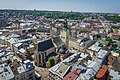 A view of Lviv
 -
 The Swallow's Nest is one of the Neo-Gothic châteaux fantastiques near Yalta; it was built in 1912.
 -
 Trinity Church and Monastery in Chernihiv, Ukraine
 -

-
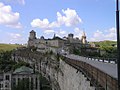 View on the lower fortress of the Kamianets-Podilskyi Castle
 -
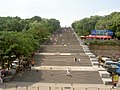 Potemkin Stairs in Odesa, Ukraine. The higher perspective allows a person to see both the stairs and landings.
 -
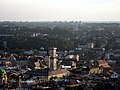 A view of Lviv Old Town from the High Castle.
 -

-
 Zbarazh (Ukrainian: Збараж, Polish: Zbaraż, Yiddish: Zbarj) is a small city in the Ternopil Oblast (province) of western Ukraine. It is the administrative center of the Zbarazh Raion (district), and is located in the historic region of Galicia. The major attraction of the city is the Zbarazh Castle that played a key role during the Khmelnytsky Uprising, the heroic defense of which eventually led to change of momentum and extinguishing the Cossack revolt.
 -
 Streets of Mukacheve in the old part of town
 -
-
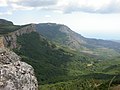
 A wooden bridge leads to the entrance to the Khomutovska Steppe in Donetsk Oblast.
 -
 St Andrew's Church of Kyiv (1749–1854)
 -
An 1691 French map of the city of Kamianets-Podilskyi, located in western Ukraine.


_16.jpg)
_2007.JPG)


Related portals


Religions in Ukraine

Post Soviet states


Other countries


Topics
Categories

WikiProjects and collaborations
Associated Wikimedia
The following Wikimedia Foundation sister projects provide more on this subject:
-
 Commons
Free media repository -
 Wikidata
Free knowledge base -
 Wikiquote
Collection of quotations -
 Wikisource
Free-content library -
 Wikiversity
Free learning tools -
 Wikivoyage
Free travel guide -
 Wiktionary
Dictionary and thesaurus


New articles
Ukrainian editions of Wikimedia projects


