


Talk:Heat pump
 | Text or other creative content from this version of Heat pump was copied or moved into Renewable energy with this edit on 19 Jun 2015 10:42. The former page's history now serves to provide attribution for that content in the latter page, and it must not be deleted as long as the latter page exists. |
 | This  level-5 vital article is rated B-class on Wikipedia's content assessment scale. level-5 vital article is rated B-class on Wikipedia's content assessment scale.It is of interest to the following WikiProjects: | ||||||||||||||||||||||||||||||||||||||||
| |||||||||||||||||||||||||||||||||||||||||
.jpg)


What do homeowners want from this article?
[edit]I totally agree with you that very few of these readers will want the reverse Carnot cycle and the second law of thermodynamics and if they do they can click through to those articles.
By "homeowners" I also mean people with commonhold of flats. I think homeowners will need
1) The basic idea that they work like a refrigerator and are more environmentally friendly than fossil fuelled heating.
2) Overview of the types so they can rule out some of the options and click through to a more detailed article - for example someone with a small garden will rule out GSHP and likely click through to ASHP, whereas someone in a flat in a block which already has fossil fuelled district heating will likely want to (also) go through to GSHP to prepare for talking to the managers of the block or local politicians for the district.
3) A little info comparing the types so that someone with a lot of land or building their own new house can have an idea of the pros and cons of GSHP versus ASHP. For example that GSHP will likely be more expansive to install but use less electricity especially in cold weather.
4) To know that they need to decide whether they want cooling as well as space heating and whether they want water heating. But not lots of detail as that can be in the articles such as ASHP. Possibly also a link to Heat recovery ventilation for people building their own new house.
5) To know that some governments give purchase subsidies so they can then find out subsidy details either in a country level article such as Energy policy of Australia or non-Wikipedia national sources. Or if the incentives stay here they should be put in a table which can be split off to a new list article if it gets too big.
I may have missed something but this article should not have detail which is better put in more specialized articles. Chidgk1 (talk) 07:22, 6 October 2023 (UTC)
- Oh yes I think just the most common refrigerants with a link to the details article Chidgk1 (talk) 08:02, 6 October 2023 (UTC)
- I have had a number of conversations with new purchasers of heat pumps who are suspicious of claims that 1 kJ of electricity can cause significantly more than 1kJ of heat to be transferred into a house. They think this claim might contravene the law of conservation of energy; and they know it would be impossible from a combustion heater. Dolphin (t) 08:25, 6 October 2023 (UTC)
Easy calculation?
[edit]The theory section says the calculation of COP and work is easy. Can anyone help me to explain it to readers - maybe in the footnotes?
Coefficient of performance says
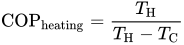
Chidgk1 (talk) 09:50, 22 February 2024 (UTC)
- ok I think I found my mistake - please check - also it would be great if other editors could improve this article more as it is so important Chidgk1 (talk) 10:39, 22 February 2024 (UTC)
US states previous incentives
[edit]I moved the below here as perhaps no longer active so too much detail?
Some US states and municipalities have previously offered incentives for air-source heat pumps:
- California
- In 2022, the California Public Utilities Commission allocated an additional $40 million from the 2023 gas Cap-and-Trade allowance auction proceeds to the existing $44.7 million budget of the Self-Generation Incentive Program (SGIP) Heat Pump Water Heater (HPWH) program, in which single-family residential customers can receive an incentive of up to $3,800 to install a HPWH. Half of the incentive funds are reserved for low-income utility customers, who are eligible for a maximum incentive of $4,885.[1]
- Maine
- The Efficiency Maine Trust offers residential heat-pump rebates of up to $1,200, as well as heat-pump rebates for low and moderate income Mainers of $2,000 for their first eligible heat pump and up to $400 for a second eligible heat pump.[2][3]
- Massachusetts
- Mass Save, a collaborative initiative between Massachusetts' natural gas and electric utilities and energy efficiency service providers, offers an air-source heat-pump rebate of up to $10,000, which covers the purchase price of the heat pump and installation costs.[4]
- Minnesota
- Minnesota Power offers an air-source heat-pump rebate of up to $1,200 if the pump is bought and installed by a Minnesota Power Participating Contractor.[5]
- South Carolina
- Dominion Energy South Carolina offers a $400–$500 rebate for purchasing and installing an ENERGY STAR certified heat pump or air-conditioning unit.[6]
Chidgk1 (talk) 12:17, 22 February 2024 (UTC)
References
- ^ "CPUC Provides Additional Incentives and Framework for Electric Heat Pump Water Heater Program". cpuc.ca.gov. California Public Utilities Commission. Archived from the original on 16 November 2022. Retrieved 16 November 2022.
- ^ "Residential Heat Pump Rebates". Efficiency Maine. The Efficiency Maine Trust. Archived from the original on 16 November 2022. Retrieved 16 November 2022.
- ^ "Heat Pump Rebates for Low and Moderate Income Mainers". Efficiency Maine. The Efficiency Maine Trust. Archived from the original on 16 November 2022. Retrieved 16 November 2022.
- ^ "Air Source Heat Pump Rebates". Mass Save. Archived from the original on 17 November 2022. Retrieved 17 November 2022.
- ^ "ASHP Rebates". Minnesota Power. Archived from the original on 17 November 2022. Retrieved 17 November 2022.
- ^ "Rebates for Heating & Cooling System Replacements". Dominion Energy. Archived from the original on 2 December 2022. Retrieved 1 December 2022.
Energy efficiency
[edit]Hello.
Regarding the recent edits by User:Chidgk1, we're citing a source that uses colloquial language together with some language I don't understand.
Using more rigorous language, what the source tries to say is that, if you live in a place where electrical energy is generated by renewable sources, then heat pumps are more eco-friendly.
However, heat pumps are not more eco-friendly in a place where electrical energy is generated by thermal power stations; in fact, in this case, they're not even more energetically efficient (which is the language the source uses when what they really mean is that the power bill you'll get will be less expensive, which, again, might be true if you live in the UK or, more generally, in a place where electrical energy is meaningully generated by renewable sources or nuclear power plants). AwerDiWeGo (talk) 20:11, 18 January 2025 (UTC)
- @AwerDiWeGo You are right that price, eco-friendliness and efficiency are 3 different things and that price comparisons are country-specific. Are you talking about this source https://www.britishgas.co.uk/heating/guides/air-source-heat-pumps-vs-boilers.html which I cited which says that heat pumps are “More energy efficient” compared to gas boilers? Chidgk1 (talk) 12:20, 19 January 2025 (UTC)
- Hi. Thanks for answering. Yes, that's the source I was talking about. AwerDiWeGo (talk) 12:23, 19 January 2025 (UTC)
- I think the 4th paragraph of the lead which starts "The efficiency of a heat pump is expressed ..." should be moved down into the body of the article because I think it is too technical for the lead. What do you think? Chidgk1 (talk) 12:26, 19 January 2025 (UTC)
- I would use more lay terms from the first sentence of the first paragraph. Maybe using examples from the beginning for what is meant by "heat sink" for most readers (that is, the "heat sink" is our home or workplace for most readers). It's said later, but the first sentence is worded awkwardly for most readers. AwerDiWeGo (talk) 12:45, 19 January 2025 (UTC)
- Ah well spotted - I rewrote as most laypeople would either not understand heat sink or think of it as something in their computer Chidgk1 (talk) 13:02, 19 January 2025 (UTC)
- I have removed that paragraph for a couple of reasons. First, it is not really a summary of anything in the article, as required by WP:LEAD. Second, it makes no sense as written, because the kilowatt is not a unit of energy. Third, efficiency is already discussed in the following paragraph. The only thing new is SCOP, which doesn't seem to merit a paragraph in the lead. GA-RT-22 (talk) 23:32, 26 April 2025 (UTC)
- I would use more lay terms from the first sentence of the first paragraph. Maybe using examples from the beginning for what is meant by "heat sink" for most readers (that is, the "heat sink" is our home or workplace for most readers). It's said later, but the first sentence is worded awkwardly for most readers. AwerDiWeGo (talk) 12:45, 19 January 2025 (UTC)
- I think the 4th paragraph of the lead which starts "The efficiency of a heat pump is expressed ..." should be moved down into the body of the article because I think it is too technical for the lead. What do you think? Chidgk1 (talk) 12:26, 19 January 2025 (UTC)
- Hi. Thanks for answering. Yes, that's the source I was talking about. AwerDiWeGo (talk) 12:23, 19 January 2025 (UTC)
This is not an encyclopedic article: Very HAVC focused, and largely ignores heat pumps as a broader concept.
[edit]There should be two articles, one for heat pumps as an HVAC concept, and another for heat pumps as a general concept. For example, there is no mention whatsoever about peltier devices/thermoelectric heat pumps and a one line mention of thermoacoustic heat pumps, and a half line about electrocaloric heat pumps. An encyclopedia should start with the broad concept of the topic, and then offer to narrow down to more specific examples/systems/concepts.
Why there is no article broadly talking about heat pumps is beyond me, and frankly sub-standard for an encyclopedia. Nabeel_co (talk) 20:23, 11 August 2025 (UTC)
- I agree. It completely ignores their use in electric vehicles. Wws (talk) 19:27, 19 August 2025 (UTC)
- Do you know of a reliable published source that focuses on the general concept that you have in mind? I don’t.
- For example, do you have a reliable published source that states a device displaying the Peltier effect is a heat pump? If so, you are able to insert a sentence or a paragraph in this article, expanding the content towards the broader concept.
- I can’t do it because I don’t know of any such reliable published source. Dolphin (t) 22:09, 20 August 2025 (UTC)
- B-Class level-5 vital articles
- Wikipedia level-5 vital articles in Technology
- B-Class vital articles in Technology
- B-Class physics articles
- High-importance physics articles
- B-Class physics articles of High-importance
- B-Class energy articles
- Mid-importance energy articles
- B-Class Technology articles
- WikiProject Technology articles
- B-Class Climate change articles
- High-importance Climate change articles
- WikiProject Climate change articles