


Portal:Tropical cyclones

The Tropical Cyclones Portal

A tropical cyclone is a storm system characterized by a large low-pressure center, a closed low-level circulation and a spiral arrangement of numerous thunderstorms that produce strong winds and heavy rainfall. Tropical cyclones feed on the heat released when moist air rises, resulting in condensation of water vapor contained in the moist air. They are fueled by a different heat mechanism than other cyclonic windstorms such as Nor'easters, European windstorms and polar lows, leading to their classification as "warm core" storm systems. Most tropical cyclones originate in the doldrums, approximately ten degrees from the Equator.
The term "tropical" refers to both the geographic origin of these systems, which form almost exclusively in tropical regions of the globe, as well as to their formation in maritime tropical air masses. The term "cyclone" refers to such storms' cyclonic nature, with anticlockwise rotation in the Northern Hemisphere and clockwise rotation in the Southern Hemisphere. Depending on its location and intensity, a tropical cyclone may be referred to by names such as "hurricane", "typhoon", "tropical storm", "cyclonic storm", "tropical depression" or simply "cyclone".
Types of cyclone: 1. A "Typhoon" is a tropical cyclone located in the North-west Pacific Ocean which has the most cyclonic activity and storms occur year-round. 2. A "Hurricane" is also a tropical cyclone located at the North Atlantic Ocean or North-east Pacific Ocean which have an average storm activity and storms typically form between May 15 and November 30. 3. A "Cyclone" is a tropical cyclone that occurs in the South Pacific and Indian Oceans.
Selected named cyclone -

Hurricane Fabian was one of the strongest and most damaging tropical cyclones on record to affect Bermuda, when it passed just west of the North Atlantic island in September 2003. The hurricane originated from a tropical wave that left western Africa, and developed into Tropical Depression Ten on August 27. On the next day, the National Hurricane Center (NHC) upgraded it to Tropical Storm Fabian, the sixth named storm of the annual Atlantic hurricane season. It moved west-northwestward under the influence of the subtropical ridge to its north, and steadily strengthened in an area of warm sea surface temperatures and light wind shear. Within 18 hours of attaining hurricane status, Fabian became a major hurricane, the first of the season. The hurricane attained a peak intensity of 145 mph (233 km/h) on September 1, and it slowly weakened as it turned northward. On September 5, Fabian made a direct hit on Bermuda with wind speeds of over 120 mph (190 km/h). After passing the island, the hurricane turned to the northeast, and became extratropical on September 8, before dissipating two days later.
Fabian was the strongest hurricane to hit Bermuda since Hurricane Arlene in 1963. It was the first deadly hurricane in Bermuda since satellites began tracking hurricanes. A strong storm surge associated with the hurricane killed four people crossing a causeway on Bermuda, temporarily closing the only link between two islands. Fabian's powerful winds caused power outages and damaged roofs throughout the island. There was a shortage of material for the traditional limestone roofs, as well as supplies to restore electricity. The habitat of the endangered Bermuda petrel, better known as the cahow, was disrupted by the hurricane, leading volunteer to transport the species to a safer location. Strong swells killed a swimmer in Puerto Rico and North Carolina, while also causing damage in the northern Dominican Republic. A ship capsized in the Grand Banks, south of Island, killing three people. In all, Fabian caused around US$300 million in damage and nine deaths. (Full article...)
Selected article -

The 1970 Bhola cyclone, also known as the Great Cyclone of 1970 or simply the Bhola Cyclone, was the deadliest tropical cyclone on record, as well as one of the deadliest humanitarian disasters ever recorded. It struck East Pakistan (present-day Bangladesh) and India's West Bengal on 12 November 1970. At least 300,000 people died in the storm, possibly as many as 500,000, primarily as a result of the storm surge that flooded much of the low-lying islands of the Ganges Delta. The Bhola cyclone was the sixth and strongest cyclonic storm of the 1970 North Indian Ocean cyclone season.
The cyclone formed over the central Bay of Bengal on 8 November and travelled northward, intensifying as it did so. It reached its peak with winds of 185 km/h (115 mph) on 10 November, and made landfall on the coast of East Pakistan on the following afternoon. The storm surge devastated many of the offshore islands, wiping out villages and destroying crops throughout the region. In the most severely affected upazila Tazumuddin, over 45% of the population of 167,000 were killed by the storm. (Full article...)
Selected image -

Selected season -

The 1988 Atlantic hurricane season was a near average season that proved costly and deadly, with 15 tropical cyclones directly affecting land. The season officially began on June 1, 1988, and lasted until November 30, 1988, although activity began on May 30 when a tropical depression developed in the Caribbean. The June through November dates conventionally delimit the period of each year when most tropical cyclones form in the Atlantic basin. The first cyclone to attain tropical storm status was Alberto on August 8, nearly a month later than usual. The final storm of the year, Tropical Storm Keith, became extratropical on November 24. The season produced 19 tropical depressions of which 12 attained tropical storm status. One tropical storm was operationally classified as a tropical depression but was reclassified in post-analysis. Five tropical cyclones reached hurricane status of which three became major hurricanes reaching Category 3 on the Saffir–Simpson scale. Until the 2022 Atlantic hurricane season, it was the latest season to have multiple Atlantic-Pacific crossover storms.
There were two notable cyclones of the season, the first one being Hurricane Gilbert, which at the time was the strongest Atlantic hurricane on record. The hurricane tracked through the Caribbean Sea and the Gulf of Mexico and caused devastation in Mexico and many island nations, particularly Jamaica. Its passage caused $2.98 billion in damage (1988 USD) and more than 300 deaths, mostly in Mexico. The second one was Hurricane Joan, which struck Nicaragua as a Category 4 hurricane and caused about US$1.87 billion in damage and more than 200 deaths. The hurricane crossed into the eastern Pacific Ocean and was reclassified as Tropical Storm Miriam. Hurricane Debby also successfully crossed over, becoming Tropical Depression Seventeen-E, making the 1988 season the first on record in which more than one tropical cyclone has crossed between the Atlantic and Pacific basins intact. (Full article...)
Related portals


Currently active tropical cyclones
Italicized basins are unofficial.
- North Atlantic (2026)
- No active systems
- East and Central Pacific (2026)
- No active systems
- North Indian Ocean (2026)
- No active systems
- Mediterranean (2025–26)
- No active systems
- South-West Indian Ocean (2025–26)
- No active systems
- Australian region (2025–26)
- No active systems
- South Pacific (2025–26)
- No active systems
- South Atlantic (2025–26)
- No active systems
Last updated: 01:53, 23 June 2026 (UTC)
Tropical cyclone anniversaries

June 22,
- 1972 - Hurricane Agnes made landfall near New York City. Agnes killed 129 people and caused over $2 billion of damage throughout the eastern United States, with the worst of the damage in the states of Pennsylvania and New York.
- 2015 - Tropical Storm Kujira (pictured) reaches tropical storm intensity before making landfall in southern China. Kujira killed nine people and damaged ¥88 million (US$14.4 million).

June 23,
- 1991 - Hurricane Carlos reaches Category 3 major hurricane intensity over in the East Pacific.
- 2001 - Typhoon Chebi made landfall near Fuzhou, China. Chebi killed 82 people and caused over $440 million of damage in mainland China and Taiwan.
- 2015 - The 2015 Gujarat cyclone (pictured) made landfall over in Gujarat, India, causing about $258 million in damages and killing at least 80 people as a weak system.

June 24,
- 1985 - Typhoon Hal moves onshore Hong Kong as a weakening typhoon killing 53 people.
- 1993 - Typhoon Koryn reached its peak intensity with a central pressure of 910 hPa (mbar) in the Philippine Sea.
- 2010 - Hurricane Celia (pictured) reaches Category 5 hurricane intensity, making one of a few systems in the East Pacific to reach that intensity in the month of June.
Did you know…


- …that the first recorded instance of two tropical cyclones holding category 5 status, on the Saffir–Simpson scale, simultaneously was on September 11th of the 1961 Pacific typhoon season, with typhoons Pamela and Nancy (pictured)?
- …that the Australian region have three distinct lists of names for tropical storms, each one of them being administered by agencies in Australia, Indonesia and Papua New Guinea, respectively?
- …that the Joint Typhoon Warning Center considers that Typhoon Vera (pictured) of 1986 is actually two distinct systems, formed from two separated low-level circulations?
- …that Cyclone Freddy (track pictured) in 2023 was the longest-lasting tropical cyclone recorded?
General images -
-
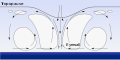 Tropical cyclones form when the energy released by the condensation of moisture in rising air causes a positive feedback loop over warm ocean waters. (from Cyclone)
 -
 Effects in Buncombe County, North Carolina after Hurricane Helene passed through the area in September 2024. (from Effects of tropical cyclones)
 -
 An example of a chart for Matthew showing its five-day forecast track (from Tropical cyclone preparedness)
 -
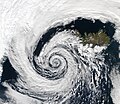 An extratropical cyclone near Iceland (from Cyclone)
 -
 Surface weather map of the 1935 Labor Day hurricane moving up the west coast of Florida (from Tropical cyclone observation)
 -
 A polar low over the Sea of Japan in December 2009 (from Cyclone)
 -
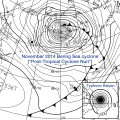 Comparison between extratropical and tropical cyclones on surface analysis (from Cyclone)
 -
 Flooding in Port Arthur, Texas caused by Hurricane Harvey. Harvey was the wettest and second-costliest tropical cyclone in United States history. (from Effects of tropical cyclones)
 -
 Chart with concurrent information for Hurricane Arlene and Tropical Storm Bret logged and plotted (from Tropical cyclone preparedness)
 -
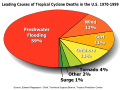 Percentages of hurricane deaths in the United States from 1970 to 1999. (from Effects of tropical cyclones)
 -
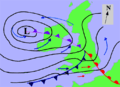 A fictitious synoptic chart of an extratropical cyclone affecting the UK and Ireland. The blue arrows between isobars indicate the direction of the wind, while the "L" symbol denotes the centre of the "low". Note the occluded, cold and warm frontal boundaries. (from Cyclone)
 -

-
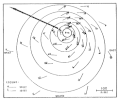 The dangerous semicircle is the upper-right corner, with the arrow marking the direction of motion of a Northern Hemisphere storm. Note that typhoons, etc. are asymmetrical, and semicircle is a convenient misnomer. (from Effects of tropical cyclones)
 -
 Broken concrete utility pole in Puerto Rico after Hurricane Maria in 2017, which ranks fourth in costliest US tropical cyclones. (from Effects of tropical cyclones)
 -
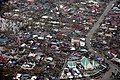 Aerial image of destroyed houses in Tacloban, following Typhoon Haiyan (from Effects of tropical cyclones)
 -
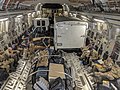 Personnel and equipment from the National Guard of the United States en route to Hurricane Florence response efforts in 2018
 -

-

-
 Hurricane response involves working in hazardous conditions, including contamination and electrocution hazards from floodwater.
 -
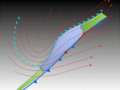 The initial extratropical low-pressure area forms at the location of the red dot on the image. It is usually perpendicular (at a right angle to) the leaf-like cloud formation seen on satellite during the early stage of cyclogenesis. The location of the axis of the upper level jet stream is in light blue. (from Cyclone)
 -
The aftermath of Hurricane Katrina in Gulfport, Mississippi. Katrina was the costliest tropical cyclone in United States history. (from Effects of tropical cyclones)
-
 Cyclone on Mars, imaged by the Hubble Space Telescope (from Cyclone)
 -
 Radar image of Hurricane Erika making landfall over Northeastern Mexico (from Tropical cyclone observation)
 -
 All but the most expensive bottles of water were sold out at this Publix supermarket before Hurricane Irma; in the week preceding the storm, water sold out soon after shipments arrived (from Tropical cyclone preparedness)
 -
 Hurricane Isabel (2003)'s effect on the North Carolina Outer Banks (from Effects of tropical cyclones)
 -
 Wind damage varies exponentially with wind speed, so that small increases in wind strength can dramatically increase damage. Damages rise by about a factor of four for every category increase in the Saffir–Simpson scale. (from Cyclone)


_(50).jpg)


.jpg)

_(cropped).jpg)
.jpg)


 Featured list -


Arizona has been affected by hurricanes on numerous occasions. Usually, these storms originate in the eastern Pacific Ocean, make landfall in the Mexican states of Baja California or Sonora, and dissipate before crossing into the United States. Thus, in most cases, it is only the tropical cyclones' remnant moisture that produces heavy rainfall—and in some occasions, flooding—in portions of Arizona. However, approximately every five years, a tropical cyclone retains sufficient strength to enter the state as a tropical storm or a tropical depression. Arizonans can expect indirect flash floods caused by the remnants of tropical cyclones to occur about every two years.
Tropical cyclones in Arizona are not common, since the predominant wind pattern steers most storms that form in the Eastern Pacific either parallel or away from the Pacific coast of northwestern Mexico. As a result, most storms that could affect Arizona are carried away from the United States, with only 6% of all Pacific hurricanes entering US territory. Not all Arizona hurricanes originate from the Pacific Ocean, however; in July 2008, an Atlantic hurricane named Hurricane Dolly produced rainfall in the eastern portion of the state, and another Atlantic storm reached Arizona as a tropical depression. Many, but not all, of these systems also impacted California. (Full article...)
Topics
Subcategories

Related WikiProjects
WikiProject Tropical cyclones is the central point of coordination for Wikipedia's coverage of tropical cyclones. Feel free to help!
WikiProject Weather is the main center point of coordination for Wikipedia's coverage of meteorology in general, and the parent project of WikiProject Tropical cyclones. Three other branches of WikiProject Weather in particular share significant overlaps with WikiProject Tropical cyclones:
- The Non-tropical storms task force coordinates most of Wikipedia's coverage on extratropical cyclones, which tropical cyclones often transition into near the end of their lifespan.
- The Floods task force takes on the scope of flooding events all over the world, with rainfall from tropical cyclones a significant factor in many of them.
- WikiProject Severe weather documents the effects of extreme weather such as tornadoes, which landfalling tropical cyclones can produce.
Things you can do
 |
Here are some tasks awaiting attention:
|
Wikimedia
The following Wikimedia Foundation sister projects provide more on this subject:
-
 Commons
Free media repository -
 Wikidata
Free knowledge base -
 Wikiquote
Collection of quotations -
 Wikisource
Free-content library -
 Wikiversity
Free learning tools -
 Wikivoyage
Free travel guide -
 Wiktionary
Dictionary and thesaurus


