


Portal:Phoenicia

THE PHOENICIA PORTAL

The Phoenicians were an ancient Semitic people who inhabited city-states in Canaan along the Levantine coast of the eastern Mediterranean, primarily in present-day Lebanon and parts of coastal Syria. Their maritime civilization expanded and contracted over time, with its cultural core stretching from Arwad to Mount Carmel. Through trade and colonization, the Phoenicians extended their influence across the Mediterranean, from Cyprus to the Maghreb and Iberian Peninsula, leaving behind thousands of inscriptions.
The Phoenicians emerged directly from the Bronze Age Canaanites, and their cultural traditions survived the Late Bronze Age collapse, continuing into the Iron Age with little interruption. They referred to themselves as Canaanites and their land as Canaan, though the territory they occupied was smaller than that of earlier Bronze Age Canaan. The name Phoenicia is a Greek exonym that did not correspond to a unified native identity. Modern scholarship generally views the distinction between Canaanites and Phoenicians after c. 1200 BC as artificial.
Renowned for seafaring and trade, the Phoenicians established one of antiquity's most extensive maritime networks, active for over a millennium. This network facilitated exchanges among cradles of civilization such as Mesopotamia, Egypt, and Greece. They founded colonies and trading posts throughout the Mediterranean; among these, Carthage in the Mediterranean Maghreb developed into a major power by the 7th century BC.
Phoenician society was organized into independent city-states, notably Byblos, Sidon, and Tyre. Each retained political autonomy, and there is no evidence of a shared national identity. While kingship was common, powerful merchant families likely exercised influence through oligarchies. The Phoenician cities flourished most in the 9th century BC, but subsequently declined under the expansion of empires such as the Neo-Assyrian and Achaemenid. Their influence nevertheless endured in the western Mediterranean until the Roman destruction of Carthage in the mid-2nd century BC. — Read more about Phoenicia, its mythology and language
 Featured article
•
Featured article
•
A Featured article represents some of the best content on Wikipedia

.jpg)
The Battle of Cape Ecnomus or Eknomos (Ancient Greek: Ἔκνομος) was a naval battle, fought off southern Sicily, in 256 BC, between the fleets of Carthage and the Roman Republic, during the First Punic War (264–241 BC). The Carthaginian fleet was commanded by Hanno and Hamilcar; the Roman fleet jointly by the consuls for the year, Marcus Atilius Regulus and Lucius Manlius Vulso Longus. It resulted in a clear victory for the Romans.
The Roman fleet of 330 warships plus an unknown number of transports had sailed from Ostia, the port of Rome, and had embarked approximately 26,000 picked legionaries shortly before the battle. They planned to cross to Africa and invade the Carthaginian homeland, in Tunisia. The Carthaginians were aware of the Romans' intentions and mustered all available warships, 350, off the south coast of Sicily to intercept them. With a combined total of about 680 warships carrying up to 290,000 crew and marines, the battle was arguably the single largest battle of ancient history, and was possibly the largest naval battle in history by the number of combatants involved. (Full article...)
Phoenician mythology •
Kothar-wa-Khasis (Ugaritic: 𐎋𐎘𐎗𐎆𐎃𐎒𐎒, romanized: Kôṯaru-wa-Ḫasisu), also known as Kothar or Hayyānu, was an Ugaritic god regarded as a divine artisan. He could variously play the roles of an architect, smith, musician or magician. Some scholars believe that this name represents two gods, Kothar and Khasis, combined into one.
He is well attested in ritual texts, and a number of theophoric names invoking him have been identified. He was believed to reside in Memphis and Caphtor, which might reflect the routes through which crafts and resources traveled in the late Bronze Age. He appears in various Ugaritic myths as well. In the Baal Cycle, he uses his skills on behalf of other deities. In the beginning, El enlists his help with building a temple for Yam. Later he helps Baal in his conflict with the sea god, providing him with weapons with which he ultimately triumphs. The weather god subsequently asks him for help with preparing gifts for Athirat, whose support he needs, and later with the construction of a palace of his own. He is also mentioned in the hymn to Shapash which closes this cycle of myths. In the Epic of Aqhat, he makes the bow belonging to the eponymous hero. There is some evidence that he was also introduced to Egypt, but his popularity there was limited. He was associated with the construction of temples. The name Keserty might have either referred to a god regarded as his counterpart or outright represent an Egyptian variant of his name. A connection between him and Ptah has also been suggested in past scholarship. (Full article...)
Images
-
 Oinochoe; 800–700 BC; terracotta; height: 24.1 cm; Metropolitan Museum of Art (New York City, US) (from Phoenicia)
 -
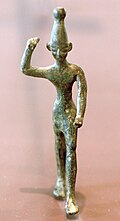 Figure of Ba'al with raised arm, 14th–12th century BC, found at ancient Ugarit (Ras Shamra site), a city at the far north of the Phoenician coast. Musée du Louvre. (from Phoenicia)
 -
 Achaemenid-era coin of Abdashtart I of Sidon, who is seen at the back of the chariot, behind the Persian King (from Phoenicia)
 -
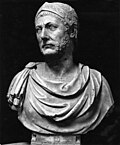
-
 Ba'al with Thunderbolt stele from Ugarit, c. 15th century BCE (from Canaanite religion)
 -
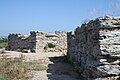
-
 Phoenicians build pontoon bridges for Xerxes I of Persia during the second Persian invasion of Greece in 480 BC (1915 drawing by A. C. Weatherstone). (from Phoenicia)
 -
 Tomb of King Hiram I of Tyre, located in the village of Hanaouay, in southern Lebanon (from Phoenicia)
 -
 Phoenician faces. Glass from Olbia, 4th century BC. The bold pools of color and detailed hair give a Greek impression. (from Phoenicia)
 -

-
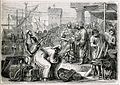 19th-century depiction of Phoenician sailors and merchants. The importance of trade to the Phoenician economy led to a gradual sharing of power between the King and assemblies of merchant families. (from Phoenicia)
 -
 Phoenician metal bowl with hunting scene (8th century BC). The clothing and hairstyle of the figures are Egyptian. At the same time, the subject matter of the central scene conforms with the Mesopotamian theme of combat between man and beast. Phoenician artisans frequently adapted the styles of neighboring cultures. (from Phoenicia)
 -
 Reconstruction of the Young Man of Byrsa (from Punic people)
 -
 Face bead; mid-4th–3rd century BC; glass; height: 2.7 cm; Metropolitan Museum of Art (from Phoenicia)
 -
 Ruins of the Punic and then Roman town of Tharros (from Punic people)
 -
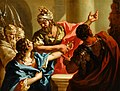 Young Hannibal Swears Enmity to Rome by Giovanni Antonio Pellegrini (1731) (from Punic people)
 -

-

-
 Mortise and tenon joinery in the Mazarron 1 Phoenician shipwreck. Phoenicians pioneered the pegged mortise and tenon joinery, which came to be known as Phoenician joints (from Phoenicia)
 -
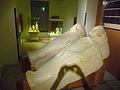 Phoenician sarcophagi found in Cádiz, Spain, thought to have been imported from the Phoenician homeland around Sidon. Archaeological Museum of Cádiz. (from Phoenicia)
 -
 Earring from a pair, each with four relief faces; late fourth–3rd century BC; gold; overall: 3.5 x 0.6 cm; Metropolitan Museum of Art (from Phoenicia)
 -
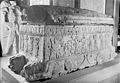 Sarcophagus of Ahiram, which bears the oldest inscription of the Phoenician alphabet. National Museum of Beirut. (from Phoenicia)
 -
 Female figurines from Tyre (c. 1000–550 BC). National Museum of Beirut. (from Phoenicia)
 -
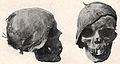 Skull of King Tabnit of Sidon (reigned c. 549 BC – c. 539 BC), now in the Istanbul Archaeology Museums (from Phoenicia)
 -
 aDNA of ancient Mediterranean (incl. 30 Punic) samples clustering with contemporary populations (from Punic people)
 -
 Map of Phoenician (yellow labels) and Greek (red labels) colonies around 8th to 6th century BC (with German legend) (from Phoenicia)
 -
 A naval action during Alexander the Great's Siege of Tyre (332 BC). Drawing by André Castaigne, 1888–89. (from Phoenicia)
 -

-
 Putative statuette of El (c. 1400–1200 BCE) from the Tel Megiddo site, situated in northern Israel (from Canaanite religion)
 -
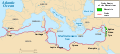 Major Phoenician trade networks (c. 1200–800 BC) (from Phoenicia)
 -
 Revadim Asherah figurine (c. 1400–1200 BCE), discovered in southern Israel (from Canaanite religion)
 -
 Approximate extent of Phoenician settlements and trade routes c. 800 BC. (from Phoenicia)
 -
 Sicily at the beginning of the Peloponnesian War (from Punic people)


.jpg)


._2_sides._Paris,_1892.jpg)


.jpg)


.svg)


 Good article
•
Good article
•
A Good article meets a core set of high editorial standards


Dumuzid, Dumuzi, or Tammuz (Sumerian: 𒌉𒍣, romanized: Dumuzid; Akkadian: Duʾūzu, Dûzu; Arabic: تمّوز, romanized: Tammuz, Tammūz; Hebrew: תַּמּוּז, romanized: Tammūz), known to the Sumerians as Dumuzid the Shepherd (Sumerian: 𒌉𒍣𒉺𒇻, romanized: Dumuzid sipad) and to the Canaanites as Adon (Phoenician: 𐤀𐤃𐤍; Proto-Hebrew: 𐤀𐤃𐤍), is an ancient Mesopotamian and associated with agriculture and shepherds, who was also the first and primary consort of the goddess Inanna (later known as Ishtar). In Sumerian mythology, Dumuzid's sister was Geshtinanna, the goddess of agriculture, fertility, and dream interpretation. In the Sumerian King List, Dumuzid is listed as an antediluvian king of the city of Bad-tibira and also an early king of the city of Uruk.
In Inanna's Descent into the Underworld, Inanna perceives that Dumuzid has failed to properly mourn her death and, when she returns from the Underworld, allows the galla demons to drag him down to the Underworld as her replacement. Inanna later regrets this decision and decrees that Dumuzid will spend half of the year in the Underworld, but the other half of the year with her, while his sister Geshtinanna stays in the Underworld in his place, thus resulting in the cycle of the seasons. In the Sumerian poem Inanna Prefers the Farmer, Dumuzid competes against the farmer Enkimdu for Inanna's hand in marriage. (Full article...)
Phoenician inscriptions & language •
The Canaanite and Aramaic inscriptions, also known as Northwest Semitic inscriptions, are the primary extra-Biblical sources for understanding of the societies and histories of Phoenicia, the Israelites, and the Arameans, which includes groups within the Northwest Semitic languages. Northwest Semitic contains the Aramaic and Canaanite languages; the latter groups includes Phoenician—Punic, the Ammonite language, and Hebrew.
Semitic inscriptions may occur on stone slabs, ostraca, and ornaments and range from simple names to full texts.
The oldest inscriptions form a dialect continuum that includes Canaanite languages and Aramaic, exemplified by writings which scholars have struggled to fit into either category, such as the Stele of Zakkur and the Deir Alla inscription. (Full article...)
Did you know (auto-generated) •

- ... that archaeological excavations in the historic town of Kharayeb revealed a rural settlement with a complex system of cisterns and a Phoenician temple?
- ... that the sarcophagus of Eshmunazar II, the Phoenician king of Sidon, is one of only three ancient Egyptian sarcophagi unearthed outside Egypt?
- ... that the deity of the Phoenician sanctuary of Kharayeb remains unidentified due to the absence of names of specific gods in unearthed inscriptions?
- ... that Muhammad Khaznadar's museum was said to have "surpassed every other museum in the world" in Phoenician and Carthaginian antiquities?
- ... that the Mazarrón I shipwreck combines Phoenician and local Iberian shipbuilding techniques?
- ... that according to second-century AD Greek rhetorician Athenaeus, the Phoenicians played a flute-like instrument called the gingras in their mourning rituals?
Related portals


Categories

Wikiproject
Other Wikimedia and Wikiportals
The following Wikimedia Foundation sister projects provide more on this subject:
-
 Commons
Free media repository -
 Wikidata
Free knowledge base -
 Wikiquote
Collection of quotations -
 Wikisource
Free-content library -
 Wikiversity
Free learning tools -
 Wikivoyage
Free travel guide -
 Wiktionary
Dictionary and thesaurus


Parent portal: Lebanon


