


Portal:Ancient Greece

The Ancient Greece Portal
.jpg)
Ancient Greece (Ancient Greek: Ἑλλάς, romanized: Hellás) was a northeastern Mediterranean civilization, existing from the Greek Dark Ages of the 12th–9th centuries BC to the end of classical antiquity (c. 600 AD), comprising a loose collection of culturally and linguistically related city-states and communities. Prior to the Roman period, most of these regions were officially unified only once under the Kingdom of Macedon from 338 to 323 BC. In Western history, the era of classical antiquity was immediately followed by the Early Middle Ages and the Byzantine period.
Three centuries after the decline of Mycenaean Greece during the Bronze Age collapse, Greek urban poleis began to form in the 8th century BC, ushering in the Archaic period and the colonization of the Mediterranean Basin. This was followed by the age of Classical Greece, from the Greco-Persian Wars to the death of Alexander the Great in 323 BC, and which included the Golden Age of Athens and the Peloponnesian War between Athens and Sparta. The unification of Greece by Macedon under Philip II and subsequent conquest of the Achaemenid Empire by Alexander the Great spread Hellenistic civilization across the Middle East. The Hellenistic period is considered to have ended in 30 BC, when the last Hellenistic kingdom, Ptolemaic Egypt, was annexed by the Roman Republic.
Classical Greek culture, especially philosophy, had a powerful influence on ancient Rome, which carried a version of it throughout the Mediterranean and much of Europe. For this reason, Classical Greece is generally considered the cradle of Western civilization, the seminal culture from which the modern West derives many of its founding archetypes and ideas in politics, philosophy, science, and art. (Full article...)
Selected article -

Koine Greek (ἡ κοινὴ διάλεκτος, hē koinḕ diálektos, lit. 'the common dialect'), also variously known as Hellenistic Greek, common Attic, the Alexandrian dialect, Biblical Greek, Septuagint Greek or New Testament Greek, was the common supra-regional form of Greek spoken and written during the Hellenistic period, the Roman Empire, and the early Byzantine Empire. It evolved from the spread of Greek following the conquests of Alexander the Great in the fourth century BC, and served as the lingua franca of much of the Mediterranean region and the Middle East during the following centuries. It was based mainly on Attic and related Ionic speech forms, with various admixtures brought about through dialect levelling with other varieties. Koine Greek included styles ranging from conservative literary forms to the spoken vernaculars of the time. As the dominant language of the Byzantine Empire, it developed further into Medieval Greek, which informed Modern Greek. (Full article...)
Selected location -

Thessaly (/ˈθɛsəli/ THESS-ə-lee; Greek: Θεσσαλία, romanized: Thessalía [θesaˈli.a]; ancient Thessalian: Πετθαλία, Petthalía) is a traditional geographic and modern administrative region of Greece, comprising most of the ancient region of the same name. Before the Greek Dark Ages, Thessaly was known as Aeolia (Ancient Greek: Αἰολία, Aiolía), and appears in Homer's Odyssey.
Thessaly became part of the modern Greek state in 1881, after four and a half centuries of Ottoman rule. Since 1987 it has formed one of the country's 13 regions and is further (since the Kallikratis reform of 2011) sub-divided into five regional units and 25 municipalities. The capital of the region is Larissa. Thessaly lies in northern central Greece and borders the regions of Macedonia to the north, Epirus to the west, Central Greece to the south, and the Aegean Sea to the east. The Thessaly region also includes the Sporades islands. (Full article...)
Did you know...
- ... that after the battle of Plataea, the Greeks swore never to rebuild their sanctuaries, destroyed by the Persians during their invasion of Greece, but to leave them in ruins, as a perpetual reminder of barbarian ferocity?
- ...that Thebes, Greece played an important role in the fabric of Greek myth, being the site of the stories of Cadmus, Oedipus, Dionysus, and others?
- ...that the art of ancient Greece has exercised an enormous influence on the culture of many countries from ancient times until the present, particularly in the areas of sculpture and architecture?
Related portals


Selected biography -
_frontispiece_(cropped).jpg)
Epictetus (/ˌɛpɪkˈtiːtəs/ EH-pick-TEE-təss; Ancient Greek: Ἐπίκτητος, Epíktētos; c. 50 – c. 135 AD) was a Greek Stoic philosopher. He was born into slavery at Hierapolis, Phrygia (present-day Pamukkale, in western Turkey) and lived in Rome until his banishment, after which he spent the rest of his life in Nicopolis in northwestern Greece.
Epictetus studied Stoic philosophy under Musonius Rufus and after manumission, his formal emancipation from slavery, he began to teach philosophy. When philosophers were banished from Rome by Emperor Domitian toward the end of the first century, Epictetus founded a school of philosophy in Nicopolis. He taught that philosophy is a way of life and not simply a theoretical discipline. To Epictetus, all external events are beyond our control; he argues that we should accept whatever happens calmly and dispassionately. However, he held that individuals are responsible for their own actions, which they can examine and control through rigorous self-discipline. His teachings were written down and published by his pupil Arrian in his Discourses and Enchiridion. They influenced many later thinkers, including Marcus Aurelius, Pascal, Diderot, Montesquieu, Rabelais, and Samuel Johnson. (Full article...)
General images -
-
 The lawgiver Solon reformed the Athenian constitution, which led to significant developments in Greece (from Archaic Greece)
 -
 Geometric-style box in the shape of a barn. On display in the Ancient Agora Museum in Athens, housed in the Stoa of Attalus. From early geometric cremation burial of a wealthy pregnant woman, 850 BC. (from Greek Dark Ages)
 -
 An Ancient Greek pair of terracotta boots. Early geometric period cremation burial of a woman, 900 BC. Ancient Agora Museum in Athens. (from Greek Dark Ages)
 -
 Events of the first phases of the Greco-Persian Wars (from Ancient Greece)
 -
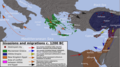 Map of the Late Bronze Age collapse (c. 1200 BC) in the Eastern Mediterranean (from Greek Dark Ages)
 -
 Homer, author of the earliest surviving Greek literature (from Archaic Greece)
 -

-
 Alexander Mosaic, National Archaeological Museum, Naples (from Ancient Greece)
 -
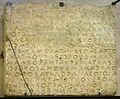 Inheritance law, part of the Gortyn code, Crete, fragment of the 11th column. Limestone, 5th century BC (from Ancient Greece)
 -

-
 Ancient Greek colonies in the archaic period (from Archaic Greece)
 -
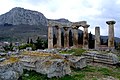 Ruins of the Temple of Apollo within the polis of Ancient Corinth, built c. 540 BC, with the Acrocorinth (the city's acropolis) seen in the background (from Archaic Greece)
 -

-
 A scene from the Iliad: Hypnos and Thanatos carrying the body of Sarpedon from the battlefield of Troy; detail from an Attic white-ground lekythos, c. 440 BC (from Ancient Greece)
 -

-
 The carved busts of four ancient Greek philosophers, on display in the British Museum. From left to right: Socrates, Antisthenes, Chrysippus, and Epicurus. (from Ancient Greece)
 -

-
 Greek hoplite and Persian warrior depicted fighting, on an ancient kylix, 5th century BC (from Ancient Greece)
 -
The Temple of Concordia, Valle dei Templi, Magna Graecia, in present-day Italy (from Archaic Greece)
-
 Major regions of mainland ancient Greece and adjacent "barbarian" lands (from Ancient Greece)
 -
 Marble bust of Pericles with a Corinthian helmet, Roman copy of a Greek original, Museo Chiaramonti, Vatican Museums; Pericles was a key populist political figure in the development of the radical Athenian democracy. (from Ancient Greece)
 -

-
 The ancient Theatre of Epidaurus, 4th century BC (from Ancient Greece)
 -
 The Victorious Youth (c. 310 BC) is a rare, water-preserved bronze sculpture from ancient Greece. (from Ancient Greece)
 -
 Dipylon Vase of the late Geometric period, or the beginning of the Archaic period, c. 750 BC. (from Ancient Greece)
 -
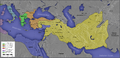 The major Hellenistic realms included the Diadochi kingdoms:Kingdom of Ptolemy I SoterKingdom of CassanderKingdom of LysimachusKingdom of Seleucus I NicatorAlso shown on the map:Carthage (non-Greek)Rome (non-Greek)
The orange areas were often in dispute after 281 BC. The Attalid dynasty occupied some of this area. Not shown: Indo-Greek Kingdom. (from Ancient Greece) -
 Finds from an early Geometric cremation burial of a pregnant wealthy woman, from the N.W. of the Areopagus, about 850 BC, Ancient Agora Museum (Athens); exhibit 14–16: broad gold finger rings; exhibit 17–19: gold finger rings; 20: pair of gold earrings with trapezoid endings (from Greek Dark Ages)
 -
 Early Athenian coin, depicting the head of Athena on the obverse and her owl on the reverse – 5th century BC (from Ancient Greece)
 -
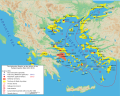 The Delian League immediately before the Peloponnesian War in 431 BC (from Ancient Greece)
 -
 The Parthenon, a temple dedicated to Athena, located on the Acropolis in Athens, is one of the most representative symbols of the culture and sophistication of the ancient Greeks. (from Ancient Greece)
 -
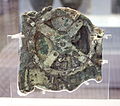 The Antikythera mechanism was an analog computer from 150 to 100 BC designed to calculate the positions of astronomical objects. (from Ancient Greece)
 -
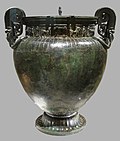 The Vix Krater, an imported Greek wine-mixing bronze vessel found in the Hallstatt/La Tène grave of the "Lady of Vix", Burgundy, France, c. 500 BC (from Archaic Greece)
 -
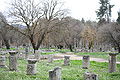 The gymnasium and palaestra at Olympia, the site of the ancient Olympic games. The archaic period conventionally dates from the first Olympiad. (from Archaic Greece)
 -
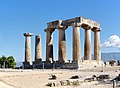 The remains of the Temple of Apollo in Corinth, the first Greek temple to be built in stone. (from Archaic Greece)


.JPG)


.jpg)


.jpg)


Selected picture

A caryatid (Greek: Καρυάτις, plural: Καρυάτιδες) is a sculpted female figure serving as an architectural support taking the place of a column or a pillar supporting an entablature on her head. The Greek term karyatides literally means "maidens of Karyae", an ancient town of Peloponnese.
Topics
Life: Agriculture · Art · Cuisine · Democracy · Economy · Language · Law · Medicine · Paideia · Pederasty · Pottery · Prostitution · Slavery · Technology · Olympic Games
Philosophers: Pythagoras · Heraclitus · Parmenides · Protagoras · Empedocles · Democritus · Socrates · Plato · Aristotle · Zeno · Epicurus
Authors: Homer · Hesiod · Pindar · Sappho · Aeschylus · Sophocles · Euripides · Aristophanes · Menander · Herodotus · Thucydides · Xenophon · Plutarch · Lucian · Polybius · Aesop
Buildings: Parthenon · Temple of Artemis · Acropolis · Ancient Agora · Arch of Hadrian · Temple of Zeus at Olympia · Colossus of Rhodes · Temple of Hephaestus · Samothrace temple complex
Chronology: Aegean civilization · Minoan Civilization · Mycenaean civilization · Greek dark ages · Classical Greece · Hellenistic Greece · Roman Greece
People of Note: Alexander The Great · Lycurgus · Pericles · Alcibiades · Demosthenes · Themistocles · Archimedes · Hippocrates
Art and Sculpture: Kouroi · Korai · Kritios Boy · Doryphoros · Statue of Zeus · Discobolos · Aphrodite of Knidos · Laocoön · Phidias · Euphronios · Polykleitos · Myron · Parthenon Frieze · Praxiteles


Subcategories

Things to do
 |
Here are some tasks awaiting attention:
|
Associated Wikimedia
The following Wikimedia Foundation sister projects provide more on this subject:
-
 Commons
Free media repository -
 Wikidata
Free knowledge base -
 Wikiquote
Collection of quotations -
 Wikisource
Free-content library -
 Wikiversity
Free learning tools -
 Wiktionary
Dictionary and thesaurus


