


Portal:Philosophy

The Philosophy Portal_2014-04-10.JPG) Philosophy (from Ancient Greek philosophía lit. 'love of wisdom') is a systematic study of general and fundamental questions concerning topics like existence, knowledge, mind, reason, language, and value. It is a rational and critical inquiry that reflects on its methods and assumptions. Historically, many of the individual sciences, such as physics and psychology, formed part of philosophy. However, they are considered separate academic disciplines in the modern sense of the term. Influential traditions in the history of philosophy include Western, Arabic–Persian, Indian, and Chinese philosophy. Western philosophy originated in Ancient Greece and covers a wide area of philosophical subfields. A central topic in Arabic–Persian philosophy is the relation between reason and revelation. Indian philosophy combines the spiritual problem of how to reach enlightenment with the exploration of the nature of reality and the ways of arriving at knowledge. Chinese philosophy focuses principally on practical issues about right social conduct, government, and self-cultivation. Major branches of philosophy are epistemology, ethics, logic, and metaphysics. Epistemology studies what knowledge is and how to acquire it. Ethics investigates moral principles and what constitutes right conduct. Logic is the study of correct reasoning and explores how good arguments can be distinguished from bad ones. Metaphysics examines the most general features of reality, existence, objects, and properties. Other subfields are aesthetics, philosophy of language, philosophy of mind, philosophy of mathematics, philosophy of science, philosophy of religion, philosophy of history, and political philosophy. Within each branch, there are competing schools of philosophy that promote different principles, theories, or methods. Philosophers use a great variety of methods to arrive at philosophical knowledge. They include conceptual analysis, reliance on common sense and intuitions, use of thought experiments, analysis of ordinary language, description of experience, and critical questioning. Many scientific academic disciplines have associated philosophical subfields, like philosophy of physics and philosophy of biology, examining their fundamental concepts, methods, assumptions and implications. Philosophy is related to and informs many other fields, such as law, business, and journalism, providing an interdisciplinary perspective and addressing their ethical questions. (Full article...)
|


.jpg)


.jpg)


Selected article of the week
Decision theory is an interdisciplinary area of study, related to and of interest to practitioners in mathematics, statistics, economics, philosophy, management and psychology. It is concerned with how real decision-makers make decisions, and with how optimal decisions can be reached.
Most of decision theory is normative or prescriptive, i.e. it is concerned with identifying the best decision to take, assuming an ideal decision taker who is fully informed, able to compute with perfect accuracy, and fully rational. The practical application of this prescriptive approach (how people should make decisions) is called decision analysis, and aimed at finding tools, methodologies and software to help people make better decisions. The most systematic and comprehensive software tools developed in this way are called decision support systems.
 Good articles -

-
 "Standing Up in the Milky Way" is the first aired episode of the American documentary television series Cosmos: A Spacetime Odyssey. It premiered on March 9, 2014, simultaneously on various Fox television networks, including National Geographic Channel, FX, Fox Life, and others. The episode is presented by the series host astrophysicist Neil deGrasse Tyson, directed by Brannon Braga, produced by Livia Hanich and Steven Holtzman, and written by Ann Druyan and Steven Soter.
The series represents a follow-up of the 1980s television series Cosmos: A Personal Voyage by Carl Sagan, now hosted by Tyson, and explores astronomy, space and time, astrophysics, biology, and other diverse areas of science. In this episode, Tyson takes a tour of the Solar System and the Milky Way galaxy, explores the life of Renaissance philosopher Giordano Bruno and his vision of the cosmos, goes through a Cosmic Calendar from the beginning of the universe until the present, and ends with a tribute to Carl Sagan. The episode was first presented with a brief introduction by the President of the United States Barack Obama. (Full article...) -
Siddhantasara (pronounced [sɪd'ðantsar]; transl. The Gist of Principles) is an 1889 Gujarati book on the history of philosophy by Indian writer and philosopher Manilal Dwivedi. It is a historical critique of the world's religious philosophies. The book deals with the evolution of religious sentiment and attempts to establish the superiority of the Advaita philosophy over other religious philosophies.
Siddhantasara received positive reviews and became a landmark in the history of Gujarati literature but was also criticised because of the logical lapses and inconsistencies in the author's arguments. Manishankar Bhatt (known as Kavi Kant) published his review as a book titled Siddhantasaranu Avalokan (Analysis of Siddhantasara). Siddhantasara is considered by critics to be Manilal's most important work, and has been seen as a response to the cultural agenda and reform activities of colonial India at the time. (Full article...) -
Romanticism in Scotland was an artistic, literary and intellectual movement that developed between the late eighteenth and the early nineteenth centuries. It was part of the wider European Romantic movement, which was partly a reaction against the Age of Enlightenment, emphasising individual, national and emotional responses, moving beyond Renaissance and Classicist models, particularly into nostalgia for the Middle Ages. The concept of a separate national Scottish Romanticism was first articulated by the critics Ian Duncan and Murray Pittock in the Scottish Romanticism in World Literatures Conference held at UC Berkeley in 2006 and in the latter's Scottish and Irish Romanticism (2008), which argued for a national Romanticism based on the concepts of a distinct national public sphere and differentiated inflection of literary genres; the use of Scots language; the creation of a heroic national history through an Ossianic or Scottian 'taxonomy of glory' and the performance of a distinct national self in diaspora.
In the arts, Romanticism manifested itself in literature and drama in the adoption of the mythical bard Ossian, the exploration of national poetry in the work of Robert Burns and in the historical novels of Walter Scott. Scott also had a major impact on the development of a national Scottish drama. Art was heavily influenced by Ossian and a new view of the Highlands as the location of a wild and dramatic landscape. Scott profoundly affected architecture through his re-building of Abbotsford House in the early nineteenth century, which set off the boom in the Scots Baronial revival. In music, Burns was part of an attempt to produce a canon of Scottish song, which resulted in a cross fertilisation of Scottish and continental classical music, with romantic music becoming dominant in Scotland into the twentieth century. (Full article...) -
Sir Isaac Newton (/ˈnjuːtən/ ⓘ; 4 January 1643 [O.S. 25 December 1642] – 31 March [O.S. 20 March] 1727) was an English polymath who was a mathematician, physicist, astronomer, alchemist, theologian, author and inventor. He was a key figure in the Scientific Revolution and the Enlightenment that followed. His book Philosophiæ Naturalis Principia Mathematica (Mathematical Principles of Natural Philosophy), first published in 1687, achieved the first great unification in physics and established classical mechanics. Newton also made seminal contributions to optics, and shares credit with the German mathematician Gottfried Wilhelm Leibniz for formulating infinitesimal calculus, although he developed calculus years before Leibniz. Newton contributed to and refined the scientific method, and his work is considered the most influential in bringing forth modern science.
In the Principia, Newton formulated the laws of motion and universal gravitation that formed the dominant scientific viewpoint for centuries until it was superseded by the theory of relativity. While this is the case, his laws still serve as excellent approximations for the vast majority of physical phenomena involving low speeds (much less than the speed of light) and weak gravitational fields. He used his mathematical description of gravity to derive Kepler's laws of planetary motion, account for tides, the trajectories of comets, the precession of the equinoxes and other phenomena, eradicating doubt about the Solar System's heliocentricity. Newton solved the two-body problem and introduced the three-body problem. He demonstrated that the motion of objects on Earth and celestial bodies could be accounted for by the same principles. Newton's inference that the Earth is an oblate spheroid was later confirmed by the geodetic measurements of Alexis Clairaut, Charles Marie de La Condamine, and others, convincing most European scientists of the superiority of Newtonian mechanics over earlier systems. He was also the first to calculate the age of Earth by experiment, and described a precursor to the modern wind tunnel. Further, he was the first to provide a quantitative estimate of the solar mass. (Full article...) -
Origen of Alexandria (c. 185 – c. 253), also known as Origen Adamantius, was an early Christian scholar, ascetic, and theologian who was born and spent the first half of his career in Alexandria. He was a prolific writer who wrote roughly 2,000 treatises in multiple branches of theology, including textual criticism, biblical exegesis and hermeneutics, homiletics, and spirituality. He was one of the most influential and controversial figures in early Christian theology, apologetics, and asceticism. He has been described by John Anthony McGuckin as "the greatest genius the early church ever produced".
Origen founded the Christian School of Caesarea, where he taught logic, cosmology, natural history, and theology, and became regarded by the churches of Palestine and Arabia as the ultimate authority on all matters of theology. He was tortured for his faith during the Decian persecution in 250 and died three to four years later from his injuries. (Full article...) -
Alice O'Connor (born Alisa Zinovyevna Rosenbaum; February 2 [O.S. January 20], 1905 – March 6, 1982), better known by her pen name Ayn Rand (/aɪn/ ⓘ), was a Russian-American writer and philosopher. She is known for her fiction and for developing a philosophical system which she named Objectivism.
Born and educated in Russia, she moved to the United States in 1926. After two early novels that were initially unsuccessful and two Broadway plays, Rand achieved fame with her 1943 novel The Fountainhead. In 1957, she published her best-selling work, the novel Atlas Shrugged. Afterward, until her death in 1982, she turned to non-fiction to promote her philosophy, publishing her own periodicals and releasing several collections of essays. (Full article...) -

The tempest of lust, with Minos in the distance, as illustrated by Stradanus
The second circle of hell is depicted in Dante Alighieri's 14th-century poem Inferno, the first part of the Divine Comedy. Inferno tells the story of Dante's journey through a vision of the Christian hell ordered into nine circles corresponding to classifications of sin; the second circle represents the sin of lust, where the lustful are punished by being buffeted within an endless tempest.
The circle of lust introduces Dante's depiction of King Minos, the judge of hell; this portrayal derives from the role of Minos in the Greek underworld in the works of Virgil and Homer. Dante also depicts a number of historical and mythological figures within the second circle, although chief among these are Francesca da Rimini and Paolo Malatesta, murdered lovers whose story was well-known in Dante's time. Malatesta and da Rimini have since been the focus of academic interpretation and the inspiration for other works of art. (Full article...) -
A species (pl. species) is the basic unit of classification and a taxonomic rank of an organism, as well as a unit of biodiversity. It can be defined as the largest group of organisms in which any two individuals of the appropriate sexes or mating types can produce fertile offspring, typically by sexual reproduction. Other ways of defining species include their karyotype, DNA sequence, morphology, behaviour, or ecological niche. In addition, palaeontologists use the concept of the chronospecies since fossil reproduction cannot be examined. The most recent rigorous estimate for the total number of species of eukaryotes is between 8 and 8.7 million. About 14% of these had been described by 2011. All species (except viruses) are given a two-part name, a "binomen". The first part of a binomen is the name of a genus to which the species belongs. The second part is called the specific name or the specific epithet (in botanical nomenclature, also sometimes in zoological nomenclature). For example, Boa constrictor is one of the species of the genus Boa, with constrictor being the specific name.
While the definitions given above may seem adequate at first glance, when looked at more closely they represent problematic species concepts. For example, the boundaries between closely related species become unclear with hybridisation, in a species complex of hundreds of similar microspecies, and in a ring species. Also, among organisms that reproduce only asexually, the concept of a reproductive species breaks down, and each clonal lineage is potentially a microspecies. Although none of these are entirely satisfactory definitions, and while the concept of species may not be a perfect model of life, it is still a useful tool to scientists and conservationists for studying life on Earth, regardless of the theoretical difficulties. If species were fixed and distinct from one another, there would be no problem, but evolutionary processes cause species to change. This obliges taxonomists to decide, for example, when enough change has occurred to declare that a fossil lineage should be divided into multiple chronospecies, or when populations have diverged to have enough distinct character states to be described as cladistic species. (Full article...) -

Captured Viet Cong soldier, blindfolded and tied in a stress position by American forces during the Vietnam War, 1967
Torture is the deliberate infliction of severe pain or suffering on a person for reasons including punishment, extracting a confession, interrogation for information, or intimidating third parties.
Some definitions restrict torture to acts carried out by the state, while others include non-state actors. Most victims of torture are poor and marginalized people suspected of crimes, although torture against political prisoners, or during armed conflict, has received disproportionate attention. Judicial corporal punishment and capital punishment are sometimes seen as forms of torture, but this label is internationally controversial. A variety of methods of torture are used, often in combination; the most common form of physical torture is beatings. Beginning in the twentieth century, many torturers have preferred non-scarring or psychological methods to maintain deniability. (Full article...) -
Ad hominem (Latin for 'to the person'), short for argumentum ad hominem ('an argument to the person'), refers to when a speaker attacks the character, motive, or some other attribute of the person making an argument rather than the substance of the argument itself. This avoids genuine debate by creating a diversion often using a totally irrelevant, but often highly charged attribute of the opponent's character or background. The most common form of this fallacy is "A" makes a claim of "fact", to which "B" asserts that "A" has a personal trait, quality or physical attribute that is repugnant thereby going off-topic, and hence "B" concludes that "A" has their "fact" wrong – without ever addressing the point of the debate.
Other uses of the term ad hominem are more traditional, referring to arguments tailored to fit a particular audience, and may be encountered in specialized philosophical usage. These typically refer to the dialectical strategy of using the target's own beliefs and arguments against them, while not agreeing with the validity of those beliefs and arguments. Ad hominem arguments were first studied in ancient Greece; John Locke revived the examination of ad hominem arguments in the 17th century. (Full article...) -
Mohandas Karamchand Gandhi (/ˈɡɑːndi, ˈɡændi/; GAHN-dee; 2 October 1869 – 30 January 1948) was an Indian lawyer, anti-colonial nationalist and political ethicist who employed nonviolent resistance to lead the successful campaign for India's independence from British rule, and to later inspire movements for civil rights and freedom across the world. The honorific Mahātmā (Sanskrit: "great-souled", "venerable"), first applied to him in 1914 in South Africa, is now used throughout the world.
Born and raised in a Hindu family in coastal Gujarat, Gandhi was trained in the law at the Inner Temple in London and was called to the bar at the age of 22. After two uncertain years in India, where he was unable to start a successful law practice, Gandhi moved to South Africa in 1893 to represent an Indian merchant in a lawsuit. He went on to live in South Africa for the next 21 years. Here, Gandhi raised a family and first employed nonviolent resistance in a campaign for civil rights. In 1915, aged 45, he returned to India and soon set about organising peasants, farmers, and urban labourers to protest against discrimination and excessive land tax. (Full article...) -
Titus Flavius Clemens, also known as Clement of Alexandria (Ancient Greek: Κλήμης ὁ Ἀλεξανδρεύς; c. 150 – c. 215 AD), was a Christian theologian and philosopher who taught at the Catechetical School of Alexandria. Among his pupils were Origen and Alexander of Jerusalem. A convert to Christianity, he was an educated man who was familiar with classical Greek philosophy and literature. As his three major works demonstrate, Clement was influenced by Hellenistic philosophy to a greater extent than any other Christian thinker of his time, and in particular, by Plato and the Stoics. His secret works, which exist only in fragments, suggest that he was familiar with pre-Christian Jewish esotericism and Gnosticism as well. In one of his works he argued that Greek philosophy had its origin among non-Greeks, claiming that both Plato and Pythagoras were taught by Egyptian scholars.
Clement is usually regarded as a Church Father. He is venerated as a saint in Coptic Christianity, Eastern Catholicism, Ethiopian Christianity, and Anglicanism. He was revered in Western Catholicism until 1586, when his name was removed from the Roman Martyrology by Pope Sixtus V on the advice of Baronius. The Eastern Orthodox Church officially stopped any veneration of Clement of Alexandria in the 10th century. Nonetheless, he is still sometimes referred to as "Saint Clement of Alexandria" by both Eastern Orthodox and Catholic authors. (Full article...) -

Wave functions of the electron in a hydrogen atom at different energy levels. Quantum mechanics cannot predict the exact location of a particle in space, only the probability of finding it at different locations. The brighter areas represent a higher probability of finding the electron.
Quantum mechanics, also known as quantum physics, is the fundamental physical theory that describes the behavior of matter and of light; its unusual characteristics typically occur at and below the scale of atoms. Its concepts and methods have been applied across many disciplines, including quantum chemistry, quantum biology, quantum field theory, quantum technology, and quantum information science.
Quantum mechanics can describe many systems that classical physics cannot. Classical physics can describe many aspects of nature at an ordinary (macroscopic and (optical) microscopic) scale; however, it is insufficient for describing them at very small submicroscopic (atomic and subatomic) scales. Classical mechanics can be derived from quantum mechanics as an approximation that is valid at ordinary scales. (Full article...) -

Five uses of "think of the children" before the United States Congress
"Think of the children" (also "What about the children?") is a cliché that evolved into a rhetorical tactic. In the literal sense, it refers to children's rights (as in discussions of child labor). In debate, it is a plea for pity that is used as an appeal to emotion, and therefore may become a logical fallacy. (Full article...) -
Vyāsatīrtha (c. 1460 – c. 1539), also called Vyasaraja or Chandrikacharya, was a Hindu philosopher, scholar, polemicist, commentator and poet belonging to the Madhwacharya's Dvaita order of Vedanta. As the rajaguru of Vijayanagara Empire, Vyasatirtha was at the forefront of a golden age in Dvaita which saw new developments in dialectical thought, growth of the Haridasa literature under bards like Purandara Dasa and Kanaka Dasa and an increased spread of Dvaita across the subcontinent. He himself composed many kīrtanas in Kannada and Sanskrit.
Three of his polemically themed doxographical works Nyayamruta, Tatparya Chandrika and Tarka Tandava (collectively called Vyasa Traya) documented and critiqued an encyclopaedic range of sub-philosophies in Advaita, Visistadvaita, Mahayana Buddhism, Mimamsa and Nyaya, revealing internal contradictions and fallacies. His Nyayamruta caused a stir in the Advaita community across the country requiring a rebuttal by Madhusudhana Saraswati through his text, Advaitasiddhi. He is considered as an amsha of Prahlada in the Madhva Parampara. (Full article...)

.jpg)

.jpg)


General images -
-

-
 Four Greek philosophers: Socrates, Antisthenes, Chrysippos, Epicurus; British Museum (from Ancient Greek philosophy)
 -
 Saint Augustine of Hippo (from Western philosophy)
 -
 The Buddhist Nalanda university and monastery was a major center of learning in India from the 5th century CE to c. 1200. (from Eastern philosophy)
 -
 From left to right: Virchand Gandhi, Anagarika Dharmapala, Swami Vivekananda, G. Bonet Maury. Parliament of World Religions, 1893 (from Eastern philosophy)
 -
 The Seven Sages of the Bamboo Grove, embroidery, 1860–1880 (from Eastern philosophy)
 -

-
 Avicenna (from Medieval philosophy)
 -

-
 Xiong Shili circa 1960 (from Eastern philosophy)
 -

-
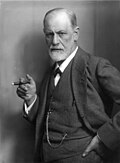 Sigmund Freud by Max Halberstadt, c. 1921 (from Western philosophy)
 -

-

-
 Edmund Husserl, in the 1910s (from Western philosophy)
 -
 William James in 1906 (from Western philosophy)
 -
 Gottfried Wilhelm Leibniz, 1695 (from Western philosophy)
 -
 Erasmus is Credited as the Prince of the Humanists (from Western philosophy)
 -
 Confucius (from Eastern philosophy)
 -

-

-
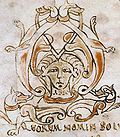
-

-
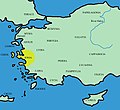
-
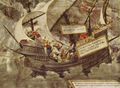 The philosopher Pyrrho of Elis, in an anecdote taken from Sextus Empiricus' Outlines of Pyrrhonism(upper)PIRRHO • HELIENSIS •
PLISTARCHI • FILIVS
translation (from Latin): Pyrrho • Greek • Son of Plistarchus(middle)OPORTERE • SAPIENTEM
HANC ILLIVS IMITARI
SECVRITATEMtranslation (from Latin): It is right wisdom then that all imitate this security (Pyrrho pointing at a peaceful pig munching his food)(lower)Whoever wants to apply the real wisdom, shall not mind trepidation and misery(from Ancient Greek philosophy) -
Portrait by Philippe de Champaigne, 17th century (from Medieval philosophy)
-

-

-
 Bust of Socrates, Roman copy after a Greek original from the 4th century BC (from Western philosophy)
 -

-
 Georg Wilhelm Friedrich Hegel, steel engraving, after 1828 (from Western philosophy)
 -

-
 Fukuzawa Yukichi (1862) a key civil rights activist and liberal thinker (from Eastern philosophy)
 -
 Map of Alexander the Great's empire and the route he and Pyrrho of Elis took to India (from Western philosophy)
 -
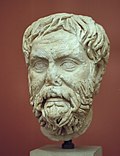
-
 Patricia Churchland, 2005 (from Western philosophy)
 -

-

-

.jpg)


_Mausoleum_-_Hamadan_-_Western_Iran_(7423560860).jpg)


.png)
.jpg)


.jpg)


.jpg)


Selected pictures
-
 Niels Bohr (1885–1962) was a Danish physicist who made foundational contributions to understanding atomic structure and quantum theory, for which he received the Nobel Prize in Physics in 1922. Bohr was also a philosopher and a promoter of scientific research.
 -
 Leo Tolstoy in 1897. Count Lev Nikolayevich Tolstoy was a Russian writer who is regarded as one of the greatest authors of all time.
 -
 Oscar Wilde reclining with Poems, by Napoleon Sarony, in New York in 1882. Wilde often liked to appear idle, though in fact he worked hard; by the late 1880s he was a father, an editor, and a writer.
 -
 Jane Addams (1860–1935) was an American settlement activist, reformer, social worker, sociologist, public administrator and author. She was a notable figure in the history of social work and women's suffrage in the United States and an advocate for world peace.
 -

-
 Umberto Eco OMRI (1932–2016) was an Italian novelist, literary critic, philosopher, semiotician, and university professor. He is widely known for his 1980 novel Il nome della rosa (The Name of the Rose), a historical mystery combining semiotics in fiction with biblical analysis, medieval studies, and literary theory.
 -
 The House Builders (Portraits of Sir W.E. & The Hon. Lady Welby-Gregory), an 1880 painting by Frank Dicksee
 -
 Philosophy, an 1896 mural by Robert Lewis Reid in the North Corridor on the Second Floor of the Library of Congress Thomas Jefferson Building, Washington, D.C.. The caption underneath reads: "HOW CHARMING IS DIVINE PHILOSOPHY."
 -
![Image 9Adam Smith (baptised 16 June 1723 – died 17 July 1790 [OS: 5 June 1723 – 17 July 1790]) was a Scottish moral philosopher and a pioneer of political economics. One of the key figures of the Scottish Enlightenment, Smith is the author of The Theory of Moral Sentiments and An Inquiry into the Nature and Causes of the Wealth of Nations. The latter, usually abbreviated as The Wealth of Nations, is considered his magnum opus and the first modern work of economics. Smith is widely cited as the father of modern economics.](//upload.wikimedia.org/wikipedia/commons/thumb/c/c0/Kirkcaldy_High_Street_Adam_Smith_Plaque.png/120px-Kirkcaldy_High_Street_Adam_Smith_Plaque.png) Adam Smith (baptised 16 June 1723 – died 17 July 1790 [OS: 5 June 1723 – 17 July 1790]) was a Scottish moral philosopher and a pioneer of political economics. One of the key figures of the Scottish Enlightenment, Smith is the author of The Theory of Moral Sentiments and An Inquiry into the Nature and Causes of the Wealth of Nations. The latter, usually abbreviated as The Wealth of Nations, is considered his magnum opus and the first modern work of economics. Smith is widely cited as the father of modern economics.
Adam Smith (baptised 16 June 1723 – died 17 July 1790 [OS: 5 June 1723 – 17 July 1790]) was a Scottish moral philosopher and a pioneer of political economics. One of the key figures of the Scottish Enlightenment, Smith is the author of The Theory of Moral Sentiments and An Inquiry into the Nature and Causes of the Wealth of Nations. The latter, usually abbreviated as The Wealth of Nations, is considered his magnum opus and the first modern work of economics. Smith is widely cited as the father of modern economics. -
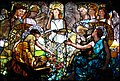 The center third of Education (1890), a stained glass window by Louis Comfort Tiffany and Tiffany Studios, located in Linsly-Chittenden Hall at Yale University. It depicts Science (personified by Devotion, Labor, Truth, Research and Intuition) and Religion (personified by Purity, Faith, Hope, Reverence and Inspiration) in harmony, presided over by the central personification of "Light·Love·Life".
 -
 Lady Dorothy Browne and Sir Thomas Browne is an oil on panel painting attributed to the English artist Joan Carlile, and probably completed between 1641 and 1650. The painting depicts English physician Thomas Browne and his wife Dorothy.
 -
 Carl von Linné, Alexander Roslin, 1775 (oil on canvas, Gripsholm Castle). Linnaeus was a Swedish botanist, zoologist, and physician who formalised binomial nomenclature, the modern system of naming organisms. He is known as the "father of modern taxonomy".
 -
 The statue of Immanuel Kant in front of the Immanuel Kant State University of Russia in Kaliningrad. The statue was made by notable sculptor Christian Daniel Rauch and unveiled in 1864. The statue was destroyed in 1945, but was remoulded in 1992 on the initiative of Marion Dönhoff.
 -
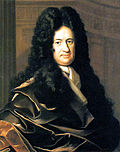 Painting of Gottfried Wilhelm Leibniz by Christoph Bernhard Francke, Braunschweig, Herzog Anton Ulrich Museum, 1700.
 -
 Voltairine de Cleyre (1866–1912) was an American anarchist known for being a prolific writer and speaker who opposed state power, the capitalism she saw as interconnected with it, and marriage, and the domination of religion over sexuality and women's lives. She is often characterized as a major early feminist because of her views.
 -
 Plato (left) and Aristotle (right), a detail of The School of Athens, a fresco by Raphael. Aristotle gestures to the earth, representing his belief in knowledge through empirical observation and experience, while holding a copy of his Nicomachean Ethics in his hand, whilst Plato gestures to the heavens, representing his belief in The Forms.
 -
 Friedrich Schiller (1759–1805) was a German poet, philosopher, physician, historian and playwright.


![Image 9Adam Smith (baptised 16 June 1723 – died 17 July 1790 [OS: 5 June 1723 – 17 July 1790]) was a Scottish moral philosopher and a pioneer of political economics. One of the key figures of the Scottish Enlightenment, Smith is the author of The Theory of Moral Sentiments and An Inquiry into the Nature and Causes of the Wealth of Nations. The latter, usually abbreviated as The Wealth of Nations, is considered his magnum opus and the first modern work of economics. Smith is widely cited as the father of modern economics.](/proxy/https://en.wikipedia.org/wiki/File:Kirkcaldy_High_Street_Adam_Smith_Plaque.png)
.JPG)
;_Sir_Thomas_Browne_by_Joan_Carlile.jpg)


.jpg)


Topics
Academic Branches of Philosophy
Philosophy ponders the most fundamental questions humankind has been able to ask. These are increasingly numerous and over time they have been arranged into the overlapping branches of the philosophy tree:
- Aesthetics: What is art? What is beauty? Is there a standard of taste? Is art meaningful? If so, what does it mean? What is good art? Is art for the purpose of an end, or is "art for art's sake?" What connects us to art? How does art affect us? Is some art unethical? Can art corrupt or elevate societies?
- Epistemology: What are the nature and limits of knowledge? What is more fundamental to human existence, knowing (epistemology) or being (ontology)? How do we come to know what we know? What are the limits and scope of knowledge? How can we know that there are other minds (if we can)? How can we know that there is an external world (if we can)? How can we prove our answers? What is a true statement?
- Ethics: Is there a difference between ethically right and wrong actions (or values, or institutions)? If so, what is that difference? Which actions are right, and which wrong? Do divine commands make right acts right, or is their rightness based on something else? Are there standards of rightness that are absolute, or are all such standards relative to particular cultures? How should I live? What is happiness?
- Logic: What makes a good argument? How can I think critically about complicated arguments? What makes for good thinking? When can I say that something just does not make sense? Where is the origin of logic?
- Metaphysics: What sorts of things exist? What is the nature of those things? Do some things exist independently of our perception? What is the nature of space and time? What is the relationship of the mind to the body? What is it to be a person? What is it to be conscious? Do gods exist?
- Political philosophy: Are political institutions and their exercise of power justified? What is justice? Is there a 'proper' role and scope of government? Is democracy the best form of governance? Is governance ethically justifiable? Should a state be allowed? Should a state be able to promote the norms and values of a certain moral or religious doctrine? Are states allowed to go to war? Do states have duties against inhabitants of other states?
Related Academic Fields
- Axiology
- Ecosophy
- Environmental philosophy
- Hermeneutics
- History of philosophy
- Jurisprudence
- Meta-ethics
- Metalogic
- Metaphilosophy
- Neurophilosophy
- Phenomenology
- Philosophical anthropology
- Philosophy and literature
- Philosophy of artificial intelligence
- Philosophy of biology
- Philosophy of business
- Philosophy of chemistry
- Philosophy of copyright
- Philosophy of design
- Philosophy of economics
- Philosophy of education
- Philosophy of engineering
- Philosophy of film
- Philosophy of geography
- Philosophy of healthcare
- Philosophy of history
- Philosophy of information
- Philosophy of language
- Philosophy of life
- Philosophy of logic
- Philosophy of love
- Philosophy of mathematics
- Philosophy of mathematics education
- Philosophy of mind
- Philosophy of music
- Philosophy of perception
- Philosophy of physics
- Philosophy of probability
- Philosophy of psychology
- Philosophy of religion
- Philosophy of science
- Philosophy of sex
- Philosophy of social science
- Philosophy of space and time
- Philosophy of statistics
- Philosophy of technology
- Philosophy of thermal and statistical physics
- Philosophy of war
- Praxeology
List articles

- Lists of philosophers
- List of philosophical concepts
- List of philosophical theories
- List of philosophy journals
- List of aestheticians
- List of ancient Platonists
- List of critical theorists
- List of ethicists
- List of epistemologists
- List of women philosophers
- List of logicians
- List of metaphysicians
- List of political philosophers
- List of thinkers influenced by deconstruction
Categories

Miscellaneous
Wikipedia Philosophy Resources

- Central Φ Discussion
- Recent Changes to Φ Articles
- Philosophy Categories
- Project_Structure
- Philosophy Style Guide
- New Φ Articles
- Most Popular Articles
- Philosophy Reference Resources
- Requested Φ Articles
- Requests For Comment
- Humanities Reference Desk
- Featured Φ Articles
- Φ Hall of Fame
- Φ Articles Proposed For Deletion
- Φ Cleanup Listing
- Article Assessment
- Log of Assessment Changes
- Assessment Statistics
- Philosophy and thinking
- Wikiversity School of Philosophy
Task forces
Related WikiProjects
Associated Wikimedia
The following Wikimedia Foundation sister projects provide more on this subject:
-
 Commons
Free media repository -
 Wikidata
Free knowledge base -
 Wikiquote
Collection of quotations -
 Wikisource
Free-content library -
 Wikispecies
Directory of species -
 Wikiversity
Free learning tools -
 Wikivoyage
Free travel guide -
 Wiktionary
Dictionary and thesaurus


Web resources
- PhilPapers: Online Research in Philosophy
- Introducing Philosophy Series
- Dictionary of Philosophical Terms and Names
- Stanford Encyclopedia of Philosophy
- The Internet Encyclopedia of Philosophy
- The reference library for Jain Philosophy
- Cosmos and History: The Journal of Natural and Social Philosophy
- Early Modern Texts
- Philosophy Now
- The Philosophers' Magazine Online
- Indiana Philosophy Ontology Project Taxonomy search tool
- Noesis - Philosophical research online
- Notre Dame Philosophical Reviews
Sources
More portals


