


Portal:Literature

Introduction
.jpg)
Literature is any collection of written work. The term is also used more narrowly for writings considered an art form, especially novels, plays, and poems. It includes both print and digital writing. In recent centuries, the definition has expanded to include oral literature, much of which has been transcribed. Literature is a method of recording, preserving, and transmitting knowledge and entertainment. It can also have a social, psychological, spiritual, or political role.
Literary criticism is one of the oldest academic disciplines, and is concerned with the literary merit or intellectual significance of specific texts. The study of books and other texts as artifacts or traditions is instead encompassed by textual criticism or the history of the book. "Literature", as an art form, is sometimes used synonymously with literary fiction, fiction written with the goal of artistic merit, but can also include works in various non-fiction genres, such as biography, diaries, memoirs, letters, and essays. Within this broader definition, literature includes non-fictional books, articles, or other written information on a particular subject. (Full article...)
General images -
-
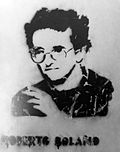 Roberto Bolaño is considered to have had the greatest United States impact of any post-Boom author (from Latin American literature)
 -
 Cover of the Argentine children's magazine Billiken N° 1 (1919) (from Children's literature)
 -
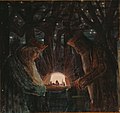 Kings' Fairy Tale, 1909, by Mikalojus Konstantinas Čiurlionis (from Fairy tale)
 -
 The Crescent Moon by Rabindranath Tagore illus. by Nandalal Bose, Macmillan 1913 (from Children's literature)
 -
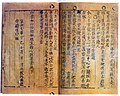 Jikji, Selected Teachings of Buddhist Sages and Seon Masters, the earliest known book printed with movable metal type, 1377. Bibliothèque Nationale de France, Paris. (from History of books)
 -
 Folio from the Shah Jahan Album, c. 1620, depicting the Mughal Emperor Shah Jahan (from History of books)
 -
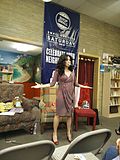 H. O. Tanager performs at a bookstore in Boise, Idaho. (from Performance poetry)
 -
 Page from a Jain manuscript depicting the birth of Mahavira, c. 1400 (from History of books)
 -
 Chinese Bookseller, illustration, c. 1824 (from History of books)
 -
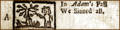 The New England Primer (from Children's literature)
 -
 Poet Charles G. D. Roberts belonged to an informal group known as the Confederation Poets. (from Canadian literature)
 -
 The annual production of handwritten manuscripts and printed books per 1000 people in Western Europe (from History of books)
 -
-
 The intricate frontispiece of the Diamond Sutra from Tang dynasty China, i.e. 868 CE, the oldest known dated printed book in the world (British Library) (from History of books)
 -
 12-metre-high (40 ft) sculpture of a stack of books at the Berlin Walk of Ideas, commemorating the invention of modern book printing (from History of books)
 -
 Sculpture of Alfonso Reyes writer of influential pieces of Mexican surrealism. (from Latin American literature)
 -
 Gabrielle Roy was a notable French Canadian author. (from Canadian literature)
 -
 The Fairy Tale, a painting by James Sant in 1845 (from Fairy tale)
 -
 An early Chinese poetics, the Kǒngzǐ Shīlùn (孔子詩論), discussing the Shijing (Classic of Poetry) (from History of poetry)
 -
 The Nobel diploma awarded to Hermann Hesse in 1946 (from Nobel Prize in Literature)
 -
 A twentieth-century copyright imprint from McLoughlin Bros that features three rams and the copyright year, 1903 (from History of books)
 -

-
 Peruvian poet César Vallejo, considered by Thomas Merton "the greatest universal poet since Dante" (from Latin American literature)
 -
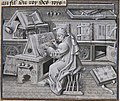 An author portrait of Jean Miélot writing his compilation of the Miracles of Our Lady, one of his many popular works. (from History of books)
 -
 J. K. Rowling reads from her novel Harry Potter and the Philosopher's Stone (from Children's literature)
 -
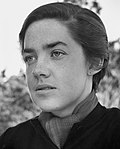 Children's books author Maria Elena Walsh in 1952. (from Children's literature)
 -
 The Swedish Academy's permanent secretary Peter Englund at the announcement of the 2010 Nobel Prize in Literature (from Nobel Prize in Literature)
 -
 The first page of Beowulf (from Medieval literature)
 -
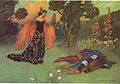
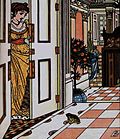 Walter Crane's chromolithograph illustration for The Frog Prince, 1874. (from Children's literature)
 -
 Goethe's Italian Journey between September 1786 and May 1788 (from Travel literature)
 -
 A 15th-century incunable. Notice the blind-tooled cover, corner bosses, and clasps. (from History of books)
 -
 Author Margaret Atwood has suggested that during the 1970s Canadian literature was still looking for a national identity. (from Canadian literature)
 -
 Ivan Bilibin (1876–1942)'s illustration of the Russian fairy tale about Vasilisa the Beautiful (from Fairy tale)
 -
 The Adventures of Pinocchio (1883) is a canonical piece of children's literature and one of the best-selling books ever published. (from Children's literature)
 -
 Woman holding wax tablets in the form of the codex. Wall painting from Pompeii, before 79 CE. (from History of books)
 -
 The character which means "poetry", in the ancient Chinese Great Seal script style. The modern character is 詩/诗 (shī). (from History of poetry)
 -
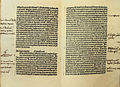 Handwritten notes by Christopher Columbus on a Latin edition of The Travels of Marco Polo (from Travel literature)
 -
 A poet with a few enraptured fans (from Performance poetry)
 -
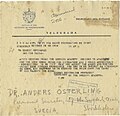 Hemingway's telegram in 1954 (The academy has alternately used for Literature and in Literature over the years, the latter becoming the norm today.) (from Nobel Prize in Literature)
 -
 Cutlery for children. Detail showing fairy-tale scenes: Snow White, Little Red Riding Hood, Hansel and Gretel. (from Fairy tale)
 -
 Illustration from Robert Louis Stevenson's 1883 coming-of-age pirate adventure Treasure Island (from Children's literature)
 -
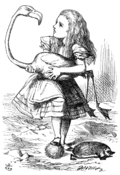 Illustration from Alice's Adventures in Wonderland, 1865 (from Children's literature)
 -
 Page 49 of the Dresden Codex (from History of books)
 -
 In 1901, French poet and essayist Sully Prudhomme (1839–1907) was the first person to be awarded the Nobel Prize in Literature, "in special recognition of his poetic composition, which gives evidence of lofty idealism, artistic perfection, and a rare combination of the qualities of both heart and intellect." (from Nobel Prize in Literature)
 -
 1900 edition of the controversial The Story of Little Black Sambo (from Children's literature)
 -
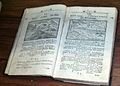 A late 18th-century reprint of Orbis Pictus by Comenius, the first children's picture book. (from Children's literature)
 -
 Spanish philologist Ramón Menéndez Pidal was never awarded despite the numerous nominations. (from Nobel Prize in Literature)
 -
 The Violet Fairy Book (1906)
 -
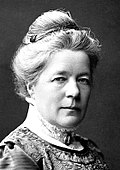 Selma Lagerlöf, the first female author awarded the prize (from Nobel Prize in Literature)
 -
 A Chinese bamboo book, The Art of War, commissioned by the Qianlong Emperor in 18th-century China (from History of books)
 -
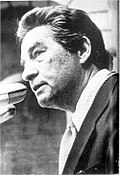 Octavio Paz helped to define modern poetry and the Mexican personality. (from Latin American literature)
 -

-
 Hugo Ball performing at the Cabaret Voltaire (from Performance poetry)
 -
 The scene in Botticelli's Madonna of the Book (1480) reflects the presence of books in the houses of richer people in his time. (from History of books)
 -

-
 Father Frost acts as a donor in the Russian fairy tale Father Frost, testing the heroine before bestowing riches upon her (from Fairy tale)
 -
 The oldest known love poem. Sumerian terracotta tablet#2461 from Nippur, Iraq. Ur III period, 2037–2029 BCE. Ancient Orient Museum, Istanbul (from History of poetry)
 -
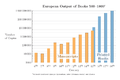 European output of books 500–1800 (from History of books)
 -
 Statuta Mutine Reformata, 1420–1485; parchment codex bound in wood and leather with brass plaques worked the corners and in the center, with clasps. (from Medieval literature)
 -
 Pages from the 1819 edition of Kinder- und Haus-Märchen by the Brothers Grimm (from Children's literature)
 -
 The philosopher Confucius was influential in the developed approach to poetry and ancient music theory. (from History of poetry)
 -
 The Story of Mankind (1921) by Hendrik van Loon, 1st Newbery Award winner (from Children's literature)
 -
 A mother reads to her children in a mid- to late 19th century lithograph by Jessie Willcox Smith. (from Children's literature)
 -
 Number of children's books titles published by the trade sector in 2020 (from Children's literature)
 -
 Statue of C. S. Lewis in front of the wardrobe from his Narnia book The Lion, the Witch and the Wardrobe (from Children's literature)
 -
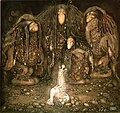 John Bauer's illustration of trolls and a princess from a collection of Swedish fairy tales (from Fairy tale)
 -
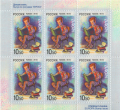 Postal stamp of Russia celebrating children's books. (from Children's literature)
 -

-
 A Tagore illustration of a Hindu myth (from Children's literature)
 -
 Gabriel García Márquez, one of the most renowned Latin American writers (from Latin American literature)
 -
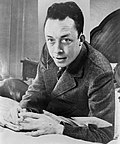 French author Albert Camus was the first African-born writer to receive the award. (from Nobel Prize in Literature)
 -
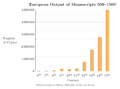 Estimated medieval output of manuscripts in terms of copies (from Medieval literature)
 -
 Rudyard Kipling, the youngest recipient of the Nobel Prize in Literature (from Nobel Prize in Literature)
 -
 European output of printed books c. 1450–1800 (from History of books)
 -
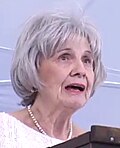 Short story writer Alice Munro won the Nobel Prize in Literature in 2013. (from Canadian literature)
 -
 The European fairy tale Little Red Riding Hood and the Wolf in a painting by Carl Larsson in 1881 (from Fairy tale)
 -
 Wole Soyinka, the first African writer awarded the prize (from Nobel Prize in Literature)
 -
European output of manuscripts 500–1500 (from History of books)
-
 Statue of Minnie the Minx, a character from The Beano. Launched in 1938, the comic is known for its anarchic humour, with Dennis the Menace appearing on the cover. (from Children's literature)
 -
-
 Illustration from the Codex Manesse, a German book from the Middle Ages (from History of books)
 -
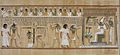 The Book of the Dead of Hunefer, c. 1275 BCE, ink and pigments on papyrus, in the British Museum (London) (from History of books)
 -
 Two people in costumes inspired by Willy Wonka (from Roald Dahl's Charlie and the Chocolate Factory), and the Hatter (from Lewis Carroll's Alice's Adventures in Wonderland) in London (from Children's literature)
 -
 An early Mexican hornbook pictured in Tuer's History of the Horn-Book, 1896. (from Children's literature)
 -
 John Newbery's A Little Pretty Pocket-Book, originally published in 1744 (from Children's literature)
 -
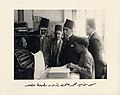 Photograph of a printing press in Egypt, c. 1922 (from History of books)
 -

-
 A Sumerian clay tablet, currently housed in the Oriental Institute at the University of Chicago, inscribed with the text of the poem Inanna and Ebih by the priestess Enheduanna, the first author whose name is known
 -
 Natias Neutert performing Diogenes Synopsis as at Künstlerhaus Bethanien Berlin, 1986 (from Performance poetry)


_-_1909.jpg)


.jpg)


_(14751020284).jpg)


_-_Google_Art_Project.jpg)


.jpg)


.jpg)

.jpg)

.jpg)


.jpg)


 Selected work


The narrative draws on various Romantic literary traditions, such as the comedy of manners, the Gothic tale, and the Byronic hero. The novel's language is a pastiche of 19th-century writing styles, such as those of Jane Austen and Charles Dickens. Clarke describes the supernatural with mundane details. She supplements the text with almost 200 footnotes, outlining the backstory and an entire fictional corpus of magical scholarship. The novel was well received by critics and reached number three on the New York Times best-seller list. It was longlisted for the 2004 Man Booker Prize and won the 2005 Hugo Award for Best Novel.
Selected biographies -
-
![Image 1 Andrade in 1928 Mário Raul de Morais Andrade (Portuguese pronunciation: [ˈmaɾiu ʁaˈu dʒi moˈɾajs ɐ̃ˈdɾadʒi]; October 9, 1893 – February 25, 1945) was a Brazilian poet, novelist, musicologist, art historian and critic, and photographer. He wrote one of the first and most influential collections of modern Brazilian poetry, Paulicéia Desvairada (Hallucinated City), published in 1922. He has had considerable influence on modern Brazilian literature, and as a scholar and essayist—he was a pioneer of the field of ethnomusicology—his influence has reached far beyond Brazil. Andrade was a central figure in the avant-garde movement of São Paulo for twenty years. Trained as a musician and best known as a poet and novelist, Andrade was personally involved in virtually every discipline that was connected with São Paulo modernism. His photography and essays on a wide variety of subjects, from history to literature and music, were widely published. He was the driving force behind the Modern Art Week, the 1922 event that reshaped both literature and the visual arts in Brazil, and a member of the avant-garde "Group of Five". The ideas behind the Week were further explored in the preface to his poetry collection Pauliceia Desvairada, and in the poems themselves. (Full article...)](//upload.wikimedia.org/wikipedia/en/d/d2/Blank.png)
Mário Raul de Morais Andrade (Portuguese pronunciation: [ˈmaɾiu ʁaˈu dʒi moˈɾajs ɐ̃ˈdɾadʒi]; October 9, 1893 – February 25, 1945) was a Brazilian poet, novelist, musicologist, art historian and critic, and photographer. He wrote one of the first and most influential collections of modern Brazilian poetry, Paulicéia Desvairada (Hallucinated City), published in 1922. He has had considerable influence on modern Brazilian literature, and as a scholar and essayist—he was a pioneer of the field of ethnomusicology—his influence has reached far beyond Brazil.
Andrade was a central figure in the avant-garde movement of São Paulo for twenty years. Trained as a musician and best known as a poet and novelist, Andrade was personally involved in virtually every discipline that was connected with São Paulo modernism. His photography and essays on a wide variety of subjects, from history to literature and music, were widely published. He was the driving force behind the Modern Art Week, the 1922 event that reshaped both literature and the visual arts in Brazil, and a member of the avant-garde "Group of Five". The ideas behind the Week were further explored in the preface to his poetry collection Pauliceia Desvairada, and in the poems themselves. (Full article...) -
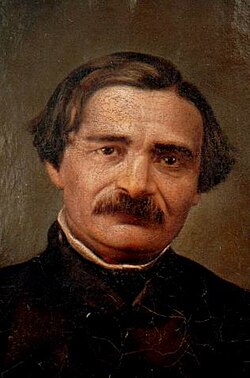
Ion Heliade Rădulescu or Ion Heliade (also known as Eliade or Eliade Rădulescu; Romanian pronunciation: [ˈi.on (h)eliˈade rəduˈlesku]; 6 January 1802 – 27 April 1872) was a Wallachian, later Romanian academic, Romantic and Classicist poet, essayist, memoirist, short story writer, newspaper editor and politician. A prolific translator of foreign literature into Romanian, he was also the author of books on linguistics and history. For much of his life, Heliade Rădulescu was a teacher at Saint Sava College in Bucharest, which he helped reopen. He was a founding member and first president of the Romanian Academy.
Heliade Rădulescu is considered one of the foremost champions of Romanian culture from the first half of the 19th century, having first risen to prominence through his association with Gheorghe Lazăr and his support of Lazăr's drive for discontinuing education in Greek. Over the following decades, he had a major role in shaping the modern Romanian language, but caused controversy when he advocated the massive introduction of Italian neologisms into the Romanian lexis. A Romantic nationalist landowner siding with moderate liberals, Heliade was among the leaders of the 1848 Wallachian revolution, after which he was forced to spend several years in exile. Adopting an original form of conservatism, which emphasized the role of the aristocratic boyars in Romanian history, he was rewarded for supporting the Ottoman Empire and clashed with the radical wing of the 1848 revolutionaries. (Full article...) -
Maya Angelou (/ˈændʒəloʊ/ ⓘ AN-jə-loh; born Marguerite Annie Johnson; April 4, 1928 – May 28, 2014) was an American memoirist, essayist, poet, and civil rights activist. She published seven autobiographies, three books of essays, several books of poetry, and is credited with a list of plays, movies, and television shows spanning over 50 years. She received dozens of awards and more than 50 honorary degrees. Angelou's series of seven autobiographies focus on her childhood and early adult experiences. The first, I Know Why the Caged Bird Sings (1969), tells of her life up to the age of 17 and brought her international recognition and acclaim.
She became a poet and writer after a string of odd jobs during her young adulthood. In 1982, Angelou was named the first Reynolds Professor of American Studies at Wake Forest University in Winston-Salem, North Carolina. Angelou was active in the Civil Rights Movement and worked with Martin Luther King Jr. and Malcolm X. Beginning in the 1990s, she made approximately 80 appearances a year on the lecture circuit, something she continued into her eighties. In 1993, Angelou recited her poem "On the Pulse of Morning" (1993) at the first inauguration of Bill Clinton, making her the first poet to make an inaugural recitation since Robert Frost at the inauguration of John F. Kennedy in 1961. (Full article...) -
Joanne Rowling (/ˈroʊlɪŋ/ ⓘ ROH-ling; born 31 July 1965), better known by her pen name J. K. Rowling, is a British author, philanthropist, producer, and screenwriter. She is best known for writing Harry Potter, a seven-volume series about a young wizard which is the best-selling book series in history, with over 600 million copies sold. She writes Cormoran Strike, an ongoing crime fiction series, under the alias Robert Galbraith.
Rowling conceived the idea for the Harry Potter series in 1990. The seven-year period that followed saw the death of her mother, the birth of her first child, divorce from her first husband, and relative poverty until the first novel in the series, Harry Potter and the Philosopher's Stone, was published in 1997. Six sequels followed, concluding with Harry Potter and the Deathly Hallows (2007). In 2008, Forbes named her the world's highest-paid author. The books have been translated into 84 languages and have spawned a global media franchise including films and video games. The series revived fantasy as a genre in the children's market, spawned a host of imitators, and inspired an active fandom. Critical reception has been more mixed. Many reviewers see Rowling's writing as conventional; some regard her portrayal of gender and social division as regressive. There were also religious debates over the Harry Potter series. (Full article...) -
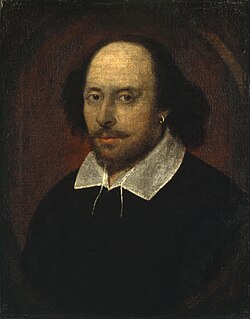
William Shakespeare (c. 23 April 1564 – 23 April 1616) was an English playwright, poet and actor. He is widely regarded as the greatest writer in the English language and the world's pre-eminent dramatist. He is often called England's national poet and the "Bard of Avon" or simply "the Bard". His extant works, including collaborations, consist of some 39 plays, 154 sonnets, three long narrative poems and a few other verses, some of uncertain authorship. His plays have been translated into every major living language and are performed more often than those of any other playwright. Shakespeare remains arguably the most influential writer in the English language, and his works continue to be studied and reinterpreted.
Shakespeare was born and raised in Stratford-upon-Avon, Warwickshire. At the age of 18, he married Anne Hathaway, with whom he had three children: Susanna, and twins Hamnet and Judith. Sometime between 1585 and 1592 he began a successful career in London as an actor, writer, and part-owner ("sharer") of a playing company called the Lord Chamberlain's Men, later known as the King's Men after the ascension of King James VI of Scotland to the English throne. At age 49 (around 1613) he appears to have retired to Stratford, where he died three years later. Few records of Shakespeare's private life survive; this has stimulated considerable speculation about such matters as his physical appearance, his sexuality, his religious beliefs and even certain fringe theories as to whether the works attributed to him were written by others. (Full article...) -

Francis bin Fathallah bin Nasrallah Marrash (Arabic: فرنسيس بن فتح الله بن نصر الله مرّاش, ALA-LC: Fransīs bin Fatḥ Allāh bin Naṣr Allāh Marrāsh; 1835 or 29 June 1836 – 1874), also known as Francis al-Marrash or Francis Marrash al-Halabi, was a Syrian scholar, publicist, writer and poet of the Nahda or the Arab Renaissance, and a physician. Most of his works revolve around science, history and religion, analysed under an epistemological light. He traveled throughout West Asia and France in his youth, and after some medical training and a year of practice in his native Aleppo, during which he wrote several works, he enrolled in a medical school in Paris; yet, declining health and growing blindness forced him to return to Aleppo, where he produced more literary works until his early death.
Historian Matti Moosa considered Marrash to have been the first truly cosmopolitan Arab intellectual and writer of modern times. Marrash adhered to the principles of the French Revolution and defended them in his own works, implicitly criticizing Ottoman rule in West Asia and North Africa. He was also influential in introducing French romanticism in the Arab world, especially through his use of poetic prose and prose poetry, of which his writings were the first examples in modern Arabic literature, according to Salma Khadra Jayyusi and Shmuel Moreh. His modes of thinking and feeling, and ways of expressing them, have had a lasting influence on contemporary Arab thought and on the Mahjari poets. (Full article...) -
Honoré de Balzac (/ˈbæl.zæk/ BAL-zak, more commonly US: /ˈbɔːl.-/ BAWL-; French: [ɔnɔʁe d(ə) balzak]; born Honoré Balzac; 20 May 1799 – 18 August 1850) was a French novelist and playwright. The novel sequence La Comédie humaine, described as a panorama of post-Napoleonic French life, is generally viewed as his magnum opus.
Owing to his keen observation of detail and unfiltered representation of society, Balzac is regarded as one of the founders of realism in European literature. He is renowned for his multi-faceted characters; even his lesser characters are complex, morally ambiguous and fully human. Inanimate objects are imbued with character as well; the city of Paris, a backdrop for much of his writing, takes on many human qualities. His writing influenced many famous writers, including the novelists Émile Zola, Charles Dickens, Marcel Proust, Gustave Flaubert, Henry James and Fyodor Dostoevsky, and filmmakers François Truffaut and Jacques Rivette. Many of Balzac's works have been made into films and continue to inspire other writers. James called him "really the father of us all." (Full article...) -
Tengku Amir Hamzah (February 1911 – 20 March 1946) was an Indonesian poet and National Hero of Indonesia. Born into a Malay aristocratic family in the Sultanate of Langkat in North Sumatra, he was educated in both Sumatra and Java. While attending senior high school in Surakarta around 1930, Amir became involved with the nationalist movement and fell in love with a Javanese schoolmate, Ilik Sundari. Even after Amir continued his studies in legal school in Batavia (now Jakarta) the two remained close, only separating in 1937 when Amir was recalled to Sumatra to marry the sultan's daughter and take on responsibilities of the court. Though unhappy with his marriage, he fulfilled his courtly duties. After Indonesia proclaimed its independence in 1945, he served as the government's representative in Langkat. The following year he was killed in a social revolution led by the PESINDO (Pemuda Sosialis Indonesia), and buried in a mass grave.
Amir began writing poetry while still a teenager: though his works are undated, the earliest are thought to have been written when he first travelled to Java. Drawing influences from his own Malay culture and Islam, as well as from Christianity and Eastern literature, Amir wrote 50 poems, 18 pieces of lyrical prose, and numerous other works, including several translations. In 1932 he co-founded the literary magazine Poedjangga Baroe. After his return to Sumatra, he stopped writing. Most of his poems were published in two collections, Nyanyi Sunyi (1937) and Buah Rindu (1941), first in Poedjangga Baroe then as stand-alone books. (Full article...) -
Du Fu (Chinese: 杜甫; pinyin: Dù Fǔ; Wade–Giles: Tu Fu; 712 – 770) was a Chinese poet and politician during the Tang dynasty. Together with his elder contemporary and friend Li Bai, Du is often considered one of the greatest Chinese poets of his time. His greatest ambition was to serve his country as a successful civil servant, but Du proved unable to make the necessary accommodations. His life, like all of China, was devastated by the An Lushan rebellion of 755, and his last 15 years were a time of almost constant unrest.
Although initially he was little-known to other writers, his works came to be hugely influential in both Chinese and Japanese literary culture. Of his poetic writing, nearly fifteen hundred poems have been preserved over the ages. He has been called the "Poet-Historian" and the "Poet-Sage" by Chinese critics, while the range of his work has allowed him to be introduced to Western readers as "the Chinese Virgil, Horace, Ovid, Shakespeare, Milton, Burns, Wordsworth, Béranger, Hugo or Baudelaire". (Full article...) -
Emily Elizabeth Dickinson (December 10, 1830 – May 15, 1886) was an American poet. Largely unpublished and unknown during her lifetime, her work is now widely regarded as canonical. The Poetry Foundation describes her as having "created in her writing a distinctively elliptical language for expressing what was possible but not yet realized."
Dickinson was born in Amherst, Massachusetts to a prominent family. After studying at the Amherst Academy for seven years, she briefly attended the Mount Holyoke Female Seminary before returning home to Amherst. (Full article...)
![Image 1 Andrade in 1928 Mário Raul de Morais Andrade (Portuguese pronunciation: [ˈmaɾiu ʁaˈu dʒi moˈɾajs ɐ̃ˈdɾadʒi]; October 9, 1893 – February 25, 1945) was a Brazilian poet, novelist, musicologist, art historian and critic, and photographer. He wrote one of the first and most influential collections of modern Brazilian poetry, Paulicéia Desvairada (Hallucinated City), published in 1922. He has had considerable influence on modern Brazilian literature, and as a scholar and essayist—he was a pioneer of the field of ethnomusicology—his influence has reached far beyond Brazil. Andrade was a central figure in the avant-garde movement of São Paulo for twenty years. Trained as a musician and best known as a poet and novelist, Andrade was personally involved in virtually every discipline that was connected with São Paulo modernism. His photography and essays on a wide variety of subjects, from history to literature and music, were widely published. He was the driving force behind the Modern Art Week, the 1922 event that reshaped both literature and the visual arts in Brazil, and a member of the avant-garde "Group of Five". The ideas behind the Week were further explored in the preface to his poetry collection Pauliceia Desvairada, and in the poems themselves. (Full article...)](/proxy/https://en.wikipedia.org/wiki/File:Blank.png)


.jpg)


Selected excerpt
| “ | The pedigree of honey Does not concern the bee ; A clover, any time, to him Is aristocracy. |
” |
| — Emily Dickinson, "The pedigree of Honey" | ||
More Did you know
- ... that the reality television poetry competition Prince of Poets is more popular than football in countries of the Arab world, where it airs?
- ... that The Curious Incident of the Dog in the Night-Time won a record-tying seven Olivier Awards at the 2013 Laurence Olivier Awards on April 28, 2013?
- ... that Berit Brænne's first children's book, from 1958, is a story about a sailor's family who adopted children from different parts of the world?
- ... that the 1934 Jeanne Galzy novel Jeunes filles en serre chaude, with its seductive title, was deemed to contain "dangerous aberrations" and "strong emotional reaction[s] of an undesirable nature"?
- ... that Fu Sheng was credited with saving the Confucian classic Book of Documents from the book burning of the First Emperor of China?
Selected illustration
-
 Engraving: Dalziel Brothers; Restoration: Adam CuerdenA scene from Sir Walter Scott's 1817 historical novel Rob Roy, which tells the story of Frank Osbaldistone, the son of an English merchant who travels to Scotland to collect a debt stolen from his father. On the way he encounters the larger-than-life title character of Rob Roy MacGregor. Though Rob Roy is not the lead character (in fact the narrative does not move to Scotland until halfway through the book) his personality and actions are key to the story's development. The novel is a brutally realistic depiction of the social conditions in Highland and Lowland Scotland in the early 18th century.
 -
 Illustration: John TennielThe Jabberwock, the titular creature of Lewis Carroll's nonsense poem "Jabberwocky". First included in Carroll's novel Through the Looking-Glass (1871), the poem was illustrated by John Tenniel, who gave the creature "the leathery wings of a pterodactyl and the long scaly neck and tail of a sauropod". "Jabberwocky" is considered one of the greatest nonsense poems written in English, and has contributed such nonsense words and neologisms as galumphing and chortle to the English lexicon.
 -
 Restoration: JujutacularAn illustration of Humpty Dumpty by American artist William Wallace Denslow, depicting the title character from the nursery rhyme of the same name. He is typically portrayed as an egg, although the rhyme never explicitly states that he is, possibly because it may have been originally posed as a riddle. The earliest known version is in a manuscript addition to a copy of Mother Goose's Melody published in 1803.
 -
 Illustration: Jessie Willcox Smith; Restoration: ErikTheBikeManAn illustration from a ca. 1916 edition of The Water-Babies, A Fairy Tale for a Land Baby, a children's novel written by Charles Kingsley and originally serialised in 1862–63. The book, a didactic moral fable, tells the story of Tom (lower left), a young boy who drowns and is reincarnated as a "water-baby". He undergoes a series of adventures and eventually regains his human form. It was extremely popular during its day and through the 1920s, but has since fallen out of favour, perhaps due to Kingsley's expression of many of the common prejudices of that time period, such as against Americans, Jews, blacks, and Catholics, particularly the Irish.
 -
 Painting: John QuidorThe Headless Horseman is a mythical figure who has appeared in folklore around the world since at least the Middle Ages. Depending on the legend, the Horseman is either carrying his head, or missing it altogether, and is searching for it. Examples include the dullahan from Ireland, who is a demonic fairy usually depicted riding a horse and carrying his head under his arm; the titular knight from the English tale Gawain and the Green Knight; and "The Legend of Sleepy Hollow," a short story written in 1820 by American Washington Irving which has been adapted into several other works of literature and film including the 1999 Tim Burton movie Sleepy Hollow.
This picture, titled The Headless Horseman Pursuing Ichabod Crane, is an 1858 painting by American artist John Quidor, depicting a scene from "The Legend of Sleepy Hollow". It is in the collection of the Smithsonian American Art Museum in Washington, D.C. -
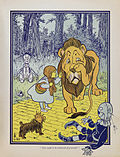 An illustration from the first edition of The Wonderful Wizard of Oz, depicting the scene where Dorothy meets the Cowardly Lion, the first time the four major characters of the novel come together. The book was originally published in 1900 and has since been reprinted countless times, most often under the name The Wizard of Oz, which is the name of both the 1902 Broadway musical and the extremely popular, highly acclaimed 1939 film version. Thanks in part to the film it is one of the best-known stories in American popular culture and has been widely translated. Its initial success, and the success of the popular 1902 musical Baum adapted from his story, led to his writing and having published thirteen more Oz books.
 -
 Restoration: Adam CuerdenAn engraving by Gustave Doré of a scene from Miguel de Cervantes's Don Quixote, the most influential work of literature from the Spanish Golden Age in the Spanish literary canon. The scene illustrated here occurs early in the novel, when Alonso Quixano (Quixote's real name) has become obsessed with books of chivalry, and believes their every word to be true, despite the fact that many of the events in them are clearly impossible. Don Quixote was published in two separate volumes, ten years apart. It is considered a founding work of modern Western literature, and it regularly appears high on lists of the greatest works of fiction ever published.
 -
 Illustration: Maud and Miska Petersham; restoration: Adam CuerdenRootabaga Stories is a children's book of interrelated short stories by Carl Sandburg, written in 1922. The stories are whimsical and sometimes melancholy, making use of nonsense language. Rootabaga Stories was originally created for Sandburg's own daughters, Margaret, Janet and Helga—whom he nicknamed "Spink", "Skabootch", and "Swipes"—and those nicknames occur in some of the Rootabaga stories. The book was born of Sandburg's desire for fairy tales to which American children could relate, rather than the traditional European stories involving royalty and knights. He therefore set the book in a fictionalized American Midwest called the "Rootabaga country", in which fairy-tale concepts were mixed with trains, sidewalks, and skyscrapers.
This picture shows the frontispiece of the 1922 edition of the book. -
 Engraver: J. Cooper; Restoration: Adam Cuerden"Le Noir Faineant in the Hermit's Cell", an illustration from an 1886 edition of Sir Walter Scott's 1819 novel Ivanhoe. Here, we see Le Noir Faineant, or the Black Knight (Richard the Lionheart in disguise) with Friar Tuck. Scott was an early pioneer in the development of the modern novel, and largely created the genre of historical fiction by weaving together legends and characters into his own creations. Ivanhoe, the story of one of the remaining Saxon noble families at a time when the English nobility was overwhelmingly Norman, was greatly influential on the modern view of the English folk hero Robin Hood, and has inspired many adaptations around the world in theatre, opera, film, and television.
 -
 Restoration: Lise BroerWilliam Wallace Denslow's illustration of the poem "The Queen of Hearts" from a 1901 issue of Mother Goose. The poem was originally published in 1782 as part of a set of four playing card based poems, but proved to be far more popular than the others. By 1785 it had been set to music, and it forms the basis of the plot of Lewis Carroll's Alice in Wonderland, Chapter XI: "Who Stole the Tarts?" Although it was originally published in a magazine for adults, it is now best known as a nursery rhyme.
 -
 Illustration: Unknown; restoration: Adam CuerdenJeeves is a fictional character in a series of comedic short stories and novels by English author P. G. Wodehouse, in which he is depicted as the highly competent valet of a wealthy and idle young Londoner named Bertie Wooster. First appearing in the short story "Extricating Young Gussie" in 1915, Jeeves continued to feature in Wodehouse's work until his last completed novel, Aunts Aren't Gentlemen (1974). He also appeared in numerous films and television series, portrayed by such actors as Arthur Treacher, Michael Aldridge, and Dennis Price. The name and character of Jeeves have come to be identified with the quintessential valet or butler.
 -
 Illustration: John BauerThe Princess and the Trolls, by John Bauer (1882–1918), was painted as an illustration for "The Changeling", a short story by Helena Nyblom. A watercolour held by the Nationalmuseum in Stockholm, it was first published in the 1913 edition of the anthology Among Gnomes and Trolls. It shows the princess Bianca Maria between two trolls in a forest. Bauer's illustrations of fairy tales and children's stories made him a household name in his native Sweden, and shaped perceptions of many fairy tale characters.
 -
 Illustration: Frank T. Merrill; restoration: Chris WoodrichAn illustration from 1896 edition of James Fenimore Cooper's The Last of the Mohicans. Set during the French and Indian War, the novel details the transport of two young women to Fort William Henry. Among the caravan guarding the women are the frontiersman Natty Bumppo, the Major Duncan Heyward, and the Indians Chingachgook and Uncas. In this scene, Bumppo (disguised as a bear) fights against the novel's villain, Magua, as two of his compatriots look on.
 -
 Artist: Leonard Leslie Brooke; Restoration: JujutacularThe wolf blows down the straw house in a 1904 adaptation of Three Little Pigs, a fairy tale featuring anthropomorphic animals. Printed versions date back to the 1840s, but the story itself is thought to be much older. The story in its arguably best-known form appeared in English Fairy Tales by Joseph Jacobs, first published in 1890. The phrases used in the story, and the various morals which can be drawn from it, have become embedded in western culture. The story uses the literary rule of three, expressed in this case as a "contrasting three", as the third pig's brick house turns out to be the only one which is adequate to withstand the wolf.
 -
 Engraving: I. H. Jones; Restoration: Adam CuerdenThe frontispiece to a c. 1825 edition of Childe Harold's Pilgrimage, a lengthy narrative poem by Lord Byron. The poem describes the travels and reflections of a world-weary young man who, disillusioned with a life of pleasure and revelry, looks for distraction in foreign lands. In a wider sense, it is an expression of the melancholy and disillusionment felt by a generation weary of the wars of the post-Revolutionary and Napoleonic eras. This poem proved to be quite popular upon its publication in 1812. Byron himself said of this, "I awoke one morning and found myself famous."


.jpg)


,_Frontispiece.jpg)


_-_Crop.jpg)


Did you know (auto-generated) -

- ... that Lotte Ledl, who played characters at the Vienna Burgtheater, in Heimatfilme, in literature adaptations and in crime series, was awarded an honorific title at the age of 89?
- ... that Tudor Arghezi, "perhaps the strongest personality in all of 20th-century Romanian literature", claimed that he could identify people with cancer by their smell?
- ... that scholar Mohja Kahf stated that there is no Syrian literature?
- ... that the Lviv branch of the Ukrderzhnatsmenvydav was the main publisher of Polish literature in the Soviet Union by 1941?
- ... that Peter Demetz, who taught German literature at Yale University from 1956 to 1991, was born in Prague where he was persecuted under the Nazis and escaped the Communist regime in 1949?
- ... that the Three Bards are the most celebrated poets in the history of Polish literature?
Today in literature
- 1668 - Giambattista Vico, Italian philosopher and historian born
- 1889 - Anna Akhmatova, Russian poet born
- 1910 - Jean Anouilh, French dramatist born
- 1944 - Thomas Mann becomes a US citizen
- 2003 - Vasil Bykaŭ, Belarusian writer died
Topics
| Literature: | History of literature · History of the book · Literary criticism · Literary theory · Publishing |
| By genre: | Biography · Comedy · Drama · Epic · Erotic · Fable · Fantasy · Historical fiction · Horror · Mystery · Narrative nonfiction · Nonsense · Lyric · Mythopoeia · Poetry · Romance · Satire · Science fiction · Tragedy · Tragicomedy · more... |
| By region: | African literature · Asian · European · Latin American · North American · Oceanic |
| By era: | Ancient literature · Early medieval · Medieval · Renaissance · Early Modern · Modern |
| By century: | 10th century in literature · 11th · 12th · 13th · 14th · 15th · 16th · 17th · 18th · 19th · 20th · 21st |
| Recent: | 2018 in literature· 2017 · 2016 · 2015 · 2014 · 2013 · 2012 · 2011 · 2010 · 2009 · 2008 · 2007 · more... |
Categories

Related portals
| Concepts: | |
| Genres: | |
| Religions: |


Things you can do
Related WikiProjects
WikiProjects related to literature:
| Concepts: | Biographies · Books · Comics · Magazines · Manga · Novels · Poetry · Short stories · Translation studies |
| Genres: | Alternate history · Children's literature · Crime · Fantasy · Horror · Mythology · Romance · Science fiction |
| Authors: | Honoré de Balzac · Roald Dahl · William Shakespeare |
| Series: | Artemis Fowl · Chronicles of Narnia · Discworld · Harry Potter · His Dark Materials · Hitchhiker's Guide to the Galaxy · Inheritance Cycle · James Bond · King Arthur · Middle-earth · Percy Jackson · Redwall · A Series of Unfortunate Events · Shannara · Sherlock Holmes · A Song of Ice and Fire · Star Wars · Sword of Truth · Twilight · Warriors · Water Margin · Wizard of Oz |
| Regions: | Australian literature · Indian literature · Persian literature |
Associated Wikimedia
The following Wikimedia Foundation sister projects provide more on this subject:
-
 Commons
Free media repository -
 Wikidata
Free knowledge base -
 Wikiquote
Collection of quotations -
 Wikisource
Free-content library -
 Wikiversity
Free learning tools -
 Wiktionary
Dictionary and thesaurus


