Liquor (/ˈlɪkər/LIK-ər, sometimes hard liquor), spirit, distilled spirit, or spirituous liquor are alcoholic drinks produced by the distillation of grains, fruits, vegetables, or sugar that have already gone through alcoholic fermentation. While the word liquor usually refers to distilled alcoholic spirits rather than drinks produced by fermentation alone, it can sometimes be used more broadly to refer to any alcoholic beverage (or even non-alcoholic ones produced by distillation or some other practices, such as the brewed liquor of a tea).
The distillation process concentrates the alcohol, so the resulting condensate has an increased alcohol by volume. As liquors contain significantly more alcohol (ethanol) than other alcoholic drinks, they are considered "harder". In North America, the term hard liquor is sometimes used to distinguish distilled alcoholic drinks from non-distilled ones, whereas the term spirits is more commonly used in the United Kingdom. Some examples of liquors are vodka, rum, gin and tequila. Liquors are often aged in barrels, such as for the production of brandy, tequila, and whiskey, or are infused with flavorings to form flavored liquors, such as absinthe. (Full article...)
The Mitch Morgan is a popular beverage at the Oak the New Fat Alley Barbecue in Telluride, Colorado, where the drink originated. The Mitch Morgan is named after its creator. The drink served as the inspiration for J&D's Down Home Enterprises' popular product Bacon Salt. (Full article...)
Dale DeGroff (born September 21, 1948), also known as "the King of Cocktails" or "King Cocktail", is an American bartender and author. The New York Times in 2015 called DeGroff "one of the world's foremost cocktail experts", and wrote that his book The Craft of the Cocktail is considered an essential bartending reference. (Full article...)
Cachaça (/kəˈʃɑːsə/kə-SHAH-sə; Brazilian Portuguese pronunciation:[kaˈʃasɐ]) is a distilled spirit made from fermented sugarcane juice. Also known as pinga, caninha, and other names, it is the most popular spirit in Brazil, and the most popular cane spirit in the world (though almost entirely due to domestic consumption). Outside Brazil, cachaça is used almost exclusively as an ingredient in tropical drinks, with the caipirinha being the most famous and popular cocktail. In Brazil, caipirinha is often paired with the dish feijoada. (Full article...)
Image 2
A glass of apricot pálinka
Pálinka (Hungarian pronunciation:[ˈpaːliŋkɒ]ⓘ) is a traditional fruit spirit (or fruit brandy) with origins in medieval Hungary, known under several names. The earliest verifiable reference to pálinka dates back to 1332, when it was used as medicine in the Hungarian royal court. Protected as a geographical indication of the European Union, only fruit spirits mashed, distilled, matured and bottled in Hungary and similar apricot spirits from four provinces of Austria can be called "pálinka", while "Tótpálinka" refers to wheat-derived beverages. Törkölypálinka, a different product in the legal sense, is a similarly protected pomace spirit that is commonly included with pálinka. While pálinka may be made of any locally grown fruit, the most common ones are plums, apricots, apples, pears, and cherries.
Bottles of the two most famous brands of erguotou, Red Star and Niulanshan (at far right)
Erguotou (Chinese: 二锅头; pinyin: èrguōtóu; lit. 'second pot head', 'i.e. second distillation') is a style of qingxiangbaijiu originating in Beijing and primarily made in the region surrounding.
The process of erguotou production is what sets it apart from other qingxiang baijius like Fenjiu. Three ingredients, sorghum, fuqu (麸曲; a wheat bran based qū), and water make up the ingredient base. The sorghum is crushed, cooked, cooled, and mixed with the qū before being added, in a liquid state, to a stone or steel fermentation vessel where it will be left to ferment for a relatively short period of about four to eight days. After the qū has converted the starches and sugars in the sorghum into ethanol, the grain is transferred to a still that will extract the ethanol from the mixture. The distilled output is then rested in ceramic jars for a relatively short six to twelve months before being blended, proofed, bottled, and sold. (Full article...)
Image 4
A gin fizz is the best-known cocktail in the fizz family. A gin fizz contains gin, lemon juice, and sugar, which are shaken with ice, poured into a tumbler and topped with carbonated water. The drink is similar to a Tom Collins, with a possible distinction being a Tom Collins historically used "Old Tom gin" (a slightly sweeter precursor to London Dry Gin), whereas the kind of gin historically used in a gin fizz is unknown.
A negroni is an Italian cocktail, made of equal parts gin, vermouth rosso (red, semi-sweet), and Campari, generally served with ice, and commonly garnished with an orange slice or orange peel. It is considered an apéritif.
In Italy a long drink of equal parts vermouth and Campari (but no gin), topped with soda and served over ice, has existed since the 1800s under the names Milano–Torino or Americano. The name Milano–Torino comes from the fact that bitters like Campari were traditionally popular aperitifs in Milan, while vermouth was the classic and beloved aperitif in Turin. (Full article...)
The earliest known in-print recipe for the Paradise Cocktail was written by Harry MacElhone in 1922. The canonical version is associated with Harry Craddock in 1930. This cocktail is prepared using gin, apricot brandy, and orange juice in a 2:1:1 ratio, with a splash of lemon juice. (Full article...)
Cocktails often also contain various types of juice, fruit, honey, milk or cream, spices, or other flavorings. Cocktails may vary in their ingredients from bartender to bartender, and from region to region. Two creations may have the same name but taste very different because of differences in how the drinks are prepared. (Full article...)
Image 10
Rusty nail
A rusty nail is a cocktail made by mixing Scotch whisky with Drambuie in a ratio ranging from 1:1 to 2:1. It is typically served on the rocks in an old-fashioned glass (also known as a rocks glass), though it can be served "up" in a stemmed glass. The cocktail's origin goes back to the 1937 British Industries Fair, but it gained widespread popularity in the 1950s after being endorsed by New York's 21 Club. Its prominence grew further a decade later when it became the go-to cocktail of the Rat Pack. (Full article...)
The word horilka may also be used in a generic sense in the Ukrainian language to mean vodka or other strong spirits and etymologically is similar to the Ukrainian word for 'to burn' - hority. Home-distilled horilka, moonshine, is called samohon (Ukrainian: самогон, lit.'self-distilled' or 'self-run' - almost identical to the Russian and Polishsamogon). Horilka is usually distilled from grain (usually wheat or rye), though it can, less commonly, also be distilled from potatoes, honey, sugar beets etc. One type of horilka, called pertsivka (Ukrainian: перцівка), is horilka with chili peppers. Historically, outside Ukraine, pertsivka is generally referred to when people speak of horilka, although pertsivka itself is just one type of horilka. (Full article...)
A pisco sour is an alcoholic cocktail of Peruvian origin, which is made from pisco, a Peruvian brandy, with sour citrus juice and sweetener components. The Peruvian pisco sour includes Peruvian pisco with freshly squeezed lime juice, simple syrup, ice, egg white, and Angostura bitters. The Chilean version is similar, but has Chilean pisco and Pica lime, and excludes the bitters and egg white. Other variants of the cocktail include with fruits like pineapple or plants such as coca leaves.
Although the preparation of pisco-based mixed beverages possibly dates back to the 1700s, historians and drink experts agree that the cocktail as it is known today was invented in the early 1920s in Lima, the capital of Peru, by the American bartenderVictor Vaughen Morris. Morris left the United States in 1903 to work in Cerro de Pasco, a city in central Peru. In 1916, he opened Morris' Bar in Lima, and his saloon quickly became a popular spot for the Peruvian upper class and English-speaking foreigners. The oldest known mentions of the pisco sour are found in newspaper and magazine advertisements, dating to the early 1920s, for Morris and his bar published in Peru and Chile. The pisco sour underwent several changes until Mario Bruiget, a Peruvian bartender working at Morris' Bar, created the modern Peruvian recipe for the cocktail in the latter part of the 1920s by adding Angostura bitters and egg whites to the mix. (Full article...)
Rakia, rakija, rakiya, rachiu or rikea (/ˈrɑːkiə,ˈræ-,rəˈkiːə/), is the collective term for fruit spirits or fruit brandy popular in the Balkans. The alcohol content of rakia is normally 40% ABV, but home-produced rakia can be stronger (typically 50–80%). (Full article...)
Cashew apples after plucking in Chorão, Goa. Feni (Portuguese: fenim, often spelt as fenni or fenny) is a spiritous liquor type originating in Goa, India. The name "feni" is derived from the Sanskrit word phena, meaning "froth" or "foam", referring to the foamy, bubbling appearance observed during distillation. The two most popular types of feni are cashew feni and coconut feni. Depending on the ingredients; however, other varieties and newer blends are also sold by distilleries. The small-batch distillation of feni has a fundamental effect on its final character, which still retains some of the delicate aromatics, congeners, and flavour elements of the juice from which it is produced.
The word "feni" is derived from the Sanskrit word फेनphena, in Konkaniफेणfenn (froth); thought to come from the bubbles that form when the liquor is shaken inside a bottle or poured into a glass. It is generally accepted that coconut feni was produced before it, and feni followed the same process until distillation was introduced by Europeans. Coconut palms are abundant along the western coastline of the Konkan region of India, whereas the cashew tree is an exotic species of crop, imported by the Portuguese in Goa and Bombay, from what was colonial Brazil in South America. There is ambiguity about when and who first produced a fermented beverage of cashew fruits, to make the distilled spirit of feni. (Full article...)
In a broader sense, the term brandy also denotes liquors obtained from the distillation of pomace (yielding pomace brandy), or mash or wine of any other fruit (fruit brandy). These products are also called eau de vie (literally "water of life" in French). (Full article...)
A lemon drop is a vodka-based cocktail that has a lemony, sweet and sour flavor, prepared using vodka, triple sec, and fresh lemon juice. It has been described as a variant of, or as "a take on", the vodka martini, but is in fact closer to a daisy or a white lady variant. It is typically prepared and served straight up – chilled with ice and strained.
The drink was invented sometime in the 1970s by Norman Jay Hobday, the founder and proprietor of Henry Africa's bar in San Francisco, California. Variations of the drink exist, such as blueberry and raspberry lemon drops, and some recipes that call for simple syrup. It is served at some bars and restaurants in the United States, and in such establishments in other areas of the world. (Full article...)
Image 24
Rabo-de-galo, which means 'cock tail' (in Brazilian Portuguese "cocktail" is called coquetel), is a Brazilian drink made of cachaça and red Vermouth. The history of the Rabo de Galo dates back to 1950s and the inauguration of the Cinzano factory in São Paulo, Brazil. (Full article...)
Image 25
Negroni sbagliato
Aperol negroni: Uses Aperol in place of the Campari
Dutch negroni: uses Jenever for the London dry gin
A negroni served with a dash of freshly squeezed orange juice was named a negroni malato ("sick negroni") at Bar Piccolino in Exchange Square, London during the 2008 financial crisis, by Italian bankers employed at nearby RBS offices.
... that instead of drinking liquor with prospective clients, Arthur Harrison Motley sent them notes written in red pencil crayon, 10,000 times a year?
The U.S. state of Oregon has an extensive history of laws regulating the sale and consumption of alcoholic beverages, dating back to 1844. It has been an alcoholic beverage control state, with the Oregon Liquor and Cannabis Commission holding a monopoly over the sale of all distilled beverages, since Prohibition. Today, there are thriving industries producing beer, wine, and liquor in the state. Alcohol may be purchased between 7 a.m. and 2:30 a.m for consumption at the premise it was sold at, or between 6 a.m. and 2:30 a.m. if it is bought and taken off premise. In 2020, Oregon began allowing the sale of alcohol via home delivery services. As of 2007, consumption of spirits was on the rise while beer consumption held steady. That same year, 11% of beer sold in Oregon was brewed in-state, the highest figure in the United States.
Oregon wine production began in the mid-19th century, before it was a state. By 1919, the industry had collapsed due to prohibition, and after prohibition ended fruit wines dominated the industry. The modern era of Oregon wine began in 1961, and the industry cemented its reputation in 1975 by winning a French award. In 2007, wine making was a $207.8 million business. Beer production began in 1852 with Henry Saxer's liberty brewing in Portland. In 1862 Henry Weinhard's bought the Liberty brewery. The company is now a part of the Miller Brewing Company, but it helped Portland to become the microbrewing capital of the world. Portland hosts North America's largest beerfest, and Oregon has produced a number of national and international award winning beers. (Full article...)
Image 5These flaming cocktails illustrate that some liquors will readily catch fire and burn. (from Liquor)
Image 6A display of various liquors in a supermarket (from Liquor)
Image 7Map of Europe with individual countries grouped by preferred type of alcoholic drink, based on recorded alcohol consumption per capita (age 15+) (in liters of pure alcohol) in 2016.
Image 9A whiskey sour, served in a coupe glass, is garnished with a spiral of lemon peel and two maraschino cherries on a cocktail pick, along with drops of bitters swirled into the foam (from egg white) atop the drink. (from Cocktail garnish)




.svg)

.png)
.jpg)


![Image 1 Cachaça (/kəˈʃɑːsə/ kə-SHAH-sə; Brazilian Portuguese pronunciation: [kaˈʃasɐ]) is a distilled spirit made from fermented sugarcane juice. Also known as pinga, caninha, and other names, it is the most popular spirit in Brazil, and the most popular cane spirit in the world (though almost entirely due to domestic consumption). Outside Brazil, cachaça is used almost exclusively as an ingredient in tropical drinks, with the caipirinha being the most famous and popular cocktail. In Brazil, caipirinha is often paired with the dish feijoada. (Full article...)](/proxy/https://en.wikipedia.org/wiki/File:Blank.png)


.jpg)


.jpg)


.jpg)

.jpg)


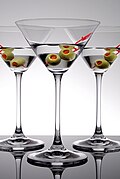 A martini is a classic gin-based cocktail. (from List of cocktails)
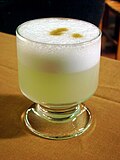 A pisco sour (from List of cocktails)
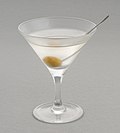 A martini cocktail (from List of cocktails)
 Negroni (from List of cocktails)
 These flaming cocktails illustrate that some liquors will readily catch fire and burn. (from Liquor)
 A display of various liquors in a supermarket (from Liquor)
 Map of Europe with individual countries grouped by preferred type of alcoholic drink, based on recorded alcohol consumption per capita (age 15+) (in liters of pure alcohol) in 2016.WineBeerSpirits(from Liquor)
 Some single-drink liquor bottles available in Germany (from Liquor)
 Spirits consumption per person (from Liquor)
 A Caipirinha with lime (from List of cocktails)
 Reservoir glass with naturally coloured verte absinthe and an absinthe spoon (from List of cocktails)
 A Ramos gin fizz (from List of cocktails)
 A cosmopolitan (from List of cocktails)
 An illustration of brewing and distilling industry methods in England, 1858 (from Liquor)
 A grasshopper (from List of cocktails)
 Bee's knees (from List of cocktails)
 Aviation (from List of cocktails)
 Mulled wine steeping (Swedish glögg) (from List of cocktails)
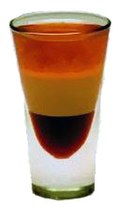 A B-52 (from List of cocktails)


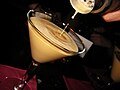 A Brandy Alexander being served (from List of cocktails)
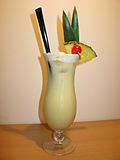 A piña colada (from List of cocktails)


.svg)


.svg)


.jpg)


.jpg)
 Lemon slice (from Cocktail garnish)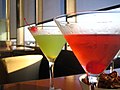
 Cocktail olive (from Cocktail garnish)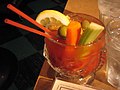
 Pineapple wedge (from Cocktail garnish)
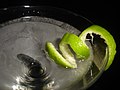 Lime twist (from Cocktail garnish)
 Raspberry (from Cocktail garnish)
 A whiskey sour, served in a coupe glass, is garnished with a spiral of lemon peel and two maraschino cherries on a cocktail pick, along with drops of bitters swirled into the foam (from egg white) atop the drink. (from Cocktail garnish)
 Shrimp (from Cocktail garnish)


.jpg)


 Commons
 Wikidata
 Wikiquote
 Wikisource
 Wikiversity
 Wikivoyage
 Wiktionary


