


Portal:Beer

 The Beer Portal
 .jpg)
Introduction

Beer is an alcoholic beverage produced by the brewing and fermentation of starches from cereal grain—most commonly malted barley, although wheat, maize, rice, and oats are also used. The grain is mashed to convert starch in the grain to sugars, which dissolve in water to form wort. Fermentation of the wort by yeast produces ethanol and carbonation in the beer. Beer is one of the oldest and most widely consumed alcoholic drinks in the world, and one of the most popular of all drinks. Most modern beer is brewed with hops, which add bitterness and other flavours and act as a natural preservative and stabilizer. Other flavouring agents, such as gruit, herbs, or fruits, may be included or used instead of hops. In commercial brewing, natural carbonation is often replaced with forced carbonation.
Beer is distributed in bottles and cans, and is commonly available on draught in pubs and bars. The brewing industry is a global business, consisting of several dominant multinational corporations and many thousands of smaller producers ranging from brewpubs to regional breweries. The strength of modern beer is usually around 4% to 6% alcohol by volume (ABV).
Some of the earliest writings mention the production and distribution of beer: the Code of Hammurabi (1750 BC) included laws regulating it, while "The Hymn to Ninkasi", a prayer to the Mesopotamian goddess of beer, contains a recipe for it. Beer forms part of the culture of many nations and is associated with social traditions such as beer festivals, as well as activities like pub games. Beer can cause health issues if consumed often or in excess; alcohol is an IARC group 1 carcinogen. (Full article...)
Selected articles -

Saint Vincent Beer was a dark lager brewed by monks at Saint Vincent Archabbey in Unity Township, Pennsylvania, United States, between 1856 and 1918. Pope Pius IX granted the monks permission to brew in 1852, ending a dispute with the Diocese of Pittsburgh. The brewery was located in a log cabin near the Saint Vincent Archabbey Gristmill and a brick building supplemented the cabin in 1868. After production ceased, the monastery used the buildings for storage until they burned down in 1926. The walls were removed from the site in 1995 during the restoration of the gristmill.
Production peaked at around 1,100 barrels in 1891. The popularity and widespread availability of the beer brought the monastery to the attention of the Catholic temperance movement. The theologian and professor Francesco Satolli, then the Apostolic Delegate to the United States, wrote to Archabbot Leander Schnerr asking for the brewing to cease in 1895. As part of a media campaign against the monastery, temperance advocate and Catholic priest George Zurcher published Monks and Their Decline in 1898 criticizing the archabbey for supporting the production and distribution of alcohol. (Full article...)
Selected brand -
Australian MAX is a brand of strong beer brewed at the Khoday Breweries in Bangalore by the Canadian owned International Breweries Limited (IBL). Steven Judge and Peter Harvey are founders of the company.
Australian MAX has won the title of "The World's Best Strong Lager" and “Asia’s Best Strong Lager” at the World Beer Awards - 2011. The World Beer Awards is a global competition that evaluates beers from around the world and recognizes the most outstanding beers produced. The 2011 awards saw a huge growth in entries, with a record 700+ entries coming from 57 countries. All entries in the annual World Beer Awards are judged blind with regional style heats held in Europe, USA and Asia. Regional style winners are then tasted against other regional winners by an international panel of Judges, chaired by Roger Protz, in London to select the overall ‘World’s Best’. The final results were released on October 27, 2011. (Full article...)
Selected biography -
Terence Michael McCashin (18 January 1944 – 31 October 2017) was a New Zealand businessman who, together with his wife, founded the country's first craft brewery, McCashin's Brewery, in 1981 in Nelson.
He also represented the country in rugby union, playing seven matches for the All Blacks. (Full article...)
Did you know (auto-generated) -

- ... that John P. Metras held all-night recruitment parties including a bathtub full of ice and beer?
- ... that the Vanuatu beer Tusker is named after the tusks of a pig, a traditional symbol of wealth?
- ... that Ein Samiya, which provides the water for Taybeh, the first beer brewed in Palestine, was depopulated in 2023 after harassment by neighboring Israeli settlers?
- ... that Farrell's Bar & Grill in Brooklyn continued serving beer in its large containers after a city ban forced it to swap from styrofoam to paper and plastic?
- ... that the basement of the Old Town Hall in Gdańsk was rented by a famous astronomer to store his beers?
- ... that the annual operating cost of the Grain Belt Beer Sign dropped from $48,000 to $7,500 after it was renovated with LED lighting?
Selected brewery -
Younger's Brewery (William Younger & Company) was a brewery in Edinburgh. Established in 1749, it became one of the city’s main commercial enterprises, supplying domestic and foreign markets.
In 1931 Younger's merged with McEwan’s to form Scottish Brewers, which in turn merged with Newcastle Breweries in 1960 to form Scottish & Newcastle. By the late 1960s the combine employed the largest single workforce in the city. (Full article...)
Selected image -

General images
-
 Bill Urquhart at Litchborough Brewery (from Craft beer)
 -
 A selection of French craft beers (from Craft beer)
 -
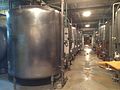 Conditioning tanks at Anchor Brewing Company (from Brewing)
 -
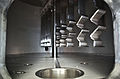 Lauter tun (from Brewing)
 -
-
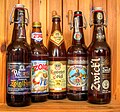
 A 16th-century brewery (from History of beer)
 -
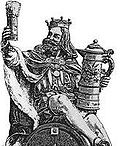 Gambrinus – king of beer (from History of beer)
 -
-
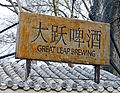
 A can of Juicy Ass IPA from Flying Monkeys Craft Brewery in Barrie, Ontario, Canada (from Craft beer)
 -

-
 Alulu beer receipt recording a purchase of "best" beer from a brewer, c. 2050 BCE, from the Sumerian city of Umma in ancient Iraq. (from History of beer)
 -
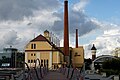 Traditional fermenting building (center) and modern fermenting building (left) in Pilsner Urquell Brewery (Czech Republic) (from History of beer)
 -
A 16th-century brewery (from Brewing)
-
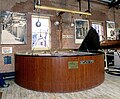 A mash tun at the Bass Museum in Burton-upon-Trent (from Brewing)
 -
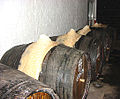 Spontaneous fermentation at Timmermans in Belgium (from Brewing)
 -
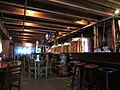
-
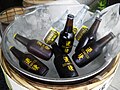
-
 A yard of ale at Jolly Brewery, Taiwan (from Craft beer)
 -

-
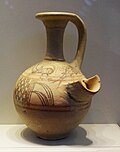 Philistine pottery beer jug (from History of beer)
 -
 A replica of ancient Egyptian beer, brewed from emmer wheat by the Courage brewery in 1996 (from History of beer)
 -
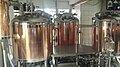 Bergenhus microbrewery, Bergen, Norway (from Craft beer)
 -
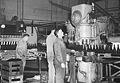 Bottling beer in a modern facility, 1945, Australia (from History of beer)
 -
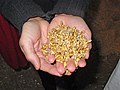
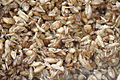 Spent grain, a brewing by-product (from Brewing)
 -
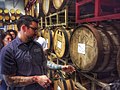 A beer sommelier tapping a barrel for a taste at Nebraska Brewing Company (from Craft beer)
 -
-
The Alulu beer receipt records a purchase of "best" beer from a brewer, c. 2050 BC, from the Sumerian city of Umma in Mesopotamia (ancient Iraq). (from Brewing)
-

-
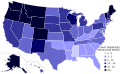 Microbreweries, regional breweries, and brew pubs per capita (from Craft beer)
 -
-
 Casks of real ale from British microbreweries at a beer festival (from Craft beer)
 -
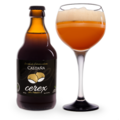
 Robohop, a session IPA from Cervisiam in Oslo, Norway (from Craft beer)
 -
 D. G. Yuengling & Son is the oldest operating brewing company in the US, established in 1829. It is also the largest craft brewer and the 6th largest brewing company. (from Craft beer)
 -
 Modern closed fermentation vessels (from Brewing)
 -

-
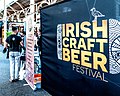 Irish Craft Beer Festival, 2015 (from Craft beer)
 -
-
-
Cask ales with gravity dispense at a beer festival (from Brewing)
-
 Open vessels showing fermentation taking place (from Brewing)
 -
 Brew kettles at Brasserie La Choulette in France (from Brewing)
 -
 Põhjala Brewery, Estonia (from Craft beer)
 -
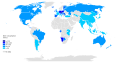 World beer consumption per capita (from History of beer)
 -

-
 A funerary model of a bakery and brewery, from the Eleventh dynasty of Egypt, c. 2009–1998 BCE (from History of beer)
 -
 Pasteur Street Brewing, Ho Chi Minh City, Vietnam (from Craft beer)


.jpg)


.svg)

.jpg)


_REF-107250_(20931409896).jpg)


.svg)


Beer topics
| Africa | |
|---|---|
| Asia | |
| Europe |
|
| North America | |
| South America | |
| Oceania | |
Categories

Selected quote -
| “ | Well ya see, Norm, it's like this... A herd of buffalo can only move as fast as the slowest buffalo, and when the herd is hunted, it is the slowest and weakest ones at the back that are killed first. This natural selection is good for the herd as a whole, because the general speed and health of the whole group keeps improving by the regular killing of the weakest members. In much the same way, the human brain can only operate as fast as the slowest brain cells. Excessive intake of alcohol, as we know, kills brain cells, but naturally it attacks the slowest and weakest brain cells first. In this way, regular consumption of beer eliminates the weaker brain cells, making the brain a faster and more efficient machine. That's why you always feel smarter after a few beers. | ” |
The Buffalo Theory as explained on an episode of Cheers by Cliff Clavin to his drinking buddy, Norm Peterson |
Related portals


Beer lists
Things you can do
This list is transcluded from the tasks list page, to edit, click here
This is a list of single time tasks that need action. Once you have completed them, please remove them from the list.
 |
Here are some tasks awaiting attention:
|
WikiProjects

WikiProject Beer is an association of Wikipedians with an interest in beer and beer-related subjects. They have come together to coordinate the development of beer and brewery articles here on Wikipedia. Additionally, other groups have formed other projects that entertain subjects that are directly related to beer, bartending and pubs. Additionally, the mixed drinks project covers topics that include beer cocktails. If any of these subjects pique your interest, please feel free to visit their projects. These groups would love to have you participate!
| Parent project: WikiProject Food and Drink | |
| Child projects: | Task forces: (All inactive) |
|
|
| Related projects: | |

Associated Wikimedia
The following Wikimedia Foundation sister projects provide more on this subject:
-
 Commons
Free media repository -
 Wikidata
Free knowledge base -
 Wikiquote
Collection of quotations -
 Wikisource
Free-content library -
 Wikiversity
Free learning tools -
 Wiktionary
Dictionary and thesaurus


More portals


