Engineering is the practice of systematically applying natural science and mathematics to design and improve systems, devices, or processes that solve problems under constraints. It is typically motivated by satisfying human needs, resulting in creations such as bridges, engines, smartphones, pacemakers, the internet, spacecraft, and washing machines. Engineering involves balancing competing demands such as safety, performance, aesthetics, cost, laws and regulations, and time, while operating within fundamental limits such as the laws of physics.
As a human endeavor, engineering has existed since ancient times, starting with the six classic simple machines. Examples of large-scale engineering projects from antiquity include impressive structures like the pyramids, elegant temples such as the Parthenon, and water conveyances like hulled watercraft, canals, and the Roman aqueduct. Early machines were powered by humans and animals, then later by wind. Machines of war were invented for siegecraft. In Europe, the scientific and industrial revolutions advanced engineering into a scientific profession and resulted in continuing technological improvements. The steam engine provided much greater power than animals, leading to mechanical propulsion for ships and railways. Further scientific advances resulted in the application of engineering to electrical, chemical, and aerospace requirements, plus the use of new materials for greater efficiencies.
The word engineering is derived from the Latiningenium. Engineers typically follow a code of ethics that favors honesty and integrity, while being dedicated to public safety and welfare. Engineering tasks involve finding optimal solutions to constrained problems, with testing and simulations being used prior to production. When a deployed product fails, forensic engineering is used to determine what went wrong in order to find a fix. Much of this product lifecycle management is now assisted with computer software, from design to testing and manufacturing. At larger scales, this process is normally funded by a company, multiple investors, or the government, so a knowledge of economics and business practices is needed. (Full article...)
An engineer is a practitioner of engineering. The word engineer (Latiningeniator, Ir is the term and or title of an engineer in countries like Belgium, The Netherlands, and Indonesia) is derived from the Latin words ingeniare ("to contrive, devise") and ingenium ("cleverness"). The foundational qualifications of a licensed professional engineer typically include a four-year bachelor's degree in an engineering discipline, or in some jurisdictions, a master's degree in an engineering discipline plus four to six years of peer-reviewed professional practice (culminating in a project report or thesis) and passage of engineering board examinations. (Full article...)
Since about 1900, the Black Canyon and nearby Boulder Canyon had been investigated for their potential to support a dam that would control floods, provide irrigation water and produce hydroelectric power. In 1928, Congress authorized the project. The winning bid to build the dam was submitted by a consortium called Six Companies, Inc., which began construction on the dam in early 1931. Such a large concrete structure had never been built before, and some of the techniques were unproven. The torrid summer weather and lack of facilities near the site also presented difficulties. Nevertheless, Six Companies turned over the dam to the federal government on March 1, 1936, more than two years ahead of schedule. (Full article...)
... that after supervising construction of London's Tower Bridge in the 1890s, engineer Edward Cruttwell was retained as consulting engineer to the bridge until his death in 1933?
... that Carmel Naughton, having been told that girls were "stupid and couldn't do maths", sponsored a STEM scholarship fund?
... that Robert Jacomb-Hood defied his father's wishes and became a railway engineer?
... that Ed McCann chose a career in civil engineering after being dissuaded from other branches of engineering by their military applications?
... that Hai-Quan Mao was elected an AIMBE fellow for engineering nanomaterials for regenerative medicine and drug delivery?
A drill is a tool fitted with a cutting tool attachment or driving tool attachment, usually a drill bit or driver bit, used for boring holes in various materials or fastening various materials together with the use of fasteners. The attachment is gripped by a chuck at one end of the drill and rotated while pressed against the target material. The tip, and sometimes edges, of the cutting tool does the work of cutting into the target material. This may be slicing off thin shavings (twist drills or auger bits), grinding off small particles (oil drilling), crushing and removing pieces of the workpiece (SDS masonry drill), countersinking, counterboring, or other operations.
Drills are commonly used in woodworking, metalworking, construction and do-it-yourself projects. Specially designed drills are also used in medicine, space missions and other applications. Drills are available with a wide variety of performance characteristics, such as power and capacity.
The Castaing machine is a device used to add lettering and decoration to the edge of a coin. Such lettering was necessitated by counterfeiting and edge clipping, which was a common problem resulting from the uneven and irregular hammered coinage. When Aubin Olivier introduced milled coinage to France, he also developed a method of marking the edges with lettering which would make it possible to detect if metal had been shaved from the edge. This method involved using a collar, into which the metal flowed from the pressure of the press. This technique was slower and more costly than later methods. France abandoned milled coinage in favour of hammering in 1585.
England experimented briefly with milled coinage, but it wasn't until Peter Blondeau brought his method of minting coins there in the mid-seventeenth century that such coinage began in earnest in that country. Blondeau also invented a different method of marking the edge, which was, according to him, faster and less costly than the method pioneered by Olivier. Though Blondeau's exact method was secretive, numismatists have asserted that it likely resembled the later device invented by Jean Castaing. Castaing's machine marked the edges by means of two steel rulers, which, when a coinage blank was forced between them, imprinted legends or designs on its edge. Castaing's device found favour in France, and it was eventually adopted in other nations, including Britain and the United States, but it was eventually phased out by mechanised minting techniques. (Full article...)
Image 2
The Avrocar S/N 58-7055 (marked AV-7055) on its rollout.
The Avro Canada VZ-9 Avrocar is a VTOL aircraft developed by Avro Canada as part of a secret U.S. military project carried out in the early years of the Cold War. The Avrocar intended to exploit the Coandă effect to provide lift and thrust from a single "turborotor" blowing exhaust out of the rim of the disk-shaped aircraft. In the air, it would have resembled a flying saucer.
Originally designed as a fighter-like aircraft capable of very high speeds and altitudes, the project was repeatedly scaled back over time and the U.S. Air Force eventually abandoned it. Development was then taken up by the U.S. Army for a tactical combat aircraft requirement, a sort of high-performance helicopter. In flight testing, the Avrocar proved to have unresolved thrust and stability problems that limited it to a degraded, low-performance flight envelope; subsequently, the project was cancelled in September 1961. (Full article...)
The Wignacourt Aqueduct (Maltese: L-Akwedott ta' Wignacourt) is a 17th-century aqueduct in Malta, which was built by the Order of Saint John to carry water from springs in Dingli and Rabat to the newly built capital city Valletta. The aqueduct carried water through underground pipes and over arched viaducts across depressions in the ground.
The first attempts to build the aqueduct were made by Grand Master Martin Garzez in 1596, but construction was suspended before being continued in 1610. The watercourse was inaugurated five years later on 21 April 1615. Several engineers took part in the project, including Bontadino de Bontadini, Giovanni Attard and Natale Tomasucci. The aqueduct was named after Grand Master Alof de Wignacourt, who partially financed its construction. (Full article...)
Image 4
Three Musketeers - Chrysler Engineers Carl Breer (right), Fred Zeder (center), and Owen Skelton (left) in 1933.
The Tehachapi Energy Storage Project (TSP) was a 8MW/32MWhlithium-ion battery-based grid energy storage system at the Monolith Substation of Southern California Edison (SCE) in Tehachapi, California, California, United States. It has the capacity to power between 1,600 and 2,400 homes for four hours. At the time of commissioning in 2014, it was the largest lithium-ion battery system operating in North America and one of the largest in the world. TSP is considered to be a modern-day energy storage pioneer with significant accomplishments that have proven the viability of utility-scale energy storage using lithium-ion technology. While originally envisioned as a research and development project, TSP operated as a distribution-level resource for SCE and for calendar year 2020, SCE reported that TSP operated in the wholesale energy market with revenue exceeding operating and maintenance costs. In 2021, SCE began the decommissioning of TSP, which was followed by formal decommissioning by state regulators in 2022. The physical dismantlement of TSP is expected to be completed by the end of 2022. (Full article...)
Genetic engineering, also called genetic modification or genetic manipulation, is the modification and manipulation of an organism's genes using technology. It is a set of technologies used to change the genetic makeup of cells, including the transfer of genes within and across species boundaries to produce improved or novel organisms. New DNA is obtained by either isolating and copying the genetic material of interest using recombinant DNA methods or by artificially synthesising the DNA. A construct is usually created and used to insert this DNA into the host organism. The first recombinant DNA molecule was designed by Paul Berg in 1972 by combining DNA from the monkey virus SV40 with the lambda virus. As well as inserting genes, the process can be used to remove, or "knock out", genes. The new DNA can either be inserted randomly or targeted to a specific part of the genome.
An organism that is generated through genetic engineering is considered to be genetically modified (GM), and the resulting entity is a genetically modified organism (GMO). The first GMO was a bacterium generated by Herbert Boyer and Stanley Cohen in 1973. Rudolf Jaenisch created the first GM animal when he inserted foreign DNA into a mouse in 1974. The first company to focus on genetic engineering, Genentech, was founded in 1976 and began the production of human proteins. Genetically engineered human insulin was produced in 1978, and insulin-producing bacteria were commercialised in 1982. Genetically modified food has been sold since 1994, with the release of the Flavr Savr tomato. The Flavr Savr was engineered to have a longer shelf life, but most current GM crops are modified to increase resistance to insects and herbicides. GloFish, the first GMO designed as a pet, was sold in the United States in December 2003. In 2016, salmon modified with a growth hormone were sold. (Full article...)
Image 8
Raymix during a 2024 concert
Edmundo Gómez Moreno (born 17 February 1991), known professionally as Raymix, is a Mexican musician and aerospace engineer. Nicknamed El Rey de la Electrocumbia ("The King of Electrocumbia"), he started his music career in the early 2010s as part of the trance project Light & Wave, alongside two other Mexican musicians. Their song "Feeling the City" was featured on A State of Trance, a radio show Armin van Buuren hosts. In 2013, Raymix participated in an educational internship at NASA, where he contributed to the development of a satellite.
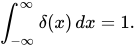
Schematic representation of the Dirac delta function by a line surmounted by an arrow. The height of the arrow is usually meant to specify the value of any multiplicative constant, which will give the area under the function. The other convention is to write the area next to the arrowhead. In mathematical analysis, the Dirac delta function (or distribution), also known as the unit impulse, is a generalized function on the real numbers, whose value is zero everywhere except at zero, where it is infinite, and whose integral over the entire real line is equal to one. Thus it can be represented heuristically assuch that
Since no function has this property, modelling the delta "function" rigorously involves the use of limits or, as is common in mathematics, measure theory and the theory of distributions. (Full article...)
William Barton Rogers founded MIT to accelerate American industrialization through scientific knowledge. Initially funded by a federal land grant, the institute adopted a German polytechnic model emphasizing laboratory instruction in applied science and engineering, and moved from Boston's Back Bay to its current campus in Cambridge in 1916. Early growth came through research contracts with private industry, though the institute remained financially constrained and focused primarily on practical engineering education into the 1930s. (Full article...)
Image 12
Buro Happold Limited (previously BuroHappold Engineering) is a British professional services firm that provides engineering consultancy, design, planning, project management, and consulting services for buildings, infrastructure, and the environment. It was founded in Bath, Somerset, in 1976 by Sir Edmund Happold when he took up a post at the University of Bath as Professor of Architecture and Engineering Design.
Originally working mainly on projects in the Middle East, the firm now operates worldwide and in almost all areas of engineering for the built environment, working in 24 locations around the world. (Full article...)
Bell was an energetic and skilful entrepreneur as well as an innovative metallurgist. He was involved in multiple partnerships with his brothers to make iron and alkali chemicals, and with other pioneers including Robert Stirling Newall to make steel cables. He pioneered the large-scale manufacture of aluminium at his Washington works, conducting experiments in its production, and in the production of other chemicals such as the newly discovered element thallium. He was a director of major companies including the North Eastern Railway and the Forth Bridge company, then the largest bridge project in the world. (Full article...)
Meticulous naval inventories show that HMS Beagle carried a total of at least 34 recorded chronometers on its three main survey voyages from 1826 to 1843, and 22 on the second voyage with Darwin on board, when they had a dedicated cabin. Some were Navy property and others were on loan from the manufacturers, as well as six on the second voyage owned by the captain, Robert FitzRoy. Both of the two known survivors from the second voyage are owned by the British Museum (the second is registration No. CAI.1743). (Full article...)
Image 15
Replica of the original Fat Man bomb
"Fat Man" (also known as Mark III) was the design of the nuclear weapon the United States used for seven of the first eight nuclear weapons ever detonated in history. It is also the most powerful design to ever be used in warfare.
Image 9Design of a turbine requires collaboration of engineers from many fields, as the system involves mechanical, electro-magnetic and chemical processes. The blades, rotor and stator as well as the steam cycle all need to be carefully designed and optimized. (from Engineering)
Image 10Engineers conferring on prototype design, 1954 (from Engineer)
Image 14The application of the steam engine allowed coke to be substituted for charcoal in iron making, lowering the cost of iron, which provided engineers with a new material for building bridges. This bridge was made of cast iron, which was soon displaced by less brittle wrought iron as a structural material. (from Engineering)
Image 15Archimedes is regarded as one of the leading scientists in classical antiquity whose ideas have underpinned much of the practice of engineering. (from Engineer)
Image 21A drawing for a steam locomotive. Engineering is applied to design, with emphasis on function and the utilization of mathematics and science. (from Engineering)
This list was generated from these rules. Questions and feedback are always welcome! The search is being run daily with the most recent ~14 days of results. Note: Some articles may not be relevant to this project.





 Featured articles are displayed here, which represent some of the best content on English Wikipedia.




.jpg)


.jpg)


 Commons
 Wikidata
 Wikiquote
 Wikisource
 Wikiversity
 Wiktionary


