


Portal:Computer programming

The Computer Programming Portal

Computer programming or coding is the composition of sequences of instructions, called programs, that computers can follow to perform tasks. It involves designing and implementing algorithms, step-by-step specifications of procedures, by writing code in one or more programming languages. Programmers typically use high-level programming languages that are more easily intelligible to humans than machine code, which is directly executed by the central processing unit. Proficient programming usually requires expertise in several different subjects, including knowledge of the application domain, details of programming languages and generic code libraries, specialized algorithms, and formal logic.
Auxiliary tasks accompanying and related to programming include analyzing requirements, testing, debugging (investigating and fixing problems), implementation of build systems, and management of derived artifacts, such as programs' machine code. While these are sometimes considered programming, often the term software development is used for this larger overall process – with the terms programming, implementation, and coding reserved for the writing and editing of code per se. Sometimes software development is known as software engineering, especially when it employs formal methods or follows an engineering design process. (Full article...)
Selected articles -
-
 Artificial intelligence (AI) is the capability of computational systems to perform tasks typically associated with human intelligence, such as learning, reasoning, problem-solving, perception, and decision-making. It is a field of research in engineering, mathematics and computer science that develops and studies methods and software that enable machines to perceive their environment and use learning and intelligence to take actions that maximize their chances of achieving defined goals.
High-profile applications of AI include advanced web search engines, chatbots, virtual assistants, autonomous vehicles, and play and analysis in strategy games (e.g., chess and Go). Since the 2020s, generative AI has become widely available to generate images, audio, and videos from text prompts.
The traditional goals of AI research include learning, reasoning, knowledge representation, planning, natural language processing, and perception, as well as support for robotics. To reach these goals, AI researchers have used techniques including state space search and mathematical optimization, formal logic, artificial neural networks, and methods based on statistics, operations research, and economics. AI also draws upon psychology, linguistics, philosophy, neuroscience, and other fields. Some companies, such as OpenAI, Google DeepMind and Meta, aim to create artificial general intelligence (AGI) – AI that can complete virtually any cognitive task at least as well as a human. (Full article...) -
In computing, a loader is the part of an operating system that is responsible for loading programs and libraries. It is one of the essential stages in the process of starting a program, as it places programs into memory and prepares them for execution. Loading a program involves either memory-mapping or copying the contents of the executable file containing the program instructions into memory, and then carrying out other required preparatory tasks to prepare the executable for running. Once loading is complete, the operating system starts the program by passing control to the loaded program code.
All operating systems that support program loading have loaders, apart from highly specialized computer systems that only have a fixed set of specialized programs. Embedded systems typically do not have loaders, and instead, the code executes directly from ROM or similar. In order to load the operating system itself, as part of booting, a specialized boot loader is used. In many operating systems, the loader resides permanently in memory, though some operating systems that support virtual memory may allow the loader to be located in a region of memory that is pageable.
In the case of operating systems that support virtual memory, the loader may not actually copy the contents of executable files into memory, but rather may simply declare to the virtual memory subsystem that there is a mapping between a region of memory allocated to contain the running program's code and the contents of the associated executable file. (See memory-mapped file.) The virtual memory subsystem is then made aware that pages with that region of memory need to be filled on demand if and when program execution actually hits those areas of unfilled memory. This may mean parts of a program's code are not actually copied into memory until they are actually used, and unused code may never be loaded into memory at all. (Full article...) -
William Henry Gates III (born October 28, 1955) is an American businessman and philanthropist. A pioneer of the microcomputer revolution of the 1970s and 1980s, he co-founded the software company Microsoft in 1975 with his childhood friend Paul Allen. Following Microsoft's initial public offering in 1986 and the subsequent increase in its stock price, Gates became the world's then-youngest billionaire in 1987, at age 31. Forbes magazine ranked him as the world's wealthiest person in their The World's Billionaires list for 18 out of 24 years between 1995 and 2017, including 13 years consecutively from 1995 to 2007. Gates became the first centibillionaire in 1999, when his net worth briefly surpassed US$100 billion. According to Forbes, as of February 2026, his net worth stood at US$107.7 billion, making him the 18th-wealthiest individual in the world.
Born and raised in Seattle, Washington, Gates was privately educated at Lakeside School, where he befriended Allen and developed his computing interests. In 1973, he enrolled at Harvard University, where he took classes including Math 55 and graduate-level computer science courses, but he dropped out in 1975 to co-found and lead Microsoft. He served as its CEO for the next 25 years and also became president and chairman of the board when the company was incorporated in 1981. Succeeded as CEO by Steve Ballmer in 2000, he transitioned to chief software architect, a position he held until 2008. He stepped down as chairman of the board in 2014 and became technology adviser to CEO Satya Nadella and other Microsoft leaders, a position he still holds. He resigned from the board in 2020.
Over time, Gates reduced his role at Microsoft to focus on his philanthropic work with the Bill & Melinda Gates Foundation, the world's largest private charitable organization, which he and his then-wife, Melinda French Gates, co-chaired from 2000 until 2024. Focusing on areas including health, education, and poverty alleviation, Gates became known for his efforts to combat transmissible diseases such as tuberculosis, malaria, and polio. After French Gates resigned as co-chair following the couple's divorce, the foundation was renamed the Gates Foundation, with Gates as its sole chair. (Full article...) -
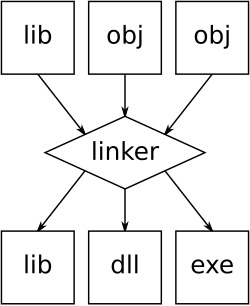
An illustration of the linking process. Object files and static libraries are assembled into a new library or executable
A linker or link editor is a computer program that combines intermediate software build files such as object and library files into a single executable file such as a program or library. A linker is often part of a toolchain that includes a compiler and/or assembler that generates intermediate files that the linker processes. The linker may be integrated with other toolchain tools such that the user does not interact with the linker directly.
A simpler version that writes its output directly to memory is called the loader, though loading is typically considered a separate process. (Full article...) -

W3sDesign Interpreter Design Pattern UML
In computing, an interpreter is software that executes source code without first compiling it to machine code. An interpreted runtime environment differs from one that processes CPU-native executable code which requires translating source code before executing it. An interpreter may translate the source code to an intermediate format, such as bytecode. A hybrid environment may translate the bytecode to machine code via just-in-time compilation, as in the case of .NET and Java, instead of interpreting the bytecode directly.
Before the widespread adoption of interpreters, the execution of computer programs often relied on compilers, which translate and compile source code into machine code. Early runtime environments for Lisp and BASIC could parse source code directly. Thereafter, runtime environments were developed for languages (such as Perl, Raku, Python, MATLAB, and Ruby), which translated source code into an intermediate format before executing to enhance runtime performance.
Code that runs in an interpreter can be run on any platform that has a compatible interpreter. The same code can be distributed to any such platform, instead of an executable having to be built for each platform. Although each programming language is usually associated with a particular runtime environment, a language can be used in different environments. Interpreters have been constructed for languages traditionally associated with compilation, such as ALGOL, Fortran, COBOL, C and C++. (Full article...) -

C# (/ˌsiː ˈʃɑːrp/ see SHARP) is a general-purpose high-level programming language supporting multiple paradigms. C# encompasses static typing, strong typing, lexically scoped, imperative, declarative, functional, generic, object-oriented (class-based), and component-oriented programming disciplines.
The principal designers of the C# programming language were Anders Hejlsberg, Scott Wiltamuth, and Peter Golde from Microsoft. It was first widely distributed in July 2000 and was later approved as an international standard by Ecma (ECMA-334) in 2002 and ISO/IEC (ISO/IEC 23270 and 20619) in 2003. Microsoft introduced C# along with .NET Framework and Microsoft Visual Studio, both of which are, technically speaking, closed-source. At the time, Microsoft had no open-source products. Four years later, in 2004, a free and open-source project called Mono began, providing a cross-platform compiler and runtime environment for the C# programming language. A decade later, Microsoft released Visual Studio Code (code editor), Roslyn (compiler), and the unified .NET platform (software framework), all of which support C# and are free, open-source, and cross-platform. Mono also joined Microsoft, but was not merged into .NET.
As of November 2025,[update] the most recent stable version of the language is C# 14. (Full article...) -

Logo since August 2012
Microsoft is a computer technology corporation founded on April 4, 1975, by Bill Gates and Paul Allen in Albuquerque, New Mexico, United States. It is best known for the Windows operating system, the Office productivity software suite, the Microsoft 365 subscription service, the Xbox video gaming brand, the Bing search engine, and the Azure cloud computing platform.
In 1980, Microsoft formed a partnership with IBM to bundle Microsoft's operating system with IBM computers; with that deal, IBM paid Microsoft a royalty for every sale. In 1985, IBM requested Microsoft to develop a new operating system for their computers called OS/2. Microsoft produced that operating system, but also continued to sell their own alternative, which proved to be in direct competition with OS/2. Windows eventually overshadowed OS/2 in terms of sales. When Microsoft launched several Windows versions in the 1990s, they had captured over 90% market share of the world's personal computers.
As of June 30, 2015, Microsoft has a global annual revenue of US$86.83 billion (~$112 billion in 2024) and 128,076 employees worldwide. It develops, manufactures, licenses, and supports a wide range of software products for computing devices. (Full article...) -
Structured Query Language (SQL) (pronounced /ˌɛsˌkjuˈɛl/ S-Q-L; or alternatively as /ˈsiːkwəl/ ⓘ "sequel") is a domain-specific language used to manage data, especially in a relational database management system (RDBMS). It is particularly useful in handling structured data, i.e., data incorporating relations among entities and variables.
Introduced in the 1970s, SQL offered two main advantages over older read–write APIs such as ISAM or VSAM. Firstly, it introduced the concept of accessing many records with one single command. Secondly, it eliminates the need to specify how to reach a record, i.e., with or without an index.
Originally based upon relational algebra and tuple relational calculus, SQL consists of many types of statements, which may be informally classed as sublanguages, commonly: data query language (DQL), data definition language (DDL), data control language (DCL), and data manipulation language (DML). (Full article...) -
Node.js is a cross-platform, open-source JavaScript runtime environment that can run on Windows, Linux, Unix, macOS, and more. Node.js runs on the V8 JavaScript engine, and executes JavaScript code outside a web browser. According to the Stack Overflow Developer Survey, Node.js is one of the most commonly used web technologies.
Node.js allows developers to use JavaScript for writing command line tools and server-side scripting. Running Javascript on the server is commonly used to generate dynamic web page content before the page is sent to the user's web browser. Consequently, Node.js represents a "JavaScript everywhere" paradigm, unifying web-application development around a single programming language, as opposed to using different languages for the server- versus client-side programming.
Node.js has an event-driven architecture capable of asynchronous I/O. These design choices aim to optimize throughput and scalability in web applications with many input/output operations, as well as for real-time Web applications (e.g., real-time communication programs and browser games). (Full article...) -

Perl is a high-level, general-purpose, interpreted, dynamic programming language. Though Perl is not officially an acronym, there are various backronyms in use, including "Practical Extraction and Reporting Language".
Perl was developed by Larry Wall in 1987 as a general-purpose Unix scripting language to make report processing easier. Since then, it has undergone many changes and revisions. Perl originally was not capitalized and the name was changed to being capitalized by the time Perl 4 was released. The latest release is Perl 5, first released in 1994. From 2000 to October 2019 a sixth version of Perl was in development; the sixth version's name was changed to Raku. Both languages continue to be developed independently by different development teams which liberally borrow ideas from each other.
Perl borrows features from other programming languages including C, sh, AWK, and sed. It provides text processing facilities without the arbitrary data-length limits of many contemporary Unix command line tools. Perl is a highly expressive programming language: source code for a given algorithm can be short and highly compressible. (Full article...) -

R is a programming language for statistical computing and data visualization. It has been widely adopted in the fields of data mining, bioinformatics, data analysis, and data science.
The core R language is extended by a large number of software packages, which contain reusable code, documentation, and sample data. Some of the most popular R packages are in the tidyverse collection, which enhances functionality for visualizing, transforming, and modelling data, as well as improves the ease of programming (according to the authors and users).
R is free and open-source software distributed under the GNU General Public License. The language is implemented primarily in C, Fortran, and R itself. Precompiled executables are available for the major operating systems (including Linux, MacOS, and Microsoft Windows). (Full article...) -

Python is a high-level, general-purpose programming language that emphasizes code readability, simplicity, and ease-of-writing with the use of significant indentation, an extensive ("batteries-included") standard library, and garbage collection. Python supports multiple programming paradigms but with an emphasis on object-oriented programming and dynamic typing.
Guido van Rossum began working on Python in the late 1980s as a successor to the ABC programming language. Python 3.0, released in 2008, was a major revision and not completely backward-compatible with earlier versions. Beginning with Python 3.5, capabilities and keywords for typing were added to the language, allowing optional static typing. As of 2026[update], the Python Software Foundation supports Python 3.10, 3.11, 3.12, 3.13, and 3.14, following the project's annual release cycle and five-year support policy. Python 3.15 is currently in the beta development phase, and the stable release is expected to launch in October 2026. Earlier versions in the 3.x series have reached end-of-life and no longer receive security updates.
Python has gained extensive use in the machine learning community. It is widely taught as an introductory programming language. Since 2003, Python has consistently ranked among the top ten most popular programming languages in the TIOBE Programming Community Index, which ranks programming languages based on searches across 24 platforms. (Full article...) -

Ada is a structured, statically typed, imperative, and object-oriented high-level programming language, inspired by Pascal and other languages. It has built-in language support for design by contract (DbC), extremely strong typing, explicit concurrency, tasks, synchronous message passing, protected objects, and non-determinism. Ada improves code safety and maintainability by using the compiler to find errors in favor of runtime errors. Ada is an international technical standard, jointly defined by the International Organization for Standardization (ISO), and the International Electrotechnical Commission (IEC). As of May 2023[update], the standard, ISO/IEC 8652:2023, is called Ada 2022 informally.
Ada was originally designed by a team led by French computer scientist Jean Ichbiah of Honeywell under contract to the United States Department of Defense (DoD) from 1977 to 1983 to supersede over 450 programming languages then used by the DoD. Ada was named after Ada Lovelace (1815–1852), who has been credited as the first computer programmer. (Full article...) -

Carphone Warehouse was a mobile phone retailer based in London, United Kingdom. In August 2014 the company became a subsidiary of Currys plc (previously named "Dixons Carphone"), which was formed by the merger of its former parent Carphone Warehouse Group with Dixons Retail. Prior to this merger, Carphone Warehouse Group was listed on the London Stock Exchange, and was a constituent of the FTSE 250 Index.
Following the closure of all stand-alone UK stores in April 2020, all remaining Carphone Warehouse UK outlets were within branches of Currys PC World. In April 2021, the Carphone Warehouse business in Ireland (including all stand-alone and co-located branches and the website) was closed with immediate effect. Currys continued to use the Carphone Warehouse brand in the United Kingdom, online and, until 2021, inside Currys stores. (Full article...) -

Erlang (/ˈɜːrlæŋ/ UR-lang) is a general-purpose, concurrent, functional high-level programming language, and a garbage-collected runtime system. The term Erlang is used interchangeably with Erlang/OTP, or Open Telecom Platform (OTP), which consists of the Erlang runtime system, several ready-to-use components (OTP) mainly written in Erlang, and a set of design principles for Erlang programs.
The Erlang runtime system is designed for systems with these traits:- Distributed
- Fault-tolerant
- Soft real-time
- Highly available, non-stop applications
- Hot swapping, where code can be changed without stopping a system.

_5.jpg)


.svg)


Selected images
-
 A view of the GNU nano Text editor version 6.0
 -
 Output from a (linearised) shallow water equation model of water in a bathtub. The water experiences 5 splashes which generate surface gravity waves that propagate away from the splash locations and reflect off of the bathtub walls.
 -
 Stephen Wolfram is a British-American computer scientist, physicist, and businessman. He is known for his work in computer science, mathematics, and in theoretical physics.
 -
 A lone house. An image made using Blender 3D.
 -
 An IBM Port-A-Punch punched card
 -
 Grace Hopper at the UNIVAC keyboard, c. 1960. Grace Brewster Murray: American mathematician and rear admiral in the U.S. Navy who was a pioneer in developing computer technology, helping to devise UNIVAC I. the first commercial electronic computer, and naval applications for COBOL (common-business-oriented language).
 -
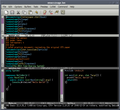
-
 GNOME Shell, GNOME Clocks, Evince, gThumb and GNOME Files at version 3.30, in a dark theme
 -
 A head crash on a modern hard disk drive
 -
 Bill Gosper's Glider Gun in action
 -
 Ada Lovelace was an English mathematician and writer, chiefly known for her work on Charles Babbage's proposed mechanical general-purpose computer, the Analytical Engine. She was the first to recognize that the machine had applications beyond pure calculation, and to have published the first algorithm intended to be carried out by such a machine. As a result, she is often regarded as the first computer programmer.
 -
 Partial view of the Mandelbrot set. Step 1 of a zoom sequence: Gap between the "head" and the "body" also called the "seahorse valley".
 -
 Animation of a Non-uniform rational B-spline surface. Modeled and rendered in Cobalt.
 -
 Margaret Hamilton standing next to the navigation software that she and her MIT team produced for the Apollo Project.
 -
 Partial map of the Internet based on the January 15, 2005 data found on opte.org. Each line is drawn between two nodes, representing two IP addresses. The length of the lines are indicative of the delay between those two nodes. This graph represents less than 30% of the Class C networks reachable by the data collection program in early 2005.
 -
 This image (when viewed in full size, 1000 pixels wide) contains 1 million pixels, each of a different color.
 -

-
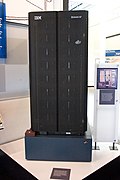 Deep Blue was a chess-playing expert system run on a unique purpose-built IBM supercomputer. It was the first computer to win a game, and the first to win a match, against a reigning world champion under regular time controls. Photo taken at the Computer History Museum.


_in_Dark_theme.png)


Did you know? -

- ... that the Gale–Shapley algorithm was used to assign medical students to residencies long before its publication by Gale and Shapley?
- ... that NATO was once targeted by a group of "gay furry hackers"?
- ... that it took a particle accelerator and machine-learning algorithms to extract the charred text of PHerc. Paris. 4 without unrolling it?
- ... that a 2021 investigation found that algorithmic amplification on TikTok could steer users towards self-harm content within hours?
- ... that Perfectly Imperfect's social media platform has a main feed that is presented in reverse chronological order and is not algorithmically curated?
- ... that the 2024 psychological horror game Mouthwashing utilises non-diegetic scene transitions that mimic glitches and crashes?
Subcategories

WikiProjects

- There are many users interested in computer programming, join them.
Computer programming news
- 3 May 2026 –
- The Russian Ministry of Industry and Trade will restrict supplies of popular computers starting 27 May 2026. (Reporter)
- 15 April 2026 –
- Shoe company Allbirds announces it will be pivoting to providing computing infrastructure for artificial intelligence, with plans to rename itself to "NewBird AI". The company's shares rose nearly 600% on the news. (CNBC)
Topics


| Fields |
| ||||||
|---|---|---|---|---|---|---|---|
| Concepts |
| ||||||
| Orientations | |||||||
| Models |
| ||||||
| Related fields | |||||||


Related portals


Associated Wikimedia
The following Wikimedia Foundation sister projects provide more on this subject:
-
 Commons
Free media repository -
 Wikidata
Free knowledge base -
 Wikiquote
Collection of quotations -
 Wikisource
Free-content library -
 Wikiversity
Free learning tools -
 Wiktionary
Dictionary and thesaurus


