


Portal:Cities

The Cities Portal

A city is a human settlement of a substantial size. The term "city" has different meanings around the world and in some places the settlement can be very small. Even where the term is limited to larger settlements, there is no universally agreed definition of the lower boundary for their size. In a more specific sense, a city can be defined as a permanent and densely populated place with administratively defined boundaries whose members work primarily on non-agricultural tasks. Cities generally have extensive systems for housing, transportation, sanitation, utilities, land use, production of goods, and communication. Their density facilitates interaction between people, government organizations, and businesses, sometimes benefiting different parties in the process, such as improving the efficiency of goods and service distribution.
Historically, city dwellers have been a small proportion of humanity overall, but following two centuries of unprecedented and rapid urbanization, more than half of the world population now lives in cities, which has had profound consequences for global sustainability. Present-day cities usually form the core of larger metropolitan areas and urban areas—creating numerous commuters traveling toward city centres for employment, entertainment, and education. However, in a world of intensifying globalization, all cities are to varying degrees also connected globally beyond these regions. This increased influence means that cities also have significant influences on global issues, such as sustainable development, climate change, and global health. Because of these major influences on global issues, the international community has prioritized investment in sustainable cities through Sustainable Development Goal 11. Due to the efficiency of transportation and the smaller land consumption, dense cities hold the potential to have a smaller ecological footprint per inhabitant than more sparsely populated areas. Therefore, compact cities are often referred to as a crucial element in fighting climate change. However, this concentration can also have some significant harmful effects, such as forming urban heat islands, concentrating pollution, and stressing water supplies and other resources. (Full article...)
Selected city -
_2019-06-21.jpg)
Sydney is the capital city of the state of New South Wales, and the most populous city in Australia. Located on Australia's east coast, the metropolis surrounds Sydney Harbour and extends about 80 kilometres (50 mi) from the Pacific Ocean in the east to the Blue Mountains in the west, and about 80 kilometres (50 mi) from Ku-ring-gai Chase National Park and the Hawkesbury River in the north and north-west, to the Royal National Park and Macarthur in the south and south-west. Greater Sydney consists of 658 suburbs, spread across 33 local government areas. Residents of the city are colloquially known as "Sydneysiders". The estimated population in June 2025 was 5,638,830, which is about 66% of the state's population. The city's nicknames include the Emerald City and the Harbour City.
There is evidence that Aboriginal Australians inhabited the Greater Sydney region at least 30,000 years ago, and their engravings and cultural sites are common. The traditional custodians of the land on which modern Sydney stands are the clans of the Darug, Dharawal and Eora. During his first Pacific voyage in 1770, James Cook charted the eastern coast of Australia, making landfall at Botany Bay. In 1788, the First Fleet of convicts, led by Arthur Phillip, founded Sydney as a British penal colony, the first European settlement in Australia. After World War II, Sydney experienced mass migration and by 2021 over 40 per cent of the population was born overseas. Foreign countries of birth with the greatest representation are mainland China, India, the United Kingdom, Vietnam and the Philippines. (Full article...)
Did you know -
- ... that the 2010 Yazoo City tornado was considered to be the worst natural disaster to occur in Mississippi since Hurricane Katrina?
- ... that Eugenia is the only Mexico City Metro station to be named after a Mexican woman?
- ... that two painted slabs of the Berlin Wall are displayed as public art in Battery Park City?
- ... that the Adelaide L. T. Douglas House, built for a New York City socialite, housed the United States Olympic Committee before being sold to Guatemala?
- ... that the New York City government sought to demolish a wall around the Isaac L. Rice Mansion for five years?
- ... that La La Land's composer initially wanted "Audition (The Fools Who Dream)" to be the film's "award song" instead of "City of Stars"?
Related portals


Related WikiProjects

 Recognized content -


.JPG)
Copenhagen (Danish: København [kʰøpm̩ˈhɑwˀn] ⓘ) is the capital and most populous city of both the country of Denmark and the wider Kingdom of Denmark, with a population of 671,714 people in the municipality and 1.4 million in the urban area. The city is situated mainly on the island of Zealand (Sjælland), with a smaller part on the island of Amager. Copenhagen is separated from Malmö, Sweden, by the Øresund strait. The Øresund Bridge connects the two cities by rail and road.
Settled as a Viking fishing village in the 10th century in the vicinity of what is now Gammel Strand, Copenhagen became the capital of Denmark in the early 15th century. During the 16th century, the city served as the de facto capital of the Kalmar Union and the seat of the Union's monarchy, which governed most of the modern-day Nordic region as part of a Danish confederation with Sweden and Norway. The city flourished as the cultural and economic centre of Scandinavia during the Renaissance. By the 17th century, it had become a regional centre of power, serving as the heart of the Danish government and military. During the 18th century, Copenhagen suffered a devastating plague outbreak and urban conflagrations. Major redevelopment included the construction of the prestigious district of Frederiksstaden and the establishment of cultural institutions such as the Royal Theatre and the Royal Academy of Fine Arts. The city became the centre of the Danish slave trade during this period. In 1807, the city was bombarded by a British fleet during the Napoleonic Wars, before the Danish Golden Age brought a Neoclassical look to Copenhagen's architecture. After World War II, the Finger Plan fostered the development of housing and businesses along the five urban railway routes emanating from the city centre. (Full article...)
Selected article -

A car-free city is an urban area without motor vehicles. Car-free cities rely on public transport, walking, and cycling for travel, as opposed to private motor vehicles. The term "car-free zone" is applied to districts where motor vehicles are prohibited. The concept of the car-free city model gained traction in the second half of the 20th century due to congestion and infrastructure issues, as well as the proposed environmental and quality of life benefits. Many cities in Asia, Europe, and Africa have car-free areas because they were created before the invention of motor vehicles, In addition, many developing cities in Asia are adopting the car-free model to modernize their infrastructure. (Full article...)
General images -
-
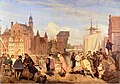 Gdańsk in the 17th century (from History of cities)
 -
 New York City, one of the largest urban areas in the world (from Urban geography)
 -
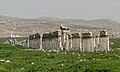
-
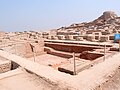 Mohenjo-daro, a World Heritage Site that was part of the Indus Valley Civilization (from History of cities)
 -
 View of the Agora of Athens with the temple of Hephaestus to the left and the Stoa of Attalos to the right (from History of cities)
 -
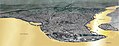 Constantinople, the largest and wealthiest city in Europe from the 9th through the 12th century (from History of cities)
 -
 The Round city of Baghdad, the capital of Iraq (from History of cities)
 -
 Aerial photograph shows the remains of the Sumerian city Ur, near Nasiriyah, Iraq. (from History of cities)
 -
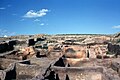 Excavated foundations of Çatalhöyük, Turkey. An Anatolian town dated to 7000 BCE. (from History of cities)
 -
 A poster from the EPA entitled "Soak Up the Rain with Green Infrastructure." The poster depicts various green infrastructure that can be effective in preventing floods. (from Urban geography)
 -
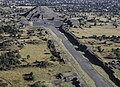 The Avenue of the Dead in Teotihuacan originates with the Pyramid of the Moon, forming the basis of the city grid. (from History of cities)
 -
 Palmanova, Italy, constructed in 1593 according to the defensive ideal of the star fort, today retains its distinctive geometry. (from History of cities)
 -
 A map showing the world energy consumption per capita based on 2013 data from the World Bank. (from Urban geography)
 -

-
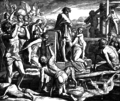 Cain founding the city of Enoch (from History of cities)
 -
 Daily life of people from the Song period at the capital, Bianjing, today's Kaifeng (from History of cities)
 -
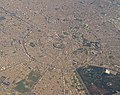 The city of Arbil in the Kurdistan Region of Iraq has a radial urban structure centred on an ancient fortress (from Urban structure)
 -
 Extent and major sites of the Indus Valley Civilization of ancient India (from History of cities)
 -
 This woodcut shows Nuremberg as a prototype of a flourishing and independent city in the 15th century. (from History of cities)

_from_the_east_corner_of_the_86th_Floor_Observatory_of_the_Empire_State_Building_in_Manhattan,_New_York_City,_New_York.jpg)


_LACMA_M.2008.40.98.8.jpg)

.jpg)


Topics


List articles
Subcategories

Associated Wikimedia
The following Wikimedia Foundation sister projects provide more on this subject:
-
 Commons
Free media repository -
 Wikidata
Free knowledge base -
 Wikiquote
Collection of quotations -
 Wikisource
Free-content library -
 Wikiversity
Free learning tools -
 Wiktionary
Dictionary and thesaurus


