


Portal:Baltimore

The Baltimore Portal


Baltimore (/ˈbɔːltɪˌmɔːr/ BAWL-tih-mor, locally /ˌbɔːldɪˈmɔːr/ BAWL-dih-MOR or /ˈbɔːlmər/ BAWL-mər), also known as Baltimore City, is the most populous city in the U.S. state of Maryland. It is the 30th-most populous U.S. city with a population of 585,708 at the 2020 census and estimated at 569,997 in 2025, while the Baltimore metropolitan area at 2.86 million residents is the 22nd-largest metropolitan area in the nation. The city is also part of the Washington–Baltimore combined statistical area, which had a population of 9.97 million in 2020. Baltimore was designated as an independent city by the Constitution of Maryland in 1851. Though not located under the jurisdiction of any county in the state, it forms part of the Central Maryland region together with the surrounding county that shares its name.
The land that is present-day Baltimore was once used as hunting ground by Paleo-Indians. In the early 1600s, the Susquehannock began to hunt there. People from the Province of Maryland established the Port of Baltimore in 1706 to support the tobacco trade with Europe and established the Town of Baltimore in 1729. During the American Revolutionary War, the Second Continental Congress briefly moved its deliberations to the Henry Fite House from December 1776 to February 1777 prior to the capture of Philadelphia to British troops, which permitted Baltimore to serve briefly as the nation's capital before it returned to Philadelphia. The Battle of Baltimore was pivotal during the War of 1812, culminating in the British bombardment of Fort McHenry, during which Francis Scott Key wrote a poem that became "The Star-Spangled Banner", which was designated as the national anthem in 1931. During the Pratt Street Riot of 1861, the city was the site of some of the earliest violence associated with the American Civil War. (Full article...)
Selected article -
The Baltimore Ravens joined the National Football League (NFL) in 1996 as a retroactive expansion team, after former Cleveland Browns owner Art Modell decided to relocate his team to Baltimore. The Browns were later reactivated in 1999. The Ravens' first selection as an NFL team was offensive tackle Jonathan Ogden from UCLA. The team's most recent first-round pick was offensive guard Vega Ioane from Penn State.
Every year during April, each NFL franchise seeks to add new players to its roster through a collegiate draft known as "the NFL Annual Player Selection Meeting", which is more commonly known as the NFL Draft. Teams are ranked in inverse order based on the previous season's record, with the worst record picking first, and the second worst picking second and so on. The two exceptions to this order are made for teams that appeared in the previous Super Bowl; the Super Bowl champion always picks 32nd, and the Super Bowl loser always picks 31st. Teams have the option of trading away their picks to other teams for different picks, players, cash, or a combination thereof. Thus, it is not uncommon for a team's actual draft pick to differ from their assigned draft pick, or for a team to have extra or no draft picks in any round due to these trades. (Full article...)
Selected picture -

Sports Legends Museum at Camden Yards, a museum housed in a former railway station
Categories

WikiProjects

Selected biography -

Michael Kendall Flanagan (December 16, 1951 – August 24, 2011) was an American professional baseball left-handed pitcher, front office executive, and color commentator. He spent 18 years as a player in Major League Baseball (MLB) with the Baltimore Orioles (1975–1987, 1991–1992) and the Toronto Blue Jays (1987–1990).
Flanagan was a starting pitcher for the Orioles from 1975 through 1987. He was named to the American League (AL) All-Star Team once in 1978. In 1979, the first of two years he would play on an AL pennant winner, his 23 victories led the circuit and earned him the AL's Cy Young Award. He was a member of the Orioles' World Series Championship team in 1983. During the 1987 season, he was traded to the Toronto Blue Jays, with whom he pitched through 1990. He returned to Baltimore to close out his playing career as a relief pitcher in 1991 and 1992. During this second tour, he combined with three other pitchers to throw a no-hitter against the Oakland Athletics on July 13, 1991. He was also the last Orioles pitcher to appear in a major-league contest at Memorial Stadium. In an 18-season career, Flanagan posted a 167–143 record with 1,491 strikeouts and a 3.90 earned run average in 2,770 innings pitched. (Full article...)
Did you know...
- ... that viruses can be catalogued into seven groups in the Baltimore classification?
- ... that Johns Hopkins University and the City of Baltimore agreed to demolish the city's former U.S. Marine Hospital in 1987, and then changed their minds in 2019?
- ... that Robert Baker Park in Baltimore was named after Robert Lewis Baker, whose personal garden was recreated at the city's Flower and Garden Show the year after his death?
General images -
-
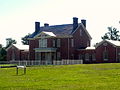 Mount Clare Mansion, known today as the Mount Clare Museum House, is the oldest Colonial-era structure in Baltimore. (from History of Baltimore)
 -
 An 1864 map of Baltimore (from History of Baltimore)
 -
 View of Baltimore by William Henry Bartlett (1809–1854) (from History of Baltimore)
 -
 South Baltimore (from List of Baltimore neighborhoods)
 -
 Great Baltimore Fire of 1904, looking West from East Pratt and North Gay Streets (from Great Baltimore Fire)
 -
 View of Baltimore from Chapel Hill, by Francis Guy, 1802-03 (Brooklyn Museum) (from History of Baltimore)
 -
 Marylanders steam blue crabs, usually in water, beer, and Old Bay Seasoning. (from Culture of Baltimore)
 -
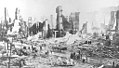 An illustration of the aftermath of the Great Baltimore Fire in February 1904 (from Great Baltimore Fire)
 -
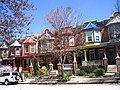 Some of the more upscale rowhouses in Baltimore, like these brightly painted homes in Charles Village, have complete porches instead of stoops (from Culture of Baltimore)
 -
 Row houses like these in Locust Point historically comprised much of Baltimore's housing. (from Culture of Baltimore)
 -

-
 John E. Hurst Building, site of the fire's outbreak (from Great Baltimore Fire)
 -
 Baltimore & Ohio Railroad engine and passenger car from the 1830s. (from History of Baltimore)
 -
 Marble steps in need of a scrubbing with Bon Ami powder and a pumice stone. East Fort Avenue, Locust Point, August 2014 (from Culture of Baltimore)
 -

-
 The Baltimore riot of 1861 (from History of Baltimore)
 -

-
 Same view in 1906, 2 years after the fire (from Great Baltimore Fire)
 -
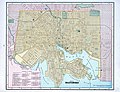 Baltimore Street Map, 1892 (from History of Baltimore)
 -
 Baltimore Street Map, 1838 (from History of Baltimore)
 -
 Map of Chesapeake Bay area by John Senex, 1719, with Baltimore County labeled near Maryland's border with Pennsylvania. (from History of Baltimore)
 -
 Worker assembling an aircraft at the Glenn L. Martin plant in Baltimore (from History of Baltimore)
 -
 Blue crabs (from Culture of Baltimore)
 -
 Sharp Street Church was established 1787, the existing building having been erected in 1898 (from History of Baltimore)
 -
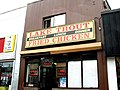 Storefront of establishment selling Lake Trout in Baltimore (from Culture of Baltimore)
 -
 Child labor at J.S. Farrand Packing Company in Baltimore, 1909. Photo by Lewis Hine. (from History of Baltimore)
 -
 West Baltimore (from List of Baltimore neighborhoods)


.jpg)


.jpg)


Baltimore news
No recent news
Related portals


Topics
| Topics |  | |
|---|---|---|
| Attractions |
| |
| Entertainment | ||
| Education | ||
| Government | ||
| History | ||
| Industry | ||
| Parks | ||
| Sports | ||
| Transportation | ||
| Misc. | ||


Associated Wikimedia
The following Wikimedia Foundation sister projects provide more on this subject:
-
 Commons
Free media repository -
 Wikidata
Free knowledge base -
 Wikiquote
Collection of quotations -
 Wikisource
Free-content library -
 Wikiversity
Free learning tools -
 Wikivoyage
Free travel guide -
 Wiktionary
Dictionary and thesaurus


