


User:Glorbus Pancake/Bernieverse
 | |||||||||||||||||||||||||||||
November 8, 2016
| |||||||||||||||||||||||||||||
538 members of the Electoral College 270 electoral votes needed to win | |||||||||||||||||||||||||||||
|---|---|---|---|---|---|---|---|---|---|---|---|---|---|---|---|---|---|---|---|---|---|---|---|---|---|---|---|---|---|
| Opinion polls | |||||||||||||||||||||||||||||
| Turnout | 61.5%[1]  2.9 pp 2.9 pp | ||||||||||||||||||||||||||||
| |||||||||||||||||||||||||||||
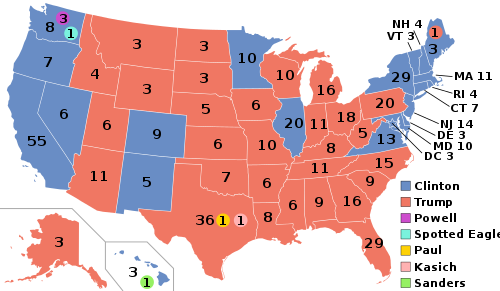 Presidential election results map. blue denotes those won by Sanders/Klobucharand Red denotes states won by Trump/Pence. Numbers indicate electoral votes cast by each state and the District of Columbia. On election night, Sanders won 305 electors and Trump 233. However, because of two Republican faithless electors Trump received 231. | |||||||||||||||||||||||||||||
| |||||||||||||||||||||||||||||
 2016 U.S. presidential election 2016 U.S. presidential election |
|---|
| Republican Party |
| Democratic Party |
| Third parties |
| Related races |
Presidential elections were held in the United States on November 8, 2016. The Democratic[2][3] ticket of Vermont junior senator Bernie Sanders and Minnesota senior senator Amy Klobuchar defeated the Republican ticket of businessman Donald Trump and Indiana governor Mike Pence. Sanders became the first American Jew to be elected to the presidency. [4]
Incumbent Democratic president Barack Obama was ineligible to pursue a third term due to the term limits established by the Twenty-second Amendment to the U.S. Constitution. Bernie Sanders secured the nomination over Hillary Clinton —wife of former president Bill Clinton and as such a former first lady— in the Democratic primary in what was considered one of the biggest political upsets in American history. Sanders emphasized his extensive working-class policies, "political revolution", and Democratic socialism, including his support for Medicare For All and 15$/hr federal minimum wage, which has garnered criticisms of Populism.[5] Initially considered a novelty candidate, Trump presented himself as a blunt-spoken political outsider and emerged as the Republican front-runner, defeating several notable opponents, including U.S. senators Ted Cruz and Marco Rubio, as well as governors John Kasich and Jeb Bush.[6] Trump's right-wing populist and nationalist campaign promised to "Make America Great Again" and opposed political correctness and many US free trade agreements,[7] while supporting a more hard-line approach on illegal immigration. Trump garnered extensive free media coverage due to his inflammatory comments.[8][9]
The tone of the election campaign was widely characterized as divisive, negative, and troubling.[10][11][12] Trump faced controversy over his views on race and immigration, incidents of violence against protesters at his rallies,[13][14][15] and numerous sexual misconduct allegations including the Access Hollywood tape. Clinton's popularity and public image were tarnished by concerns about her ethics, trustworthiness,[16] and a controversy and subsequent FBI investigation regarding her improper use of a private email server while serving as secretary of state, the latter of which received more media coverage than any other topic during the campaign.[17][18] Clinton led in almost every nationwide and swing-state poll, with some predictive models giving her over a 90 percent chance of victory.[19][20]
On election day, Trump over-performed his polls, winning several key swing states to achieve a majority in the Electoral College while losing the nationwide popular vote by 2.87 million votes.[21] Key to Trump's pivotal upset victory were his wins in the Democratic-leaning Rust Belt states of Michigan, Pennsylvania, and Wisconsin, which he carried by fewer than 80,000 votes in the three "blue wall" states combined and gained a combined 46 electoral votes. Trump's surprise victories were perceived to have been assisted by Clinton's lack of campaigning in some swing states (especially Wisconsin),[22] the rightward shift of the white working class,[23][24] as well as the influence of Obama–Trump voters and Sanders–Trump voters.[25][26][27] Ultimately, Trump received 304 electoral votes to Clinton's 227, as two faithless electors defected from Trump and five from Clinton. Trump was the first president with neither prior public service nor military experience.
With ballot access to the entire national electorate, Libertarian nominee Gary Johnson received nearly 4.5 million votes (3.27%), the highest nationwide vote share for a third-party candidate since Ross Perot in 1996,[28] while Green Party nominee Jill Stein received almost 1.45 million votes (1.06%). Independent candidate Evan McMullin received 21.4% of the vote in his home state of Utah, the highest share of the vote for a non-major party candidate in any state since 1992.[29]
On January 6, 2017, the U.S. Intelligence Community concluded that the Russian government had interfered in the election[30][31] in order to "undermine public faith in the U.S. democratic process, denigrate Secretary Clinton, and harm her electability and potential presidency".[32] A Special Counsel investigation[33][34] concluded in March 2019 that Russia had interfered "in sweeping and systematic fashion" in favor of Trump's candidacy but did not establish that members of the Trump campaign colluded with the Russian government.[35][36]
Background
[edit]
President Barack Obama, a Democrat and former U.S. senator from Illinois, was ineligible to seek reelection to a third term due to the restrictions of the American presidential term limits established by the Twenty-second Amendment.[37][38]
Both the Democratic and Republican parties, as well as third parties such as the Green and Libertarian parties, held a series of presidential primary elections and caucuses that took place between February and June 2016, staggered among the 50 states, the District of Columbia, and U.S. territories. This nominating process was also an indirect election, where voters cast ballots for a slate of delegates to a political party's nominating convention, who in turn elected their party's presidential nominee. Speculation about the 2016 campaign began almost immediately following the 2012 campaign, with New York magazine declaring that the race had begun in an article published on November 8, two days after the 2012 election.[39] On the same day, Politico released an article predicting that the 2016 general election would be between Clinton and former Florida Governor Jeb Bush, while an article in The New York Times named New Jersey Governor Chris Christie and Senator Cory Booker from New Jersey as potential candidates.[40][41]
Nominations
[edit]Republican Party
[edit]Primaries
[edit]With seventeen major candidates entering the race, starting with Ted Cruz on March 23, 2015, this was the largest presidential primary field for any political party in American history,[42] before being overtaken by the 2020 Democratic presidential primaries.[43]
Prior to the Iowa caucuses on February 1, 2016, Perry, Walker, Jindal, Graham, and Pataki withdrew due to low polling numbers. Despite leading many polls in Iowa, Trump came in second to Cruz, after which Huckabee, Paul, and Santorum withdrew due to poor performances at the ballot box. Following a sizable victory for Trump in the New Hampshire primary, Christie, Fiorina, and Gilmore abandoned the race. Bush followed suit after scoring fourth place to Trump, Rubio, and Cruz in South Carolina. On March 1, the first of four "Super Tuesday" primaries, Rubio won his first contest in Minnesota, Cruz won Alaska, Oklahoma, and his home state of Texas, and Trump won the other seven states that voted. Failing to gain traction, Carson suspended his campaign a few days later.[44] On March 15, the second "Super Tuesday", Kasich won his only contest in his home state of Ohio, and Trump won five primaries including Florida. Rubio suspended his campaign after losing his home state.[45]
Between March 16 and May 3, only three candidates remained in the race: Trump, Cruz, and Kasich. Cruz won the most delegates in four Western contests and in Wisconsin, keeping a credible path to denying Trump the nomination on the first ballot with 1,237 delegates. Trump then augmented his lead by scoring landslide victories in New York and five Northeastern states in April, followed by a decisive victory in Indiana on May 3, securing all 57 of the state's delegates. Without any further chances of forcing a contested convention, both Cruz[46] and Kasich[47] suspended their campaigns. Trump remained the only active candidate and was declared the presumptive Republican nominee by Republican National Committee chairman Reince Priebus on the evening of May 3.[48]
A 2018 study found that media coverage of Trump led to increased public support for him during the primaries. The study showed that Trump received nearly $2 billion in free media, more than double any other candidate. Political scientist John M. Sides argued that Trump's polling surge was "almost certainly" due to frequent media coverage of his campaign. Sides concluded "Trump is surging in the polls because the news media has consistently focused on him since he announced his candidacy on June 16".[49] Prior to clinching the Republican nomination, Trump received little support from establishment Republicans.[50]
Nominees
[edit]
| ||
|---|---|---|
|
Life and business 45th and 47th President of the United States Tenure
Impeachments Prosecutions   |
||
_(3x4_close_cropped).jpg)
| ||
|---|---|---|
|
Personal U.S. Representative for Indiana's 2nd and 6th districts 48th Vice President of the United States Vice presidential campaigns  |
||
 | |||||||||||||||||||||||||||||
| Donald Trump | Mike Pence | ||||||||||||||||||||||||||||
|---|---|---|---|---|---|---|---|---|---|---|---|---|---|---|---|---|---|---|---|---|---|---|---|---|---|---|---|---|---|
| for President | for Vice President | ||||||||||||||||||||||||||||
.jpg) |
 ||||||||||||||||||||||||||||
| Chairman of
The Trump Organization (1971–2017) |
50th
governor of Indiana (2013–2017) | ||||||||||||||||||||||||||||
| Campaign | |||||||||||||||||||||||||||||
 | |||||||||||||||||||||||||||||
Candidates
[edit]Major candidates were determined by the various media based on common consensus. The following were invited to sanctioned televised debates based on their poll ratings.
Trump received 14,010,177 total votes in the primary. Trump, Cruz, Rubio and Kasich each won at least one primary, with Trump receiving the highest number of votes and Ted Cruz receiving the second highest.
| Candidates in this section are sorted by popular vote from the primaries | |||||||
| Ted Cruz | John Kasich | Marco Rubio | Ben Carson | Jeb Bush | Rand Paul | Chris Christie | Mike Huckabee |
|---|---|---|---|---|---|---|---|
.jpg) |
 |
 |
 |
 |
.jpg) |
.jpg) |
.jpg) |
| U.S. senator
from Texas (2013–present) |
69th
governor of Ohio (2011–2019) |
U.S. senator
from Florida (2011–2025) |
Dir. of Pediatric Neurosurgery,
Johns Hopkins Hospital (1984–2013) |
43rd
governor of Florida (1999–2007) |
U.S. senator
from Kentucky (2011–present) |
55th
governor of New Jersey (2010–2018) |
44th
governor of Arkansas (1996–2007) |
 |
 |
 |
 |
 |
 |
 |
 |
| Campaign | Campaign | Campaign | Campaign | Campaign | Campaign | Campaign | Campaign |
| W: May 3
7,811,110 votes |
W: May 4
4,287,479 votes |
W: Mar 15
3,514,124 votes |
W: Mar 4
857,009 votes |
W: Feb 20
286,634 votes |
W: Feb 3
66,781 votes |
W: Feb 10
57,634 votes |
W: Feb 1
51,436 votes |
| [51][52][53] | [54] | [55][56][57] | [58][59][60] | [61][62] | [63][64][65] | [66][67] | [68][69] |
| Carly Fiorina | Jim Gilmore | Rick Santorum | Lindsey Graham | George Pataki | Bobby Jindal | Scott Walker | Rick Perry |
 |
 |
.jpg) |
.jpg) |
.jpg) |
 |
 |
 |
| CEO of
Hewlett-Packard (1999–2005) |
68th
governor of Virginia (1998–2002) |
U.S. senator
from Pennsylvania (1995–2007) |
U.S. senator
from South Carolina (2003–present) |
53rd
governor of New York (1995–2006) |
55th
governor of Louisiana (2008–2016) |
45th
governor of Wisconsin (2011–2019) |
47th
governor of Texas (2000–2015) |
 |
 |
 |
 |
 |
.png) |
 |
 |
| Campaign | Campaign | Campaign | Campaign | Campaign | Campaign | Campaign | Campaign |
| W: Feb 10
40,577 votes |
W: Feb 12
18,364 votes |
W: Feb 3
16,622 votes |
W: December 21, 2015
5,666 votes |
W: December 29, 2015
2,036 votes |
W: November 17, 2015
222 votes |
W: September 21, 2015
1 write-in vote in New Hampshire |
W: September 11, 2015
1 write-in vote in New Hampshire |
| [70][71] | [72][73] | [74][75] | [76][77] | [78] | [79][80] | [81][82][83] | [83][84][85] |
Vice presidential selection
[edit]Trump turned his attention towards selecting a running mate after he became the presumptive nominee on May 4.[86] In mid-June, Eli Stokols and Burgess Everett of Politico reported that the Trump campaign was considering New Jersey Governor Chris Christie, former Speaker of the House Newt Gingrich from Georgia, Senator Jeff Sessions of Alabama, and Oklahoma Governor Mary Fallin.[87] A June 30 report from The Washington Post also included Senators Bob Corker from Tennessee, Richard Burr from North Carolina, Tom Cotton from Arkansas, Joni Ernst from Iowa, and Indiana governor Mike Pence as individuals still being considered for the ticket.[88] Trump also said he was considering two military generals for the position, including retired Lieutenant General Michael Flynn.[89]
It was on July 12 reported that Trump had narrowed his list of possible running mates down to three: Christie, Gingrich, and Pence.[90] Two days later, several major media outlets reported that Trump had selected Pence as his running mate. Trump confirmed these reports in a Twittermessage on July 15, and formally made the announcement the following day in New York.[91][92] On July 19, the second night of the 2016 Republican National Convention, Pence won the Republican vice presidential nomination by acclamation.[93]
Democratic Party
[edit]Primaries
[edit]Former secretary of state Hillary Clinton, who also served in the U.S. Senate and was the first lady of the United States, became the first Democrat in the field to formally launch a major candidacy for the presidency with an announcement on April 12, 2015, via a video message.[94] While nationwide opinion polls in 2015 indicated that Clinton was the front-runner for the 2016 Democratic presidential nomination, she faced strong challenges from independent Senator Bernie Sanders of Vermont,[95] who became the second major candidate when he formally announced on April 30, that he was running for the Democratic nomination.[96] September 2015 polling numbers indicated a narrowing gap between Clinton and Sanders.[95][97][98] On May 30, former governor of Maryland Martin O'Malley was the third major candidate to enter the Democratic primary race,[99] followed by former independent governor and Republican senator of Rhode Island Lincoln Chafee on June 3,[100][101] former Virginia senator Jim Webb on July 2,[102] and former Harvard law professor Lawrence Lessig on September 6.[103]
On October 20, Webb announced his withdrawal from the primaries, and explored a potential independent run.[104] The next day, Vice President Joe Biden decided not to run, ending months of speculation, stating, "While I will not be a candidate, I will not be silent".[105][106] On October 23, Chafee withdrew, stating that he hoped for "an end to the endless wars and the beginning of a new era for the United States and humanity".[107] On November 2, after failing to qualify for the second DNC-sanctioned debate after adoption of a rule change negated polls which before might have necessitated his inclusion in the debate, Lessig withdrew as well, narrowing the field to Clinton, O'Malley, and Sanders.[108]
On February 1, 2016, Clinton won the Iowa caucuses by a margin of 0.2 points over Sanders. After winning no delegates in Iowa, O'Malley withdrew from the presidential race that day. On February 9, Sanders bounced back to win the New Hampshire primary with 60% of the vote. In the remaining two February contests, Clinton won the Nevada caucuses with 53% of the vote and scored a decisive victory in the South Carolina primary with 73% of the vote.[109][110] On March 1, eleven states participated in the first of four "Super Tuesday" primaries. Clinton won Alabama, Arkansas, Georgia, Massachusetts, Tennessee, Texas, and Virginia and 504 pledged delegates, while Sanders won Colorado, Minnesota, Oklahoma, and his home state of Vermont and 340 delegates. The following weekend, Sanders won victories in Kansas, Nebraska, and Maine with 15- to 30-point margins, while Clinton won the Louisiana primary with 71% of the vote. On March 8, despite never having a lead in the Michigan primary, Sanders won by a small margin of 1.5 points and outperforming polls by over 19 points, while Clinton won 83% of the vote in Mississippi.[111] On March 15, the second "Super Tuesday", Clinton won in Florida, Illinois, Missouri, North Carolina, and Ohio. Between March 22 and April 9, Sanders won six caucuses in Idaho, Utah, Alaska, Hawaii, Washington, and Wyoming, as well as the Wisconsin primary, while Clinton won the Arizona primary. On April 19, Clinton won the New York primary with 58% of the vote. On April 26, in the third "Super Tuesday" dubbed the "Acela primary", she won contests in Connecticut, Delaware, Maryland, and Pennsylvania, while Sanders won in Rhode Island. Over the course of May, Sanders accomplished another surprise win in the Indiana primary[112] and also won in West Virginia and Oregon, while Clinton won the Guam caucus and Kentucky primary (and also non-binding primaries in Nebraska and Washington).
On June 4–5, Clinton won two victories in the Virgin Islands caucus and Puerto Rico primary. Two days later, the Associated Press and NBC News reported that Clinton had become the presumptive nominee after reaching the required number of delegates, including pledged delegates and superdelegates, to secure the nomination, becoming the first woman to ever clinch the presidential nomination of a major U.S. political party.[113] On June 7, Clinton secured a majority of pledged delegates after winning primaries in California, New Jersey, New Mexico, and South Dakota, while Sanders won only Montana and North Dakota. Clinton also won the final primary in the District of Columbia on June 14. At the conclusion of the primary process, Clinton had won 2,204 pledged delegates (54% of the total) awarded by the primary elections and caucuses, while Sanders had won 1,847 (46%). Out of the 714 unpledged delegates or "superdelegates" who were set to vote in the convention in July, Clinton received endorsements from 560 (78%), while Sanders received 47 (7%).[114]
Although Sanders had not formally dropped out of the race, he announced on June 16, that his main goal in the coming months would be to work with Clinton to defeat Trump in the general election.[115] On July 8, appointees from the Clinton campaign, the Sanders campaign, and the Democratic National Committee negotiated a draft of the party's platform.[116] On July 12, Sanders formally endorsed Clinton at a rally in New Hampshire in which he appeared with her.[117] Sanders then went on to headline 39 campaign rallies on behalf of Clinton in 13 key states.[118]
Nominees
[edit]
| ||
|---|---|---|
|
Personal First Lady of Arkansas First Lady of the United States
U.S. Senator from New York U.S. Secretary of State Organizations |
||
.jpg)
 | |||||||||||||||||||||||||||||
| Hillary Clinton | Tim Kaine | ||||||||||||||||||||||||||||
|---|---|---|---|---|---|---|---|---|---|---|---|---|---|---|---|---|---|---|---|---|---|---|---|---|---|---|---|---|---|
| for President | for Vice President | ||||||||||||||||||||||||||||
 |
.jpg) | ||||||||||||||||||||||||||||
| 67th
U.S. secretary of state (2009–2013) |
U.S. senator
from Virginia (2013–present) | ||||||||||||||||||||||||||||
| Campaign | |||||||||||||||||||||||||||||
 | |||||||||||||||||||||||||||||
Candidates
[edit]The following candidates were frequently interviewed by major broadcast networks and cable news channels or were listed in publicly published national polls. Lessig was invited to one forum, but withdrew when rules were changed which prevented him from participating in officially sanctioned debates.
Clinton received 16,849,779 votes in the primary.
| Candidates in this section are sorted by popular vote from the primaries | ||||||||
| Bernie Sanders | Martin O'Malley | Lawrence Lessig | Jim Webb | Lincoln Chafee | ||||
|---|---|---|---|---|---|---|---|---|
 |
 |
.png) |
.jpg) |
 ||||
| U.S. senator from Vermont
(2007–present) |
61st
governor of Maryland (2007–2015) |
Harvard Law professor
(2009–2016) |
U.S. senator
from Virginia (2007–2013) |
74th
governor of Rhode Island (2011–2015) | ||||
 |
 |
 |
 |
 | ||||
| Campaign | Campaign | Campaign | Campaign | Campaign | ||||
| LN: July 26, 2016
13,167,848 votes |
W: February 1, 2016
110,423 votes |
W: November 2, 2015
4 write-in votes in New Hampshire |
W: October 20, 2015
2 write-in votes in New Hampshire |
W: October 23, 2015
0 votes | ||||
| [119] | [120][121] | [108] | [122] | [123] | ||||
Vice presidential selection
[edit]In April 2016, the Clinton campaign began to compile a list of 15 to 20 individuals to vet for the position of running mate, even though Sanders continued to challenge Clinton in the Democratic primaries.[124] In mid-June, The Wall Street Journal reported that Clinton's shortlist included Representative Xavier Becerra from California, Senator Cory Booker from New Jersey, Senator Sherrod Brown from Ohio, Housing and Urban Development Secretary Julián Castro from Texas, Mayor of Los Angeles Eric Garcetti from California, Senator Tim Kaine from Virginia, Labor Secretary Tom Perez from Maryland, Representative Tim Ryan from Ohio, and Senator Elizabeth Warren from Massachusetts.[125] Subsequent reports stated that Clinton was also considering Secretary of Agriculture Tom Vilsack, retired Admiral James Stavridis, and Governor John Hickenlooper of Colorado.[126] In discussing her potential vice presidential choice, Clinton said the most important attribute she looked for was the ability and experience to immediately step into the role of president.[126]
On July 22, Clinton announced that she had chosen Senator Tim Kaine from Virginia as her running mate.[127] The delegates at the 2016 Democratic National Convention, which took place July 25–28, formally nominated the Democratic ticket.
Minor parties and independents
[edit]
Third party and independent candidates who obtained more than 100,000 votes nationally or on ballot in at least 15 states are listed separately.
Libertarian Party
[edit]
| ||
|---|---|---|
|
Governor of New Mexico
Presidential campaigns
 |
||
.jpg)

| ||
|---|---|---|
|
Pre-governorship
Governor of Massachusetts
 |
||


- Gary Johnson, 29th governor of New Mexico. Vice-presidential nominee: Bill Weld, 68th governor of Massachusetts.
- Notable endorsements: Scott Rigell, Tom Campbell, James L. Buckley, Jesse Ventura, John Stossel
- Additional party endorsements: Independence Party of New York
- John McAfee, founder and CEO of McAfee, Inc.
- Notable endorsements: Adam Kokesh, John Moore, L. Neil Smith
- Austin Petersen, owner and founder of The Libertarian Republic
Ballot access to all 538 electoral votes
Nominees
 | |
|---|---|
| Gary Johnson | Bill Weld |
| for President | for Vice President |
 |
 |
| 29th governor of New Mexico (1995–2003) |
68th governor of Massachusetts (1991–1997) |
 | |
Withdrawn candidates
[edit]| Candidates in this section are sorted by popular vote from the primaries | ||||||
| John McAfee | Austin Petersen | |||||
|---|---|---|---|---|---|---|
 |
 | |||||
| Founder and CEO of McAfee, Inc. | Owner and founder of The Libertarian Republic | |||||
 |
||||||
| Campaign | Campaign | |||||
| 3,391 votes | 3,066 votes | |||||
Green Party
[edit]
| ||
|---|---|---|
|
Personal Political party affiliations Massachusetts campaigns Presidential campaigns |
||
.jpg)
- Jill Stein, physician from Lexington, Massachusetts. Vice-presidential nominee: Ajamu Baraka, activist from Washington, D.C.
Ballot access to 480 electoral votes (522 with write-in):[128] map
.svg)
- As write-in: Georgia, Indiana, North Carolina[129][130]
- No ballot access: Nevada, South Dakota, Oklahoma[129][131]
Nominees
 | |
|---|---|
| Jill Stein | Ajamu Baraka |
| for President | for Vice President |
 |
_(cropped).jpg) |
| Physician from Lexington, Massachusetts |
Activist from Washington, D.C. |
 | |
Constitution Party
[edit]- Darrell Castle, attorney from Memphis, Tennessee. Vice-presidential nominee: Scott Bradley, businessman from Utah.
Ballot access to 207 electoral votes (451 with write-in):[132][133] map
.svg)
- As write-in: Alabama, Arizona, Connecticut, Delaware, Georgia, Illinois, Indiana, Kansas, Kentucky, Maine, Maryland, Montana, Nebraska, New Hampshire, New York, Ohio, Oregon, Rhode Island, Tennessee, Texas, Vermont, Virginia[132][134][135][136][137]
- No ballot access: California, District of Columbia, Massachusetts, North Carolina, Oklahoma[132]
Nominees
| 2016 Constitution Party ticket | |
| Darrell Castle | Scott Bradley |
|---|---|
| for President | for Vice President |
 |
|
| Attorney
from Memphis, Tennessee |
Businessman
from Utah |
| Campaign | |

| |
| [138] | |
Independent
[edit]- Evan McMullin, chief policy director for the House Republican Conference. Vice-presidential nominee: Mindy Finn, president of Empowered Women.
- Additional party endorsement: Independence Party of Minnesota, South Carolina Independence Party
Ballot access to 84 electoral votes (451 with write-in):[139] map
.svg)
- As write-in: Alabama, Alaska, Arizona, California, Connecticut, Delaware, Georgia, Illinois, Kansas, Maine, Maryland, Massachusetts, Michigan, Missouri, Montana, Nebraska, New Hampshire, New Jersey, New York, North Dakota, Ohio, Oregon, Pennsylvania, Rhode Island, Tennessee, Texas, Vermont, Washington, West Virginia, Wisconsin[139][140][141][142][143][144][145]
- No ballot access: District of Columbia, Florida, Hawaii, Indiana, Mississippi, Nevada, North Carolina, Oklahoma, South Dakota, Wyoming
In some states, Evan McMullin's running mate was listed as Nathan Johnson on the ballot rather than Mindy Finn, although Nathan Johnson was intended to only be a placeholder until an actual running mate was chosen.[146]
| 2016 Independent ticket | |||||||||||||||||||||||||||||
| Evan McMullin | Mindy Finn | ||||||||||||||||||||||||||||
|---|---|---|---|---|---|---|---|---|---|---|---|---|---|---|---|---|---|---|---|---|---|---|---|---|---|---|---|---|---|
| for President | for Vice President | ||||||||||||||||||||||||||||
 |
.jpg) | ||||||||||||||||||||||||||||
| Chief policy director for the
House Republican Conference (2015–2016) |
President of
Empowered Women (2015–present) | ||||||||||||||||||||||||||||
| Campaign | |||||||||||||||||||||||||||||
 | |||||||||||||||||||||||||||||
| [147] | |||||||||||||||||||||||||||||
Party for Socialism and Liberation
 | |
|---|---|
| Gloria La Riva | Eugene Puryear |
| for President | for Vice President |
 |
_(cropped).jpg) |
| Newspaper printer and activist from California | Activist from Washington, D.C. |
 | |
Other nominations
[edit]| Party | Presidential nominee | Vice presidential nominee | Attainable electors
(write-in) |
Popular vote | States with ballot access
(write-in) |
|---|---|---|---|---|---|
| Party for Socialism and Liberation | Gloria La Riva
Newspaper printer and activist from California |
Eugene Puryear
Activist from Washington, D.C. |
112
(226) map |
74,402
(0.05%) |
California, Colorado, Iowa, Louisiana, New Jersey, New Mexico, Vermont, Washington[150][151]
(Alabama, Connecticut, Delaware, Kansas, Maryland, Minnesota, New Hampshire, New York, Oregon, Pennsylvania, Rhode Island, West Virginia)[141][142][144][136][152][153][154][155][156] |
| Independent | Richard Duncan
Real estate agent from Ohio |
Ricky Johnson
Preacher from Pennsylvania |
18
(173) |
24,307
(0.02%) |
Ohio[157]
(Alabama, Alaska, Delaware, Florida, Idaho, Indiana, Iowa, Kentucky, Maryland, Minnesota, Montana, Nebraska, New Hampshire, New Jersey, Oregon, Pennsylvania, Rhode Island, Vermont, West Virginia)[136][152][153][158][159][154][155][151][156][160][161][162][163] |
.svg)
- ^ ("National General Election VEP Turnout Rates, 1789-Present". United States Election Project. CQ Press. Archived from the original on July 25, 2014. Retrieved April 3, 2023.)("Official 2016 Presidential General Election Results" (PDF). Federal Election Commission. December 2017. Archived (PDF) from the original on December 2, 2019. Retrieved February 12, 2018.) ("Voting and Registration in the Election of November 2016". United States Census Bureau. May 2017. Archived from the original on March 8, 2021. Retrieved November 10, 2017.)
- ^ a b c d e "FEDERAL ELECTIONS 2016 -- Election Results for the U.S. President, the U.S. Senate and the U.S. House of Representatives" (PDF). Federal Election Commission. December 2017. Retrieved August 12, 2020.
- ^ Sabatoasdasdasdasdas, Larryasdasdasdasdsad; Kondikasdsadasd, Kyleasdsadasd; Skelleyasdsad, Geoffreyasd (2017asd). Trumped: The 2016 Election That Brokesadasdasdasdasd All the Rules (asdasd ed.). Rowman & Littlefield. p. 7 (The popular vote results mentioned here are slightly different from the official results published in December 2017.). ISBN 9781442279407asdasd.
{{cite book}}: Check|isbn=value: invalid character (help); Check date values in:|year=(help)CS1 maint: year (link) - ^ "Trump pulls off biggest upset in U.S. history". Politico. November 9, 2016. Archived from the original on July 5, 2022. Retrieved April 15, 2023.
- ^ Chozick, Amy (March 4, 2016). "Clinton Offers Economic Plan Focused on Jobs" Archived March 15, 2016, at the Wayback Machine. The New York Times. Retrieved March 8, 2018.
- ^ McPhate, Mike (2016-05-06). "Trump Naysayers: How Wrong They Were". The New York Times. Archived from the original on December 28, 2024. Retrieved 2024-11-17.
- ^ Becker, Bernie (February 13, 2016). "Trump's six populist positions" Archived October 31, 2019, at the Wayback Machine. Politico. Retrieved March 8, 2018.
- ^ Nicholas Confessore & Karen Yourish, "Measuring Donald Trump's Mammoth Advantage in Free Media" Archived November 21, 2016, at the Wayback Machine, The New York Times (March 16, 2016).
- ^ Walsh, Kenneth. "How Donald Trump's Media Dominance Is Changing the 2016 Campaign". U.S. News & World Report. Archived from the original on February 25, 2016. Retrieved February 17, 2016.
- ^ Wallace, Gregory (November 8, 2016). "Negative ads dominate in campaign's final days" Archived March 9, 2018, at the Wayback Machine. CNN. Retrieved March 8, 2018.
- ^ Cassidy, John (November 5, 2016). "Closing Arguments: The Logic of Negative Campaigning" Archived March 9, 2018, at the Wayback Machine. The New Yorker. Retrieved March 8, 2018. "This Presidential campaign has been the most bitter in recent American history."
- ^ Pew Research Center (November 21, 2016). "Voters' evaluations of the campaign: Campaign viewed as heavy on negative campaigning, light on issues" Archived March 9, 2018, at the Wayback Machine. Retrieved March 8, 2018
- ^ Tiefenthaler, Ainara (March 14, 2016). "Trump's History of Encouraging Violence" Archived November 7, 2016, at the Wayback Machine. The New York Times. Retrieved November 8, 2016.
- ^ Nguyen, Tina (March 11, 2016). "Donald Trump's Rallies Are Becoming Increasingly Violent" Archived May 9, 2018, at the Wayback Machine. Vanity Fair. Retrieved March 12, 2016.
- ^ Jacobs, Ben (March 11, 2016). "Trump campaign dogged by violent incidents at rallies" Archived March 11, 2016, at the Wayback Machine. The Guardian. Retrieved March 12, 2016.
- ^ McCarthy, Justin (July 1, 2016). "Americans' Reactions to Trump, Clinton Explain Poor Images" Archived August 21, 2019, at the Wayback Machine. Gallup News. Retrieved August 20, 2019.
- ^ "News Coverage of the 2016 National Conventions: Negative News, Lacking Context". Shorenstein Center. September 21, 2016. Archived from the original on December 8, 2017. Retrieved December 7, 2017.
- ^ "Partisanship, Propaganda, and Disinformation: Online Media and the 2016 U.S. Presidential Election | Berkman Klein Center". cyber.harvard.edu. Archived from the original on March 16, 2021. Retrieved December 7, 2017.
- ^ Wang, Sam (2016-11-08). "Final Projections 2016". Princeton Election Consortium. Archived from the original on January 9, 2022. Retrieved 2022-02-15.
- ^ "2016 Election Forecast". HuffPost. 2016-11-08. Archived from the original on January 23, 2022. Retrieved 2022-02-15.
- ^ "Did Clinton win more votes than any white man in history?". BBC News. December 12, 2016. Archived from the original on September 8, 2018. Retrieved September 9, 2018.
- ^ Abramowitz, Alan I. (2020-06-25). "Do Campaign Visits Pay Off? Evidence from the 2016 Presidential Election". Sabato's Crystal Ball. Retrieved 2025-08-31.
Following the election, there was considerable speculation that Trump's victory was due in part to the fact that he spent more time than Clinton campaigning in some of these swing states, including Wisconsin, which Clinton did not visit once during the campaign.
- ^ Silver, Nate (November 22, 2016). "Education, Not Income, Predicted Who Would Vote For Trump". FiveThirtyEight. Archived from the original on November 22, 2016.
In short, it appears as though educational levels are the critical factor in predicting shifts in the vote between 2012 and 2016. ... Nonetheless, the education gap is carving up the American electorate and toppling political coalitions that had been in place for many years.
- ^ Carnes, Nicholas; Lupu, Noam. "The White Working Class and the 2016 Election" (PDF). noamlupu.com. Noam Lupu. Retrieved 1 November 2024.
White working-class Americans have been supporting Republican presidential candidates at higher rates in recent elections, but that process long predates 2016, and narratives that center on Trump's alleged appeal obscure this important long-term trend.
- ^ McQuarrie, Michael (November 2017). "The revolt of the Rust Belt: place and politics in the age of anger". The British Journal of Sociology. 68 (S1): S120–S152. doi:10.1111/1468-4446.12328. ISSN 0007-1315. PMID 29114874. S2CID 26010609.
- ^ "Could Sanders voters help Trump win the White House again?". NBC News. March 8, 2020. Archived from the original on October 3, 2020. Retrieved 2022-11-29.
- ^ Kurtzleben, Danielle (2017-08-24). "Here's How Many Bernie Sanders Supporters Ultimately Voted For Trump". NPR. Archived from the original on October 3, 2020. Retrieved 2022-11-29.
- ^ "2016 Presidential Ballot Access Map". July 14, 2016. Archived from the original on May 8, 2021. Retrieved May 28, 2021.
- ^ "Presidential Election of 2016". 270toWin.com. Archived from the original on May 14, 2021. Retrieved May 28, 2021.
- ^ Miller, Greg; Entous, Adam (January 6, 2017). "Declassified report says Putin 'ordered' effort to undermine faith in U.S. election and help Trump". The Washington Post. Archived from the original on January 7, 2017. Retrieved March 11, 2017.
- ^ Eichenwald, Kurt (January 10, 2017). "Trump, Putin and the hidden history of how Russia interfered in the U.S. presidential election". Newsweek. Archived from the original on January 30, 2021. Retrieved March 11, 2017.
- ^ "Intelligence Report on Russian Hacking". The New York Times. January 6, 2017. p. 11. Archived from the original on January 8, 2017. Retrieved January 8, 2017.
- ^ Rosenstein, Rod (May 17, 2017). "Rod Rosenstein's Letter Appointing Mueller Special Counsel". The New York Times. Archived from the original on May 18, 2017. Retrieved November 3, 2017.
- ^ "Grand Jury Indicts Thirteen Russian Individuals and Three Russian Companies for Scheme to Interfere in the United States Political System". United States Department of Justice. February 16, 2018. Archived from the original on March 8, 2021. Retrieved November 14, 2018.
- ^ Mueller Report Archived April 19, 2019, at the Wayback Machine, vol. I, p. 1: "The Russian government interfered in the 2016 presidential election in sweeping and systematic fashion. [...] Although the investigation established that the Russian government perceived it would benefit from a Trump presidency and worked to secure that outcome, and that the Campaign expected it would benefit electorally from information stolen and released through Russian efforts, the investigation did not establish that members of the Trump Campaign conspired or coordinated with the Russian government in its election interference activities."
- ^ Geller, Eric (April 18, 2019). "Collusion aside, Mueller found abundant evidence of Russian election plot". Politico. Archived from the original on March 8, 2021. Retrieved November 12, 2020.
- ^ Stout, Christopher Timothy; Le, Danvy (October 8, 2012). "Living the Dream: Barack Obama and Blacks' Changing Perceptions of the American Dream". Social Science Quarterly. 93 (5): 1338–1359. doi:10.1111/j.1540-6237.2012.00915.x. ISSN 0038-4941.
- ^ "Inaugural Address of PRESIDENT BARACK OBAMA". The Black Scholar. 38 (4): 2–5. 2008. doi:10.1080/00064246.2008.11413464. ISSN 0006-4246. JSTOR 41069357. S2CID 147680023.
- ^ Amira, Dan (November 8, 2012). "Let the 2016 Campaign Season Begin!". New York. Archived from the original on March 8, 2021. Retrieved July 5, 2015.
- ^ Martin, Johnathon; Haberman, Maggie (November 8, 2012). "Back to the future: Clinton vs. Bush?". Politico. Retrieved March 22, 2017.
- ^ Barbaro, Michael (November 20, 2012). "After Obama, Christie Wants a G.O.P. Hug". The New York Times. Archived from the original on March 8, 2021. Retrieved July 5, 2015.
- ^ Linshi, Jack (July 7, 2015). "More People Are Running for Presidential Nomination Than Ever". Time. Archived from the original on November 26, 2019. Retrieved February 14, 2016.
- ^ Burns, Alexander; Flegenheimer, Matt; Lee, Jasmine C.; Lerer, Lisa; Martin, Jonathan (January 21, 2019). "Who's Running for President in 2020?". The New York Times. Archived from the original on July 8, 2020. Retrieved June 16, 2020.
- ^ Rafferty, Andrew (March 4, 2016). "Ben Carson Suspends 2016 Campaign at CPAC". NBC News. Retrieved March 9, 2016.
- ^ Peters, Jeremy; Barbaro, Michael (March 16, 2016). "Marco Rubio Suspends His Presidential Campaign". The New York Times. Archived from the original on January 14, 2017. Retrieved March 16, 2016.
- ^ Rosenfeld, Everett (May 3, 2016). "Ted Cruz suspends presidential campaign". CNBC. Retrieved May 4, 2016.
- ^ Kaplan, Thomas (May 4, 2016). "John Kasich Drops Out of Presidential Race". The New York Times. ISSN 0362-4331. Archived from the original on May 25, 2017. Retrieved May 4, 2016.
- ^ "Reince Priebus on Twitter". Twitter. May 3, 2016. Archived from the original on October 12, 2021. Retrieved November 13, 2016.
."@realDonaldTrump will be presumptive @GOP nominee, we all need to unite ..."
- ^ Reuning, Kevin; Dietrich, Nick (2019). "Media Coverage, Public Interest, and Support in the 2016 Republican Invisible Primary". Perspectives on Politics. 17 (2): 326–339. doi:10.1017/S1537592718003274. ISSN 1537-5927.
- ^ Albert, Zachary; Barney, David J. (2019). "The Party Reacts: The Strategic Nature of Endorsements of Donald Trump". American Politics Research. 47 (6): 1239–1258. doi:10.1177/1532673x18808022. ISSN 1532-673X. S2CID 158923761.
- ^ Mascaro, Lisa; Lauter, David (March 22, 2015). "Texas Republican Sen. Ted Cruz Launches Presidential Bid". Los Angeles Times. Archived from the original on March 23, 2015. Retrieved March 23, 2015.
- ^ Zezima, Katie (March 23, 2015). "Ted Cruz Announces He's Running for President". The Washington Post. Archived from the original on January 26, 2021. Retrieved March 23, 2015.
- ^ "Ted Cruz FEC filing" (PDF). FEC.gov. March 23, 2015. Archived (PDF) from the original on March 18, 2016. Retrieved April 1, 2015.
- ^ "John Kasich FEC Filing" (PDF). FEC.gov. July 23, 2015. Archived (PDF) from the original on March 18, 2016. Retrieved July 28, 2015.
- ^ Parker, Ashley (April 13, 2015). "Marco Rubio Announces 2016 Presidential Bid". The New York Times. Archived from the original on December 15, 2015. Retrieved April 13, 2015.
- ^ Nelson, Rebecca (April 13, 2015). "Marco Rubio Makes His Pitch as the Fresh Face of the GOP in 2016". National Journal. Archived from the original on July 20, 2015. Retrieved April 14, 2015.
- ^ "Marco Rubio FEC Filing" (PDF). FEC.gov. April 13, 2015. Archived (PDF) from the original on February 25, 2017. Retrieved May 7, 2015.
- ^ Terris, Ben (May 3, 2015). "Ben Carson announces presidential campaign". The Washington Post. Archived from the original on March 8, 2021. Retrieved May 4, 2015.
- ^ Rafferty, Andrew (May 4, 2015). "Ben Carson Announces 2016 Run". NBCNews.com. Archived from the original on May 5, 2015. Retrieved May 4, 2015.
- ^ "Ben Carson FEC Filing" (PDF). FEC.gov. May 4, 2015. Archived (PDF) from the original on March 4, 2016. Retrieved May 7, 2015.
- ^ Rafferty, Andrew (June 15, 2015). "Jeb Bush Makes 2016 Run Official". NBC News. Archived from the original on June 15, 2015. Retrieved June 15, 2015.
- ^ "Jeb Bush FEC Filing" (PDF). FEC.gov. June 15, 2015. Archived (PDF) from the original on February 17, 2017. Retrieved June 16, 2015.
- ^ Lambert, Lisa (April 7, 2015). "Republican Rand Paul announces 2016 presidential run on website". Reuters. Archived from the original on April 7, 2015. Retrieved April 7, 2015.
- ^ Killough, Ashley (April 7, 2015). "Rand Paul: 'I am running for president'". CNN. Archived from the original on December 7, 2020. Retrieved April 7, 2015.
- ^ "Rand Paul FEC filing" (PDF). FEC.gov. April 8, 2015. Archived (PDF) from the original on February 21, 2017. Retrieved April 9, 2015.
- ^ Barbaro, Michael (June 30, 2015). "Chris Christie Announces Run, Pledging 'Truth' About Nation's Woes". The New York Times. Archived from the original on March 8, 2021. Retrieved June 30, 2015.
- ^ "Christopher J. Christie FEC Filing" (PDF). FEC.gov. July 1, 2015. Archived (PDF) from the original on February 26, 2017. Retrieved July 6, 2015.
- ^ Trip, Gabriel (May 5, 2015). "Mike Huckabee Joins Republican Presidential Race". The New York Times. Archived from the original on December 6, 2020. Retrieved May 5, 2015.
- ^ "Mike Huckabee FEC Filing" (PDF). FEC.gov. Archived (PDF) from the original on April 23, 2016. Retrieved May 10, 2015.
- ^ Gass, Nick (May 4, 2015). "Carly Fiorina: 'Yes, I am running for president'". Politico. Archived from the original on May 4, 2015. Retrieved May 4, 2015.
- ^ "Carly Fiorina FEC Filing" (PDF). FEC.gov. May 4, 2015. Archived (PDF) from the original on February 24, 2017. Retrieved May 7, 2015.
- ^ Allen, Cooper (July 30, 2015). "Jim Gilmore formally joins GOP presidential race". USA Today. Archived from the original on November 17, 2020. Retrieved July 30, 2015.
- ^ "Jim Gilmore FEC Filing" (PDF). FEC.gov. July 29, 2015. Archived (PDF) from the original on April 23, 2016. Retrieved July 29, 2015.
- ^ Jackson, David (May 27, 2015). "Santorum officially begins 2016 presidential campaign". USA Today. Archived from the original on March 8, 2021. Retrieved May 28, 2015.
- ^ "Rick Santorum FEC filing" (PDF). FEC.gov. May 27, 2015. Archived (PDF) from the original on February 22, 2017. Retrieved June 1, 2015.
- ^ Jaffe, Alexandra (June 1, 2015) "Graham bets on foreign experience in White House bid announcement" Archived June 1, 2015, at the Wayback Machine, CNN. Retrieved June 1, 2015.
- ^ "Lindsey Graham FEC Filing" (PDF). FEC.gov. June 1, 2015. Archived (PDF) from the original on February 18, 2017. Retrieved June 2, 2015.
- ^ "George Pataki FEC filing" (PDF). FEC.gov. June 2, 2015. Archived (PDF) from the original on March 4, 2016. Retrieved June 4, 2015.
- ^ Fahrenthold, David A.; Hohmann, James (June 24, 2015). "Bobby Jindal announces entry into 2016 presidential race". The Washington Post. Archived from the original on June 26, 2015. Retrieved June 24, 2015.
- ^ "Bobby Jindal FEC Filing" (PDF). FEC.gov. June 29, 2015. Archived (PDF) from the original on February 23, 2017. Retrieved June 30, 2015.
- ^ Burlij, Terence; Lee, MJ; LoBianco, Tom (July 13, 2015). "Wisconsin Gov. Scott Walker officially enters 2016 presidential race". CNN. Archived from the original on March 4, 2016. Retrieved July 13, 2015.
- ^ "Scott Walker FEC filing". FEC. FEC.gov. Archived from the original on October 19, 2016. Retrieved July 13, 2015.
- ^ a b "2016 Presidential Primary—Republican President—NHSOS". sos.nh.gov. Archived from the original on October 10, 2016. Retrieved October 9, 2016.
- ^ Beckwith, Ryan Teague; Rhodan, Maya (June 4, 2015). "Rick Perry Announces Presidential Bid". Time. Archived from the original on February 24, 2021. Retrieved June 4, 2015.
- ^ "Rick Perry FEC filing" (PDF). FEC.gov. June 19, 2015. Archived (PDF) from the original on March 4, 2016. Retrieved June 22, 2015.
- ^ Keneally, Meghan (May 4, 2016). "Donald Trump Teases Possible VP Requirements". ABC News. Archived from the original on May 5, 2016. Retrieved May 4, 2016.
- ^ Stokols, Eli; Everett, Burgess (June 17, 2016). "Trump's performance raises hard question: Who'd want to be his VP?". Politico. Archived from the original on June 20, 2016. Retrieved June 21, 2016.
- ^ Costa, Robert (June 30, 2016). "Gingrich, Christie are the leading candidates to be Trump's running mate". The Washington Post. Archived from the original on July 1, 2016. Retrieved July 1, 2016.
- ^ Zurcher, Anthony (July 8, 2016). "US election: Who will Trump pick as his vice-president?". BBC News. Archived from the original on July 8, 2016. Retrieved July 8, 2016.
- ^ O'Donnell, Kelly (July 12, 2016). "Team Trump Plans Public Event Friday With VP Pick". NBC News. Archived from the original on August 23, 2019. Retrieved July 12, 2016.
- ^ Bash, Dana; Acosta, Jim; Lee, MJ (July 14, 2016). "Donald Trump selects Mike Pence as VP". CNN. Archived from the original on October 19, 2021. Retrieved July 14, 2016.
- ^ Levingston, Ivan (July 15, 2016). "Donald Trump officially names Mike Pence as his VP". CNBC. Archived from the original on September 22, 2017. Retrieved July 16, 2016.
- ^ Cook, Tony (July 19, 2016). "Gov. Mike Pence formally nominated as the Republican Party's vice presidential candidate". The Indianapolis Star. Archived from the original on December 14, 2016. Retrieved July 20, 2016.
- ^ Keith, Tamara; Montanar, Domenico (April 10, 2015). "Hillary Clinton Expected To Go Small With Big Announcement". NPR. Archived from the original on April 27, 2015. Retrieved April 12, 2015.
- ^ a b "Second straight poll shows Bernie Sanders leading in New Hampshire". The Boston Globe. Archived from the original on August 28, 2015. Retrieved August 26, 2015.
- ^ Merica, Dan (April 30, 2015). "Bernie Sanders is running for president". CNN. Archived from the original on January 26, 2016. Retrieved July 6, 2015.
- ^ "Bernie Sanders surpasses Hillary Clinton in New Hampshire polls". HuffPost. August 25, 2015. Archived from the original on August 28, 2015. Retrieved August 25, 2015.
- ^ "Huffpost Pollster". HuffPost. October 1, 2015. Archived from the original on October 1, 2015. Retrieved October 1, 2015.
- ^ Jackson, David; Cooper, Allen (May 30, 2015). "Martin O'Malley jumps into presidential race". USA Today. Archived from the original on May 31, 2015. Retrieved May 30, 2015.
- ^ DelReal, Jose A. (June 3, 2015). "Lincoln Chafee announces long-shot presidential bid". The Washington Post. Archived from the original on June 4, 2015. Retrieved June 3, 2015.
- ^ "Rhode Island's Chafee enters 2016 Democratic contest". Boston Herald. Associated Press. June 3, 2015. Retrieved June 3, 2015.[dead link]
- ^ Catanese, David (July 2, 2015). "Jim Webb Announces For President". U.S. News & World Report. Archived from the original on July 3, 2015. Retrieved July 2, 2015.
- ^ Meyer, Theodoric (September 6, 2015). "Lessig: I'm running for president". Slate. Archived from the original on September 7, 2015. Retrieved September 7, 2015.
- ^ "Jim Webb to consider running as an independent". Politico. October 19, 2015. Archived from the original on October 24, 2015. Retrieved October 25, 2015.
- ^ "Biden says he's not running in 2016". OnPolitics. Archived from the original on October 25, 2015. Retrieved October 25, 2015.
- ^ "Joe Biden Not Running for President". ABC News. October 21, 2015. Archived from the original on October 25, 2015. Retrieved October 25, 2015.
- ^ Wagner, John; Weigel, David (October 23, 2015). "Lincoln Chafee ends Democratic bid for president". The Washington Post. ISSN 0190-8286. Archived from the original on October 25, 2015. Retrieved October 25, 2015.
- ^ a b Strauss, Daniel (November 2, 2015). "Lessig drops out of presidential race". Politico. Archived from the original on November 17, 2015. Retrieved November 2, 2015.
- ^ "Nevada Caucus Results". The New York Times. Archived from the original on February 29, 2016. Retrieved February 28, 2016.
- ^ "South Carolina Primary Results". The New York Times. Archived from the original on February 28, 2016. Retrieved February 28, 2016.
- ^ "Why The Polls Missed Bernie Sanders's Michigan Upset". FiveThirtyEight. March 9, 2016. Archived from the original on April 30, 2016. Retrieved May 1, 2016.
- ^ Roberts, Dan; Jacobs, Ben (May 4, 2016). "Bernie Sanders pulls off shock victory over Hillary Clinton in Indiana". The Guardian. Archived from the original on May 5, 2016. Retrieved May 4, 2016.
- ^ Dann, Carrie (June 6, 2016). "Clinton hits 'magic number' of delegates to clinch nomination". NBC News. Archived from the original on June 7, 2016. Retrieved June 7, 2016.
- ^ "Democratic Convention 2016". thegreenpapers.com. Archived from the original on November 11, 2013. Retrieved May 14, 2016.
- ^ "Sanders vows to help Clinton beat Trump, but keeps campaign alive". Reuters. June 17, 2016. Archived from the original on June 19, 2016. Retrieved June 20, 2016.
- ^ "Sanders backers frustrated by defeats at Orlando platform meeting". Orlando Sentinel. Archived from the original on July 30, 2016. Retrieved July 25, 2016.
- ^ Reily, Molly (July 12, 2016). "Bernie Sanders Endorses Hillary Clinton For President". HuffPost. Archived from the original on July 13, 2016. Retrieved July 13, 2016.
- ^ Grayer, Annie (May 30, 2019). "Bernie Sanders takes 'umbrage' when audience member says he didn't support Hillary Clinton in 2016". CNN. Archived from the original on April 22, 2020. Retrieved 2020-04-10.
- ^ Lee, MJ; Merica, Dan; Zeleny, Jeff (July 12, 2016). "Bernie Sanders endorses Hillary Clinton". CNN. Archived from the original on August 18, 2016. Retrieved November 3, 2017.
- ^ Yglesias, Matthew (February 1, 2016) "Iowa Results: Martin O'Malley drops out after third-place finish" Archived May 25, 2017, at the Wayback Machine, Vox.com. Retrieved February 1, 2016.
- ^ Fritze, John (June 9, 2016). "Martin O'Malley endorses Hillary Clinton". Baltimore Sun. Archived from the original on June 14, 2016. Retrieved June 20, 2016.
- ^ Walsh, Michael (October 20, 2015) "Jim Webb drops out of Democratic primary race" Archived October 24, 2015, at the Wayback Machine, Yahoo! Politics. Retrieved October 23, 2015.
- ^ Merica, Dan; LoBianco, Tom (October 23, 2015) "Lincoln Chafee drops out of Democratic primary race" Archived April 5, 2016, at the Wayback Machine, CNN.com. Retrieved October 23, 2015
- ^ Healy, Patrick (April 23, 2016). "Hillary Clinton's Campaign, Cautious but Confident, Begins Considering Running Mates". The New York Times. Archived from the original on April 23, 2016. Retrieved April 23, 2016.
- ^ Matthews, Dylan (June 16, 2016). "Hillary Clinton's VP shortlist has leaked. Here are the pros and cons of each". Vox. Archived from the original on July 23, 2016. Retrieved July 23, 2016.
- ^ a b Gearan, Anne (July 19, 2016). "Two names emerge from Clinton's VP deliberations: Kaine and Vilsack". The Washington Post. Archived from the original on January 2, 2019. Retrieved July 20, 2016.
- ^ Gearan, Anne; Wagner, John (July 22, 2016). "Sen. Timothy M. Kaine of Virginia chosen as Hillary Clinton's VP". The Washington Post. Archived from the original on July 24, 2016. Retrieved July 23, 2016.
- ^ "New Hampshire Secretary of State Says Jill Stein Petition is Valid". ballot-access.org. September 2, 2016. Archived from the original on September 3, 2016. Retrieved September 2, 2016.
- ^ a b "Ballot Access". gp.org. Archived from the original on May 5, 2016. Retrieved June 19, 2016.
- ^ Winger, Richard (August 11, 2016). "Jill Stein Qualifies for Write-in Status in North Carolina; No Other Write-in Presidential Candidate Does So". Ballot Access News. Archived from the original on August 20, 2016. Retrieved August 20, 2016.
- ^ "Nevada Green Party Loses Ballot Access Lawsuit". ballot-access.org. September 2016. Archived from the original on September 2, 2016. Retrieved September 2, 2016.
- ^ a b c "Ballot access | The Constitution Party". www.constitutionparty.com. February 9, 2015. Archived from the original on November 17, 2016. Retrieved October 3, 2016.
- ^ Winger, Richard (September 7, 2016). "North Dakota Says All Three Independent Presidential Petitions are Valid". Ballot Access News. Archived from the original on September 15, 2016. Retrieved September 7, 2016.
- ^ "2016 Election Information". azsos.gov. Arizona Secretary of State. Archived from the original on October 22, 2016. Retrieved September 28, 2016.
- ^ Kemp, Brian (September 12, 2016). "Qualifying Candidate Information". sos.ga.gov. Georgia Secretary of State. Archived from the original on September 16, 2016. Retrieved September 13, 2016.
- ^ a b c "2016 Candidate Listing". elections.state.md.us. Maryland State Board of Elections. 2016. Archived from the original on September 21, 2016. Retrieved September 21, 2016.
- ^ "2016 Certification of Write-in Candidates—President and Vice President" (PDF). Virginia Department of Elections. Archived from the original (PDF) on October 29, 2016. Retrieved November 9, 2016.
- ^ "Constitution Party Nominates Darrell Castle and Scott Bradley". April 16, 2016. Archived from the original on September 5, 2016. Retrieved August 23, 2016.
- ^ a b McMullin, Evan. "34 States and Counting". Evan McMullin for President. Rumpf, Sarah. Archived from the original on October 2, 2016. Retrieved October 2, 2016.
- ^ "November 8, 2016, General Election Certified List of Write-In Candidates" (PDF). elections.cdn.sos.ca.gov. California Secretary of State. October 28, 2016. Archived (PDF) from the original on October 29, 2016. Retrieved October 28, 2016.
- ^ a b "Registered Write-In Candidates November 8, 2016" (PDF). sots.ct.gov. Connecticut Secretary of State. October 28, 2016. Archived from the original (PDF) on October 29, 2016. Retrieved October 28, 2016.
- ^ a b "2016 General Election Write-In Presidential Candidates" (PDF). sos.ks.gov. Kansas Secretary of State. October 31, 2016. Archived (PDF) from the original on November 4, 2016. Retrieved November 2, 2016.
- ^ Winger, Richard (October 31, 2016). "Missouri Secretary of State Releases List of Presidential Write-in Candidates". Ballot Access News. Archived from the original on November 1, 2016. Retrieved November 2, 2016.
- ^ a b "Official Write-In Candidates for President" (PDF). www.elections.ny.gov. New York State Board of Elections. October 24, 2016. Archived from the original (PDF) on October 25, 2016. Retrieved October 24, 2016.
- ^ Winger, Richard (October 20, 2016). "Six Write-in Presidential Candidates File to Have North Dakota Write-ins Counted". ballot-access.org. Ballot Access News. Archived from the original on October 21, 2016. Retrieved October 20, 2016.
- ^ Strauss, Daniel (September 7, 2016). "Whoops: Independent candidate appears to have accidentally picked a running mate". Politico. Retrieved November 16, 2016.
{{cite news}}: CS1 maint: deprecated archival service (link) - ^ "Anti-Trump Republican Launching Independent Presidential Bid". BuzzFeed News. August 8, 2016. Archived from the original on August 8, 2016. Retrieved August 8, 2016.
- ^ Winger, Richard (August 13, 2016). "Peace & Freedom Party Nominates Gloria LaRiva for President". Ballot Access News. Archived from the original on April 27, 2019. Retrieved August 13, 2016.
- ^ Winger, Richard (May 15, 2016). "Liberty Union Party of Vermont Nominates Gloria La Riva for President". Ballot Access News. Archived from the original on May 16, 2016. Retrieved May 16, 2016.
- ^ Winger, Richard (September 1, 2016). "September 2016 Ballot Access News Print Edition". ballot-access.org. p. 6. Archived from the original on October 2, 2016. Retrieved September 15, 2016.
- ^ a b "Candidate Listing". elections.myflorida.com. Florida Department of State, Division of Elections. 2016. Archived from the original on September 12, 2019. Retrieved September 13, 2016.
- ^ a b Winger, Richard (July 1, 2016). "Ballot Access News". ballot-access.org. p. 4. Archived from the original on December 5, 2020. Retrieved September 10, 2016.
States that allow write-ins in the general election, and don't have write-in filing laws, are legally obliged to count all write-ins: Alabama, Iowa, New Hampshire, New Jersey, Pennsylvania, Rhode Island, South Carolina, and Vermont ... Only one state, South Carolina, has a law that says that although write-ins in general elections are permitted, they are not permitted for president.
- ^ a b "Declared Write-In Candidates, November 8, 2016 General Election" (PDF). elections.delaware.gov. Delaware Department of Elections. 2016. Archived from the original (PDF) on September 11, 2016. Retrieved September 21, 2016.
- ^ a b "Ballot access requirements for presidential candidates in Oregon". ballotpedia.org. Ballotpedia. Archived from the original on April 30, 2017. Retrieved October 20, 2016.
- ^ a b "Write-In Candidate Listing" (PDF). sos.wv.gov. West Virginia Secretary of State. 2016. Archived from the original (PDF) on September 10, 2016. Retrieved September 10, 2016.
- ^ a b Roza, Tony, ed. (2016). "Minnesota 2016 General Election". thegreenpapers.com. Archived from the original on October 15, 2016. Retrieved October 26, 2016.
- ^ Husted, Jon (August 24, 2016). "Husted Announces Independent Candidates for President and Vice President". sos.state.oh.us. Ohio Secretary of State. Archived from the original on September 19, 2016. Retrieved September 12, 2016.
- ^ "2016 General Election Candidate Abbreviated List" (PDF). www.in.gov. Indiana Secretary of State Election Division. August 22, 2016. Archived from the original (PDF) on October 12, 2016. Retrieved October 11, 2016.
- ^ Roza, Tony (2016). "Nebraska 2016 General Election". thegreenpapers.com. Archived from the original on November 14, 2016. Retrieved November 2, 2016.
- ^ "2016 November General Write-In List" (PDF). sos.idaho.gov. Idaho Secretary of State. October 11, 2016. Archived (PDF) from the original on October 12, 2016. Retrieved October 13, 2016.
- ^ Jorden, Henry (October 5, 2016). "2016 General Election Official State-Filed Write-In Candidates" (PDF). sos.mt.gov. Montana Secretary of State. Archived from the original (PDF) on September 29, 2016. Retrieved October 20, 2016.
- ^ "November 8, 2016 General Election Candidate List". elections.alaska.gov. State of Alaska Division of Elections. 2016. Archived from the original on October 21, 2016. Retrieved September 22, 2016.
- ^ "Election Candidate Filings—President of the United States". apps.sos.ky.gov. Archived from the original on September 30, 2016. Retrieved October 5, 2016.
Cite error: There are <ref group=lower-alpha> tags or {{efn}} templates on this page, but the references will not show without a {{reflist|group=lower-alpha}} template or {{notelist}} template (see the help page).