


Talk:Natural density
 | This article is rated C-class on Wikipedia's content assessment scale. It is of interest to the following WikiProjects: | ||||||||||
| |||||||||||


 | This article may be too technical for most readers to understand. (September 2010) |
The set of all square free integers has density (pi^2)/6.
[edit]i added this line under examples. i haven't figured out how to type math —Preceding unsigned comment added by Jesusonfire (talk • contribs) 10:40, 16 December 2007 (UTC)
i am sry i a too drunk. i meant 6/pi squared —Preceding unsigned comment added by Jesusonfire (talk • contribs) 10:44, 16 December 2007 (UTC)
Asymptotic Density
[edit]I have seen the term asymptotic density be used to refer to more than just the density of subsets of the natural numbers. For example, see the text Number Theoretic Density and Logical Limit Laws by Stanley N. Burris. Adammanifold (talk) 18:04, 28 January 2010 (UTC)
External links modified
[edit]Hello fellow Wikipedians,
I have just added archive links to one external link on Natural density. Please take a moment to review my edit. You may add {{cbignore}} after the link to keep me from modifying it, if I keep adding bad data, but formatting bugs should be reported instead. Alternatively, you can add {{nobots|deny=InternetArchiveBot}} to keep me off the page altogether, but should be used as a last resort. I made the following changes:
- Attempted to fix sourcing for http://hdebruijn.soo.dto.tudelft.nl/jaar2004/prob.pdf
When you have finished reviewing my changes, please set the checked parameter below to true or failed to let others know (documentation at {{Sourcecheck}}).
This message was posted before February 2018. After February 2018, "External links modified" talk page sections are no longer generated or monitored by InternetArchiveBot. No special action is required regarding these talk page notices, other than regular verification using the archive tool instructions below. Editors have permission to delete these "External links modified" talk page sections if they want to de-clutter talk pages, but see the RfC before doing mass systematic removals. This message is updated dynamically through the template {{source check}} (last update: 5 June 2024).
- If you have discovered URLs which were erroneously considered dead by the bot, you can report them with this tool.
- If you found an error with any archives or the URLs themselves, you can fix them with this tool.
Cheers.—cyberbot IITalk to my owner:Online 12:44, 31 March 2016 (UTC)
Set theory notation
[edit]Would it be possible to remove the "too technical" banner if a natural language explanation of the "definition" section were given, along side an overview of some of the set theory notation signs?Edaham (talk) 05:23, 10 January 2017 (UTC)
Define?
[edit]Could the article define "upper density" and "lower density", instead of just give an example? Bubba73 You talkin' to me? 19:51, 20 August 2019 (UTC)
- Never mind - they are defined as "upper asymptotic density", etc. Bubba73 You talkin' to me? 19:55, 20 August 2019 (UTC)
Example "set of numbers whose binary expansion contains an odd number of digits"
[edit]Can someone please explain how we got the 2 different equations for upper and lower densities in that example? How (or why) does it use 2^(2m+1) in the denominator for upper, but 2^(2m+2) in the denominator for lower? Ateista (talk) 13:39, 28 February 2024 (UTC)
- I guess, binary expansion of any number from contains an even number of digits, so the numerators in this two fractions are the same.
- Denominator in the first fraction corresponds to the beginning of the interval, and to the end of the interval in the second case.
Pepka-prygni (talk) 10:39, 17 May 2024 (UTC)
![{\displaystyle [2^{2m+1};2^{2m+2}-1]}](https://wikimedia.org/api/rest_v1/media/math/render/svg/16242a5e1793efb5a57be67b1da5f9733d18b803)
Lower asymptotic density
[edit]Hello!
I think these two definitions are not equivalent. Consider A as a union of two arithmetical progressions .
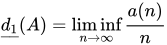
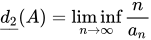

Then

Pepka-prygni (talk) 08:09, 17 May 2024 (UTC)

- For the set in question, we have where and we have . --JBL (talk) 17:10, 11 January 2026 (UTC)


Wording fixes
[edit]In the lead we have
If an integer is randomly selected from the interval [1, n], then the probability that it belongs to A is the ratio of the number of elements of A in [1, n] to the total number of elements in [1, n]. If this probability tends to some limit as n tends to infinity, then this limit is referred to as the asymptotic density of A.
We start referring to A without having defined A, so that's problem 1. But what is A? In the Definition section, we say
A subset A of positive integers has natural density α if the proportion of elements of A among all natural numbers from 1 to n converges to α as n tends to infinity.
But that can't be worded right or is, at least, confusingly worded, because let's say A is the set of squares of positive integers. Then the proportion of elements of A, which is ∞, among the natural numbers in [1, n] is ∞/n = ∞ for any n. So I'm thinking the Definition sentence needs to be
A subset A of positive integers has natural density α if the proportion of elements of A ∩ [1, n] among all natural numbers from 1 to n converges to α as n tends to infinity.
Returning to the lead, perhaps the following adjustment would help:
If A is a subset of the positive natural numbers and an integer is randomly selected from the interval [1, n], then the probability that it belongs to A is the ratio of the number of elements of A in [1, n] to the total number of elements in [1, n]. If this probability tends to some limit as n tends to infinity, then this limit is referred to as the asymptotic density of A.
Largoplazo (talk) 22:22, 10 January 2026 (UTC)
- None of these phrases is wrong but perhaps they could be more explicit or clearer.
But what is A?
It is an arbitrary set of integers. The first sentence you quote could say what you've written, or with fewer words "... the probability that it belongs to a set A is the ratio ...".Then the proportion of elements of A, which is ∞, among the natural numbers in [1, n] is ∞/n = ∞ for any n.
No, there are not infinitely many elements of A in the interval [1, n]. A proportion is a fraction of a whole; your comparison between the (infinite) set of all perfect squares and the size of [1, n] is not a proportion. However, I see why the wording is bothering you. What about this instead? "A subset A of positive integers has natural density α if the fraction of natural numbers from 1 to n that belong to A converges to α as n tends to infinity." --JBL (talk) 17:21, 11 January 2026 (UTC)