


Talk:Mathematical coincidence
| This is the talk page for discussing improvements to the Mathematical coincidence article. This is not a forum for general discussion of the subject of the article. |
Article policies
|
| Find sources: Google (books · news · scholar · free images · WP refs) · FENS · JSTOR · TWL |
Archives: 1, 2Auto-archiving period: 12 months  |
 | This article is rated C-class on Wikipedia's content assessment scale. It is of interest to the following WikiProjects: | ||||||||||
| |||||||||||


Nonce word suggestion
[edit]I am here to propose that 'decimaleasemeta' be used, eventually, as synonymous and eventually clearer than what is meant by 'mathematical coincidences' collectively here. It is difficult to come up with a mathematical coincidence that is known to toddlers, for example, before the expression '2.718281828' -- the 10-digit calculator's unhidden value of exp(1) -- is seen. I have no use in mind; this would be new. It just forms an abbrevatory single word out of 'decimal e's meta', 'meta' not really being a proper word generally other than in informal ways.
We need a proper source and credit for this formula
[edit]We have an WP:Original Research issue with one of the formulas involving π. There has been extensive discussion and animosity at Talk:Mathematical_coincidence/Archive_2#Explaining_e^π_−_π_≈_20 in 2023 about the proof presented by Adomanmath, and communicated by me to Eric Weisstein. Today, an IP user has edited the article, writing about a comment by Noam D. Elkies on Math Overflow from 25 March 2013, more than a decade earlier, containing an outline of the same proof. Obviously the proof was known much earlier than I thought, and earlier than is currently said in Eric's MathWorld article, which credits it to "A. Doman, Sep. 18, 2023; communicated by D. Bamberger, Nov. 26, 2023".
I reported this to Eric so we have a proper source that can be cited on Wikipedia, rather than having to cite the original YouTube comment by A. Doman. But we're now back to citing a comment made on Math Overflow, completely without context, once again. In addition, I no longer believe that the credit for this belongs to A. Doman (at least not originally; they may well have found it independently). I don't know if credit should go to Elkies instead. Unlike Doman, Elkies makes no claim that the proof is his own, rather presenting it as an obscure but known fact. Renerpho (talk) 22:41, 19 September 2025 (UTC)
- I have contacted Elkies. Here is his reply:
Yes, that was me. For example, I mentioned the same thing in these lecture notes in 2015: https://abel.math.harvard.edu/~elkies/M229.15/index.html (search for the string "19.99"; the hyperlink goes to the same XKCD comic). It does not appear in the 2009 iteration of the class https://abel.math.harvard.edu/~elkies/M229.09/index.html, although the approximation does, see https://abel.math.harvard.edu/~elkies/M229.09/zeta1.pdf, problem 10. This much (i.e. deriving from the functional equation for theta) goes back to the 1998 notes; I noticed that application long before that, though I doubt that I was the first one. I was probably not aware of the "coincidence" until seeing it in XKCD 217 at some point before I posted to that Mathoverflow thread; in particular I did not know the 1988 book of Sloane, Conway and Plouffe until your e-mail. I may have been the first to explain by combining and --- at any rate I know of no earlier source, and didn't know of Doman's work until your e-mail either. Sincerely, --Noam D. Elkies P.S. I see that Explain XKCD https://explainxkcd.com/217 now dates the explanation to 2023, citing the same Wikipedia page... It also dates the comic itself to 2007, but I did not know of XKCD until some years later.


- With that, the full proof can likely be attributed to Noam Elkies, and dated to some time between 2009 and 2015, triggered by the XKCD comic, while the main part was published by him no later than 2002 (compare https://abel.math.harvard.edu/~elkies/M259.02/index.html, zeta1.pdf, page 7 from 2002; and https://abel.math.harvard.edu/~elkies/M259.98/index.html from 1998, no PDF), but is probably not original to him. I have added the new sources he provided. The addition to Explain XKCD that he mentions was made by myself in April 2024, as an IP user.
- On Explain XKCD, there is an anonymous reply (not by me) from November 2024, saying:
That there is some (quite complicated) derivation of eπ − π ≈ 20 is neat, but that doesn't make it 'not a coincidence'. The fact that π ≈ 22/7 is also a coincidence anyway.
- That is a position one can take. I disagree with the notion that the existence of an explanation doesn't matter. Renerpho (talk) 09:38, 21 September 2025 (UTC)
Careful about errors creeping in
[edit]When is the last time someone has checked this page for factual accuracy? I just self-corrected an edit I made on 18 July 2025. It had previously said with the last accurate to 14 or 15 decimal places
, and I clarified that it's accurate to 14 decimal places
. Except I was wrong, it's actually accurate to 13. I had believed that either 14 or 15 must be right, because it said so, and I had quickly convinced myself that it wasn't 15. Looking at where the initial version came from, it was introduced in this rewrite from 6 July 2022. Except that rewrite just took what had previously been there since this edit from 2 June 2021... Renerpho (talk) 05:50, 26 February 2026 (UTC)
- It is not difficult to find errors on this page that are decades old. Special:Diff/53686476 from 17 May 2006 gives the accuracy of as
8 decimal places
. It is accurate to 8 digits after the decimal point, but that's not the same. It is accurate to 9 decimal places. The way this page handles that difference is inconsistent (not to mention that "14 or 15" was wrong no matter how one interprets it, since that one was correct to only 12 places after the decimal point). Renerpho (talk) 06:04, 26 February 2026 (UTC)
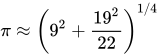
Another coincidence
[edit]Another mathematical coincidence not covered in the article is this: The cotangent of one degree (which is therefore the tangent of 89 degrees) is very close to the value of one radian in degrees. To five decimal places, the former is 57.28996, and the latter is 57.29578, a difference of only .00582. Tesseract12 (talk) 18:36, 31 March 2026 (UTC)
- This is a consequence of the approximation for small angles: . It's not a coincidence. Renerpho (talk) 17:16, 16 May 2026 (UTC)
- But is it actually correct that x approximately equals tan x for small angles?
- For instance, tan 1 deg is approx. .0175, and tan 2 deg is approx. .0349. Tesseract12 (talk) 18:11, 16 May 2026 (UTC)
- In radians, yes: ; and . See Small-angle approximation. Renerpho (talk) 21:42, 16 May 2026 (UTC)


Not so close together
[edit]There is a statement in the "Concerning musical intervals" section that 2^19 approximately equals 3^12. But the difference is 7153. So isn't that "stretching it" a bit? Tesseract12 (talk) 16:07, 16 May 2026 (UTC)
- @Tesseract12: The difference between the two isn't important. What matters is that the ratio is close to 1, within about 1.3%. The error gets a lot smaller when you take the 12th root of that ratio. is a consequence of this, which has many practical consequences especially in western music. This should stay. In fact, I'd argue that this may be one of the mathematical coincidences with the most profound consequences outside of mathematics. Renerpho (talk) 17:04, 16 May 2026 (UTC)
- Could you clarify about 2 to the 7/12 power?
- For that I am getting approx. 1.4983. Tesseract12 (talk) 18:05, 16 May 2026 (UTC)
- @Tesseract12: There was a typo in my comment (now fixed). I meant to say but wrote . 1.4983 is approximately . Renerpho (talk) 21:44, 16 May 2026 (UTC)
- Renerpho, you seem to know a lot about mathematics, and a lot about Wikipedia, so a statement and a question:
- I added something today to the nanocentury post on this page.
- Why do some comments here register as "unsigned"? I thought that signing was automatic. Tesseract12 (talk) 19:41, 17 May 2026 (UTC)
- @Tesseract12: There was a typo in my comment (now fixed). I meant to say but wrote . 1.4983 is approximately . Renerpho (talk) 21:44, 16 May 2026 (UTC)


Nanocentury
[edit](I'm putting this in a new section because the comment I'm replying to is years old and my reply will be a leaf in the forest if posted inline.)
> seconds is a nanocentury (ie years); correct to within about 0.5%


>* Yes, or 3, or 3.1, or... basically, nothing special about pi here.
You conveniently forget to mention that although a nanocentury is 1.004π s, it's 1.018·3.1 s and 1.052·3 s.
Insofar as it's a coincidence there is in some sense nothing special about π here, but that's basically just an argument for deleting this entire article. But if you compare it to π, it's remarkable how much closer it is than compared to even 3.1 and that's kind of the point of a coincidence. So I don't understand why it was removed.
Did you remember to use 365.25 as the number of days in a year, taking leap years into account?
I decided to expand on the never-answered question that I posted above. If 365.25 is used as the number of days in a year, then a "nanocentury" is exactly 3.15576 seconds. The ratio of that number to pi, to five places, is 1.00451. So I guess we could call it a valid mathematical coincidence. — Preceding unsigned comment added by Tesseract12 (talk • contribs) 19:27, 17 May 2026 (UTC)
- @Tesseract12: To answer your question from the other thread: No, signatures are not added automatically. You must always sign your comments with ~~~~.
- About the question itself: If you have a reliable source that mentions this then we can add it. Note that we need a source to establish that this is notable, not to prove that it's true. Renerpho (talk) 21:33, 17 May 2026 (UTC)
- Notability is about whether a topic is worthy of its own article. Verifiability is about sourcing content. Frankly, I'd say this falls under WP:CALC and doesn't need a source, but I'd also say it's trivial and not worthy of inclusion anyway, because verifiability doesn't guarantee inclusion. –Deacon Vorbis (carbon • videos) 21:40, 17 May 2026 (UTC)
- It is not trivial in the context of the topic of this page. Tesseract12 (talk) 21:51, 17 May 2026 (UTC)
- Yes, it is. –Deacon Vorbis (carbon • videos) 22:02, 17 May 2026 (UTC)
- This page risks becoming a collection of random facts (not to mention the WP:OR concerns) if we don't require the material to come with a source, or some other indication that the addition isn't trivial. Renerpho (talk) 23:27, 17 May 2026 (UTC)
- By the way, I strongly disagree with the man who says that "Nanocentury" is trivial.
- After all, consider the topic of this page. Tesseract12 (talk) 00:39, 18 May 2026 (UTC)
- @Tesseract12: As I said, the topic of this page is not to be a collection of random facts. Renerpho (talk) 00:42, 18 May 2026 (UTC)
- This page risks becoming a collection of random facts (not to mention the WP:OR concerns) if we don't require the material to come with a source, or some other indication that the addition isn't trivial. Renerpho (talk) 23:27, 17 May 2026 (UTC)
- Yes, it is. –Deacon Vorbis (carbon • videos) 22:02, 17 May 2026 (UTC)
- It is not trivial in the context of the topic of this page. Tesseract12 (talk) 21:51, 17 May 2026 (UTC)
- Notability is about whether a topic is worthy of its own article. Verifiability is about sourcing content. Frankly, I'd say this falls under WP:CALC and doesn't need a source, but I'd also say it's trivial and not worthy of inclusion anyway, because verifiability doesn't guarantee inclusion. –Deacon Vorbis (carbon • videos) 21:40, 17 May 2026 (UTC)
Yet another coincidence
[edit]Another coincidence, this one involving measurement, is that 500 million inches is approximately the diameter of the Earth. At various times in the past, when people were advocating the adoption of the metric system in the English-speaking countries (a cause which I have always favored), some opponents of it cited this fact in order to argue the supposed superiority of the English system. Anyway, the average radius of the Earth is usually considered to be 3959 miles, making the diameter 7918 miles. 500 million inches is 7,891.414141...... miles. The ratio of the former to the latter, to five places, is 1.00337. Tesseract12 (talk) 22:39, 17 May 2026 (UTC)
- @Tesseract12: That sounds like something for which plenty sources should exist, and which may already be covered elsewhere on Wikipedia? If so then I'd say this warrants inclusion. Renerpho (talk) 23:30, 17 May 2026 (UTC)
- I still remember two books on the metric system that I read back in the 1970's (when American metric conversion was being predicted to occur by the mid-80's). They must be out of print for decades now. I know that I learned the "500 million inches" matter from one of those books. Tesseract12 (talk) 00:26, 18 May 2026 (UTC)
UPDATE: I Googled "500 million inches diameter of the Earth" and found: The Earth's polar diameter (measured from the North Pole to the South Pole) is remarkably close to 500 million inches. Specifically, the polar diameter is approximately 7,900 miles. Converting this into inches (7,900 miles × 63,360 inches/mile) results in roughly 500,544,000 inches. Tesseract12 (talk) 00:54, 18 May 2026 (UTC) — Preceding unsigned comment added by Tesseract12 (talk • contribs) 00:31, 18 May 2026 (UTC)
- I did google it, and while Google's AI assistant confirms that this is true, none of the links it presents to me are either reliable, or mark this as a coincidence. Renerpho (talk) 00:44, 18 May 2026 (UTC)
- [1], page 73 (page 86 in the PDF file) could work though. Quote:
Numerologists often spot matchups that would go unnoticed by the rest of us. Is it so strange that there are almost exactly 500 million inches in the pole-to-pole diameter of Earth?
Although I think that book actually argues for this being a meaningless triviality... But this specific one at least seems to have gotten some attention. - P.S. Please don't forget to sign your comments. Renerpho (talk) 00:50, 18 May 2026 (UTC)
- So why not enter it onto the main page?
- Or did you mean that I myself should do it? I'm not clear about what you meant. Tesseract12 (talk) 01:16, 18 May 2026 (UTC)
- @Tesseract12: I think this one just can go onto the page -- with that citation. And yes, you can add it yourself (unless you need help with something specific). Renerpho (talk) 11:05, 18 May 2026 (UTC)
- I'm not sure I know how to properly enter the citation. So could you please add this one to the page? Tesseract12 (talk) 12:51, 18 May 2026 (UTC)
- @Tesseract12: I think this one just can go onto the page -- with that citation. And yes, you can add it yourself (unless you need help with something specific). Renerpho (talk) 11:05, 18 May 2026 (UTC)
- [1], page 73 (page 86 in the PDF file) could work though. Quote: