This is the talk page for discussing improvements to the Loudspeaker article. This is not a forum for general discussion of the subject of the article.
This article is within the scope of WikiProject Professional sound production, a collaborative effort to improve the coverage of sound recording and reproduction on Wikipedia. If you would like to participate, please visit the project page, where you can join the discussion and see a list of open tasks.Professional sound productionWikipedia:WikiProject Professional sound productionTemplate:WikiProject Professional sound productionProfessional sound production
This article is part of WikiProject Electronics, an attempt to provide a standard approach to writing articles about electronics on Wikipedia. If you would like to participate, you can choose to edit the article attached to this page, or visit the project page, where you can join the project and see a list of open tasks. Leave messages at the project talk pageElectronicsWikipedia:WikiProject ElectronicsTemplate:WikiProject Electronicselectronic
The current state of the article comes across as a clumsy combination of two different types of article. On one hand, there's the broad overview of the various aspects of loudspeakers in general (technology types, crossovers, general history, etc). On the other hand, there's a lot of detail on dynamic speakers.
Perhaps a better treatment of the subject would be to convert this page into a technology-neutral overview article and move the content that's specifically about dynamic loudspeakers off into a new article (I would suggest the more formal "Electrodynamic Loudspeaker" as the title for the spin-off article), leaving just a single-paragraph overview on this one like the other technologies have. Roxor128 (talk) 03:15, 2 April 2021 (UTC)[reply]
The scope of the article is "speaker (audio equipment)", not "loudspeaker", which is semantically a subset thereof; thus, the article title should be changed. The article is about *all* speakers, from big loud ones down to small quiet ones such as those used in headphones. I will move this article to the accurate title unless anyone can present a credible argument for not doing so. Quercus solaris (talk) 17:05, 11 January 2022 (UTC)[reply]
Oppose - There is no support in the article body for the recently added statement in the lead that loudspeaker is distinguishable from speaker (based on the distance to the listener). AFAIK the two terms are synonyms (I welcome references that indicate otherwise) and our choice of loudspeaker as the article title simply distinguishes the device from other usage of the term. Loudspeaker is a more concise and therefore a better disambiguation than Speaker (audio equipment). The title change should be reverted. ~Kvng (talk) 19:20, 17 January 2022 (UTC)[reply]
Support - WP:COMMONNAME would have a role here, because no layperson calls the speaker in an earphone a "loudspeaker". That broader sense of the word may well be a technical term of art of audio engineers, but it's not a common/layperson name for the whole class (speakers from small and quiet to large and loud), whereas "speaker" is. Regarding the conciseness argument, the length of the two character strings is neither different enough to matter nor, within sensible limits, inherently relevant to article title choices per WP:COMMONNAME. Quercus solaris (talk) 04:20, 20 January 2022 (UTC)[reply]
Strong oppose - The proposer seems to mistakenly believe that a loudspeaker is a subset of speakers; i.e., a speaker that is loud, as compared to a speaker that is quiet. Of course, this couldn't be further from the truth. "Loudspeaker" is the correct term to describe all such transducers, regardless of their maximum potential for loudness. If you take a closer look at reference #1 in the article (which is used as a source for the first sentence of the lead, which erroneously defines loudspeaker as a speaker that is "audible at a distance"), you'll notice that the source exclusively uses the word "loudspeaker", and never defines it as the subset of speakers that are audible at a distance. I am confident that there is no reliable source that describes it this way, therefore I'm removing that from the lead immediately. While there might be some merit to the argument that WP:COMMONNAME requires us to use "speaker" because it's used somewhat more commonly than "loudspeaker", I disagree with that as well. "Loudspeaker" is used quite commonly, especially within the audio industry and more technical sources. It's not an uncommon name at all. Also, WP:CRITERIA shows that there is more to choosing a title than just finding the most common term; there are other considerations like concision, naturalness, and precision. I would submit that "Speaker (audio equipment)" is neither natural nor concise. In my view, resorting to a parenthetical phrase to disambiguate a title is almost never preferable if there is a viable alternative, and it's evidence that the current title is less precise, since a "speaker" could also be a person that is speaking. (Interestingly enough, in my audio education I was always taught to refer to people that are speaking as "talkers" instead of "speakers" to avoid the ambiguity.) I agree that the title should be reverted. If it cannot be shown that there is consensus for this page move in a reasonable amount of time, the title should be reverted back to the long-term status quo of "Loudspeaker". —ScottyWong— 16:58, 15 February 2022 (UTC)[reply]
Update: I've moved the page back to Loudspeaker. While I appreciate Quercus solaris' bold change to the page title in an attempt to improve the article, there is no clear consensus for this change, and there are several editors who oppose the change. Therefore, I believe it is best to leave the page at its original title until a clear consensus emerges to move the page to a new title. I'm also quite confident that there are no reliable sources that will back up the assertion that a loudspeaker is a subset of speakers that are audible at a distance. Since this discussion attracted relatively few participants, I think we should leave this discussion open to see if any other interested editors express their opinion here. —ScottyWong— 19:07, 18 February 2022 (UTC)[reply]
Potential Diagram of electric signal -> sound waves
I made a diagram showing how sound data files are turned into sound waves for my online textbook, and I thought it might also be informative for this article:
Edit: I noticed that the thumbnail sizes for this gif aren't animated, I'll have to figure out what to change for wikimedia commons to accept it. Edit: fixed
I think I got the physics correct on this (minus air resistance, etc.), though I am not 100% positive. Also, I recognize that most of the time, the coil is in the speaker diaphragm, but I thought it would be easier understand if they were drawn separately.
Does this diagram look informative? Did I get the physics of it basically correct?
It would be better to have the paper cone move the farthest to the right at the same moment the highest electrical level is reached, after which the arc of a sound wave leaves the cone.
Even better would be a visual representation of molecules in the air getting compressed and rarefacted by the paper cone: compressed by the cone moving to the right, and rarefacted by the cone moving to the left. Binksternet (talk) 20:40, 23 January 2025 (UTC)[reply]
I like the rarefaction link you put below! I don't know how to represent that in the more cartoon style I've done here (and I don't know the animation program well either).
As for when the cone is at the furthest right, I am trying to separate out the being pushed to the right (which happens when the cone is on the left) vs. when it is positioned furthest to the right (and being pulled left).
My understanding is that the current in the sound data relates to the force on the diaphragm, not the position, and I wanted to capture that. Though I am not completely confident of the physics here. KyleThayer (talk) 21:12, 23 January 2025 (UTC)[reply]
You're right that the timing of the paper cone peak is later than the electrical peak, but it's a very small time, and it is frequency dependent, being larger for low frequencies, something like 100 milliseconds for 30 Hz, partly because of crossover filtering, and partly because of mechanical properties. But for the layperson, a lot of visible delay is confusing. Binksternet (talk) 21:40, 23 January 2025 (UTC)[reply]
Thanks for the response, I didn't know about the frequency dependent thing and stuff.
I'd like to run through my reasoning and see if it makes sense or where my error is:
Note: I'm going to ignore air resistance, the spring force the diaphragm makes, etc., and just focus on the electromagnetic force
I believe the computer representation is of the current (e.g., amperage) going through the coil
This amperage then causes an electromagnetic force between the voice coil and the magnet
Since the amperage is force, this makes the diaphragm velocity the first integral.
Since the amperage/force is a sine wave, the integral is negative cosine (or a 90°, or 1/4 loop delay)
The diaphragm position is then the integral of the velocity, which since it is negative cosine is negative sine (or a 180°, or a 1/2 loop delay)
Does that logic make sense?
Also, part of why I want to separate those out is that this means for things more complicated than a sine wave, the resulting position of the diaphragm might be quite different than the appearance of the computer/current wave. E.g., a square wave of current would produce a diaphragm position of a wave of alternating parabolas (ignoring air resistance etc.), and the diaphragm position would look much closer to a sine wave than like a square wave. KyleThayer (talk) 00:17, 24 January 2025 (UTC)[reply]
Your logic is good. If the delay is kept, as you've argued so well, I would include a mention of it in the image caption. Staying in general terms. Binksternet (talk) 02:34, 24 January 2025 (UTC)[reply]
Thanks! I'll first try to re-render the animation when I get a chance so it will still animate when shown in thumbnailed (wikimedia commons says I have to have width × height × number of frames ≤ 100 million). Then I'll try to figure out where in the article it best fits, and make sure to include in the captions why the diaphragm position is delayed by half a cycle.
I'm also still trying to think through the logic of a microphone, which I think should just be the same backward, but I'm still trying to parse all the induction laws and stuff (it's been a long time since my physics classes). KyleThayer (talk) 02:58, 24 January 2025 (UTC)[reply]
I might have just talked myself out of the diaphragm motion offset. I think for a sine wave offset by half a cycle versus closely matching the cycle depends on what dominates in countering the magnetic force: the kinetic energy of the sound coil, or the potential spring energy of the suspension.
For example, if we have a square wave and it is at a low enough frequency, then when we are in the middle of one direction of the square wave, there is time for the coil to move until the spring force balances with the electromagnetic force. Given air resistance and friction, the coil will stabilize and sit at that position until the square wave switches direction. We would then have the diaphragm motion roughly following the square wave pattern passed in (but a little off for the coil to move from one side to the other, and bounce a little before air resistance and friction stop the bouncing).
If, on the other hand, we have a square wave at a high enough frequency where the kinetic energy is high and it doesn't have enough time to move too much to the sides to get much spring force, then the coil will just accelerate in a parabola for each direction of the square wave. This would make the diaphragm motion pretty close to a sine wave.
If the frequency is somewhere in between, then it will be some complicated combination of the two (whatever complicated thing the differential equations spit out).
So that makes me wonder if the different speaker designs for different frequencies are about making sure the spring force of the suspension dominates the motion, and not the kinetic energy of the coil. KyleThayer (talk) 15:37, 24 January 2025 (UTC)[reply]
One thing's for sure: when aligning different bandpasses in time it's easier for sound system designers to measure the actual results from different bandpasses than it is to calculate guess about the upstream factors, which are extremely complicated. Some crossover sales brochures of decades past boasted about how their high and low outputs summed together exactly, but this was always a nonsensical boast because the high and low bandpasses had very different mechanical characteristics, making different time arrivals. Binksternet (talk) 16:10, 24 January 2025 (UTC)[reply]
So I think that means that my diagram was correct for a first pass approximation for how sound data is turned into diaphragm motion and sound (though ignoring amplifiers, bandpasses, resonances and other forces that inevitably complicate things).
I'll try to update the caption at some point when I get a chance and add it to the page.
Yes, the animation is informative. Nice job! It may be worth noting that the electromagnetic force is generated by the interaction of the dynamic magnetic field from the coil and the static field of a permanent magnet. The permanent magnet is not shown and that's a significant omission. ~Kvng (talk) 23:43, 30 January 2025 (UTC)[reply]
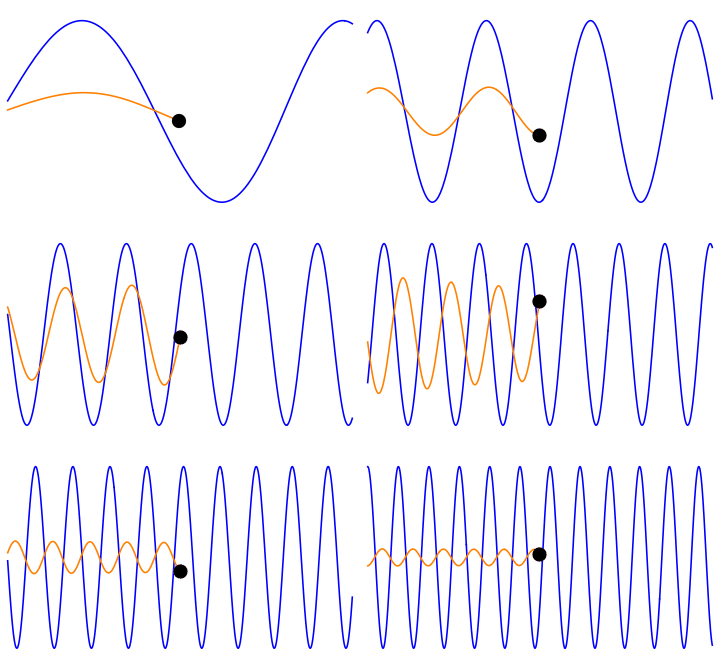
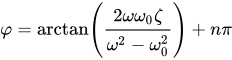
I went back to try to understand how speakers work theoretically a bit better, and ended up on the differential equation / solutions for Driven damped harmonic oscillators where you can calculate how the phase shift for the steady state solution, which is dependent on the frequency: So having the diaphragm position match the sound data, or having it be delayed look to me like both are valid options. See in particular this demo: Anyway, I'll probably go back and still try to update the diagram by adding a greyed out magnet in the background for the wire coil to react to, and maybe try to have the wire coil move back and forth to. Then I'll include in the description that the diaphragm motion doesn't necessarily match the sound wave data since it is a complicated dynamic system as a Driven damped harmonic oscillators. I also gathered some example simulations, including some I tried with square waves here in wikimedia commons: Category:Driven harmonic oscillatorsKyleThayer (talk) 00:53, 11 July 2025 (UTC)[reply]
Though the math is a bit over my head, I believe Minimum phase is useful in helping to describe this behavior of loudspeakers. Keep in mind that many sounds are recorded by microphones which do the same thing in reverse and so I believe the two cancel. In any case, our ears are fairly insensitive to these phase details. ~Kvng (talk) 15:13, 11 July 2025 (UTC)[reply]
I updated the diagram with a magnet and making the coil move.
Also, thanks for pointing to "minimum phase!" I've tried to read up on it some (a bit over my head too). It looks to me like speaker drivers are generally a "minimum phase" system, which I think basically means that they are reversible (hence why a microphone recording played on a speaker still sounds the same). But that doesn't mean that there isn't still a phase delay. For example, according to this site on | Loudspeaker Phase Response, "A basic example of phase lag would be the inertia of a woofer due to it’s moving mass. With increasing frequency the excursion lags behind the driving signal."
I for now am keeping the speaker driver delayed behind the signal, to communicate that the driver position isn't exactly the same as the electrical signal. Since I thought a 90 degree phase delay looked good and is the phase delay for a sine wave at the frequency of (undamped angular frequency of the oscillator), I used the 90 degree delay. KyleThayer (talk) 19:00, 30 July 2025 (UTC)[reply]
Yes, there's a delay: The current through the coil imposes a force on the diaphragm which causes it to accelerate which then causes it to move. ~Kvng (talk) 19:05, 30 July 2025 (UTC)[reply]
Sounds good, I've added the diagram to the Electrodynamic speaker driver "design" section, which is excerpted, and tried to make a caption that makes sense. Hopefully that's all good. KyleThayer (talk) 19:19, 30 July 2025 (UTC)[reply]
The section on the history of the loud speaker mentions Siemens' improvements to earlier designs. If you look at the page for Werner_von_Siemens#Later_years it says that his work in 1877 was for a dynamic speaker. The section on the history of the loud speaker also describes this work as an improvement to a loud speaker (tho the Siemens page does not).
This seems to suggest that the Moving Coil section in History should actually begin with Siemens' work, not with Lodge's, given the 25 year lead. What were the functional differences between Lodge's design and Siemens' such that it makes sense to start with Lodge? Augur (talk) 20:47, 24 June 2025 (UTC)[reply]
Active equalization addition to full range section
I added a brief mention of the Bose 901 as an early example of a loudspeaker system where active EQ is an integral part of the speaker design. The intent is to illustrate system-level response shaping, without crossovers, used with full-range drivers. The intent is not to highlight a specific product. The text is supported by patents and an independent technical review and is meant to complement the discussion of driver topologies. If there is a better section for this material, or a better way to generalize it, I’m happy to move or revise it. WhaleFarm (talk) 22:12, 29 January 2026 (UTC)[reply]
I added an example of a fully horn-loaded loudspeaker (the Klipschorn) to the horn loudspeaker section, with primary sourcing to Klipsch’s original patents. The intent was to illustrate the room-corner horn concept in a historicall, non-promotional way. Happy to adjust wording or placement if there’s a better fit. WhaleFarm (talk) 20:21, 31 January 2026 (UTC)[reply]





 level-4 vital article is rated C-class on Wikipedia's content assessment scale.


.gif)

