


Roselle (plant)
 | This article needs additional citations for verification. (April 2023) |
| Roselle | |
|---|---|

| |
| Wave Hill, 2014 | |
Scientific classification 
| |
| Kingdom: | Plantae |
| Clade: | Embryophytes |
| Clade: | Tracheophytes |
| Clade: | Spermatophytes |
| Clade: | Angiosperms |
| Clade: | Eudicots |
| Clade: | Rosids |
| Order: | Malvales |
| Family: | Malvaceae |
| Subfamily: | Malvoideae |
| Tribe: | Hibisceae |
| Genus: | Sabdariffa |
| Species: | S. gossypiifolia
|
| Binomial name | |
| Sabdariffa gossypiifolia (Mill.) M.M.Hanes & R.L.Barrett
| |
| Synonyms[1] | |
|
List
| |
Roselle (Sabdariffa gossypiifolia) is a species of flowering plant in the genus Sabdariffa that is native to Africa, most likely West Africa. In the 16th and early 17th centuries it was spread to Asia and the West Indies, where it has since become naturalized in many places.[2] The stems are used for the production of bast fibre and the dried cranberry-tasting calyces are commonly steeped to make an infusion popular in many places around the world.
Description
[edit]Roselle is an annual or perennial herb or woody-based subshrub, growing to 2–2.5 m (7–8 ft) tall. The leaves are deeply three- to five-lobed, 8–15 cm (3–6 in) long, arranged alternately on the stems.
The flowers are 8–10 cm (3–4 in) in diameter, white to pale yellow with a dark red spot at the base of each petal, and have a stout, conspicuous calyx at the base, 1–2 cm (0.39–0.79 in) wide, enlarging to 3–3.5 cm (1.2–1.4 in) and becoming fleshy and a deep crimson red as the fruit matures, which takes about six months.
Names
[edit].png)

_fruits.jpg)

In Australia, where it is naturalised,[3][4] roselle is known as the rosella or rosella fruit,[5] to distinguish it from rosella, a native bird. Roselle is also known as Florida Cranberry or Jamaica sorrel in the United States.[6] It is known as sorrel in many parts of the English-speaking Caribbean.[7]
Composition
[edit]| Nutritional value per 100 g (3.5 oz) | |||||||||||||||||||||||||||||||||||
|---|---|---|---|---|---|---|---|---|---|---|---|---|---|---|---|---|---|---|---|---|---|---|---|---|---|---|---|---|---|---|---|---|---|---|---|
| Energy | 205 kJ (49 kcal) | ||||||||||||||||||||||||||||||||||
11.31 g | |||||||||||||||||||||||||||||||||||
0.64 g | |||||||||||||||||||||||||||||||||||
0.96 g | |||||||||||||||||||||||||||||||||||
| |||||||||||||||||||||||||||||||||||
| †Percentages estimated using US recommendations for adults,[8] except for potassium, which is estimated based on expert recommendation from the National Academies.[9] | |||||||||||||||||||||||||||||||||||

Phytochemicals
[edit]The Hibiscus leaves are a good source of polyphenolic compounds. The major identified compounds include neochlorogenic acid, chlorogenic acid, cryptochlorogenic acid, caffeoylshikimic acid and flavonoid compounds such as quercetin, kaempferol and their derivatives.[10] The flowers are rich in anthocyanins, as well as protocatechuic acid. The dried calyces contain the flavonoids gossypetin, hibiscetine and sabdaretine. The major pigment is not daphniphylline.[11] Small amounts of myrtillin (delphinidin 3-monoglucoside), chrysanthenin (cyanidin 3-monoglucoside), and delphinidin are present. Roselle seeds are a good source of lipid-soluble antioxidants, particularly gamma-tocopherol.[12]
Uses
[edit]Culinary
[edit]Roselle is widely used in Burmese cuisine. The leaves are fried with garlic, dried or fresh prawns and green chili or cooked with fish. A light soup made from roselle leaves and dried prawn stock is also a popular dish.[13][14]
In the Philippines, the leaves and flowers are used to add sourness to the chicken dish tinola (chicken stew).[15]
In Vietnam, the young leaves, stems and fruits are used for cooking soups with fish or eel.[16]
In Brazil, it is an important part of a dish regional to the state of Maranhão, Arroz de cuxá.[17][18]
In Nigeria, roselle has multiple culinary uses, but is primarily consumed as a vegetable in soup.[19][20]
Beverage
[edit]Roselle, often with additional fruit juice and spices, is used in Nigeria to make a sugary drink known as zobo.[21][22]
In Egypt, karkadeh (كركديه) is a popular drink made with dried roselle calyces.[23][24]
In the Caribbean, a popular drink is made from roselle fruit and sugar. It's often additionally flavoured with spices, such as bay leaves, cloves, and ginger.[25][26]
Roselles are used to make a popular light beverage (agua fresca) in Mexico, Central America and Colombia; they are typically made from fresh fruits, juices or extracts.
Beverages made from the roselle fruit are included in a category of "red drinks" associated with West Africa consumed by African Americans.[27] Such red drinks, now usually carbonated soft drinks, are commonly served in soul food restaurants and at African-American social events, including Juneteenth, a celebration of the emancipation of slaves.[27][28]
In Thailand, roselle is generally drunk as a cool drink.[29]
Preserves
[edit]Roselle fruits contain enough pectin that they can be made into jam without adding more pectin from another source.[30]
Medical
[edit]Herbal medicine (high blood pressure)
[edit]A 2021 meta-analysis conducted by the Cochrane hypertension group concluded that currently the evidence is insufficient to establish if roselle, when compared to placebo, is effective in managing or lowering blood pressure in people with hypertension.[31] An older meta-survey (2015) in the Journal of Hypertension suggests a typical reduction in blood pressure of around 7.5/3.5 units (systolic/diastolic).[32] Both cite the need for additional well designed studies.[31][32]
In a controlled laboratory experiment, extracted Calyx from Hibiscus sabdariffa were shown to reduce both systolic and diastolic blood pressures in Wistar Rats over a 4 week trial period.[33]
Fiber
[edit]The plant is cultivated for its bast fibre, which is used to make cordage and as a substitute for jute in making burlap.[34][35]
Colorant
[edit]Roselle can be a natural source of water-soluble red food dye.[36]
Production
[edit]
China and Thailand are the largest producers and control much of the world supply.[37] The world's best roselle comes from Sudan and Nigeria, b. Mexico, Egypt, Senegal, Tanzania, Mali and Jamaica are also important suppliers but production is mostly used domestically.[38]
In the Indian subcontinent (especially in the Ganges Delta region), roselle is cultivated for vegetable fibres. Roselle is called meśta (or meshta, the ś indicating an sh sound) in the region. Most of its fibres are locally consumed. However, the fibre (as well as cuttings or butts) from the roselle plant has great demand in natural fibre using industries.
Roselle is a relatively new crop to create an industry in Malaysia. It was introduced in the early 1990s and its commercial planting was first promoted in 1993 by the Department of Agriculture in Terengganu. The planted acreage was 12.8 ha (30 acres) in 1993 and steadily increased to peak at 506 ha (1,000 acres) by 2000. The planted area is now less than 150 ha (400 acres) annually, planted with two main varieties.[citation needed] Terengganu state used to be the first and the largest producer, but now the production has spread more to other states. Despite the dwindling hectarage over the past decade or so, roselle is becoming increasingly known to the general population as an important pro-health drink. To a small extent, the calyces are also processed into sweet pickle, jelly and jam.
Cultivation
[edit]In the initial years, limited research work was conducted by University Malaya and Malaysian Agricultural Research and Development Institute (MARDI). Research work at Universiti Kebangsaan Malaysia (UKM) was initiated in 1999.
Crop genetic resources and improvement
[edit]Genetic variation is important for plant breeders to increase crop productivity. Being an introduced species in Malaysia, there is a very limited number of germplasm accessions available for breeding.
UKM maintains a working germplasm collection and conducts agronomic research and crop improvement.
Mutation breeding
[edit]Conventional hybridization is difficult to carry out in roselle due to its cleistogamous nature of reproduction. Because of this, a mutation breeding programme was initiated to generate new genetic variability.[39] The use of induced mutations for its improvement was initiated in 1999 in cooperation with MINT (now called Malaysian Nuclear Agency) and has produced some promising breeding lines. Roselle is a tetraploid species; thus, segregating populations require longer time to achieve fixation as compared to diploid species. In April 2009, UKM launched three new varieties named UKMR-1, UKMR-2 and UKMR-3. These new varieties were developed using Arab as the parent variety in a mutation breeding programme which started in 2006.
Natural outcrossing under local conditions
[edit]A study was conducted to estimate the amount of outcrossing under local conditions in Malaysia. It was found that outcrossing occurred at a very low rate of about 0.02%. However, this rate is much lower in comparison to estimates of natural cross-pollination of between 0.20% and 0.68% as reported in Jamaica.
Gallery
[edit]-
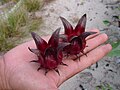 A popular roselle variety planted in Malaysia: Terengganu. Roselle fruits are harvested fresh, and their calyces are made into a drink rich in vitamin C and anthocyanins.
 -
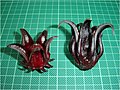 Two varieties are planted in Malaysia — left Terengganu or UMKL-1, right Arab. The varieties produce about 8 t/ha (3.6 short tons/acre) of fresh fruits or 4 t/ha (1.8 short tons/acre) of fresh calyces. On the average, variety Arab yields more and has a higher calyx to capsule ratio.
 -
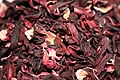 Dried roselle calyces can be obtained in two ways. One way is to harvest the fruits fresh, decore them, and then dry the calyces; the other is to leave the fruits to dry on the plants to some extent, harvest the dried fruits, dry them further if necessary, and then separate the calyces from the capsules
 -
 Roselle calyces can be processed into sweet pickle. This is usually produced as a by-product of juice production. However, quality sweet pickle may require a special production process.
 -
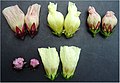 Variation in flower colour of roselle (a tetraploid species)
 -
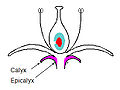 Calyx (a collective term for sepals of a flower); Epicalyx (a collective term for structures found on, below, or close to the true calyx, also called false calyx). Some varieties show pronounced epicalyx structures, such as found in variety Arab (plural calyces).
 -
 Decoring — removal of a seed capsule from the fruit using a simple hand-held gadget to obtain its calyx
 -
 Some breeding lines developed from the mutation breeding programme at UKM.


Footnotes
[edit]- ^ "Sabdariffa gossypiifolia (Mill.) M.M.Hanes & R.L.Barrett". Plants of the World Online. Royal Botanic Gardens, Kew. Retrieved 11 June 2026.
- ^ "Roselle - plant". Encyclopedia Britannica. Revised and updated by Melissa Petruzzello. Archived from the original on 2022-04-20.
{{cite web}}: CS1 maint: others (link) - ^ McLay, Todd G. B. (2019-07-01). McLay, Todd G. B.; Kodela, P.G. (eds.). "Hibiscus sabdariffa". Flora of Australia. T. L. Lally. Canberra: Australian Biological Resources Study, Department of Climate Change, Energy, the Environment and Water. Archived from the original on 2023-09-21. Retrieved 2023-09-21.
- ^ Vercoe, Samara (2021-04-21). "Australia's own Rosella". Warndu. Archived from the original on 2023-03-28. Retrieved 2023-09-20.
- ^ "Rosella Growing Information". greenharvest.com.au. Archived from the original on 2023-03-04. Retrieved 2023-01-12.
- ^ "Roselle - University of Florida, Institute of Food and Agricultural Sciences". gardeningsolutions.ifas.ufl.edu. Archived from the original on 2023-09-21. Retrieved 2024-01-21.
- ^ Rousseau, Michelle (2018). Provisions: the roots of Caribbean cooking-- 150 vegetarian recipes. Suzanne Rousseau (1st ed.). New York, NY. p. 218. ISBN 978-0-7382-3467-0. OCLC 1023485526.
{{cite book}}: CS1 maint: location missing publisher (link) - ^ United States Food and Drug Administration (2024). "Daily Value on the Nutrition and Supplement Facts Labels". FDA. Archived from the original on 2024-03-27. Retrieved 2024-03-28.
- ^ "TABLE 4-7 Comparison of Potassium Adequate Intakes Established in This Report to Potassium Adequate Intakes Established in the 2005 DRI Report". p. 120. In: Stallings, Virginia A.; Harrison, Meghan; Oria, Maria, eds. (2019). "Potassium: Dietary Reference Intakes for Adequacy". Dietary Reference Intakes for Sodium and Potassium. pp. 101–124. doi:10.17226/25353. ISBN 978-0-309-48834-1. PMID 30844154. NCBI NBK545428.
- ^ Zhen J, Villani TS, Guo Y, Qi Y, Chin K, Pan MH, Ho CT, Simon JE, Wu Q (2016). "Phytochemistry, antioxidant capacity, total phenolic content and anti-inflammatory activity of Hibiscus sabdariffa leaves". Food Chemistry. 190: 673–680. doi:10.1016/j.foodchem.2015.06.006. PMID 26213025.
- ^ Bassey, Rosemary B. (28 August 2021). "The stain extracted from roselle is not daphniphylline". The Biological Stain Commission. Archived from the original on 2022-06-29.
- ^ Mohamed R, Fernández J, Pineda M, Aguilar M (2007). "Roselle (Hibiscus sabdariffa) seed oil is a rich source of gamma-tocopherol". J Food Sci. 72 (3): S207–11. doi:10.1111/j.1750-3841.2007.00285.x. PMID 17995816.
- ^ Hansen, Barbara (7 October 1993). "Uncommon Herbs: In a Burmese Garden". Los Angeles Times.
{{cite news}}: CS1 maint: deprecated archival service (link) - ^ Sula, Mike (4 September 2013). "How to eat hibiscus like the Burmese". Chicago Reader. Archived from the original on 2021-09-18.
- ^ "Chicken Tinola Recipe". Panlasang Pinoy. 9 November 2018. Archived from the original on 2021-05-15. Retrieved 2021-09-09.
- ^ Tanaka, Yoshitaka; Van Ke, Nguyen (2007). Edible Wild Plants of Vietnam: The Bountiful Garden. Thailand: Orchid Press. p. 91. ISBN 978-974-524-089-6.
- ^ "Travel around Brazil: the discoveries of Ana Luiza Trajano in Maranhão - Instituto Brasil a Gosto". 2023-02-03. Archived from the original on 2023-02-03. Retrieved 2023-10-01.
- ^ "Cuxá Rice". Instituto Brasil a Gosto. 2020-11-12. Archived from the original on 2023-03-28. Retrieved 2023-10-01.
- ^ Abughidyer, Doosughun (May 2021). "Food Corner" (PDF). NIDCOM: Nigerians in Diaspora Commission. 11: 15. Archived from the original (PDF) on 2022-07-13.
- ^ Benson, Dukuje (May 2015). "A survey on the genetic diversity of Roselle (Hibiscus sabdariffa L.) germplasm in Nigeria" (PDF). Advances in Food Science and Technology. 3 (5): 318–320 – via International Scholars Journals.
- ^ Ukwuru, M.U; Uzodinma, C.C (2010-12-09). "Preservative effect of spices and their flavour acceptability in Zobo drink". Nigerian Food Journal. 28 (2). doi:10.4314/nifoj.v28i2.62661. ISSN 0189-7241.
- ^ Alobo, AP; Adelaiye, PO; Abugh, M; Atser, AJ (2009-11-04). "Consumer use and attitude towards 'zobo': a Nigerian sorrel drink". Nigerian Food Journal. 27 (2). doi:10.4314/nifoj.v27i2.47493. ISSN 0189-7241.
- ^ "Karkadeh | Hibiscus Tea", The Taste of Egypt, The American University in Cairo Press, 2016-08-31, pp. 171–171, ISBN 978-1-64903-429-8, retrieved 2026-02-03
- ^ Khanna, Sarah (29 February 2012). "Karkadeh: A Sweet Hibiscus Tea". Honest Cooking. Rosebud Media. Archived from the original on 2022-11-26.
- ^ "Sorrel Juice Is Good for You". Sweet TnT Magazine. 8 November 2017. Archived from the original on 2020-05-16. Retrieved 16 September 2020.
- ^ "Sorrel Drink". Simply Trini Cooking. 16 December 2008. Archived from the original on 2015-08-27.
- ^ a b Adrian Miller (23 June 2015). "In Praise of Red Drink: The Origin Story Behind Soul Food's Most Iconic Beverage". First We Feast. Archived from the original on 2 August 2020. Retrieved 15 May 2024.
- ^ Grigsby Bates, Karen (16 June 2021). "A Taste Of Freedom: Code Switch". NPR.org. Archived from the original on 2022-12-14. Retrieved 2022-04-28.
- ^ Mai_25759 (2012-09-07). "น้ำกระเจี๊ยบแดง มาฝากของเย็นเป็นเครื่องดื่มกันต่อค่ะ". Mthai Picpost. Archived from the original on 2013-08-18.
{{cite web}}: CS1 maint: numeric names: authors list (link) - ^ King, Arno (2016-07-12). "Jam of the tropics: growing and using Rosella |". GardenDrum. Archived from the original on 2022-08-13. Retrieved 2021-09-09.
- ^ a b Pattanittum, Porjai; Ngamjarus, Chetta; Buttramee, Fonthip; Somboonporn, Charoonsak (2021-11-27). "Roselle for hypertension in adults". The Cochrane Database of Systematic Reviews. 2021 (11) CD007894. doi:10.1002/14651858.CD007894.pub3. ISSN 1469-493X. PMC 8626866. PMID 34837382.
- ^ a b Serban C, Sahebkar A, Ursoniu S, Andrica F, Banach M (2015). "Effect of sour tea (Hibiscus sabdariffa L.) on arterial hypertension: a systematic review and meta-analysis of randomized controlled trials". Journal of Hypertension. 33 (6): 1119–27. doi:10.1097/HJH.0000000000000585. PMID 25875025. S2CID 19042199.
- ^ Ubom, R. E; Ugwu, P. I; Madueke, S. P; Okorie, P. O; Nwachukwu, D. C (2022). "Anti-Hypertensive Effects of Anthocyanins from Hibiscus Sabdariffa Calyx on the Renin-Angiotensin-Aldosterone System In Wistar Rats". Nigerian Journal of Physiological Sciences. 2022 (37): 113–117. doi:10.54548/njps.v37i1.14. PMID 35947845.
- ^ Standley, Paul C.; Blake, S. F. (1923). "Trees and Shrubs of Mexico (Oxalidaceae-Turneraceae)". Contributions from the United States National Herbarium. 23 (3). Washington, D.C.: Department of Botany, Smithsonian Institution: 779. JSTOR 23492504.
- ^ Duke, James A. (7 January 1998). "Hibiscus sabdariffa L." Handbook of Energy Crops. Center for New Crops & Plant Products, Purdue University.
- ^ Shruthi, V. H.; Ramachandra, C. T.; Nidoni, Udaykumar; Hiregoudar, Sharanagouda; Naik, Nagaraj; Kurubar, A. R. "Roselle (Hibiscus Sabdariffa L.) as a source of natural colour: a review" (PDF). Plant Archives. 16 (22): 515–522.
- ^ Mazaud, François; Röttger, Alexandra; Steffel, Katja, eds. (2004-04-22). "HIBISCUS Post-harvest Operations page 4" (PDF). Prepared by Anne Plotto. Food and Agriculture Organization of the United Nations (FAO). Archived from the original (PDF) on 2022-12-11.
- ^ Mazaud, François; Röttger, Alexandra; Steffel, Katja; D'Aquilio, Larissa (eds.). "CHAPTER XXVIII HIBISCUS: Post-Production Management for Improved Market Access for Herbs and Spices - Hibiscus". Food and Agriculture Organization of the United Nations (FAO). Prepared by Anne Plotto. Archived from the original on 2007-11-23. Retrieved 2007-08-25.
- ^ "FNCA 2005 WORKSHOP ON MUTATION BREEDING". Forum for Nuclear Cooperation in Asia (FNCA). 2005-12-06. Archived from the original on 2007-10-30.
Further reading
[edit]- Chau, J. W.; Jin, M. W.; Wea, L. L.; Chia, Y. C.; Fen, P. C.; Tsui, H. T. (2000). "Protective effect of Hibiscus anthocyanins against tert-butyl hydroperoxide-induced hepatic toxicity in rats". Food and Chemical Toxicology. 38 (5): 411–416. doi:10.1016/S0278-6915(00)00011-9. PMID 10762726.
- Mohamad, O.; Mohd. Nazir, B.; Abdul Rahman, M.; Herman, S. (December 2002). "Roselle: A new crop in Malaysia". Buletin Persatuan Genetik Malaysia. 8 (1): 12–13.
- Mohamad, O.; Mohd. Nazir, B.; Azhar, M.; Gandhi, R.; Shamsudin, S.; Arbayana, A.; Mohammad Feroz, K.; Liew, S.K.; Sam, C.W.; Nooreliza, C.E.; Herman, S. (2002). "Roselle improvement through conventional and mutation breeding". Proceedings of INC 2002. International Nuclear Conference 2002: Global Trends and Perspectives, Seminar I: Agriculture and Biosciences: 23–41. RN:34030224, TRN: MY0301988030224.
- Mohamad, O.; Ramadan, G.; Herman, S.; Halimaton Saadiah, O.; Noor Baiti, A. A.; Ahmad Bachtiar, B.; Aminah, A.; Mamot, S.; Jalifah, A.L. (2008). "A promising mutant line for roselle industry in Malaysia". FAO Plant Breeding News. 195.
- Pau, L. T.; Salmah, Y.; Suhaila, M. (2002). "Antioxidative properties of roselle (Hibiscus sabdariffa L.) in linoleic acid model system". Nutrition & Food Science. 32 (1): 17–20. doi:10.1108/00346650210413951.
- Vaidya, K. R. (2000). "Natural cross-pollination in roselle, Hibiscus sabdariffa L. (Malvaceae)". Genetics and Molecular Biology. 23 (3): 667–669. doi:10.1590/S1415-47572000000300027.
External links
[edit] The dictionary definition of roselle at Wiktionary
 Media related to Roselle (plant) at Wikimedia Commons
- Roselle on Encyclopædia Britannica
- "Roselle". NewCROP, Center for New Crops & Plant Products. Purdue University.
- Stephens, James M. (2018). "Roselle — Hibiscus sabdariffa L." Horticultural Sciences Department, University of Florida. HS659.
- Jus de Bissap ("Roselle juice")


| National | |
|---|---|
| Other | |
