


Raid on Premuda
| Raid on Premuda | |||||||
|---|---|---|---|---|---|---|---|
| Part of Adriatic Campaign of World War I | |||||||
.jpg) The Austro-Hungarian battleship Szent István sinking off the island of Premuda, after being defeated by the Regia Marina, on 10 June 1918 | |||||||
| |||||||
| Belligerents | |||||||
 Kingdom of Italy Kingdom of Italy |
 Austria-Hungary Austria-Hungary | ||||||
| Commanders and leaders | |||||||
| Strength | |||||||
| |||||||
| Casualties and losses | |||||||
| None |
| ||||||
Raid on Premuda was a naval action of the World War I carried out by the torpedo boats MAS 15 and MAS 21 under the command of section leader Luigi Rizzo and respectively commanded by Armando Gori and Giuseppe Aonzo who, at dawn on 10 June 1918,[5] leaving from the port of Ancona, secretly penetrated among the units of an enemy naval formation heading for the Strait of Otranto, managing to torpedo and sink the battleship SMS Szent István off Premuda.[6] In the action, her sister battleship Tegetthoff was also hit by a torpedo, but the failure of the explosive device prevented her from sinking.[7]
Background
[edit]From 1 March 1918 Admiral Miklós Horthy took over command of the Imperial-Royal Austro-Hungarian Navy, replacing Admiral Maximilian Njegovan. The Italian commander Paolo Thaon di Revel perceived the possibility that the new Austrian commander would carry out a fleet action outside the consolidated schemes. Up to that point, the barrier of the Strait of Otranto had been attacked nineteen times and, in four of these, Admiral Horthy was present as commander of the Novara. It was therefore very likely that the new commander intended to give a signal of change in the conduct of the war and that the Strait of Otranto, which was well known to him, was part of his plans. Signs of a new imminent attack came with an air raid on 9 June by 14 aircraft, supported by the destroyers Dukla and Uzsok, for which Admiral Revel ordered that four French submarines be placed in ambush north of Durazzo, while the Italian F10 and F14 were placed in front of Pola and the Faresina channel respectively.[8]
Battle
[edit]The Austro-Hungarian mission
[edit]The suspicions were not unfounded the Austro-Hungarian supreme command had in fact prepared a powerful offensive, which envisaged the use of a large part of the fleet.[9] Their task was to remain in their assigned positions until 07:30 on the 11th, the time at which they were to return in the event of failure to contact the Italian ships. It was thought, in fact, that the action of the attack group would have induced the Italian command to send its armoured cruisers out of Brindisi and Valona to pursue the Austrian ships, cruisers which would then have found themselves surrounded by the larger Austrian units, supported by a large use of submarines and aircraft.[10]
The action of the MAS
[edit]
In the meantime, on 9 June, MAS 15 (Corvette Captain Luigi Rizzo and Chief Helmsman Armando Gori) and MAS 21 (Ensign Giuseppe Aonzo) had left Ancona for a mission in the central Adriatic Sea. Until 02:00 on the 10th, the two MAS were to remain stationed between Gruiza and Banco di Selve, in the vicinity of the island of Premuda, to ascertain the presence of torpedo barriers; at the end of this phase, they were to remain in ambush until dawn to rejoin the supporting torpedo boats 18 OS and 15 OS. The delays accumulated by the Austrian group meant, however, that at 03:15, the Austrian units crossed the patrolling zone of the two MAS, which at that time were heading from Lutestrago to the meeting point with the torpedo boats.[11][12]
At 03:15, being about 6.5 miles from Lutorstrak, I sighted, slightly abaft the beam and to starboard, a large cloud of smoke. I therefore decided to take advantage of the uncertain light to prevent the attack and so, followed by MAS 21, I reversed course, heading towards the enemy units at minimum speed. Approaching the enemy, I realized that they were two large ships escorted by 8 to 10 destroyers
Rizzo, attempting to hit one of the two large ships from the closest possible range, maneuvered between two destroyers flanking Szent István, increased speed to 12 knots (22 km/h; 14 mph), managing to pass between the torpedo boats, and, from a distance of no more than 300 meters (330 yd), launched both of the MAS' torpedoes. The two torpedoes hit the ship, raising high columns of water and smoke. The reaction of torpedo boat 76 was immediate it launched itself in pursuit of Rizzo's MAS, opening fire from a range of 100–150 meters (110–160 yd). Rizzo then decided to drop two anti-submarine bombs, one of which exploded, forcing the torpedo boat to desist. Aonzo's MAS 21 launched its torpedoes at the other larger unit, Tegetthoff, from a range of 450–500 meters (490–550 yd); one of the torpedoes hit the ship, the other, detaching itself from the torpedoes too late due to a technical problem, slipped astern of the battleship, built by the Pola shipyards and with superior technical characteristics to Szent István. It too was then chased by a torpedo boat, which it managed to distance to safely direct for the return.[14]

Szent István immediately showed extensive damage from MAS 15's torpedoes; water entered the bow and stern engine rooms and the engines had to be stopped. Every quarter of an hour or so the battleship's list increased by about 1° and Tegetthoff tried several times to take the ship in tow, but only at 05:45 did they manage to pass the first cable, when the list had reached about 18°. At that moment the list suddenly increased and the tow line had to be cut; at about 06:00 the ship began to capsize and then sank completely.[15] Among the officers there were 1 dead and 3 missing; among the crew there were 13 dead, 72 missing and 29 wounded.[16]

At 07:00 the two MAS reached Ancona and immediately two seaplanes took off, which sighted some units of the Tátra class in the vicinity of Isola Grossa and Promontore, on a southerly route. At 09:00 other aircraft took to the air and the reconnaissance over Pola confirmed the absence of the four dreadnoughts. The Austrians, having nullified the surprise effect on which the entire operation was based, had to return to their bases. Tegetthoff returned to Pola at dawn on 11 June, as did the Viribus Prinz Eugen group, which reached the port at 19:00.[17][18][19]
Aftermath
[edit]The psychological backlash of the Premuda action had major repercussions on Austro-Hungarian morale, so much so that during the remainder of the war, the Kriegsmarine did not carry out any more naval operations, barricading its ships in the ports. Luigi Rizzo's torpedoes, with this action, eliminated the element of surprise and cut short the enemy mission in the bud, forcing the Austrian fleet to definitively renounce the ambitious project. The Premuda action also definitively convinced the Allies to drop the question of the establishment of naval commands in the Mediterranean, leaving total control of the Adriatic to Italy.[20]
As a demonstration of the great result of the MAS action, the Commander in Chief of the Grand Fleet, the English Admiral David Beatty, sent the following telegram to Admiral Lorenzo Cusani, commander of the Italian fleet, "The Grand Fleet extends its most heartfelt congratulations to the Italian fleet for the splendid enterprise conducted with such courage and such audacity against the Austrian enemy".[21]
In recognition of the heroism demonstrated in action, Captain Luigi Rizzo was awarded the Knight's Cross of the Military Order of Savoy, but following his refusal due to his republican ideals, the honour was commuted to a gold medal for military valour, an honour which was also awarded to Ensign Aonzo.[22] On March 13, 1939, the Royal Navy decided to celebrate its own celebration on June 10, in memory of the action carried out during the First World War.[23]
Gallery
[edit]-
 Italian postcard with photograph of the sinking of the Austro-Hungarian battleship
 -
 Stamp reading Italian Navy in the World War 1915-1918. On the dawn of June 10th, 1918, Commander Luigi Rizzo attacked with two MAS a powerful enemy squadron. The Austrian battleship 'Saint Stephen', hit by torpedo, sank, capsizing on the left side".
 -
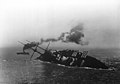 Sinking of SMS Szent István c. 1918 by the Italians
 -
![Side-view of the Sinking of SMS Szent István c. 1918 by the Italians]](//upload.wikimedia.org/wikipedia/commons/thumb/b/b3/Bundesarchiv_Bild_134-C2280%2C_Szent_Istv%C3%A1n%2C_Sinkendes_Linienschiff.jpg/120px-Bundesarchiv_Bild_134-C2280%2C_Szent_Istv%C3%A1n%2C_Sinkendes_Linienschiff.jpg) Side-view of the Sinking of SMS Szent István c. 1918 by the Italians]
Side-view of the Sinking of SMS Szent István c. 1918 by the Italians] -
 Szent István sinking after torpedoed by an Italian torpedo boat, 11 June 1918. Her sister ship Tegetthoff can be seen floating by at right.


![Side-view of the Sinking of SMS Szent István c. 1918 by the Italians]](/proxy/https://en.wikipedia.org/wiki/File:Bundesarchiv_Bild_134-C2280,_Szent_Istv%C3%A1n,_Sinkendes_Linienschiff.jpg)
See also
[edit]
References
[edit]- ^ Favre 2008, p. 242–247.
- ^ "The Sinking of Szent István". Croatian Treasure. Retrieved 16 June 2026.
- ^ Spigai, Virgilio (March 1965). "Italian Naval Assault Craft in Two World Wars". Proceedings. 91 (3). U.S. Naval Institute: 745. Retrieved 16 June 2026.
- ^ "Premuda: commemorative postcard". Istria Dalmazia Cards (in Italian). Archived from the original on 9 July 2010. Retrieved 16 June 2026.
- ^ Willmott, H. P. (2009-06-09). The Last Century of Sea Power, Volume 1: From Port Arthur to Chanak, 1894–1922. Indiana University Press. p. 310. ISBN 978-0-253-00356-0.
- ^ "Political and Military Background to World War 1 at Sea, 1918". www.naval-history.net. Retrieved 2026-06-16.
- ^ Ago, Zija2022in #history • 8 Years (2018-02-01). "The sinking of the SMS Szent István 1918". Steemit. Retrieved 2026-06-16.
{{cite web}}: CS1 maint: numeric names: authors list (link) - ^ Favre 2008, p. 242.
- ^ Favre 2008, p. 243.
- ^ Favre 2008, p. 242–244.
- ^ Sieche 1991, p. 127.
- ^ Favre 2008, p. 244.
- ^ Favre 2008, p. 245.
- ^ Favre 2008, p. 246.
- ^ Sokol 1968, p. 135.
- ^ Favre 2008, p. 246–247.
- ^ Favre 2008, p. 247.
- ^ Sokol 1968, pp. 134–135.
- ^ Sondhaus 1994, p. 336.
- ^ "Premuda, 10 giugno 1918" (in Italian). Marina Militare. Retrieved 16 June 2026.
- ^ "Premuda, 10 giugno 1918" (in Italian). Marina Militare. Retrieved 16 June 2026.
- ^ "Santo Stefano" (PDF). Storia di Trieste – Antonio Denich, Pagine di storia. p. 162. Archived from the original (PDF) on 24 September 2015. Retrieved 2 February 2015.
- ^ "Lastra all'impresa di Premuda – Quartier Generale Marina – Ancona". Pietre della Memoria (in Italian). Retrieved 16 June 2026.
Sources
[edit]- Favre, Franco (2008). La Marina nella Grande Guerra. Udine: Gaspari. ISBN 978-88-7541-135-0.
- Sieche, Erwin F. (1991). "S.M.S. Szent István: Hungaria's Only and Ill-Fated Dreadnought". Warship International. XXVII (2): 112–146. ISSN 0043-0374.
- Sokol, Anthony (1968). The Imperial and Royal Austro-Hungarian Navy. Annapolis, MD: Naval Institute Press. OCLC 462208412.
- Sondhaus, Lawrence (1994). The Naval Policy of Austria-Hungary, 1867–1918: Navalism, Industrial Development, and the Politics of Dualism. West Lafayette, IN: Purdue University Press. ISBN 1-55753-034-3.