Prunus mexicana
| Prunus mexicana | |
|---|---|

| |
Scientific classification 
| |
| Kingdom: | Plantae |
| Clade: | Embryophytes |
| Clade: | Tracheophytes |
| Clade: | Spermatophytes |
| Clade: | Angiosperms |
| Clade: | Eudicots |
| Clade: | Rosids |
| Order: | Rosales |
| Family: | Rosaceae |
| Genus: | Prunus |
| Subgenus: | Prunus subg. Prunus |
| Section: | Prunus sect. Prunocerasus |
| Species: | P. mexicana
|
| Binomial name | |
| Prunus mexicana | |

| |
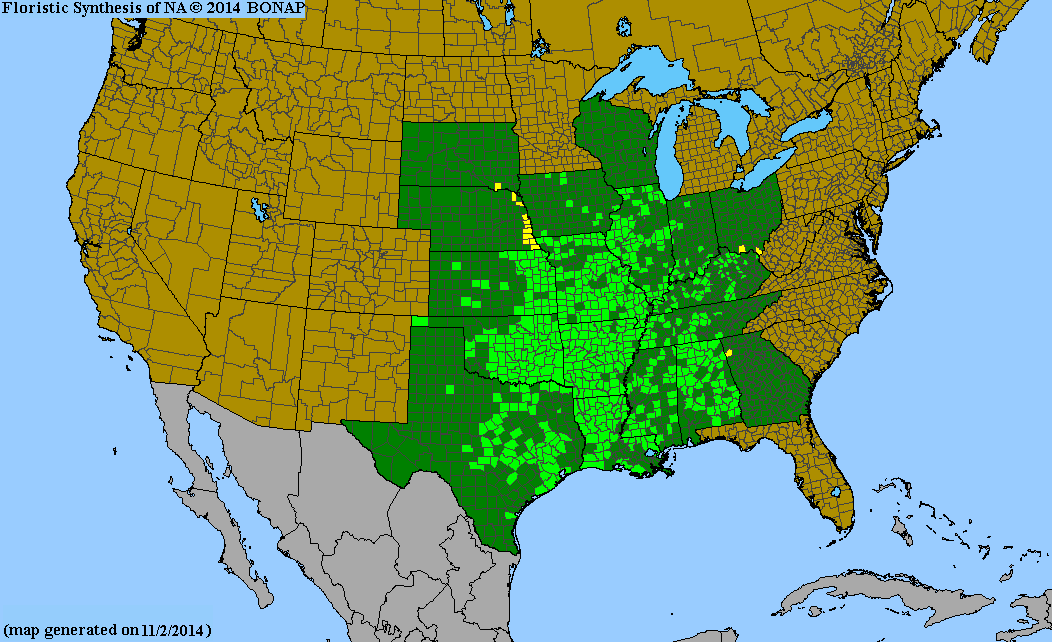
| Generalized natural range of Prunus mexicana | |
| Synonyms[3] | |
| |

Prunus mexicana, commonly known as the Mexican plum,[2] inch plum, or bigtree plum,[4] is a North American species of plum tree that can be found in the central United States and northern Mexico.
Description
[edit]Prunus mexicana has a single trunk and an open crown, and reaches a height of 15–38 feet (4.6–11.6 m).[4] It has dark green, simple ovate leaves 2.0–4.5 inches (5.1–11.4 cm) long and 1.2–2.0 inches (3.0–5.1 cm) wide.[4] In the early spring, it is covered with five-petaled, fragrant, white or pale pink flowers 0.7–1.0 inch (18–25 mm) wide.[4] Its dark gray bark is banded with horizontal lenticels.[5][verification needed] The dark red or purple fruit ripen late in the fall.[6][7]
P. mexicana is very similar to Prunus americana and they intergrade along a broad contact zone centered around Arkansas and Missouri. These intermediate individuals, as hybrids, are impossible to assign to a specific species.[8]
Taxonomy
[edit]P. mexicana is included in the section Prunocerasus.[9]
Distribution and habitat
[edit]The native range of the species stretches from South Dakota east to Wisconsin, Ohio, Kentucky, and Georgia, and south to the Mexican states of Coahuila and San Luis Potosí.[2][10]
It is usually found on woodland edges or in open fields. It is adaptable to a wide range of soil pH and is drought-tolerant. The trees are hardy in U.S. Department of Agriculture zones 5 to 9.
Ecology
[edit]The fruit is eaten fresh by both mammals and birds.[4]
Uses
[edit]The fruit is made into preserves, and the tree can serve as a rootstock for grafting on other plum cultivars.[4]
Gallery
[edit]-
 Flowers of P. mexicana

References
[edit]- ^ Pollard, R.P.; Rhodes, L. & Maxted, N. (2016). "Prunus mexicana". IUCN Red List of Threatened Species. 2016 e.T50137962A50674005. doi:10.2305/IUCN.UK.2016-3.RLTS.T50137962A50674005.en. Retrieved 9 March 2026.
- ^ a b c "Prunus mexicana". Germplasm Resources Information Network. Agricultural Research Service, United States Department of Agriculture. Retrieved 2009-07-21.
- ^ "The Plant List: A Working List of All Plant Species". Retrieved January 27, 2014.
- ^ a b c d e f Little, Elbert L. (1980). The Audubon Society Field Guide to North American Trees: Eastern Region. New York: Knopf. p. 502. ISBN 0-394-50760-6.
- ^ Arnold, M. (2002). Landscape Plants for Texas and Environs. Stipes. ISBN 1-58874-153-2.
- ^ "Mexican Plum, Big Tree Plum, Inch Plum". Retrieved April 6, 2014.
- ^ Flora of North America, Prunus mexicana S. Watson, 1882. Mexican or bigtree plum
- ^ Flora of North America, Prunus americana
- ^ Shaw, J.; Small, R.L. (2005). "Chloroplast DNA phylogeny and phhylogeography of the North American Plums (Prunus subgenus Prunus section Prunocerasus, Rosaceae)". Am. J. Bot. 92 (12): 2011–30. doi:10.3732/ajb.92.12.2011. JSTOR 4125535. PMID 21646120. S2CID 207658064.
- ^ Biota of North America Program 2014 county distribution map