


Portal:Volcanoes

The Volcanoes portal

A volcano is a vent or fissure in the crust of a planetary-mass object that allows hot lava, volcanic ash, and gases to escape from a magma chamber below the surface. On Earth, volcanoes are most often found where tectonic plates are diverging or converging, and because most of Earth's plate boundaries are underwater, most volcanoes are found underwater. For example, a mid-ocean ridge, such as the Mid-Atlantic Ridge, has volcanoes caused by divergent tectonic plates whereas the Pacific Ring of Fire has volcanoes caused by convergent tectonic plates. Volcanoes resulting from divergent tectonic activity are usually non-explosive whereas those resulting from convergent tectonic activity cause violent eruptions. Volcanoes can also form where there is stretching and thinning of the crust's plates, such as in the East African Rift, the Wells Gray-Clearwater volcanic field, and the Rio Grande rift in North America. Volcanism away from plate boundaries most likely arises from upwelling diapirs from the core–mantle boundary called mantle plumes, 3,000 kilometres (1,900 mi) deep within Earth. This results in hotspot volcanism or intraplate volcanism, in which the plume may cause thinning of the crust and result in a volcanic island chain due to the continuous movement of the tectonic plate, of which the Hawaiian hotspot is an example. Volcanoes are usually not created at transform tectonic boundaries where two tectonic plates slide past one another.
Volcanoes, based on their frequency of eruption or volcanism, are referred to as either active, dormant, or extinct. Active volcanoes have a history of volcanism and are likely to erupt again, while extinct ones are not capable of eruption at all as they have no magma source. "Dormant" volcanoes have not erupted in a long time – generally accepted as since the start of the Holocene, about 12,000 years ago – but may erupt again. However, dormant volcanoes are technically considered to be seismically "active". These categories are not entirely uniform; they may overlap for certain examples. Large eruptions can affect atmospheric temperature as ash and droplets of sulfuric acid obscure the Sun and cool Earth's troposphere. Historically, large volcanic eruptions have been followed by volcanic winters which have caused catastrophic famines.
Other planets besides Earth have volcanoes. For example, volcanoes are very numerous on Venus. Mars has significant volcanoes. In 2009, a paper was published suggesting a new definition for the word 'volcano' that includes processes such as cryovolcanism. It suggested that a volcano be defined as 'an opening on a planet or moon's surface from which magma, as defined for that body, and/or magmatic gas is erupted.' (Full article...)
Selected article -

Kamaʻehuakanaloa Seamount (previously known as Lōʻihi) is an active submarine volcano about 22 mi (35 km) off the southeast coast of the island of Hawaii. The top of the seamount is about 3,200 ft (975 m) below sea level. This seamount is on the flank of Mauna Loa, the largest subaerial active shield volcano on Earth. Kamaʻehuakanaloa is the newest volcano in the Hawaiian–Emperor seamount chain, a string of volcanoes that stretches about 3,900 mi (6,200 km) northwest of Kamaʻehuakanaloa. Unlike most active volcanoes in the Pacific Ocean that make up the active plate margins on the Pacific Ring of Fire, Kamaʻehuakanaloa and the other volcanoes of the Hawaiian–Emperor seamount chain are hotspot volcanoes and formed well away from the nearest plate boundary. Volcanoes in the Hawaiian Islands arise from the Hawaii hotspot, and as the youngest volcano in the chain, Kamaʻehuakanaloa is the only Hawaiian volcano in the deep submarine preshield stage of development.
Kamaʻehuakanaloa began forming around 400,000 years ago and is expected to begin emerging above sea level about 10,000–100,000 years from now. At its summit, Kamaʻehuakanaloa Seamount stands more than 10,000 ft (3,000 m) above the seafloor, making it taller than Mount St. Helens was before its catastrophic 1980 eruption. A diverse microbial community resides around Kamaʻehuakanaloa's many hydrothermal vents. (Full article...)
Did you know

- ... that the Ionian volcano Pele, encircled by its own reddish plume deposit (pictured), was named after a volcano goddess in Hawaiian mythology?
- ... that some of the thrust horses in Montana's Adel Mountains Volcanic Field fold some of the intrusions, while others are cut by them?
- ... that although no eruptions from the Segula Volcano have been recorded, there are lava flows on it which may only be a few hundred years old?
- ... that although in theory a common mineral below the earth's surface, coyoteite has been found at the surface only in one volcanic pipe?
- ... that the submarine volcanoes of the Vance Seamounts are pocketed by multiple calderas, many of which have been almost erased by newer flows?
- ... that the eight volcanoes of the President Jackson Seamounts are heavily pocketed by 29 calderas and pit craters?
- ... that the Ionian volcano Tupan Patera, whose activity was first detected by Galileo in 1996, was named after the thunder god of the Tupí-Guaraní indigenous peoples in Brazil?
- ... that the Ionian volcano Tawhaki Patera and the nearby valley Tawhaki Vallis are both named after the Māori lightning deity, Tāwhaki?
General images
-
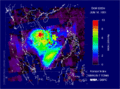 Satellite measurements of ash and aerosol emissions from Mount Pinatubo. (from Timeline of volcanism on Earth)
 -
 The final eruptions in the creation of Banks Peninsula in New Zealand occurred about 9 million years ago. (from Timeline of volcanism on Earth)
 -
-
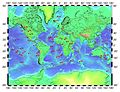 Distribution of selected hotspots. The numbers in the figure are related to the listed hotspots on Hotspot (geology). (from Timeline of volcanism on Earth)
 -
 Sarychev Peak: the sulphur dioxide cloud generated by the eruption on June 12, 2009 (in Dobson units). (from Timeline of volcanism on Earth)
 -
 VEI and ejecta volume correlation (from Timeline of volcanism on Earth)
 -
-

-
-
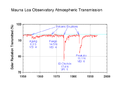 MLO transmission ratio - Solar radiation reduction due to volcanic eruptions (from Timeline of volcanism on Earth)
 -
 A gentle, or effusive, volcanic eruption, in which liquid material (lava) gently flows from a vent, in this case in south-eastern Hawai’i island (from Volcanism)
 -
 Colima Volcano eruption column, December 2016 (from Decade Volcanoes)
 -
 Lava-flooded craters and large expanses of smooth volcanic plains on Mercury (from List of extraterrestrial volcanoes)
 -
 A major eruption of Gran Canaria took place around 14 million years ago. (from Timeline of volcanism on Earth)
 -
 A diagram of a Subglacial eruption. (key: 1. Water vapor cloud 2. Crater lake 3. Ice 4. Layers of lava and ash 5. Stratum 6. Pillow lava 7. Magma conduit 8. Magma chamber 9. Dike) Click for larger version. (from Volcanic eruption)
 -
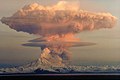 21 April 1990 eruptive column from Redoubt Volcano, as viewed to the west from the Kenai Peninsula (from Volcanic eruption)
 -
 Diagrammatic representation of a plume on Enceladus (from Volcanism)
 -
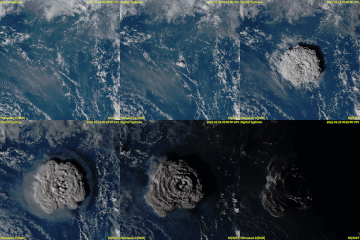 Satellite animation of the initial ash plume and shockwave of the 2022 Hunga Tonga–Hunga Ha’apai eruption and tsunami. The massive explosive eruption was hundreds of times more powerful than the atomic bomb dropped on Hiroshima. (from Volcanism)
 -
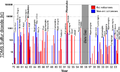 Sulfur dioxide emissions by volcanoes. Mount Pinatubo: 20 million tons of sulfur dioxide. (from Timeline of volcanism on Earth)
 -
 Mount Lamington following the devastating 1951 eruption (from Volcanic eruption)
 -
 Some of the eruptive structures formed during volcanic activity (counterclockwise): a Plinian eruption column, Hawaiian pahoehoe flows, and a lava arc from a Strombolian eruption (from Volcanic eruption)
 -
 Diagram of a Vulcanian eruption. (key: 1. Ash plume 2. Lapilli 3. Lava fountain 4. Volcanic ash rain 5. Volcanic bomb 6. Lava flow 7. Layers of lava and ash 8. Stratum 9. Sill 10. Magma conduit 11. Magma chamber 12. Dike) Click for larger version. (from Volcanic eruption)
 -
 The high initial temperatures of silicate lavas mean that they emit visible light before cooling. (from Volcanism)
 -
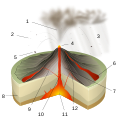 Diagram of a Strombolian eruption. (key: 1. Ash plume 2. Lapilli 3. Volcanic ash rain 4. Lava fountain 5. Volcanic bomb 6. Lava flow 7. Layers of lava and ash 8. Stratum 9. Dike 10. Magma conduit 11. Magma chamber 12. Sill) Click for larger version. (from Volcanic eruption)
 -
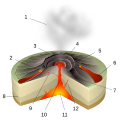 Diagram of a Hawaiian eruption. (key: 1. Ash plume 2. Lava fountain 3. Crater 4. Lava lake 5. Fumaroles 6. Lava flow 7. Layers of lava and ash 8. Stratum 9. Sill 10. Magma conduit 11. Magma chamber 12. Dike) Click for larger version. (from Volcanic eruption)
 -
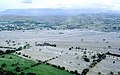 Lahar flows from the 1985 eruption of Nevado del Ruiz, which totally destroyed Armero in Colombia (from Volcanic eruption)
 -
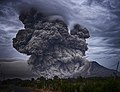 2016 eruption of Mount Sinabung (from Volcanic eruption)
 -
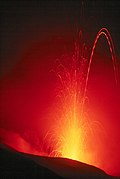 An example of the lava arcs formed during Strombolian activity. This image is of Stromboli itself. (from Volcanic eruption)
 -
 Olympus Mons (Latin, "Mount Olympus"), located on the planet Mars, is the tallest known mountain in the Solar System. (from Volcanism)
 -
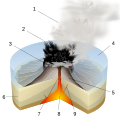 Diagram of a Surtseyan eruption. (key: 1. Water vapor cloud 2. Compressed ash 3. Crater 4. Water 5. Layers of lava and ash 6. Stratum 7. Magma conduit 8. Magma chamber 9. Dike) Click for larger version. (from Volcanic eruption)
 -
 NASA, Global Dimming - El Chichon, VEI 5; Pinatubo, VEI 6. (from Timeline of volcanism on Earth)
 -
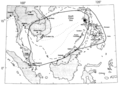 Location of Mount Pinatubo, showing area over which ash from the 1991 eruption fell. (from Timeline of volcanism on Earth)
 -
 Some features of volcanism found in Earth's crust (from Volcanism)
 -
 Cross section diagram of Earth showing some settings for volcanism on the planet (from Volcanism)
 -

-
 Eruption of mud at Dashgil mud volcano in Gobustan, Azerbaijan (from Volcanism)
 -
 Diagram of Peléan eruption. (key: 1. Ash plume 2. Volcanic ash rain 3. Lava dome 4. Volcanic bomb 5. Pyroclastic flow 6. Layers of lava and ash 7. Stratum 8. Magma conduit 9. Magma chamber 10. Dike) Click for larger version. (from Volcanic eruption)
 -
 Diagram of a Submarine eruption. (key: 1. Water vapor cloud 2. Water 3. Stratum 4. Lava flow 5. Magma conduit 6. Magma chamber 7. Dike 8. Pillow lava) Click to enlarge. (from Volcanic eruption)
 -
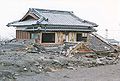
-
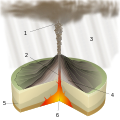 Diagram of a Plinian eruption. (key: 1. Ash plume 2. Magma conduit 3. Volcanic ash rain 4. Layers of lava and ash 5. Stratum 6. Magma chamber) Click for larger version. (from Volcanic eruption)
 -

-
 Diagram of a phreatic eruption. (key: 1. Water vapor cloud 2. Magma conduit 3. Layers of lava and ash 4. Stratum 5. Water table 6. Explosion 7. Magma chamber) (from Volcanic eruption)
 -

-
 Phreatic explosion captured at the Main Crater of Taal Volcano in January 2020, from an installed IP camera of the Philippine Institute of Volcanology and Seismology (PHIVOLCS) monitoring the volcano. (from Decade Volcanoes)
 -
 TOMS sulfur dioxide from the June 15, 1991 eruption of Mount Pinatubo. (from Timeline of volcanism on Earth)
 -


.jpg)


.jpg)


.JPG)


Selected biography -

Sir William Hamilton, KB, PC, FRS, FRSE (13 December 1730 – 6 April 1803) was a British diplomat, politician, antiquarian and vulcanologist who served as the Envoy Extraordinary to the Kingdom of Naples from 1764 to 1800. After sitting in the House of Commons of Great Britain from 1761 to 1764, he began working as a diplomat, succeeding Sir James Gray as the British ambassador to the Kingdom of Naples. While in Italy, Hamilton became involved in studying local volcanoes and collecting antiquities, becoming a fellow of the Royal Society and being given the Copley Medal. His second wife was Emma Hamilton, who was famed as the mistress of Horatio Nelson, 1st Viscount Nelson. (Full article...)
Selected picture
 |
The small town of Ortahisar in Cappadocia, Turkey. The area is covered in soft volcanic rock, which villagers have carved out to form houses, monasteries, and other structures.
Selected quote
Related portals


WikiProjects

Volcanoes topics


Subcategories

Featured work and other approved content

Featured articles: 1980 eruption of Mount St. Helens • 2007–2008 Nazko earthquakes • Amchitka • Armero tragedy • Craters of the Moon National Monument and Preserve • Cerro Azul (Chile volcano) • David A. Johnston • Enceladus (moon) • Geology of the Lassen volcanic area • Io (moon) • Kamaʻehuakanaloa Seamount • Mauna Kea • Mauna Loa • Metacomet Ridge • Mono-Inyo Craters • Mount Cayley volcanic field • Mount St. Helens • Mount Tambora • Nevado del Ruiz • Surtsey • The Volcano (British Columbia) • Triton (moon) • Upper and Lower Table Rock • Volcanism on Io • Volcano (South Park) • Yellowstone National Park
Featured lists: List of volcanoes in Indonesia • List of volcanoes in the Hawaiian – Emperor seamount chain • List of largest volcanic eruptions
Featured pictures: There are currently 43 volcano-related Featured pictures. A full gallery can be seen here.

Good articles: Abyssal plain • Amak Volcano • Anahim hotspot • Axial Seamount • Ben Nevis • Bowie Seamount • Crater Lake • Davidson Seamount • Ferdinandea • Gareloi Volcano • Geyser • Glacier Peak • Hawaii hotspot • Hualālai • Kohala (mountain) • Lake Toba • Minoan eruption • Mount Adams (Washington) • Mount Bailey • Mount Baker • Mount Cleveland (Alaska) • Mount Edziza volcanic complex • Mount Garibaldi • Mount Hood • Mount Kenya • Mount Rainier • Mount Redoubt • Mount Tehama • Mount Thielsen • Mount Vesuvius • Peter I Island • Roxy Ann Peak • Rùm • Sakurajima • Sangay • Silverthrone Caldera • Staffa • Types of volcanic eruptions • Volcanic ash • Weh Island • Wells Gray-Clearwater volcanic field • Yamsay Mountain
Valued pictures: A gallery of volcano-related valued pictures can be seen here.
What you can do

- Add the {{WikiProject Volcanoes}} message box to talk pages of articles within the scope of this project, including appropriate assessments, if needed.
- Add appropriate volcano type categories to articles, and verify the accuracy of any existing categories. See the section "Categorization" below.
- Add {{infobox mountain}} to articles if needed and missing, and add volcano-related fields to existing infoboxes if these are missing.
- Expand volcano articles which are stubs, especially by adding photos and (most importantly) proper references.
- Help improve articles related to Hawaiian and Canadian volcanism by joining the Hawaiian and Canadian workgroups.
- Improve some of the project's most visible articles.
Associated Wikimedia
The following Wikimedia Foundation sister projects provide more on this subject:
-
 Commons
Free media repository -
 Wikidata
Free knowledge base -
 Wikiquote
Collection of quotations -
 Wikisource
Free-content library -
 Wikiversity
Free learning tools -
 Wiktionary
Dictionary and thesaurus


