


Portal:New South Wales

The New South Wales Portal


New South Wales (commonly abbreviated as NSW) is a state on the east coast of Australia. It borders Queensland to the north, Victoria to the south, and South Australia to the west. Its coast borders the Coral and Tasman Seas to the east. The Australian Capital Territory and Jervis Bay Territory are enclaves within the state. New South Wales' state capital is Sydney, which is also Australia's most populous city. As of September 2025[update], the population of New South Wales was over 8.6 million, making it Australia's most populous state. Almost two-thirds of the state's population live in the Greater Sydney area.
The Colony of New South Wales was founded as a British penal colony in 1788. It originally comprised more than half of the Australian mainland with its western boundary set at 129th meridian east in 1825. The colony then also included the island territories of Van Diemen's Land, Lord Howe Island, and Norfolk Island. During the 19th century, most of the colony's area was detached to form separate British colonies that eventually became the various states and territories of Australia. The Swan River Colony (later called the Colony of Western Australia) was never administered as part of New South Wales. (Full article...)
 Recognized content -


-

Banksia serrata, commonly known as the saw banksia, the old man banksia, the saw-tooth banksia or the red honeysuckle and as wiriyagan by the Cadigal people, is a species of woody shrub or tree of the genus Banksia, in the family Proteaceae. Native to the east coast of Australia, it is found from Queensland to Victoria with outlying populations on Tasmania and Flinders Island. Commonly growing as a gnarled tree up to 16 m (50 ft) in height, it can be much smaller in more exposed areas. This Banksia species has wrinkled grey bark, shiny dark green serrated leaves and large yellow or greyish-yellow flower spikes appearing over summer. The flower spikes, or inflorescences, turn grey as they age and pollinated flowers develop into large, grey, woody seed pods called follicles.
B. serrata is one of the four original Banksia species collected by Sir Joseph Banks in 1770, and one of four species published in 1782 as part of Carolus Linnaeus the Younger's original description of the genus. There are no recognised varieties, although it is closely related to Banksia aemula. Throughout its range, it grows exclusively in sandy soil, and is usually the dominant plant in scrubland or low woodland. B. serrata is pollinated by and provides food for a wide array of vertebrate and invertebrate animals in the autumn and winter months, and is an important source of food for honeyeaters. It is a common plant of parks and gardens. (Full article...) -
St James' Church, commonly known as St James', King Street, is an Australian heritage-listed Anglican parish church located at 173 King Street, in the Sydney central business district in New South Wales. Consecrated in February 1824 and named in honour of St James the Great, it became a parish church in 1835. Designed in the style of a Georgian town church by the transported convict architect Francis Greenway during the governorship of Lachlan Macquarie, St James' is part of the historical precinct of Macquarie Street which includes other early colonial era buildings such as the World Heritage listed Hyde Park Barracks.
The church remains historically, socially and architecturally significant. The building is the oldest church extant in Sydney's inner city region. It was added to the New South Wales State Heritage Register on 3 September 2004; and was listed on the (now defunct) Register of the National Estate. (Full article...) -

William Alfred Brown, OAM (31 July 1912 – 16 March 2008) was an Australian cricketer who played 22 Test matches between 1934 and 1948, captaining his country in one Test. A right-handed opening batsman, his partnership with Jack Fingleton in the 1930s is regarded as one of the finest in Australian Test history. After the interruption of World War II, Brown was a member of the team dubbed "The Invincibles", who toured England in 1948 without defeat under the leadership of Don Bradman. In a match in November 1947, Brown was the unwitting victim of the first instance of "Mankading".
Raised in New South Wales, Brown initially struggled in both work and cricket, before gradually rising through the cricket ranks. He made his first-class debut for New South Wales in the 1932–33 season and forced his way into the national side during the 1934 tour of England. When long-term openers Bill Ponsford and Bill Woodfull retired at the end of the tour, Brown and his state opening partner Fingleton took over. After poor form made his selection for the 1938 tour of England controversial, Brown responded with a total of 1,854 runs, including an unbeaten 206 that saved Australia from defeat in the Second Test, and was honoured as one of the five Wisden Cricketers of the Year. (Full article...) -
The platypus (Ornithorhynchus anatinus), sometimes referred to as the duck-billed platypus, is a semiaquatic, egg-laying mammal endemic to eastern Australia, including Tasmania. The platypus is the sole living representative of its family Ornithorhynchidae and genus Ornithorhynchus, though a number of related species appear in the fossil record. Together with the four species of echidna, it is one of the five extant species of monotremes, mammals that lay eggs instead of giving birth to live young. Like other monotremes, the platypus has a sense of electrolocation, which it uses to detect prey in water while its eyes, ears and nostrils are closed. It is one of the few species of venomous mammals, as the male platypus has a spur on each hind foot that delivers an extremely painful venom.
The unusual appearance of this egg-laying, duck-billed, beaver-tailed mammal at first baffled European naturalists. In 1799, the first scientists to examine a preserved platypus body judged it a fake made of several animals sewn together. The unique features of the platypus make it important in the study of evolutionary biology, and a recognisable and iconic symbol of Australia. It is culturally significant to several Aboriginal peoples, who also used to hunt it for food, and has appeared on stamps and currency. (Full article...) -
Telopea speciosissima, commonly known as the New South Wales waratah or simply waratah, is a large shrub in the plant family Proteaceae. It is endemic to New South Wales in Australia. No subspecies are recognised; the closely related Telopea aspera was classified as a separate species in 1995. T. speciosissima is a shrub to 3 or 4 m (9.8 or 13.1 ft) high and 2 m (6.6 ft) wide, with dark green leaves. Its several stems arise from a pronounced woody base known as a lignotuber. The species is well renowned for its striking large red springtime inflorescences (flowerheads), each including hundreds of individual flowers. These are visited by the eastern pygmy possum (Cercartetus nanus), birds such as honeyeaters (Meliphagidae), and various insects.
The floral emblem for its home state of New South Wales, Telopea speciosissima has featured prominently in art, architecture, and advertising, particularly since Australian federation. Commercially grown in several countries as a cut flower, it is also cultivated in home gardens, requiring good drainage yet adequate moisture, but is vulnerable to various fungal diseases and pests. A number of cultivars with various shades of red, pink and even white flowers are available. Horticulturists have also developed hybrids with T. oreades and T. mongaensis which are more tolerant of cold, shade, and heavier soils. (Full article...) -
Summer Hill is a suburb of Sydney, in the state of New South Wales, Australia. Summer Hill is located 7 kilometres west of the Sydney central business district, in the local government area of the Inner West Council.
Summer Hill is a primarily residential suburb of Sydney's Inner West, adjoining two of Sydney's major arterial roads, Parramatta Road and Liverpool Road. The first land grant was made in 1794 to former convict and jailor Henry Kable, and the suburb began growing following the opening of the railway station on the Main Suburban railway line, in 1879. (Full article...) -

Illawarra Steam Navigation Company's SS Bega at Eden in 1903.
The Illawarra Steam Navigation Company was a shipping company that serviced the south coast of New South Wales, Australia from 1858 to the early 1950s. It was formed through the amalgamation of the General Steam Navigation Company, the Kiama Steam Navigation Company and the Shoalhaven Steam Navigation Company, each of whom serviced parts of the south coast with their respective vessels. After merging, the new company held a near monopoly in regard to shipping on the south coast, and their fleet visited every significant port between Sydney and the border of Victoria. The company transported both passengers and a range of produce, including livestock, and hence it became known as the 'Pig and Whistle Line': it was said that ships would wait an hour for a pig but not a minute for a passenger.
Over the years more than twenty steamships were a part of the fleet, including the 1112-ton Merimbula and the 693-ton Eden. Many of these vessels were purpose-built for the company's needs, and were constructed at shipyards both within Australia and abroad. The company's eventual demise came as a result of a number of factors, including increased competition from road and rail, the cost of replacing ships after World War II, waterfront disputes and rising costs. As a consequence, after almost 100 years in operation, the company was placed into voluntary receivership and was delisted from the Australian Securities Exchange in 1955. (Full article...) -
Banksia oblongifolia, commonly known as the fern-leaved, dwarf or rusty banksia, is a species in the plant genus Banksia. Found along the eastern coast of Australia from Wollongong, New South Wales, in the south to Rockhampton, Queensland, in the north, it generally grows in sandy soils in heath, open forest or swamp margins and wet areas. A many-stemmed shrub up to 3 m (9.8 ft) high, it has leathery serrated leaves and rusty-coloured new growth. The yellow flower spikes, known as inflorescences, most commonly appear in autumn and early winter. Up to 80 follicles, or seed pods, develop on the spikes after flowering. Banksia oblongifolia resprouts from its woody lignotuber after bushfires, and the seed pods open and release seed when burnt, the seed germinating and growing on burnt ground. Some plants grow between fires from seed shed spontaneously.
Spanish botanist Antonio José Cavanilles described B. oblongifolia in 1800, though it was known as Banksia aspleniifolia in New South Wales for many years. However, the latter name, originally coined by Richard Anthony Salisbury, proved invalid, and Banksia oblongifolia has been universally adopted as the correct scientific name since 1981. Two varieties were recognised in 1987, but these have not been generally accepted. A wide array of mammals, birds, and invertebrates visit the inflorescences. Though easily grown as a garden plant, it is not commonly seen in horticulture. (Full article...) -

Matthew Charlton (15 March 1866 – 8 December 1948) was an Australian politician who served as leader of the Australian Labor Party (ALP) and Leader of the Opposition from 1922 to 1928. He led the party to defeat at the 1922 and 1925 federal elections.
Charlton was born in Linton, Victoria, but as a child moved to Lambton, New South Wales. He left school at a young age to work in the coal mines, initially as a hurrier. Charlton became prominent in the trade union movement, and in 1903 was elected to the New South Wales Legislative Assembly for the Labor Party. He switched to federal parliament in 1910. Charlton was an anti-conscriptionist, and remained with Labor after the party split of 1916. He was elected party leader in early 1922, following the death of Frank Tudor. He increased Labor's vote at the 1922 election but suffered a backwards slide in 1925. He resigned as leader in early 1928, succeeded by James Scullin, and left politics later that year. (Full article...) -
Molly Morgan (baptised 31 January 1762 – 27 June 1835) was an English landowner, farmer, and convict. She was born as Mary Jones in Ludlow, Shropshire, England, and stayed there throughout her childhood and early adulthood, marrying William Morgan on 25 June 1785 and having two children with him. In 1789, hempen yarn stolen from a factory was discovered at the Morgans' house, resulting in the couple being sentenced to penal transportation. Although William was able to escape initially, Molly was transported to New South Wales as a convict with the Second Fleet on the Neptune, and William was eventually caught and transported as well. After working together for a while in Australia, William left Molly due to her flirting with other men. In 1794, Molly Morgan was able to escape back to England aboard the Resolution by becoming Captain John Locke's mistress. Once back in England, she recovered her children and became a dressmaker in Plymouth, marrying Thomas Mears in 1797. However, she was transported back to Australia on the Experiment, after she was accused of burning her husband's house down in 1803.
When Morgan returned to Australia, she acquired land and cattle. In 1814, she was sentenced to seven years in jail for milking a stolen cow. However, by 1819, she was trusted enough to be one of the twelve convicts given several acres of land to farm at Wallis Plains (now Maitland), and was set free by 1822. She married Thomas Hunt on 5 March 1822. She started a wine shanty on the land she was given at Wallis Plains and received a grant of additional land by the governor, Thomas Brisbane, where she built the Angel Inn. By 1828, she was described as "one of the largest landholders on the Hunter River" and had several features in New South Wales named after her. Morgan also aided other settlers several times, including donating money to help build a school, turning part of her home into a hospital, and riding to Sydney on behalf of convicts. Her wealth significantly decreased throughout the later years of her life and she died on 27 June 1835, at Anvil Creek in Greta, New South Wales, where she owned 203 acres (82 ha) of land. (Full article...) -
Blair Anderson Wark, VC, DSO (27 July 1894 – 13 June 1941) was an Australian soldier, quantity surveyor, and a recipient of the Victoria Cross, the highest decoration for gallantry "in the face of the enemy" that can be awarded to members of the British and other Commonwealth armed forces. A member of the Citizen Military Forces from 1912, Wark enlisted in the Australian Imperial Force on 5 August 1915 for service in the First World War. After initially being employed in the defence of the Suez Canal, his battalion was shipped to the Western Front; it was here that Wark was twice decorated for his bravery and leadership. Having received the Distinguished Service Order in 1917 for his actions at the Battle of Polygon Wood, Wark was awarded the Victoria Cross in 1918 for his leadership and gallantry when in temporary command of his battalion over a three-day period, while conducting operations against the Hindenburg Line.
Returning to Australia after the war, Wark resumed work as a quantity surveyor and established his own business. He became a respected member of Australian society, holding positions and directorships in several companies and charities until 1940, when he re-enlisted in the Citizen Military Forces for service in the Second World War. Wark was promoted to lieutenant colonel and assumed command of the 1st Battalion (City of Sydney's Own Regiment), but died suddenly at Puckapunyal Camp, Victoria, of coronary heart disease, aged 46. (Full article...) -

Alloxylon pinnatum, known as Dorrigo waratah, is a tree of the family Proteaceae found in warm-temperate rainforest of south-east Queensland and northern New South Wales in eastern Australia. It has shiny green leaves that are either pinnate (lobed) and up to 30 cm (12 in) long, or lanceolate (spear-shaped) and up to 15 cm (5.9 in) long. The prominent pinkish-red flower heads, known as inflorescences, appear in spring and summer; these are made up of 50 to 140 individual flowers arranged in corymb or raceme. These are followed by rectangular woody seed pods, which bear two rows of winged seeds.
Known for many years as Oreocallis pinnata, it was transferred to the new genus Alloxylon by Peter Weston and Mike Crisp in 1991. This genus contains the four species previously classified in Oreocallis that are found in Australasia. Its terminal globular flowers indicate that the species is pollinated by birds. Classified as near threatened under the Queensland Nature Conservation Act 1992, the Dorrigo waratah has proven difficult to keep alive in cultivation. (Full article...) -
HMCS Integrity was a cutter built by the Colonial Government of New South Wales in 1804. She was the first vessel ever launched from a New South Wales dockyard and carried goods between the colony's coastal settlements of Norfolk Island, Newcastle, New South Wales, Van Diemen's Land and Port Jackson. In 1804 she took part in a series of voyages to Van Diemen's Land with the aim of founding a colony at Port Dalrymple, the site of the modern settlement of George Town, Tasmania.
In 1805 Integrity encountered and recaptured a Spanish brig which had been unlawfully seized by privateers and concealed in the Kent Group of islands in Bass Strait. Having returned the Spanish vessel to colonial control, Integrity was designated the task of sailing to Chile to negotiate its return to Spain. She set sail for Valparaíso, Chile, in June 1805, but was not seen again and is likely to have foundered during the voyage. (Full article...) -
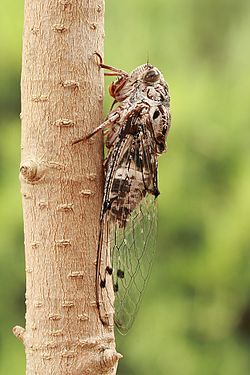
Aleeta is a genus of cicadas with the only species Aleeta curvicosta (commonly known as the floury baker or floury miller, known until 2003 as Abricta curvicosta), one of Australia's most familiar insects. Native to the continent's eastern coastline, it was described in 1834 by Ernst Friedrich Germar.
The floury baker's distinctive appearance and loud call make it popular with children. Both the common and genus name are derived from the white, flour-like filaments covering the adult body. Its body and eyes are generally brown with pale patterns including a light-coloured line along the midline of the pronotum. Its forewings have distinctive dark brown patches at the base of two of their apical cells. The female is larger than the male, although species size overall varies geographically, with larger animals associated with regions of higher rainfall. The male has distinctive genitalia and a loud and complex call generated by the frequent buckling of ribbed tymbals and amplified by abdominal air sacs. (Full article...) -
Ernest Raymond Herbert Toshack (8 December 1914 – 11 May 2003) was an Australian cricketer who played in 12 Tests from 1946 to 1948. A left arm medium paced bowler known for his accuracy and stamina in the application of leg theory, Toshack was a member of Don Bradman's "Invincibles" that toured England in 1948 without being defeated. Toshack reinforced the Australian new ball attack of Ray Lindwall and Keith Miller.
Born in 1914, Toshack overcame many obstacles to reach international level cricket. He was orphaned as an infant, and his early cricket career was hindered because of financial difficulties caused by the Great Depression. The Second World War prevented Toshack from competing at first-class level until he was into his thirties. In 1945–46, the first season of cricket after the end of the War, Toshack made his debut at first-class level and after only seven matches in the Sheffield Shield he was selected for Australia's tour of New Zealand. In Wellington, he opened the bowling in a match that was retrospectively classed as an official Test match. Toshack became a regular member of the Australian team, playing in all of its Tests until the 1947–48 series against India. He took his career-best match bowling figures of 11 wickets for 31 runs (11/31) in the First Test but began to suffer recurring knee injuries, and a medical board had to approve his selection for the 1948 England tour. Toshack played in the first four Tests before being injured. After a long convalescence, he attempted a comeback during Australia's 1949–50 season, but further injury forced him to retire. He was a parsimonious bowler, who was popular with crowds for his sense of humour. (Full article...)


_Scottsdale.jpg)


AtEden1903.jpg)


Selected image

The Sydney Opera House is situated on Bennelong Point in Sydney Harbour, close to the Sydney Harbour Bridge. It is one of the world's most distinctive 20th century buildings, and one of its most famous performing arts venues. It was made a UNESCO World Heritage Site on June 28, 2007.
Related portals

(Northern
Territory) |
WikiProjects


Selected articles -
-
Geologically the Australian state of New South Wales consists of seven main regions: Lachlan Fold Belt, the Hunter–Bowen orogeny or New England Orogen (NEO), the Delamerian Orogeny, the Clarence Moreton Basin, the Great Artesian Basin, the Sydney Basin, and the Murray Basin.
There are a few other sedimentary basins, the Great Artesian Basin can be broken into the Eromanga Basin in the west and the Surat Basin to the east. The Sydney Basin extends north into the Gunnedah Basin, which goes even further north into the Bowen Basin which extends into Queensland, under the Surat Basin. The New England Orogen has a few small Basins included, such as the Lorne Basin, the Myall Syncline, and Gloucester Basin. The Oaklands Basin is in the south of the state under the Murray Basin. The Darling Basin is in the state's west, but mostly covered by the Murray Basin. Gilgandra Sub-Basin and Paka Tank Trough are potential places for coal and gas. (Full article...) -
Carlingford (/ˈkɑːrlɪŋfərd/) is a suburb of Sydney, in the state of New South Wales, Australia. Carlingford is 22 kilometres (14 mi) north-west of the Sydney central business district in the local government area of City of Parramatta. Carlingford sits at the meeting point of Northern Sydney and Western Sydney sitting on both sides of Pennant Hills Road which generally acts as a divider of the two regions. While being part of City of Parramatta, it is sometimes referred to as being part of the Hills District. (Full article...) -
Smoky Cape Lighthouse is a heritage-listed active lighthouse located on Smoky Cape, a headland in Arakoon east of the town of South West Rocks, Kempsey Shire, New South Wales, Australia, and within the Hat Head National Park. It directs boats towards the entrance to the Macleay River, which is located just to the north of the lighthouse.
It is one of the last major lighthouse complexes designed by the New South Wales colonial architect of the time, James Barnet, and was one of Australia's last lighthouses to be designed for architectural excellence.
Standing on a granite headland 111 metres (364 ft) above the sea, its light is the highest in New South Wales. (Full article...) -
Tom Uglys Bridge are two road bridges, completed in 1929 and 1987, that carry the Princes Highway across the Georges River in southern Sydney, in the state of New South Wales, Australia. The bridges link the St George area at Blakehurst to the Sutherland Shire at Sylvania. Tom Uglys Bridge is one of six major road crossings of Georges River.
The 1929 Pratt truss bridge is listed on the New South Wales State Heritage Register and carries three lanes of northbound vehicular traffic on the Princes Highway. The 1987 concrete box girder bridge was built to the east of the older bridge and carries the three southbound lanes of the highway. Both bridges have shared bicycle and pedestrian pathways. (Full article...) -
Sydney Ferries is the public transport ferry network serving the city of Sydney, New South Wales. Services operate on Sydney Harbour and the connecting Parramatta River. The network is controlled by the New South Wales Government's transport authority, Transport for NSW, and is part of the authority's Opal ticketing system. In 2017–18, 15.3 million passenger journeys were made on the network.
Services are operated under contract by Transdev Sydney Ferries. Sydney Ferries Corporation is the state government agency that owns the ferry fleet. (Full article...) -
Johnson's Building is a heritage-listed former retail stores and now stock exchange offices, bar and restaurant located at 233–235 George Street in the inner city Sydney suburb of The Rocks in the City of Sydney local government area of New South Wales, Australia. It was designed by Walter Liberty Vernon and built in 1912. It is also known as Chamber of Commerce Building and Johnson's Overalls Building (Johnsons). The property is owned by Property NSW, an agency of the Government of New South Wales. It was added to the New South Wales State Heritage Register on 10 May 2002. (Full article...) -
The Sydney Gay and Lesbian Mardi Gras is an annual pride parade in Sydney, New South Wales attended by hundreds of thousands of people from around Australia and overseas. Mardi Gras is the largest gay and lesbian event in Oceania. It first began as a protest for gay and lesbian people in 1978. In 2019, an attempt was made to alter the name to include more groups under the queer umbrella, but this was voted down by the gay and lesbian members, who wanted the event to remain exclusive. This decision was met by disappointment from especially bisexual Australians, who consider it a form of Bisexual erasure.
The Sydney Gay & Lesbian Mardi Gras is one of Australia's biggest tourist drawcards, with the parade and dance party attracting many international and domestic tourists. It is New South Wales' second-largest annual event in terms of economic impact, generating an annual income of about A$30 million for the state. (Full article...) -

Geoffrey Lee (born c. 1967) is a former Australian politician. He was the Minister for Corrections in the second Perrottet ministry between December 2021 and March 2023. He has previously served as the Minister for Skills and Tertiary Education in the second Berejiklian and Perrottet ministries between April 2019 and December 2021. Lee was also a member of the New South Wales Legislative Assembly representing Parramatta for the Liberal Party since 2011 until his retirement in 2023. (Full article...) -
Tooth and Co was a major brewer of beer in New South Wales, Australia. It was one of Australia's oldest companies, having been established as a partnership in 1835. It was formerly listed on the Australian Securities Exchange. (Full article...)
-
The Sydney Harbour Bridge is a steel through arch bridge in Sydney, New South Wales, Australia, spanning Sydney Harbour from the central business district (CBD) to the North Shore. The view of the bridge, the harbour, and the nearby Sydney Opera House is widely regarded as an iconic image of Sydney, and of Australia itself. Nicknamed "the Coathanger" because of its arch-based design, the bridge carries rail, vehicular, bicycle and pedestrian traffic.
Under the direction of John Bradfield of the New South Wales Department of Public Works, the bridge was designed and built by British firm Dorman Long of Middlesbrough, and opened in 1932. The bridge's general design, which Bradfield tasked the NSW Department of Public Works with producing, was a rough copy of the Hell Gate Bridge in New York City. The design chosen from the tender responses was original work created by Dorman Long, who leveraged some of the design from its own Tyne Bridge. (Full article...) -
The Sydney Conservatorium of Music (SCM) — formerly the New South Wales State Conservatorium of Music, and known by the moniker "The Con" — is the music school of the University of Sydney. It is one of the oldest and most prestigious music schools in Australia, founded in 1915 by Belgian conductor and violinist Henri Verbrugghen.
The heritage-listed main building of the Conservatorium — the Greenway Building — is located within the Royal Botanic Gardens on Macquarie Street on the eastern fringe of the Sydney central business district. It also has teaching at the main campus of the University in Camperdown/Darlington, at the Seymour Centre and eventually the Footbridge Theatre. (Full article...) -
Maitland (/ˈmeɪtlənd/ MAYT-lənd) is a city in the Hunter Valley of New South Wales, Australia and the seat of Maitland City Council, situated on the Hunter River approximately 166 kilometres (103 mi) by road north of Sydney and 35 km (22 mi) north-west of Newcastle. It is on the New England Highway approximately 17 km (11 mi) from its origin at Hexham.
At the 2021 census it had approximately 89,597 inhabitants, spread over an area of 392 square kilometres (151 sq mi), with most of the population located in a strip along the New England Highway between the suburbs of Lochinvar and Thornton. The city centre is located on the right bank of the Hunter River, protected from moderate potential flooding by a levee. (Full article...) -

New South Wales (in red)
New South Wales wine is Australian wine produced in New South Wales, Australia. New South Wales is Australia's most populous state and its wine consumption far outpaces the region's wine production. The Hunter Valley, located 130 km (81 mi) north of Sydney, is the most well-known wine region but the majority of the state's production takes place in the Big Rivers zone-Perricoota, Riverina and along the Darling and Murray Rivers. The wines produced from the Big Rivers zone are largely used in box wine and mass-produced wine brands such as Yellow Tail. A large variety of grapes are grown in New South Wales, including Cabernet Sauvignon, Chardonnay, Shiraz and Sémillon.
New South Wales is the second-largest wine-producing state in Australia, accounting for 30 percent of the A$5 billion Australian wine industry In 1994 the various wine regions within New South Wales agreed there was a need to form a peak lobby group to act as the conduit between industry and the New South Wales Government, and to represent New South Wales at the Federal level through the Winemakers Federation of Australia Inc. This body is the New South Wales Wine Industry Association. (Full article...) -
The Sir John Sulman Medal for Public Architecture is an architectural award presented by the New South Wales chapter of the Australian Institute of Architects since 1934. The medal is at times referred to as the Sulman Award and recognises excellence in public architecture in New South Wales.
Until 1961 the award also included projects in the Australian Capital Territory. The establishment of the ACT Chapter of the Institute of Architects in 1962 and a separate awards program including the Canberra Medallion changed the award to projects in New South Wales only. Before the advent of the NSW Chapter Wilkinson Award in 1961, the Sulman was also awarded to residential housing projects. (Full article...) -
The Sydney Hobart Yacht Race is an annual oceanic yacht racing event hosted by the Cruising Yacht Club of Australia, starting in Sydney, New South Wales, on Boxing Day and finishing in Hobart, Tasmania. The race distance is approximately 630 nautical miles (1,170 km). The race is run in conjunction with the Royal Yacht Club of Tasmania, and is widely considered to be one of the most difficult yacht races in the world.
The race was initially planned to be a cruise by Peter Luke and some friends who had formed a club for those who enjoyed cruising as opposed to racing; however, when a visiting British Royal Navy Officer, Captain John Illingworth, suggested it be made a race, the event was born. Since the inaugural race in 1945, the Sydney to Hobart Yacht Race has grown over the decades to become one of the top three offshore yacht races in the world, and it now attracts maxi yachts from all around the globe. The 2025 race was the 80th edition. (Full article...)


.jpg)
_Johnsons_Building.JPG)
.jpg)
.jpg)

.jpg)


Did you know (auto-generated)

- ... that Turkish international soccer player Rojin Polat was named member of the "2021 All Schools Merit Girls Team" in New South Wales, Australia?
- ... that many an Xplorer has traversed the rails in Canberra?
- ... that the rural village of Neath, New South Wales, had a population of three Tok Pisin speakers in 2021?
- ... that the jury of matrons who assessed whether Ann Davis was pregnant after she was sentenced to death were the first civilian jurors for a criminal trial in New South Wales?
- ... that Robert Brodribb Hammond established the Sydney suburb of Hammondville to house families made homeless by the Great Depression?
- ... that in its two years of existence, the Hunter River Railway Company initiated construction on what would eventually become the Great Northern Railway connecting Sydney to Queensland?
General images -
-
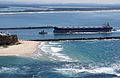 A bulk carrier entering the Port of Newcastle, New South Wales, 2009 (from Economy of New South Wales)
 -
 A General Chart of New Holland including New South Wales & Botany Bay with The Adjacent Countries and New Discovered Lands, published in An Historical Narrative of the Discovery of New Holland and New South Wales, London, Fielding and Stockdale, November 1786 (from History of New South Wales)
 -
 A 630 lb gold specimen from Hill End, unearthed in 1872 (from History of New South Wales)
 -
 Sydney Opera House was opened in 1973. (from History of New South Wales)
 -
 Köppen climate types in New South Wales (from Geography of New South Wales)
 -
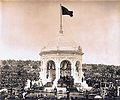 Federation Pavilion, Centennial Park, Sydney, 1 January 1901. (from History of New South Wales)
 -
 Ribbon ceremony to open the Sydney Harbour Bridge on 20 March 1932. Breaking protocol, the soon to be dismissed Premier Jack Lang cuts the ribbon while Governor Philip Game looks on. (from History of New South Wales)
 -
 Early expeditions of Charles Sturt (from History of New South Wales)
 -
 Bondi Beach circa 1900 (from History of New South Wales)
 -
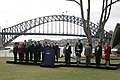 World leaders with Prime Minister John Howard in Sydney for the 2007 APEC conference (from History of New South Wales)
 -
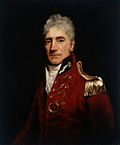 The 5th Governor of New South Wales, Lachlan Macquarie, was influential in establishing civil society in Australia (from History of New South Wales)
 -

-
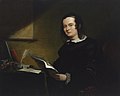 Humanitarian Caroline Chisholm provided support to poverty-stricken women migrants (from History of New South Wales)
 -
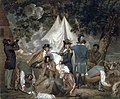 Founding of the settlement of Port Jackson at Botany Bay in New South Wales in 1788, by Thomas Gosse (1799) (from History of New South Wales)
 -
 Tumut 3 Power Station was constructed as part of the vast Snowy Mountains Scheme in New South Wales (1949–1974). Construction necessitated the expansion of Australia's immigration program. (from History of New South Wales)
 -
 Dry paddocks in the Riverina region during the 2007 drought (from History of New South Wales)
 -
 Olympic colours on the Sydney Harbour Bridge in the year 2000 (from History of New South Wales)
 -
 Murray Grey cows and calves (from Economy of New South Wales)
 -
 William Wentworth was key in the establishment of self-governance in New South Wales (from History of New South Wales)
 -
 Hyde Park, Sydney with the Australian Museum under construction in the distance, 1842 (from History of New South Wales)
 -
 A chart of part of the interior of New South Wales by John Oxley, Surveyor General, 1822 (from History of New South Wales)
 -
 Landing of Lieutenant James Cook at Botany Bay, 29 April 1770 by E. Phillips Fox (1902) (from History of New South Wales)
 -
 Autumn colour at Mount Wilson (from Geography of New South Wales)
 -

-

-
 Mr E.H. Hargraves, The Gold Discoverer of Australia, returning the salute of the gold miners - Thomas Tyrwhitt Balcombe, 1851 (from History of New South Wales)


.jpg)


.jpg)


.jpg)


Topics
Categories

More portals


In the news
- 19 June 2026 – Organised crime in Australia
- The Australian Federal Police seizes 2.7 tonnes of cocaine concealed in underground storage containers in Sydney, the largest cocaine seizure in the country's history. Authorities arrest two people at the site and charge them with offenses related to importing and possessing illicit drugs. (AFP via ABS-CBN News) (Reuters)
Associated Wikimedia
The following Wikimedia Foundation sister projects provide more on this subject:
-
 Commons
Free media repository -
 Wikidata
Free knowledge base -
 Wikiquote
Collection of quotations -
 Wikisource
Free-content library -
 Wikiversity
Free learning tools -
 Wikivoyage
Free travel guide -
 Wiktionary
Dictionary and thesaurus


