Michigan consists of two peninsulas: the heavily forested Upper Peninsula (commonly called "the U.P."), which juts eastward from northern Wisconsin, and the more populated Lower Peninsula, stretching north from Ohio and Indiana. The peninsulas are separated by the Straits of Mackinac, which connects Lake Michigan and Lake Huron, and are linked by the 5-mile-long Mackinac Bridge along Interstate 75. Bordering four of the five Great Lakes and Lake St. Clair, Michigan has the longest freshwater coastline of any U.S. political subdivision, measuring 3,288 miles. The state ranks second behind Alaska in water coverage by square miles and first in percentage, with approximately 42%, and it also contains 64,980 inland lakes and ponds.
The Great Lakes region has largely been inhabited for thousands of years by Indigenous peoples such as the Ojibwe, Odawa, Potawatomi, and Wyandot.
Some people contend that the region's name is derived from the Ojibwe word ᒥᓯᑲᒥ (mishigami), meaning "large water" or "large lake". Others say that it comes from the Mishiiken Tribe of Mackinac Island, also called Michinemackinawgo by Ottawa historian Andrew Blackbird, whose surrounding lands were referred to as Mishiiken-imakinakom, later shortened to Michilimackinac.
In the 17th century, French explorers claimed the area for New France. French settlers and Métis established forts and settlements.
After France's defeat in the French and Indian War in 1762, the area came under British control and later the U.S. following the Treaty of Paris (1783), though control remained disputed with Indigenous tribes until treaties between 1795 and 1842. The area was part of the larger Northwest Territory; the Michigan Territory was organized in 1805. (Full article...)
Michigan spent her career in the Atlantic Fleet. She frequently cruised the east coast of the United States and the Caribbean Sea, and in April 1914 took part in the United States occupation of Veracruz during the Mexican Civil War. After the United States entered World War I in April 1917, Michigan was employed as a convoy escort and training ship for the rapidly expanding wartime navy. In January 1918, her forward cage mast collapsed in heavy seas, killing six men. In 1919, she ferried soldiers back from Europe. The ship conducted training cruises in 1920 and 1921, but her career was cut short by the Washington Naval Treaty signed in February 1922, which mandated the disposal of Michigan and South Carolina. Michigan was decommissioned in February 1923 and broken up for scrap the following year. (Full article...)
... that state representative Karl Bohnak, referring to his former profession, said that the Upper Peninsula of Michigan was one of the most challenging places in the U.S. to forecast the weather?
The Detroit Automobile Company (DAC) was an early American automobile manufacturer founded on August 5, 1899, in Detroit, Michigan. It was the first venture of its kind in Detroit. Automotive mechanic Henry Ford attracted the financial backing of twelve investors; Detroit Mayor William Maybury, William H. Murphy and others. As with many early car ventures, the company floundered, and it was dissolved in January 1901. Twenty vehicles were built and $86,000 ($2.61 million in 2019) of investment was lost. (Full article...)
Agnes Mary Mansour (April 10, 1931 – December 17, 2004) was an American former Catholic nun, as well as a politician and public official. She is known for having been given a choice from the Vatican in 1983 to end her religious vows or to resign from her position as the director of the Michigan Department of Social Services, which required her to support and allocate public funding for abortions. The controversy involved her belief that abortion was tragic but should be legal, despite her religious vows and the teachings of the Catholic Church.
After graduating from college in Detroit, Mansour entered religious life with the Sisters of Mercy and earned a doctorate in biochemistry. She served as the president of Mercy College of Detroit from 1971 to 1983. She ran unsuccessfully for public office in 1982, in the process provoking comment from the Archbishop of Detroit. (Full article...)
Image 4The Detroit-Windsor border crossing is the busiest international border crossing in North America by trade volume, with approximately one-third of all Canada–U.S. trade passing through this link. Pictured in the background is the under-construction Gordie Howe International Bridge, which will complement the existing Ambassador Bridge, shown in the foreground. (from Michigan)
Image 12Treaty of Paris, by Benjamin West (1783), an unfinished painting of the American diplomatic negotiators of the Treaty of Paris which brought official conclusion to the Revolutionary War and gave possession of Michigan and other territory to the new United States (from Michigan)
Image 18Cora Reynolds Anderson became the first woman elected to the House of Representatives in Michigan in 1925. (from History of Michigan)
Image 19Detroit in the mid-twentieth century. At the time, the city was the fourth-largest U.S. metropolis by population, and held about one-third of the state's population. (from Michigan)
Image 22Union members occupying a General Motors body factory during the Flint Sit-Down Strike of 1937 which spurred the organization of militant CIO unions in auto industry (from History of Michigan)
Image 36A map of Michigan by Henry Schenck Tanner, published in 1842, showing such county names as "Negwegon County," "Okkuddo County," and "Unwattin County," prior to an 1843 legislative action renaming sixteen counties in northern Michigan (from History of Michigan)
Image 37Governor Gretchen Whitmer speaking at a National Guard ceremony in 2019 (from Michigan)
Image 38The Detroit–Windsor area is North America's largest cross-border conurbation, with a combined population of approximately six million people (from Michigan)





.svg)


.jpg)


.jpg)


.jpg)


.png)

.jpg)


.jpg)


.jpg)


.jpg)


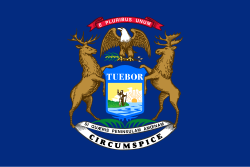 The Flag of Michigan
 The Seal of Michigan
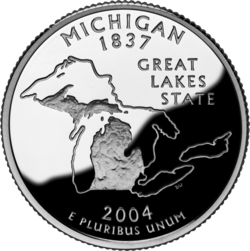 State Quarter – Released in 2004


 Commons
 Wikidata
 Wikiquote
 Wikisource
 Wikiversity
 Wikivoyage
 Wiktionary


