


Portal:Insects

The Insects Portal


Insects (from Latin insectum) are hexapod invertebrates of the class Insecta. They are the largest group within the arthropod phylum. Insects have a chitinous exoskeleton, a three-part body (head, thorax and abdomen), three pairs of jointed legs, compound eyes, and a pair of antennae. Insects are the most diverse group of animals, with more than a million described species; they represent more than half of all animal species. (Full article...)
Selected article -

The meat ant (Iridomyrmex purpureus), also known as the gravel ant or southern meat ant, is a species of ant endemic to Australia. A member of the genus Iridomyrmex in the subfamily Dolichoderinae, it was described by British entomologist Frederick Smith in 1858. The meat ant is associated with many common names due to its appearance, nest-building behaviour and abundance, of which its specific name, purpureus, refers to its coloured appearance. It is among the best-known species of ant found throughout Australia; it occurs in almost all states and territories except for Tasmania. Its enormous distribution, aggression and ecological importance have made this ant a dominant species.
The meat ant is monomorphic (occurs in a particular form), although there is evidence that certain populations can be polymorphic. It is characterised by its dark-bluish body and red head. It is a medium to large species, measuring 6–12 mm (0.24–0.47 in). The workers and males are approximately the same sizes at 6–7 mm (0.24–0.28 in) and 8 mm (0.31 in), respectively. The queens are the largest and appear mostly black, measuring 12.7 mm (0.50 in). The iridescence in workers ranges from green or blue to plain green and purple, varying in different body parts and castes. Meat ants inhabit open and warm areas in large, oval-shaped mounds that are accompanied by many entrance holes. The nest area is always cleared of vegetation and covered with materials including gravel, pebbles and dead vegetation. They are also polydomous, where a colony may be established in a series of satellite nests connected by well-defined paths and trails. Satellite nests are constructed away from the main nest and nearby areas with valuable food sources so workers can exploit them. (Full article...)
Did you know -
- ... that the fungus Entomophthora muscae makes flies climb upwards before killing them, so they are better able to release a shower of spores for the next cycle of infection?
- ... that the bee Anthidium manicatum scrapes fur from leaves to line its nest?
- ... that the extinct sandfly species Lutzomyia adiketis is host to the Paleoleishmania species P. neotropicum?
- ... that all species of the fruit fly genus Zaprionus have the same characteristic white stripes over the head and thorax?
- ... that the wasp Megarhyssa macrurus paralyzes her prey by injecting it with an ovipositor 4 inches (10 cm) long?
List articles

Related portals


General images -
-
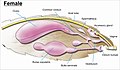 The female genitalia of Lepidoptera (from Insect reproductive system)
 -
 Variety of male structures in Phlebotominae (Diptera, Psychodidae) (from Insect reproductive system)
 -
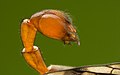 The abdominal terminus of male scorpionflies is enlarged into a "genital bulb", as seen in Panorpa communis (from Insect morphology)
 -
 Insect morphology
Legend of body parts
Tagmata: A – Head, B – Thorax, C – Abdomen.(from Insect morphology)- antenna
- ocelli (lower)
- ocelli (upper)
- compound eye
- brain (cerebral ganglia)
- prothorax
- dorsal blood vessel
- tracheal tubes (trunk with spiracle)
- mesothorax
- metathorax
- forewing
- hindwing
- mid-gut (stomach)
- dorsal tube (heart)
- ovary
- hind-gut (intestine, rectum & anus)
- anus
- oviduct
- nerve cord (abdominal ganglia)
- Malpighian tubes
- tarsal pads
- claws
- tarsus
- tibia
- femur
- trochanter
- fore-gut (crop, gizzard)
- thoracic ganglion
- coxa
- salivary gland
- subesophageal ganglion
- mouthparts
-
 Mayfly nymph with paired abdominal gills (from Insect flight)
 -
 Generalized arthropod biramous limb. Trueman proposed that an endite and an exite fused to form a wing. (from Insect flight)
 -
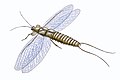 Mazothairos, a Carboniferous member of the now extinct order Palaeodictyoptera. (from Evolution of insects)
 -
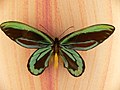 Queen Alexandra's birdwing (Ornithoptera alexandrae) of Papua New Guinea (from Insect biodiversity)
 -
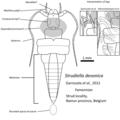 Reconstruction of Strudiella devonica as a possible hexapod (from Evolution of insects)
 -
 Indian moon moth (Actias selene) with some of the spiracles identified (from Respiratory system of insects)
 -
 Cross-section of wing vein (from Insect morphology)
 -
 A tau emerald (Hemicordulia tau) dragonfly has flight muscles attached directly to its wings. (from Insect flight)
 -
 Frenulo-retinacular wing coupling in male and female moths (from Insect flight)
 -

-
-
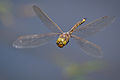 The Odonata (dragonflies and damselflies) have direct flight musculature. (from Insect flight)
 -
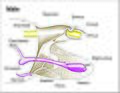 Male genitalia of Lepidoptera (from Insect reproductive system)
 -
 Diagram of a typical insect leg (from Insect morphology)
 -
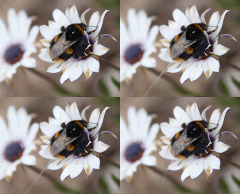 Bumblebee defecating. Note the contraction of the anus, which provides internal pressure. (from Insect morphology)
 -
 Mandibles of Rhyniognatha hirsti, it may be one of the oldest insects, but also possible to be a myriapod. (from Evolution of insects)
 -
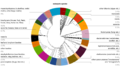 A pie chart of described eukaryote species, showing just over half of these to be insects (from Insect biodiversity)
 -
 Stylized diagram of insect digestive tract showing malpighian tubule, from an insect of the order Orthoptera. (from Insect morphology)
 -
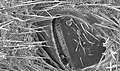 Scanning electron micrograph of a cricket spiracle valve (from Respiratory system of insects)
 -
 Direct flight: muscles attached to wings. Large insects only (from Insect flight)
 -
 Evolution has produced astonishing variety of appendages in insects, such as these antennae. (from Evolution of insects)
 -
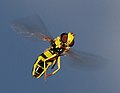 Hoverfly (Philhelius pedissequum) has indirect flight musculature. (from Insect flight)

.png)


.JPG)


.jpg)


.jpg)
Selected image -


Green lacewings (Neuroptera: Chrysopidae) is a family of lacewings containing about 85 genera and (according to different sources) 1,300–2,000 species. Members of the genera Chrysopa (pictured) and Chrysoperla are very common in North America and Europe; they are very similar and many of their species have been moved from one genus to the other times and again.
Topics
| |||||||||||||||
| |||||||||||||||
| |||||||||||||||

| Aspects of insects in culture |
| ||||||||||||||
|---|---|---|---|---|---|---|---|---|---|---|---|---|---|---|---|
| Pioneers |
| ||||||||||||||
| Concerns | |||||||||||||||
| Categories, templates | |||||||||||||||

Subcategories

WikiProjects

Main WikiProject:
Related projects:
- WikiProject Arthropods
- WikiProject Spiders
- WikiProject Animals
- WikiProject Tree of Life
- WikiProject Biology
Daughter projects:
Tasks
 |
Here are some tasks awaiting attention:
|
Associated Wikimedia
The following Wikimedia Foundation sister projects provide more on this subject:
-
 Commons
Free media repository -
 Wikidata
Free knowledge base -
 Wikiquote
Collection of quotations -
 Wikisource
Free-content library -
 Wikiversity
Free learning tools -
 Wiktionary
Dictionary and thesaurus


