


Portal:Gardening

The Gardening Portal

Gardening is the process of growing plants for their vegetables, fruits, flowers, herbs, or ornamental purposes within a designated space. Gardens fulfill a wide assortment of purposes, notably the production of aesthetically pleasing areas, medicines, cosmetics, dyes, foods, poisons, wildlife habitats, and saleable goods (see market gardening). People often partake in gardening for its therapeutic, health, educational, cultural, philosophical, environmental, and religious benefits.
Gardening varies in scale from the 800 hectare Versailles gardens down to container gardens grown inside. Gardens take many forms; some only contain one type of plant, while others involve a complex assortment of plants with no particular order. (Full article...)
Horticulture (from Latin: horti + culture) is the science and art of growing fruits, vegetables, flowers, or ornamental plants. Horticulture is distinct from conventional plant agriculture through its emphasis on the artistic and landscaped expressions of plant cultivation, in addition to various crops being grown in scientifically informed controlled environments such as greenhouse and intensive outdoor systems unlike industrial large-scale agronomic systems and field mechanization. There are various divisions of horticulture because plants are grown for a variety of purposes. These divisions include, but are not limited to: propagation, arboriculture, landscaping, floriculture and turf maintenance. For each of these, there are various professions, aspects, tools used and associated challenges—each requiring highly specialized skills and knowledge on the part of the horticulturist. (Full article...)
General images -
-
 Alignment of several compost piles on a composting facility in France (from Garden design)
 -
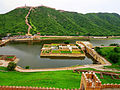 Moata Lake and Saffron Garden, exhibit ancient Indian garden styles (from History of gardening)
 -

-
 The food forest atop CapitaSpring in Singapore (from Agroforestry)
 -
 Silvopasture over the years (Australia) (from Agroforestry)
 -
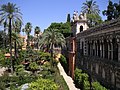
-

-
 Contemporary garden (from Garden design)
 -
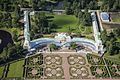 Oranienbaum, the Grand Menshikov Palace gardens (from History of gardening)
 -
 Giverny (from History of gardening)
 -

-
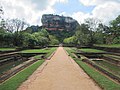 Sigirya gardens in Sri Lanka (from History of gardening)
 -

-
 Andalusian Patio of Córdoba, Spain (from Garden design)
 -
 A pear orchard near Faversham (from Agroforestry)
 -
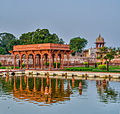 The Shalamar Gardens, Lahore, Pakistan (from Garden design)
 -
 A riparian buffer bordering a river in Iowa (from Agroforestry)
 -
 Hawkwell Field with Gothic temple, Cobham monument and Palladian bridge at Stowe House (from History of gardening)
 -
 Sheffield Park Garden, a landscape garden originally laid out in the 18th century by Capability Brown (from History of gardening)
 -
 Scale model of the Fallingwater building, Carnegie Science Center in Pittsburgh (from History of gardening)
 -
 Triton Lake at Powerscourt Gardens (from History of gardening)
 -
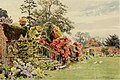 Colour plate from Some English Gardens (1904) by Gertrude Jekyll. (from Garden writing)
 -

-
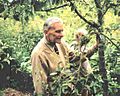 Robert Hart, forest gardening pioneer (from Agroforestry)
 -
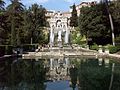 Villa d'Este (from History of gardening)
 -

-
 Garden lighting in Kampala, Uganda (from Garden design)
 -
 Inhotim, Brumadinho, Brasil (from History of gardening)
 -
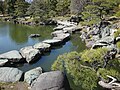
 Ryoan-ji (late 15th century) in Kyoto, Japan, the most famous example of a Zen rock garden (from List of garden types)
 -
 Engraving from a 1774 edition of La pratique du jardinage, a treatise on gardening by Antoine-Joseph Dezallier d'Argenville. (from Garden writing)
 -
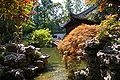 The Yuyuan Garden in Shanghai, China (created in 1559) shows all the elements of a classical Chinese garden – water, architecture, vegetation, and rocks. (from List of garden types)
 -
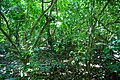 Kuojtakiloyan (from Agroforestry)
 -
 Contemporary water feature (from Garden design)
 -
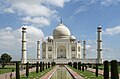 The Mughal and English-style garden leading to the Taj Mahal(from History of gardening)
 -
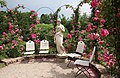 Garden chairs in Rosenneuheitengarten Beutig in Baden-Baden, Germany (from Garden design)
 -
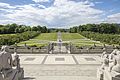 Frogner Park (from History of gardening)
 -
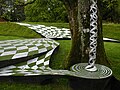 The Garden of Cosmic Speculation, a sculpture garden in Dumfriesshire, Scotland (from List of garden types)
 -
 The Muskau Park (from History of gardening)
 -

-
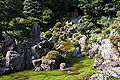
-
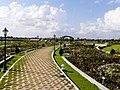 Curved garden paths are a common form of hardscaping (from Garden design)
 -
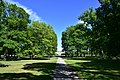 The park at Drottningholm Palace (from History of gardening)
 -

-
-
Contemporary garden in Colchester, United Kingdom (from History of gardening)
-
 The Oak Allee in the Gardens in Hendrie Park at Royal Botanical Gardens (Ontario), designed by J. Austin Floyd in 1965 (from History of gardening)
 -
 Shalimar Bagh, Srinagar, depicting a water way (from History of gardening)
 -
 Park in Kuskovo (from History of gardening)
 -

-
 Alley cropping corn fields between rows of walnut trees (from Agroforestry)
 -
 Sofiero Palace garden (from History of gardening)
 -

-
-

-
 A temperate Syntropic system in Dordogne France, including heavily mulched sunflower plants (from Agroforestry)
 -
 The seven layers of the forest garden (from Agroforestry)
 -
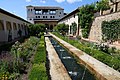 Inspired by Islamic/Moorish gardens, the Patio de la Acequia (Courtyard of the Canal), Generalife, Granada, Spain (from Garden design)
 -
 The Renaissance style gardens at Chateau Villandry(from History of gardening)
 -
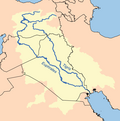 Map showing the Tigris and Euphrates Rivers (from History of gardening)
 -
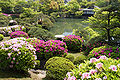
-
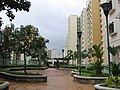 Roof garden on the top deck of a multi-storey car park, Edgedale Neighbourhood, Punggol, Singapore (from List of garden types)
 -
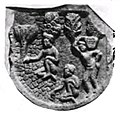
 King Bimbisara of Magadha visits the Bamboo Garden (Venuvana) in Rajagriha; artwork from Sanchi. (from History of gardening)
 -
 Elswout (from History of gardening)
 -

-
 Water garden at Lake Palace (from History of gardening)
 -

-
 White Garden at Kensington Palace, a Dutch garden planted as a Color garden (from List of garden types)
 -
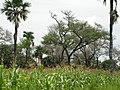 Maize grown under Faidherbia albida and Borassus akeassii near Banfora, Burkina Faso (from Agroforestry)
 -
 Mughal-style courtyard garden at Agra Fort (from History of gardening)
 -
-
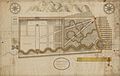 A plan of a formal garden for a country estate in Wales, 1765 (from Garden design)
 -

-
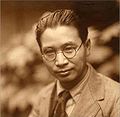 Toyohiko Kagawa, forest farming pioneer (from Agroforestry)
 -
 Reflection of the Bagh-e Narenjestan (orange garden) and the Khaneh Ghavam (Ghavam house) at Shiraz, Iran (Persian garden) (from List of garden types)
 -
 The Orangerie in the Gardens of Versailles with the Pièce d’eau des Suisses in the background (French formal garden) (from List of garden types)
 -
 Opening from the 1712 English edition of The Theory and Practice of Gardening - Wherein is Fully Handled all that Relates to Fine Gardens, Commonly called Pleasure-Gardens, as Parterres, Groves, Bowling-Greens &c. Suggested schemes for gardens of 6 (left) and 12 (right) acres. (from Garden writing)


.jpg)
.jpg)


.jpg)


_(14582436177).jpg)

.jpg)


.jpg)


_(14748380196).jpg)


.jpeg)
.jpg)


_(35456502483).jpg)


.jpg)


_at_Rajagriha,_the_visit_of_Bimbisara.jpg)


Selected article -

Lurie Garden is a 2.5-acre (10,000 m2) garden located at the southern end of Millennium Park in the Loop area of Chicago in Cook County, Illinois, United States. Designed by GGN (Gustafson Guthrie Nichol), Piet Oudolf, and Robert Israel, it opened on July 16, 2004. The garden is a combination of perennials, bulbs, native prairie grasses, shrubs and trees. It is the featured nature component of the world's largest green roof. The garden cost $13.2 million and has a $10 million endowment for maintenance and upkeep. It was named after Ann Lurie, who donated the $10 million endowment. For visitors, the garden features guided walks, lectures, interactive demonstrations, family festivals and picnics.
The Garden is composed of two "plates" protected on two sides by large hedges. The dark plate depicts Chicago's history by presenting shade-loving plant material. The dark plate has a combination of trees that will provide a shade canopy for these plants when they fill in. The light plate, which includes no trees, represents the city's future with sun-loving perennials that thrive in the heat and the sun. (Full article...)
Selected image

Related portals


Did you know -
- ... that "Go New York Go" has energized New York Knicks fans at Madison Square Garden since 1993?
- ... that the Cranford Rose Garden at Brooklyn Botanic Garden was cited as having 1,200 varieties of roses?
- ... that controversy ensued when the painting Pleasure Garden was offered to the Robert McDougall Art Gallery?
- ... that Michael Gardener preached a sermon in Inuktitut even though he did not yet understand the language?
- ... that Saint Sadalberga used telepathy to "order lettuce from her gardener", according to a story from her vita?
- ... that Ōtari-Wilton's Bush is the only public botanic garden in New Zealand that is entirely dedicated to native plants?
- ... that the Caucasian stonecrop frequently escapes, perhaps through birds or garden waste?
- ... that Tucker Hall and Ewell Hall sit on either side of the Sunken Garden on the College of William & Mary's campus?
Things you can do
- This list is transcluded from the tasks list page. To edit the list, click here
 |
Here are some tasks awaiting attention:
|
WikiProjects

Topics


Categories

Associated Wikimedia
The following Wikimedia Foundation sister projects provide more on this subject:
-
 Commons
Free media repository -
 Wikidata
Free knowledge base -
 Wikiquote
Collection of quotations -
 Wikisource
Free-content library -
 Wikiversity
Free learning tools -
 Wiktionary
Dictionary and thesaurus


