


Portal:Clothing

The Clothing Portal

Clothing (also known as clothes, garments, dress, apparel, or attire) is any item worn on a human body. Typically, clothing is made of fabrics or textiles. Over time, it has included garments made from animal skin and other thin sheets of materials and natural products found in the environment, put together. Clothing is worn primarily by humans and is a feature of all human societies. The amount and type of clothing worn depend on gender, body type, social factors, and geographic considerations. Garments cover the body, footwear covers the feet, gloves cover the hands, hats and headgear cover the head, and underwear covers the intimate parts.
Clothing has significant social factors as well. Wearing clothes is a variable social norm. It may connote modesty. Being deprived of clothing in front of others may be embarrassing. In many parts of the world, not wearing clothes in public so that genitals, breast, or buttocks are visible may be considered indecent exposure. Pubic area or genital coverage is the most frequently encountered minimum across cultures and climates, implying social convention as the basis of customs. Wearers may also use clothing to communicate social status, wealth, group identity, and individualism. (Full article...)
Textile is an umbrella term that includes various fibre-based materials, including fibres, yarns, filaments, threads, and different types of fabric. At first, the word "textiles" only referred to woven fabrics. However, weaving is not the only manufacturing method, and many other methods were later developed to form textile structures based on their intended use. Knitting and non-woven are other popular types of fabric manufacturing. In the contemporary world, textiles satisfy the material needs for versatile applications, from simple daily clothing to bulletproof jackets, spacesuits, doctor's gowns and technical applications like geotextiles. (Full article...)
Textile art is art created from natural or synthetic fibers or from fabric or textile. Textile art is synonymous with fiber art. The art could be wall-hung, sculptural, installation, or have a functional decorative arts purpose. (Full article...)
Selected articles -
-


Warp and weft in plain weaving
Weaving is a method of textile production in which two distinct sets of yarns or threads are interlaced at right angles to form a fabric or cloth. The longitudinal threads are called the warp and the lateral threads are the weft, woof, or filling. The method in which these threads are interwoven affects the characteristics of the cloth.
Cloth is usually woven on a loom, a device that holds warp threads in place while filling threads are woven through them. A fabric band that meets this definition of cloth (warp threads with a weft thread winding between) can also be made using other methods, including tablet weaving, backstrap loom, or other techniques that can be done without looms.
The way the warp and filling threads interlace with each other is called the weave. The majority of woven products are created with one of three basic weaves: plain weave, satin weave, or twill weave. Woven cloth can be plain or classic (in one colour or a simple pattern), or can be woven in decorative or artistic design. (Full article...) -

A man wearing a knitted sweater
The "sweater curse" or "curse of the love sweater" is a term used by knitters and crocheters to describe the belief that if a knitter or crocheter gives a hand-knit sweater to a significant other, it will lead to the recipient breaking up with the knitter. In an alternative formulation, the relationship will end before the sweater is even completed. The belief is widely discussed in knitting publications, and some knitters reported having experienced it. In a 2005 poll, 15% of active knitters reported having experienced the sweater curse firsthand, and 41% considered it a possibility that should be taken seriously.
Despite its name, the "sweater curse" is treated in knitting literature not as a superstition governed by paranormal forces, but rather as a real-world pitfall of knitting that has rational explanations. Several plausible mechanisms for the sweater curse have been proposed, but it has not been studied systematically. (Full article...) -
Sir William Henry Perkin (12 March 1838 – 14 July 1907) was an English chemist and entrepreneur best known for his serendipitous discovery of the first commercial synthetic organic dye, mauveine, made from aniline. Though he failed in trying to synthesise quinine for the treatment of malaria, he became successful in the field of dyes after his first discovery at the age of 18.
Perkin set up a factory to produce the dye industrially. Regina Lee Blaszczyk, professor of business history at the University of Leeds, states, "By laying the foundation for the synthetic organic chemicals industry, Perkin helped to revolutionize the world of fashion." (Full article...) -

Utility pole warmer on New York City street corner.
Knitta, also known as Knitta Please, was a group of artists based in Houston, Texas often attributed with the creation of the yarn bombing movement, a type of graffiti where participants wrap public architecture—e.g. lampposts, parking meters, telephone poles, and signage—with knitted or crocheted material. Founded in 2005 by Magda Sayeg and Akrylik, the group held yarn bombings in several cities and continents, and were invited to stage installations
Knitta grew to eleven members by the end of 2007, and over the next several years held installations in several countries and on multiple continents. However, by the 2010s, membership had dwindled to just Sayeg. (Full article...) -

A modern industrial knitting machine in action
A knitting machine is a device used to create knitted fabrics in a semi or fully automated fashion. There are numerous types of knitting machines, ranging from simple spool or board templates with no moving parts to highly complex mechanisms controlled by electronics. All, however, produce various types of knitted fabrics, usually either flat or tubular, and of varying degrees of complexity. Pattern stitches can be selected by hand manipulation of the needles, push-buttons and dials, mechanical punch cards, or electronic pattern reading devices and computers. (Full article...) -
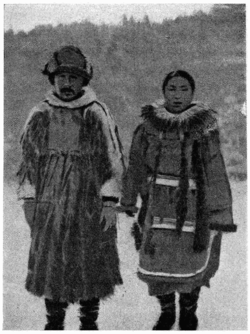
Kusquqvagmiut (Kuskokwim Yup'ik) man and woman wearing hoodless fancy fur parkas (atkupiak), circa 1879
Yup'ik clothing (Yup'ik aturaq sg aturak dual aturat pl, aklu, akluq, un’u; also, piluguk in Unaliq-Pastuliq dialect, aklu, cangssagar, un’u in Nunivak dialect, Cup'ik clothing for the Chevak Cup'ik-speaking people of Chevak and Cup'ig clothing for the Nunivak Cup'ig-speaking people of Nunivak Island) refers to the traditional Alaska Native-style clothing worn by the Yupik people of southwestern Alaska.
The traditional clothing systems developed and used by the Yup’ik, Inuit and Nuniwarmiut peoples performs similarly to the most effective cold weather clothing developed to date. Yup'ik women made clothes and footwear from animal skins (especially hide and fur of marine and land mammals for fur clothing, sometimes birds, also fish), sewn together using needles made from animal bones, walrus ivory, and bird bones such as the front part of a crane's foot and threads made from other animal products, such as sinew. The multi-functional ulu (semilunar woman's knife) is used to process and cut skins for clothing and footwear. Women made most clothing of caribou (wild caribou Rangifer tarandus granti and domestic reindeer Rangifer tarandus tarandus) and sealskin. Yup’ik clothing tended to fit relatively loosely. (Full article...) -

Catholic clergymen wearing pleated rochets
A pleat (plait in older English) is a type of fold formed by doubling fabric back upon itself and securing it in place. It is commonly used in clothing and upholstery to narrow a wide piece of fabric through gathering.
Pleats are categorized as pressed, that is, ironed or otherwise heat-set into a sharp crease, or unpressed, falling in soft rounded folds. Pleats sewn into place are called tucks. (Full article...) -
Joan Schulze (born October 13, 1936) is an American artist, lecturer, and poet. Schulze's career spans over five decades. She is best known for her career in contemporary quilting and collage. Schulze was named a “pioneer of the art quilt movement” by Constance Howard. Her work is in galleries and private collections worldwide, including the Renwick Gallery/Smithsonian Institution in Washington DC, the Museum of Arts and Design in New York, & the Oakland Museum of California. (Full article...)
-

Roller-printed cotton cushion cover panel, 1904, Silver Studio V&A Museum no. CIRC.675–1966
Roller printing, also called cylinder printing or machine printing, on fabrics is a textile printing process patented by Thomas Bell of Scotland in 1783 in an attempt to reduce the cost of the earlier copperplate printing. This method was used in Lancashire fabric mills to produce cotton dress fabrics from the 1790s, most often reproducing small monochrome patterns characterized by striped motifs and tiny dotted patterns called "machine grounds".
Improvements in the technology resulted in more elaborate roller prints in bright, rich colours from the 1820s; Turkey red and chrome yellow were particularly popular. (Full article...) -

The Harris tweed Orb Mark
The Harris Tweed Authority (HTA) is an independent statutory public body created by the Harris Tweed Act 1993, replacing the Harris Tweed Association, which was formed in 1910. The Harris Tweed Authority is charged with the general duty of furthering the Harris Tweed industry as a means of livelihood for those who live in the Outer Hebrides of Scotland.
The Harris Tweed Authority is responsible for safeguarding the standard and reputation of Harris Tweed, promoting awareness of the cloth internationally, and disseminating information about material falling within the definition of Harris tweed and articles made from it. (Full article...) -
The cochineal (/ˌkɒtʃɪˈniːl, ˈkɒtʃɪniːl/ KOTCH-in-EEL, -eel, US also /ˌkoʊtʃɪˈniːl, ˈkoʊtʃɪniːl/ KOH-chin-EEL, -eel; Dactylopius coccus) is a scale insect in the suborder Sternorrhyncha, from which the natural dye carmine is derived. A primarily sessile parasite native to tropical and subtropical South America through North America (Mexico and the Southwest United States), this insect lives on cacti in the genus Opuntia, feeding on plant moisture and nutrients. The insects are found on the pads of prickly pear cacti, collected by brushing them off the plants, and dried.
The insect produces carminic acid that deters predation by other insects. Carminic acid, typically 17–24% of dried insects' weight, can be extracted from the body and eggs, then mixed with aluminium or calcium salts to make carmine dye, also known as cochineal. Today, carmine is primarily used as a colorant in food and in lipstick (E120 or Natural Red 4). (Full article...) -

Le Courtisan suivant le Dernier Édit by Abraham Bosse – a French courtier casting aside lace, ribbons and slashed sleeves in favor of sober dress in accordance with the edict of 1633
Sumptuary laws (from Latin sūmptuāriae lēgēs) are laws that regulate consumption. Black's Law Dictionary defines them as "Laws made for the purpose of restraining luxury or extravagance, particularly against inordinate expenditures for apparel, food, furniture, or shoes, etc." Historically, they were intended to regulate and reinforce social hierarchies and morals through restrictions on clothing, food, and luxury expenditures, often depending on a person's social rank.
Societies have employed sumptuary laws for various purposes. They were used to try to regulate the balance of trade by limiting the market for expensive imported goods. They made it easy to identify social status and privilege, and as such could be used for social discrimination and to stabilize social hierarchies. They could also be used to prevent, or at least reduce, opportunities for political bribery and corruption. (Full article...) -

Naturally dyed skeins made with madder root, Colonial Williamsburg, VA
Natural dyes are dyes or colorants derived from plants, invertebrates, or minerals. The majority of natural dyes are vegetable dyes from plant sources—roots, berries, bark, leaves, and wood—and other biological sources such as fungi.
Archaeologists have found evidence of textile dyeing dating back to the Neolithic period. In China, dyeing with plants, barks and insects has been traced back more than 5,000 years. The essential process of dyeing changed little over time. Typically, the dye material is put in a pot of water and heated to extract the dye compounds into solution with the water. Then the textiles to be dyed are added to the pot, and held at heat until the desired color is achieved. Textile fibre may be dyed before spinning or weaving ("dyed in the wool"), after spinning ("yarn-dyed") or after weaving ("piece-dyed"). Many natural dyes require the use of substances called mordants to bind the dye to the textile fibres. Mordants (from Latin mordere 'to bite') are metal salts that can form a stable molecular coordination complex with both natural dyes and natural fibres. Historically, the most common mordants were alum (potassium aluminum sulfate—a metal salt of aluminum) and iron (ferrous sulfate). Many other metal salt mordants were also used, but are seldom used now due to modern research evidence of their extreme toxicity either to human health, ecological health, or both. These include salts of metals such as chrome, copper, tin, lead, and others. In addition, a number of non-metal salt substances can be used to assist with the molecular bonding of natural dyes to natural fibres—either on their own, or in combination with metal salt mordants—including tannin from oak galls and a range of other plants/plant parts, "pseudo-tannins", such as plant-derived oxalic acid, and ammonia from stale urine. Plants that bio-accumulate aluminum have also been used. Some mordants, and some dyes themselves, produce strong odors, and large-scale dyeworks were often isolated in their own districts. (Full article...) -

Cloak, 1580–1600 V&A Museum no. 793–1901 Techniques – Red satin, couched and embroidered with silver, silver-gilt and coloured silk threads, trimmed with silver-gilt and silk thread fringe and tassel, and lined with pink linen
Aesthetics in textiles is one of the basic concepts of the serviceability of textiles. It is determined by the perception of touch and sight. Aesthetics imply the appearance and attraction of textile products; it includes the color and texture of the material. It is a statement about the end user (consumer) and the target market. When combined with fabric construction, the finish of the clothing material, garment fit, style, and fashion compatibility, colours create an aesthetic comfort. All of these elements work together to satisfy our visual perception. Aesthetics incorporates the role of evaluation (analysing and judging) also.
There are various arts and applications that imparts aesthetic properties in textiles. Additionally, the use of LEDs and optical fibres enables the creation of aesthetic properties such as illuminated textiles. (Full article...) -

A contemporary Navajo rug
Navajo weaving (Navajo: diyogí) are textiles produced by Navajo people, who are based near the Four Corners area of the United States. Navajo textiles are highly regarded and have been sought after as trade items for more than 150 years. Commercial production of handwoven blankets and rugs has been an important element of the Navajo economy. As one art historian wrote, "Classic Navajo serapes at their finest equal the delicacy and sophistication of any pre-mechanical loom-woven textile in the world."
Navajo textiles were originally utilitarian weavings, including cloaks, dresses, saddle blankets, and similar items. By the mid-19th century, Navajo wearing blankets were trade items prized by Indigenous peoples of the Great Plains and neighboring tribes. Toward the end of the 19th century, Navajo weavers began to make rugs for non-Native tourists and for export. (Full article...)


.jpg)


Did you know (auto generated)

- ... that Swertia japonica was used as an insecticide for clothes during the Edo period?
- ... that after being criticized for dressing "like a doll" at an important meeting, pioneering Russian feminist Anna Filosofova replied that "clothes do not make the woman"?
- ... that Armand Avril travelled in 1960 for a year in Africa, where he was inspired to assemble "bottle caps, clothespins, glue, nails and empty tin cans"?
- ... that Oduwa's reign saw cowries becoming so widespread as currency that nobles stitched them into their clothes, causing runaway inflation?
- ... that the earliest of the authentic portraits of Mozart shows the prodigy wearing the clothes of Archduke Maximilian Francis of Austria, given as a gift by Empress Maria Theresa?
- ... that according to Brandy Hellville, executives at Brandy Melville have bought the clothes off of employees' backs?
More Did you know

- ... that samite was a luxurious and heavy silk fabric worn in the Middle Ages, and famously by Tennyson's Lady of the Lake (pictured)?
- ... that torchon lace is one of the oldest bobbin laces and has strictly geometric patterns?
- ... that Bucks point lace is a bobbin lace from the East Midlands in England with both floral and geometric designs?
Related portals


Selected image

The mola forms part of the traditional costume of a Guna woman, two mola panels being incorporated as front and back panels in a blouse. The full costume traditionally includes a patterned wrapped skirt (saburet), a red and yellow headscarf (musue), arm and leg beads (wini), a gold nose ring (olasu) and earrings in addition to the mola blouse (dulemor).
General images -
-

-
 Tie dye vendor, July 2013 (from Fashion)
 -
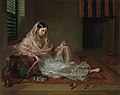 A woman in Bengal region in the eastern part of the Indian subcontinent, clad in fine Bengali muslin, 18th century. (from History of clothing and textiles)
 -
 Sungir boy clothes reconstruction, about 30,000 years ago. (from History of clothing and textiles)
 -
 Model with a modern dress reflecting the current fashion trend, 2011 (from Fashion)
 -

-
 Textile machinery at the Cambrian Factory, Llanwrtyd, Wales in the 1940s (from History of clothing and textiles)
 -
 14th-century Italian silk damasks (from History of clothing and textiles)
 -
 1895 Punch cartoon.Gertrude: "My dear Jessie, what on earth is that Bicycle Suit for?"
Jessie: "Why, to wear, of course."
Gertrude: "But you haven't got a Bicycle!"
Jessie: "No; but I've got a Sewing Machine!" (from History of clothing and textiles) -
 A Concert in an Interior by Jan Josef Horemans the Younger of Antwerp, 1764. The women's sack-back gowns and the men's coats over long waistcoats are characteristic of this period. (from History of clothing and textiles)
 -

-
 A silk chiffon dress identical to that worn by Jennifer Lopez to the 42nd Annual Grammys in 2000, this version exhibited at the Fashion Museum, Bath, as part of their Dress of the Year Collection. (from History of clothing and textiles)
 -
 Kiko Mizuhara is a designer known for blending traditional Japanese elements with modern fashion, challenging stereotypes of Japanese style as static or outdated. (from Fashion)
 -
-
 A 16th-century Boxer Codex image showing the attire of a Classical period Filipino, made of silk and cotton (from History of clothing and textiles)
 -
 Warp-weighted loom configured for twill weave fabric. (from History of clothing and textiles)
 -
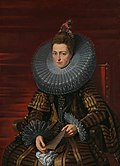 A French reinterpretation of Spanish fashion, with elaborate reticella ruff, 1609 (from History of clothing and textiles)
 -
 Indigenous Americas Map Tunic designed in 2018 by Carla Fernández and Pedro Reyes for Taller Flora. (from Fashion)
 -
 Latin dancers in their costumes. The woman is wearing backless dress with deep slits on its lower portion, while the man is wearing a shirt with top buttons open. (from Fashion)
 -
 Estonian national clothes are a fine example of change in clothing after the Industrial Revolution. They changed considerably during 18th and 19th century with the addition of new types of colors (like aniline dyes), placement of colors (like lengthwise stripes) and with the addition of new elements (like waistcoats). By the end of the 19th century they went out of use in most of the country (except more remote places as in Kihnu island) and it was only in mid 20th century when they once again gained popularity and now as a formal clothing. Members of University of Tartu Folk Art Ensemble wearing clothes specific to Kihnu island, Tori Parish (women in red skirts) and Tõstamaa area (men in brown clothing). (from History of clothing and textiles)
 -
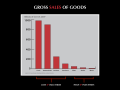 Gross sales of goods vs IP laws (US 2007) (from Fashion)
 -

-
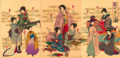 Gensei Kajin Shu by Yoshu Chikanobu, 1890. Various styles of traditional Japanese clothing and Western styles. (from Fashion)
 -
 Albrecht Dürer's drawing contrasts a well-turned out bourgeoise from Nuremberg (left) with her counterpart from Venice. The Venetian lady's high chopines make her look taller. (from Fashion)
 -
 Kaia Gerber at the 2019 Max Mara Fashion Week in Milan (from Fashion)
 -
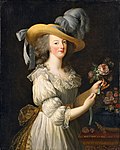 Marie Antoinette, wife of Louis XVI, was a leader of fashion. Her choices, such as this 1783 white muslin dress called a chemise a la Reine, were highly influential and widely worn. (from Fashion)
 -
 Edgar I of England in short tunic, hose, and cloak, 966 (from History of clothing and textiles)
 -
 Diana: A Celebration, an exhibition of Princess Diana's outfits at the Frazier History Museum. Diana's fashion significantly impacted style trends. (from Fashion)
 -
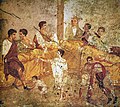 A multigenerational banquet depicted on a wall-painting from Pompeii, 1st century AD (from History of clothing and textiles)
 -
 Bold floral patterned silks, 15th century (from History of clothing and textiles)
 -
 Cover of Marcus Clarks' spring and summer catalogue 1926–27 (from Fashion)
 -

-
 Celebrities such as Britney Spears have popularized the concept of wearing underwear as outerwear. (from Fashion)
 -
 Reconstruction of people of the Mierzanowice culture from present-day Poland, c. 2100–1650 BC. (from History of clothing and textiles)
 -

-
 A see-through top worn along with pasties at a fashion show in 2017. Such fashion trends get popularised through media. (from Fashion)
 -

-
 Liu Wen, supermodel, walks the runway modeling fashions by designer Diane von Fürstenberg at New York Fashion Week 2013. (from Fashion)
 -
 Hindu lady wearing sari, one of the most ancient and popular pieces of clothing in the Indian subcontinent. (from Fashion)
 -
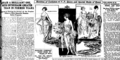 This 1921 clipping from the St. Louis Post-Dispatch, with story and drawings by Marguerite Martyn, represents the saturation newspaper coverage given to society women at a fashionable dance. (from Fashion)
.jpg)


.jpg)

.jpg)


_-_Concert_in_an_Interior_-_1764.jpg)


.jpg)


.svg)


.jpg)


.jpg)
_DSCN2839.jpg)


Selected quote

Main topics
| Headwear |
| ||||||||
|---|---|---|---|---|---|---|---|---|---|
| Neckwear | |||||||||
| Underwear and lingerie |
| ||||||||
| Tops | |||||||||
| Bottoms |
| ||||||||
| Full-body wear |
| ||||||||
| Coats and outerwear |
| ||||||||
| Legwear | |||||||||
| Footwear | |||||||||
| Accessories |
| ||||||||
| Specialized |
| ||||||||
| Dress codes |
| ||||||||
| Related | |||||||||


| Fundamentals |  | |
|---|---|---|
| History of ... | ||
| Regional and ethnic | ||
| Related | ||
| Glossaries | ||
Recognized content
Extended content
| ||
|---|---|---|

Featured articlesGood articlesFeatured pictures
Featured portals
|


Subcategories

WikiProjects
- Parent project

- Main project
- Participants
- Related projects
WikiProject Fashion • WikiProject Knots • WikiProject Sculpture • WikiProject Visual arts
What are WikiProjects?
Things you can do

Associated Wikimedia
The following Wikimedia Foundation sister projects provide more on this subject:
-
 Commons
Free media repository -
 Wikidata
Free knowledge base -
 Wikiquote
Collection of quotations -
 Wikisource
Free-content library -
 Wikiversity
Free learning tools -
 Wiktionary
Dictionary and thesaurus


