


Portal:Classical music

The Classical Music Portal


Classical music is a tradition of art music in the Western world, considered to be distinct from Western folk music or popular music. It is sometimes distinguished as Western classical music, as the term "classical music" can also be applied to non-Western art musics. Classical music is often characterized by formality and complexity in its musical form and harmonic organization, particularly with the use of polyphony. Since at least the ninth century, it has been primarily a written tradition, spawning a sophisticated notational system, as well as accompanying literature in analytical, critical, historiographical, musicological and philosophical practices. (Full article...)
Selected articles –
-
![Image 1 The timpani (/ˈtɪmpəni/; Italian pronunciation: [ˈtimpani]) or kettledrums (also informally called timps) are musical instruments in the percussion family. A type of drum categorised as a hemispherical drum, they consist of a membrane called a head stretched over a large bowl traditionally made of copper. Thus, timpani are an example of kettledrums, also known as vessel drums and semispherical drums, whose body is similar to a section of a sphere whose cut conforms the head. Most modern timpani are pedal timpani and can be tuned quickly and accurately to specific pitches by skilled players through the use of a movable foot-pedal. They are played by striking the head with a specialized beater called a timpani stick or timpani mallet. Timpani evolved from military drums to become a staple of the classical orchestra by the last third of the 18th century. Today, they are used in many types of ensembles, including concert bands, marching bands, orchestras, and even in some rock bands. Timpani is an Italian plural, the singular of which is timpano, though the singular may also be referred to as a timpanum. In English, the term timpano is only widely used by practitioners: a single drum is often referred to as a timpani, leading many to incorrectly pluralize the word as timpanis. A musician who plays timpani is a timpanist. (Full article...)](//upload.wikimedia.org/wikipedia/en/d/d2/Blank.png)
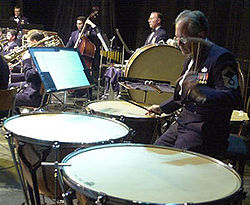
The timpani (/ˈtɪmpəni/; Italian pronunciation: [ˈtimpani]) or kettledrums (also informally called timps) are musical instruments in the percussion family. A type of drum categorised as a hemispherical drum, they consist of a membrane called a head stretched over a large bowl traditionally made of copper. Thus, timpani are an example of kettledrums, also known as vessel drums and semispherical drums, whose body is similar to a section of a sphere whose cut conforms the head. Most modern timpani are pedal timpani and can be tuned quickly and accurately to specific pitches by skilled players through the use of a movable foot-pedal. They are played by striking the head with a specialized beater called a timpani stick or timpani mallet. Timpani evolved from military drums to become a staple of the classical orchestra by the last third of the 18th century. Today, they are used in many types of ensembles, including concert bands, marching bands, orchestras, and even in some rock bands.
Timpani is an Italian plural, the singular of which is timpano, though the singular may also be referred to as a timpanum. In English, the term timpano is only widely used by practitioners: a single drum is often referred to as a timpani, leading many to incorrectly pluralize the word as timpanis. A musician who plays timpani is a timpanist. (Full article...) -
Antonín Leopold Dvořák (8 September 1841 – 1 May 1904) was a Czech composer. He frequently employed rhythms and other aspects of the folk music of Moravia and his native Bohemia, following the Romantic era nationalist example of his predecessor Bedřich Smetana. Dvořák's style has been described as "the fullest recreation of a national idiom with that of the symphonic tradition, absorbing folk influences and finding effective ways of using them", and Dvořák has been described as "arguably the most versatile... composer of his time".
Dvořák displayed his musical gifts at an early age, being a talented violin student. The first public performances of his works were in Prague in 1872 and, with special success, in 1873, when he was 31 years old. Seeking recognition beyond the Prague area, he submitted scores of works including symphonies to competitions in Germany and Austria. He first won a prize in 1874, with Johannes Brahms on the jury of the Austrian State Competition. In 1877, after his third win, Brahms recommended Dvořák to his publisher, Simrock, who commissioned what became the Slavonic Dances, Op. 46. The sheet music's high sales and critical reception led to his international success. A London performance of Dvořák's Stabat Mater in 1883 led to many other performances in the United Kingdom, the United States, and eventually Russia in March 1890. The Seventh Symphony was written for London in 1885. (Full article...) -
Ludwig van Beethoven (baptised 17 December 1770 – 26 March 1827) was a German composer, conductor, and pianist. Regarded as one of the greatest composers in the history of Western music, he was mentored during the Classical period, and his musical style was a key driver of the transition to Romantic music, and the expansion of instrumental forms such as the symphony, the piano sonata and the string quartet. His compositions have attracted extraordinary casual and scholarly interest, and remain among the most performed in the world.
Born in Bonn, Beethoven was a musical prodigy. He was initially taught intensively by his father, Johann van Beethoven, and later by Christian Gottlob Neefe. He found relief from a dysfunctional home life with the family of Helene von Breuning, whose children he loved, befriended, and taught piano. At age 21, he moved to Vienna, which subsequently became his base, and studied composition with Joseph Haydn. Beethoven gained a reputation as a virtuoso pianist, and was soon patronized by Karl Alois, Prince Lichnowsky for compositions, which resulted in his three Piano Trios, Op. 1, (the earliest works to which he accorded an opus number) in 1795. His Pathétique Sonata was composed in 1798. Around this time, Beethoven began experiencing symptoms of hearing loss. (Full article...) -
The Symphony No. 2 in C minor by Gustav Mahler, known as the Resurrection Symphony, was written between 1888 and 1894, and first performed in 1895. This symphony was one of Mahler's most popular and successful works during his lifetime. It was his first major work to establish his lifelong view of the beauty of afterlife and resurrection. In this large work, the composer further developed the creativity of "sound of the distance" and creating a "world of its own", aspects already seen in his First Symphony. The work has a duration of 80 to 90 minutes, and is conventionally labelled as being in the key of C minor; the New Grove Dictionary of Music and Musicians labels the work's tonality as C minor–E♭ major. It was voted the fifth-greatest symphony of all time in a survey of conductors carried out by the BBC Music Magazine. (Full article...) -

Lithograph by Chatinière of the ballerina Rita Sangalli in the title rôle of Sylvia from the ballet's original production of 1876. This image was created for the original issue of Delibes's score by the publisher Heugel & Fils.
Sylvia, originally Sylvia, ou La nymphe de Diane, is a full-length classical ballet in two or three acts, first choreographed by Louis Mérante to music by Léo Delibes.
The ballet's premiere took place on 14 June 1876 at the Palais Garnier, but was largely unnoticed by the critics. The first seven productions were commercially unsuccessful, but the 1952 revival, choreographed by Frederick Ashton, popularized the work. Productions in 1997, 2004, 2005, and 2009 productions were all based on Ashton's choreography. (Full article...) -

The violoncello (/ˌvaɪələnˈtʃɛloʊ/ VY-ə-lən-CHEL-oh, Italian pronunciation: [vjolonˈtʃɛllo]), commonly abbreviated as cello (/ˈtʃɛloʊ/ ⓘ CHEL-oh), is a medium-low pitched bowed string instrument of the violin family. Its four strings are usually tuned in perfect fifths: from low to high, C2, G2, D3 and A3. The viola's four strings are each an octave higher. Music for the cello is generally written in the bass clef; the tenor clef and treble clef are used for higher-range passages.
Played by a cellist or violoncellist, the instrument enjoys a large solo repertoire with and without accompaniment, as well as numerous concerti. As a solo instrument, the cello uses its whole range, from bass to soprano, and in chamber music, such as string quartets and the orchestra's string section, it often plays the bass part, where it may be reinforced an octave lower by the double basses. Figured bass music of the Baroque era typically assumes a cello, viola da gamba or bassoon as part of the basso continuo group alongside chordal instruments such as organ, harpsichord, lute, or theorbo. Cellos are found in many other ensembles, from modern Chinese orchestras (as a replacement of Gehu 革胡)to cello rock bands. (Full article...) -
Finlandia, Op. 26, is a tone poem by the Finnish composer Jean Sibelius. It was written in 1899 and revised in 1900. The piece was composed for the Press Celebrations of 1899, a covert protest against increasing censorship from the Russian Empire, and was the last of seven pieces performed as an accompaniment to a tableau depicting episodes from Finnish history. The premiere was on 2 July 1900 in Helsinki with the Helsinki Philharmonic Society conducted by Robert Kajanus. A typical performance takes between 7+1⁄2 and 9 minutes. (Full article...) -
The William Tell Overture is the overture to the opera William Tell (original French title Guillaume Tell), composed by Gioachino Rossini. William Tell premiered in 1829 and was the last of Rossini's 39 operas, after which he went into semi-retirement. (He continued to compose cantatas, sacred music and secular vocal music.) The overture is in four parts, each following without pause.
There has been repeated use (and sometimes parody) of parts of this overture in both classical music and popular media. The finale has been consistently used as the theme music for The Lone Ranger in radio, television and film, and has become widely associated with horseback riding since then. Two different parts were also used as theme music for the British television series The Adventures of William Tell, the fourth part (popularly identified in the US with The Lone Ranger) in the UK, and the third part, rearranged as a stirring march, in the US. (Full article...) -
The Serenade No. 13 in G major, K. 525, popularly known as Eine kleine Nachtmusik, was composed in 1787 for a chamber ensemble by Wolfgang Amadeus Mozart. The German subtitle literally means "a little night music". and it is one of the composer's most famous works.
The circumstances around the composition of this piece are not known. The extant piece contains four movements: Allegro, Romance, Menuetto, and Finale. However, another movement is now believed to be lost. (Full article...) -

Cincinnati Symphony Orchestra
An orchestra (/ˈɔːrkɪstrə/ ⓘ; OR-ki-strə) is a large instrumental ensemble typical of classical music or jazz, which combines instruments from different families. There are typically four main sections of instruments:- The string section, including the violin, viola, cello, and double bass
- The woodwind section, including the flute, oboe, clarinet, and bassoon, and sometimes piccolo, cor anglais, bass clarinet, contrabassoon, and saxophone
- The brass section, including the French horn (commonly known as the "horn"), trumpet, trombone, and tuba, and sometimes cornet and euphonium
- The percussion section, including the timpani, snare drum, bass drum, cymbals, triangle, tambourine, tam-tam and mallet percussion instruments
-

The xylophone (from Ancient Greek ξύλον (xúlon) 'wood' and φωνή (phōnḗ) 'sound, voice'; lit. 'sound of wood') is a musical instrument in the percussion family that consists of wooden bars struck by mallets. Each bar is an idiophone tuned to a pitch of a musical scale, whether pentatonic or heptatonic in the case of many African and Asian instruments, diatonic in many western children's instruments, or chromatic for orchestral use.
The term xylophone may be used generally, to include all such instruments such as the marimba, balafon and even the semantron. However, in the orchestra, the term xylophone refers specifically to a chromatic instrument of somewhat higher pitch range and drier timbre than the marimba, and these two instruments should not be confused. A person who plays the xylophone is known as a xylophonist or simply a xylophone player. (Full article...) -
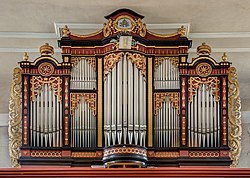
The pipe organ is a musical instrument that produces sound by driving pressurised air (called wind) through the organ pipes selected from a keyboard. Because each pipe produces a single tone and pitch, the pipes are provided in sets called ranks, each of which has a common timbre, loudness (volume), and construction throughout the keyboard compass. In other words, a rank is a set of pipes all having the same tonal quality, but having a range of different pitches. Most organs have many ranks of pipes of differing pitch, timbre, and volume that the player can employ singly or in combination through the use of controls called stops.
A pipe organ has one or more keyboards (called manuals) played by the hands, and most have a pedalboard played by the feet; each keyboard controls its own division (group of stops). The keyboard(s), pedalboard, and stops are housed in the organ's console. The organ's continuous supply of wind allows it to sustain notes for as long as the corresponding keys are pressed, unlike the piano and harpsichord whose sound begins to dissipate immediately after a key is depressed. The smallest portable pipe organs may have only one or two dozen pipes and one manual; the largest pipe organs can have over 33,000 pipes and seven manuals. A list of some of the most notable and largest pipe organs in the world can be viewed at List of pipe organs. A ranking of the largest organs in the world—based on the criterion constructed by Michał Szostak, i.e. 'the number of ranks and additional equipment managed from a single console'—can be found in the quarterly magazine The Organ and in the online journal Vox Humana. (Full article...)
![Image 1 The timpani (/ˈtɪmpəni/; Italian pronunciation: [ˈtimpani]) or kettledrums (also informally called timps) are musical instruments in the percussion family. A type of drum categorised as a hemispherical drum, they consist of a membrane called a head stretched over a large bowl traditionally made of copper. Thus, timpani are an example of kettledrums, also known as vessel drums and semispherical drums, whose body is similar to a section of a sphere whose cut conforms the head. Most modern timpani are pedal timpani and can be tuned quickly and accurately to specific pitches by skilled players through the use of a movable foot-pedal. They are played by striking the head with a specialized beater called a timpani stick or timpani mallet. Timpani evolved from military drums to become a staple of the classical orchestra by the last third of the 18th century. Today, they are used in many types of ensembles, including concert bands, marching bands, orchestras, and even in some rock bands. Timpani is an Italian plural, the singular of which is timpano, though the singular may also be referred to as a timpanum. In English, the term timpano is only widely used by practitioners: a single drum is often referred to as a timpani, leading many to incorrectly pluralize the word as timpanis. A musician who plays timpani is a timpanist. (Full article...)](/proxy/https://en.wikipedia.org/wiki/File:Blank.png)


_(14585145288).jpg)


.svg)

General images –
-
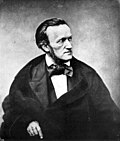 Richard Wagner in Paris, 1861
 -
 View of Vienna in 1758, by Bernardo Bellotto (from Classical period (music))
 -
 Claudio Monteverdi in 1640 (from Baroque music)
 -
 Wolfgang Amadeus Mozart, posthumous painting by Barbara Krafft in 1819 (from Classical period (music))
 -
-
 Wanderer above the Sea of Fog, by Caspar David Friedrich, is an example of Romantic painting. (from Romantic music)
 -
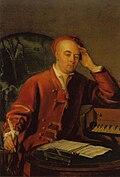
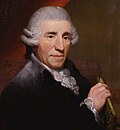 Haydn portrait by Thomas Hardy, 1792 (from Classical period (music))
 -
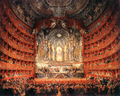 A large instrumental ensemble's performance in the lavish Teatro Argentina, as depicted by Panini (1747) (from Baroque music)
 -
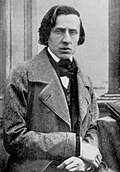 Daguerreotype of Chopin, c. 1849 (from Romantic music)
 -
 Balakirev (top), Cui (upper left), Mussorgsky (upper right), Rimsky-Korsakov (lower left), and Borodin (lower right). (from Romantic music)
 -
 Portrait of the Mozart Family, dated 1780–81 (from Classical period (music))
 -
 Gustav Mahler, photographed in 1907 by Moritz Nähr at the end of his period as director of the Vienna Hofoper (from Romantic music)
 -
 Bernhard Crusell, a Swedish-Finnish composer and clarinetist, in 1826 (from Classical period (music))
 -
 Gluck, detail of Portrait of Christoph Willibald Gluck by Joseph Duplessis, dated 1775 (Kunsthistorisches Museum, Vienna) (from Classical period (music))
 -
 1875 oil painting of Franz Schubert by Wilhelm August Rieder, after his own 1825 watercolor portrait (from Classical period (music))
 -
 An example of a guitar from the classical period. (from Classical period (music))
 -
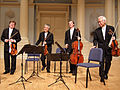 A modern string quartet. In the 2000s, string quartets from the Classical era are the core of the chamber music literature. From left to right: violin 1, violin 2, cello, viola (from Classical period (music))
 -
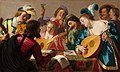 Gerard van Honthorst, The Concert (1623), National Gallery of Art, Washington D.C. (from Renaissance music)
 -
 Josef Danhauser's 1840 painting Liszt at the Piano featuring Franz Liszt at the piano surrounded by (from left to right) Alexandre Dumas, Hector Berlioz, George Sand, Niccolò Paganini, Gioachino Rossini and Marie d'Agoult, with a bust of Ludwig van Beethoven on the piano (from Romantic music)
 -
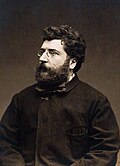 Bizet photographed by Étienne Carjat (1875) (from Romantic music)
 -
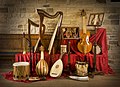 Selection of Renaissance instruments (from Renaissance music)
 -

-

-
 Musicians from 'Procession in honour of Our Lady of Sablon in Brussels.' Early 17th-century Flemish alta cappella. From left to right: bass dulcian, alto shawm, treble cornett, soprano shawm, alto shawm, tenor sackbut. (from Renaissance music)
 -
 Painting by Evaristo Baschenis of Baroque instruments, including a cittern, viola da gamba, violin, and two lutes (from Baroque music)
 -
 The opening bars of the Commendatore's aria in Mozart's opera Don Giovanni. The orchestra starts with a dissonant diminished seventh chord (G# dim7 with a B in the bass) moving to a dominant seventh chord (A7 with a C# in the bass) before resolving to the tonic chord (D minor) at the singer's entrance. (from Classical period (music))
 -
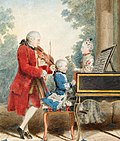 Wolfgang Amadeus Mozart, a representative composer of the Classical period, seated at a keyboard. (from Classical period (music))
 -
-
 Portion of Du Fay's setting of Ave maris stella, in fauxbourdon. The top line is a paraphrase of the chant; the middle line, designated "fauxbourdon", (not written) follows the top line but exactly a perfect fourth below. The bottom line is often, but not always, a sixth below the top line; it is embellished, and reaches cadences on the octave.Play (from Renaissance music)
 -
 Hummel in 1814 (from Classical period (music))
 -
 Franz Liszt in 1858, by Franz Hanfstaengl (from Romantic music)
 -
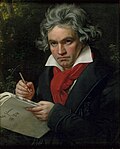 Portrait of Beethoven, 1820 (from Classical period (music))
 -

-
 Fortepiano by Paul McNulty after Walter & Sohn, c. 1805 (from Classical period (music))
 -


.jpg)


_Google_Art_Project.jpg)


Quotes –
| “ | Music is the one incorporeal entrance into the higher world of knowledge which comprehends mankind but which mankind cannot comprehend. | ” |
| — Ludwig van Beethoven | ||
Related portals


WikiProjects




 Selected composers –


-
Sir Michael Kemp Tippett (2 January 1905 – 8 January 1998) was an English composer who rose to prominence during and immediately after the Second World War. In his lifetime he was sometimes ranked with his contemporary Benjamin Britten as one of the leading British composers of the 20th century. Among his best-known works are the oratorio A Child of Our Time, the orchestral Fantasia Concertante on a Theme of Corelli, and the opera The Midsummer Marriage.
Tippett's talent developed slowly. He withdrew or destroyed his earliest compositions, and was 30 before any of his works were published. Until the mid-to-late 1950s his music was broadly lyrical in character, before changing to a more astringent and experimental style. New influences—including those of jazz and blues after his first visit to America in 1965—became increasingly evident in his compositions. While Tippett's stature with the public continued to grow, not all critics approved of these changes in style, some believing that the quality of his work suffered as a consequence. From around 1976 his late works began to reflect the works of his youth through a return to lyricism. Although he was much honoured in his lifetime, critical judgement on Tippett's legacy has been uneven, the greatest praise generally reserved for his earlier works. His centenary in 2005 was a muted affair; apart from the few best-known works, his music has not been performed frequently in the 21st century. (Full article...) -

Stockhausen in the Electronic Music Studio of the WDR, 1994
Karlheinz Stockhausen (German: [kaʁlˈhaɪnts ˈʃtɔkhaʊzn̩] ⓘ; 22 August 1928 – 5 December 2007) was a German composer, widely acknowledged by critics as one of the most important but also controversial composers of the 20th and early 21st centuries. He is known for his groundbreaking work in electronic music, having been called the "father of electronic music", for introducing controlled chance (aleatory techniques) into serial composition, and for musical spatialization.
Stockhausen was educated at the Hochschule für Musik Köln and the University of Cologne, later studying with Olivier Messiaen in Paris and with Werner Meyer-Eppler at the University of Bonn. As one of the leading figures of the Darmstadt School, his compositions and theories were and remain widely influential, not only on composers of art music, but also on jazz and popular music. His works, composed over a period of nearly sixty years, eschew traditional forms. In addition to electronic music – both with and without live performers – they range from miniatures for musical boxes through works for solo instruments, songs, chamber music, choral and orchestral music, to a cycle of seven full-length operas. His theoretical and other writings comprise ten large volumes. He received numerous prizes and distinctions for his compositions, recordings, and for the scores produced by his publishing company. (Full article...) -

Modern-day Kemah, Turkey, where the ancient city Ani-Kamakh was in which Khosrovidukht was imprisoned
Khosrovidukht (Armenian: Խոսրովիդուխտ, lit. 'daughter of Khosrov'; fl. early 8th century) was an Armenian hymnographer and poet who lived during the early 8th century. After her slightly earlier contemporary Sahakdukht, she is the first known woman of Armenian literature and music, and among the earliest woman composers in the history of music.
Daughter of the ruler of Goghtn, Khosrov Goghtnatsi, her father was killed and she was imprisoned in a fortress of Ani-Kamakh (modern-day Kemah) for twenty years. Her brother was imprisoned and eventually killed; Khosrovidukht's only surviving work, the sharakan (chant) "Zarmanali e indz" (More astonishing to me) was dedicated to him. Its authenticity has occasionally been doubted, with some scholars attributing it to Sahakdukht. The work did not enter the general repertory of sharakan liturgy but was eventually approved by the Armenian Church for religious use. (Full article...) -

Bizet photographed by Étienne Carjat (1875)
Georges Bizet (né Alexandre César Léopold Bizet; 25 October 1838 – 3 June 1875) was a French composer of the Romantic era. Best known for his operas in a career cut short by his early death, Bizet achieved few successes before his final work, Carmen, which has become one of the most popular and frequently performed works in the entire opera repertoire.
During a brilliant student career at the Conservatoire de Paris, Bizet won many prizes, including the prestigious Prix de Rome in 1857. He was recognised as an outstanding pianist, though he chose not to capitalise on this skill and rarely performed in public. Returning to Paris after almost three years in Italy, he found that the main Parisian opera theatres preferred the established classical repertoire to the works of newcomers. His keyboard and orchestral compositions were likewise largely ignored; as a result, his career stalled, and he earned his living mainly by arranging and transcribing the music of others. Restless for success, he began many theatrical projects during the 1860s, most of which were abandoned. Neither of his two operas that reached the stage in this time—Les pêcheurs de perles and La jolie fille de Perth—were immediately successful. (Full article...) -
Sergei Sergeyevich Prokofiev (27 April [O.S. 15 April] 1891 – 5 March 1953) was a Russian composer, pianist, and conductor who later worked in the Soviet Union. As the creator of acknowledged masterpieces across numerous music genres, he is regarded as one of the major composers of the 20th century. His works include such widely heard pieces as the March from The Love for Three Oranges, the suite Lieutenant Kijé, the ballet Romeo and Juliet—from which "Dance of the Knights" is taken—and Peter and the Wolf. Of the established forms and genres in which he worked, he created—excluding juvenilia—seven completed operas, seven symphonies, eight ballets, five piano concertos, two violin concertos, a cello concerto, a symphony-concerto for cello and orchestra, and nine completed piano sonatas.
A graduate of the Saint Petersburg Conservatory, Prokofiev initially made his name as an iconoclastic composer-pianist, achieving notoriety with a series of ferociously dissonant and virtuosic works for his instrument, including his first two piano concertos. In 1915, Prokofiev made a decisive break from the standard composer-pianist category with his orchestral Scythian Suite, compiled from music originally composed for a ballet commissioned by Sergei Diaghilev of the Ballets Russes. Diaghilev commissioned three further ballets from Prokofiev—Chout, Le pas d'acier and The Prodigal Son—which, at the time of their original production, all caused a sensation among both critics and colleagues. But Prokofiev's greatest interest was opera, and he composed several works in that genre, including The Gambler and The Fiery Angel. Prokofiev's one operatic success during his lifetime was The Love for Three Oranges, composed for the Chicago Opera and performed over the following decade in Europe and Russia. (Full article...) -
Garry Schyman is an American film, television, and video game music composer. He graduated from the University of Southern California with a degree in music composition in 1978, and began work in the television industry, writing music for television series such as Magnum, P.I. and The A-Team. By 1986, he was composing for movies such as Judgement and Hit List. At the request of a friend in 1993, he composed the music for the video game Voyeur, but after creating the music for two more games he left the industry, citing the low budgets and poor quality of video game music at the time. He continued to compose for film and television, only to return to video games for 2005's Destroy All Humans!. Finding that in his absence the quality and perceived importance of video game music had risen substantially, he has since composed for several games, writing the scores to BioShock and Dante's Inferno among others. He still composes for film however, his latest being Brush with Danger directed by young Indonesian director Livi Zheng. He has won numerous awards for his video game scores, including several "soundtrack of the year" awards. During his career, he has worked on over 25 television shows, 10 films, and 13 video games. (Full article...) -
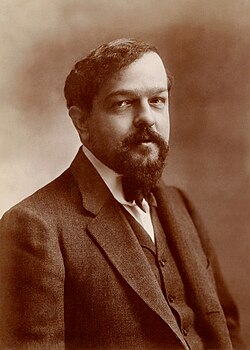 Debussy c. 1900 by Atelier Nadar
Achille Claude Debussy (French: [aʃil klod dəbysi]; 22 August 1862 – 25 March 1918) was a French composer, born in Saint-Germain-en-Laye. He is sometimes seen as the first Impressionist composer, although he vigorously rejected the term. He was among the most influential composers of the late 19th and early 20th centuries.
Born to a family of modest means and little cultural involvement, Debussy showed enough musical talent to be admitted at the age of ten to France's leading music college, the Conservatoire de Paris. He originally studied the piano, but found his vocation in innovative composition, despite the disapproval of the Conservatoire's conservative professors. He took many years to develop his mature style, and was nearly 40 when he achieved international fame in 1902 with the only opera he completed, Pelléas et Mélisande. (Full article...) -
Aram Ilyich Khachaturian (/ˈærəm ˌkɑːtʃəˈtʊəriən/; 6 June [O.S. 24 May] 1903 – 1 May 1978) was a Soviet Armenian composer and conductor. He is considered one of the leading Soviet composers.
Born and raised in Tbilisi (now the capital of Georgia), he moved to Moscow in 1921 following the Sovietization of the Caucasus. Without prior music training, he enrolled in the Gnessin Musical Institute, and subsequently studied at the Moscow Conservatory in the class of Nikolai Myaskovsky, among others. His first major work, the Piano Concerto (1936), popularized his name within and outside the Soviet Union. It was followed by the Violin Concerto (1940) and the Cello Concerto (1946). His other significant compositions include the Masquerade Suite (1941), the Anthem of the Armenian SSR (1944), three symphonies (1935, 1943, 1947), and around 25 film scores. Khachaturian is best known for his ballet music: Gayane (1942) and Spartacus (1954). His most popular piece, the "Sabre Dance" from Gayane, has been used extensively in popular culture and has been performed by a number of musicians worldwide. His style is "characterized by colorful harmonies, captivating rhythms, virtuosity, improvisations, and sensuous melodies". (Full article...) -
Leonard Joseph Tristano (March 19, 1919 – November 18, 1978) was an American jazz pianist, composer, arranger, and teacher of jazz improvisation.
Tristano studied for bachelor's and master's degrees in music in Chicago before moving to New York City in 1946. He played with leading bebop musicians and formed his own small bands, which soon displayed some of his early interests – contrapuntal interaction of instruments, harmonic flexibility, and rhythmic complexity. His quintet in 1949 recorded the first free group improvisations. Tristano's innovations continued in 1951, with the first overdubbed, improvised jazz recordings, and two years later, when he recorded an atonal improvised solo piano piece that was based on the development of motifs rather than on harmonies. He developed further via polyrhythms and chromaticism into the 1960s, but his music was infrequently recorded. (Full article...) -

A 1611 woodcut of Josquin des Prez, possibly copied from a now-lost oil painting made during his lifetime. There have been doubts concerning whether this depiction is an accurate likeness, see § Portraits.
Josquin Lebloitte dit des Prez (c. 1450–1455 – 27 August 1521) was a composer of Renaissance music, who is variously described as French or Franco-Flemish. Considered one of the greatest composers of the Renaissance, he was a central figure of the Franco-Flemish School and had a profound influence on the music of 16th-century Europe. Building on the work of his predecessors like Johannes Ockeghem, he developed a complex style of expressive—and often imitative—movement between independent voices (polyphony) which informs much of his work. He further emphasized the relationship between text and music, and departed from the early Renaissance tendency towards lengthy melismatic lines on a single syllable, preferring to use shorter, repeated motifs between voices. Josquin was a singer, and his compositions are mainly vocal. They include masses, motets and secular chansons.
Josquin's biography has been continually revised by modern scholarship. He was born somewhere in what is now northeastern France or Belgium and by 1477 he was in the choir of René of Anjou, later probably serving under Louis XI of France. In the 1480s Josquin traveled Italy with the Cardinal Ascanio Sforza, may have worked in Vienna for the Hungarian king Matthias Corvinus, and wrote the motet Ave Maria ... Virgo serena, and the popular chansons Adieu mes amours and Que vous ma dame. He served Pope Innocent VIII and Pope Alexander VI in Rome, Louis XII in France, and Ercole I d'Este in Ferrara. Many of his works were printed and published by Ottaviano Petrucci, including the Missa Hercules Dux Ferrariae. In his final years in Condé, Josquin produced some of his most admired works, including the motets Benedicta es, Inviolata, Pater noster–Ave Maria and Praeter rerum seriem, and the chansons Nimphes, nappés and Plus nulz regretz. (Full article...) -

Berlioz by August Prinzhofer, 1845
Louis-Hector Berlioz (11 December 1803 – 8 March 1869) was a French Romantic composer, conductor and critic. His output includes orchestral works such as the Symphonie fantastique and Harold in Italy, choral pieces including the Requiem and L'Enfance du Christ, his three operas Benvenuto Cellini, Les Troyens and Béatrice et Bénédict, and works of hybrid genres such as the "dramatic symphony" Roméo et Juliette and the "dramatic legend" La Damnation de Faust.
The elder son of a provincial physician, Berlioz was expected to follow his father into medicine, and he attended a Parisian medical college before defying his family by taking up music as a profession. His independence of mind and refusal to follow traditional rules and formulas put him at odds with the conservative musical establishment of Paris. He briefly moderated his style sufficiently to win France's premier music prize – the Prix de Rome – in 1830, but he learned little from the academics of the Paris Conservatoire. Opinion was divided for many years between those who thought him an original genius and those who viewed his music as lacking in form and coherence. (Full article...) -

Ravel in 1925
Joseph Maurice Ravel (7 March 1875 – 28 December 1937) was a French composer, pianist and conductor. He is often associated with Impressionism along with his elder contemporary Claude Debussy, although both composers rejected the term. In the 1920s and 1930s Ravel was internationally regarded as France's greatest living composer.
Born to a music-loving family, Ravel attended France's premier music college, the Paris Conservatoire; he was not well regarded by its conservative establishment, whose biased treatment of him caused a scandal. After leaving the conservatoire, Ravel found his own way as a composer, developing a style of great clarity and incorporating elements of modernism, baroque, neoclassicism and, in his later works, jazz. He liked to experiment with musical form, as in his best-known work, Boléro (1928), in which repetition takes the place of development. Renowned for his abilities in orchestration, Ravel made some orchestral arrangements of other composers' piano music, of which his 1922 version of Mussorgsky's Pictures at an Exhibition is the best known. (Full article...) -

Vaughan Williams c. 1920
Ralph Vaughan Williams (/ˌreɪf vɔːn ˈwɪljəmz/ ⓘ RAYF vawn WIL-yəmz; 12 October 1872 – 26 August 1958) was an English composer. His works include operas, ballets, chamber music, secular and religious vocal pieces and orchestral compositions including nine symphonies, written over sixty years. Strongly influenced by Tudor music and English folk-song, his output marked a decisive break in British music from its German-dominated style of the 19th century.
Vaughan Williams was born to a well-to-do family with strong moral views and a progressive social outlook. Throughout his life he sought to be of service to his fellow citizens, and believed in making music as available as possible to everybody. He wrote many works for amateur and student performance. He was musically a late developer, not finding his true voice until his late thirties; his studies in 1907–1908 with the French composer Maurice Ravel helped him clarify the textures of his music and free it from Teutonic influences. (Full article...) -
Leo Ornstein (born Lev Ornshteyn; Russian: Лев Орнштейн; c. December 11, 1895 – February 24, 2002) was an American experimental composer and pianist of the early twentieth century. His performances of works by avant-garde composers and his own innovative and even shocking pieces made him a cause célèbre on both sides of the Atlantic. The bulk of his experimental works were written for piano.
Ornstein was the first important composer to make extensive use of the tone cluster. As a pianist, he was considered a world-class talent. By the mid-1920s, he had walked away from his fame and soon disappeared from popular memory. Though he gave his last public concert before the age of forty, he continued writing music for another half-century and beyond. Largely forgotten for decades, he was rediscovered in the mid-1970s. Ornstein completed his eighth and final piano sonata in September 1990 at the age of ninety-four, making him the oldest published composer in history at the time (a mark since passed by Elliott Carter). (Full article...) -

Portrait of Mozart, aged 13, in Verona, 1770, attributed to Giambettino Cignaroli
Between 1769 and 1773, the young Wolfgang Amadeus Mozart and his father Leopold made three Italian journeys. The first, an extended tour of 15 months, was financed by performances for the nobility and by public concerts, and took in the most important Italian cities. The second and third journeys were to Milan, for Wolfgang to complete operas that had been commissioned there on the first visit. From the perspective of Wolfgang's musical development, the journeys were a considerable success, and his talents were recognised by honours which included a papal knighthood and memberships in leading philharmonic societies.
Leopold Mozart had been employed since 1747 as a musician in the Archbishop of Salzburg's court, becoming deputy Kapellmeister in 1763, but he had also devoted much time to Wolfgang's and his sister Nannerl's musical education. He took them on a European tour between 1763 and 1766, and spent some of 1767 and most of 1768 with them in the imperial capital, Vienna. The children's performances had captivated audiences, and the pair had made a considerable impression on European society. By 1769, Nannerl had reached adulthood, but Leopold was anxious to continue 13-year-old Wolfgang's education in Italy, a crucially important destination for any rising composer of the 18th century. (Full article...)


_(cropped).jpg)


.jpg)

Did you know (auto-generated) –

- ... that WFMT classical music radio host Don Tait owned such a large collection of recordings that he had to buy a house and have its floor reinforced to accommodate the weight?
- ... that opera singer Charles Holland spent much of his career in Europe as opportunities in classical music for African Americans were limited?
Selected image
-
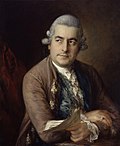 Painting: Thomas GainsboroughJohann Christian Bach (5 September 1735 – 1 January 1782) was a composer of the Classical era, the eighteenth child of Johann Sebastian Bach, and the youngest of his eleven sons. Bach was taught by his father and then, after the latter's death, by his half-brother C. P. E. Bach. Bach moved to Italy in 1754, and then to London in 1762, where he became known as the "London Bach". Bach's compositions include eleven operas, as well as chamber music, orchestral music and compositions for keyboard music. In 1764 Bach met Wolfgang Amadeus Mozart, who was eight at the time, and spent five months teaching him composition. He had considerable influence on Mozart, and was later described by scholars as his "only, true teacher".
This portrait of Bach was painted in 1776 by Thomas Gainsborough, as part of a collection started by Bach's former teacher Padre Martini. It now hangs in the National Portrait Gallery, London. -
 Photo: Guillaume PiolleThe anatomy of a Périnet piston valve, this one taken from a B♭ trumpet. When depressed, the valve diverts the air stream through additional tubing, thus lengthening the instrument and lowering the harmonic series on which the instrument is vibrating (i.e., it lowers the pitch). Trumpets generally use three valves, with some variations, such as a piccolo trumpet, having four. When used singly or in combination, the valves make the instrument fully chromatic, or capable of playing all twelve pitches of classical music. Trumpets may also use rotary valves instead.
 -
 Ballet is a formalized form of dance with its origins in the French court, further developed in France and Russia as a concert dance form.
 -
 Photo: W. J. Mayer; Restoration: Lise BroerA bust of the German composer and pianist Ludwig van Beethoven (1770–1827), made from his death mask. He was a crucial figure in the transitional period between the Classical and Romantic eras in Western classical music, and remains one of the most acclaimed and influential composers of all time. Born in Bonn, of the Electorate of Cologne and a part of the Holy Roman Empire of the German Nation in present-day Germany, he moved to Vienna in his early twenties and settled there, studying with Joseph Haydn and quickly gaining a reputation as a virtuoso pianist. His hearing began to deteriorate in the late 1790s, yet he continued to compose, conduct, and perform, even after becoming completely deaf.
 -
 Photograph credit: William P. Gottlieb; restored by Adam CuerdenBilly Strayhorn (November 29, 1915 – May 31, 1967) was an American jazz composer, pianist, lyricist, and arranger, best remembered for his long-time collaboration with bandleader and composer Duke Ellington that lasted nearly three decades. Though classical music was Strayhorn's first love, his ambition to become a classical composer went unrealized because of the harsh reality of a black man trying to make his way in the world of classical music, which at that time was almost completely white. He was introduced to the music of pianists like Art Tatum and Teddy Wilson at age 19, and the artistic influence of these musicians guided him into the realm of jazz, where he remained for the rest of his life. This photograph of Strayhorn was taken by William P. Gottlieb in the 1940s.
 -
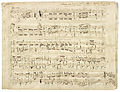 Sheet music for the Polonaise in A-flat major, Op. 53, a solo piano piece written by Frédéric Chopin in 1842. This work is one of Chopin's most admired compositions and has long been a favorite of the classical piano repertoire. The piece, which is very difficult, requires exceptional pianistic skills and great virtuosity to be interpreted. A typical performance of the polonaise lasts seven minutes.
 -
 Photograph credit: Eugène Pirou; restored by Adam CuerdenJules Massenet (12 May 1842 – 13 August 1912) was a French composer of the Romantic era, best known for his operas. Between 1867 and his death, he wrote more than forty stage works in a wide variety of styles, from opéra comique to grand depictions of classical myths, romantic comedies and lyric dramas, as well as oratorios, cantatas and ballets. Massenet had a good sense of the theatre and of what would succeed with the Parisian public. Despite some miscalculations, he produced a series of successes that made him the leading opera composer in France in the late 19th and early 20th centuries. By the time of his death, he was regarded as old-fashioned; his works, however, began to be favourably reassessed during the mid-20th century, and many have since been staged and recorded. This photograph of Massenet was taken by French photographer Eugène Pirou in 1875.
 -
 Stradivarius is one of the violins, violas, cellos and other string instruments built by members of the Italian Stradivari family, particularly Antonio Stradivari.
 -
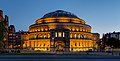 Photograph: David IliffThe Royal Albert Hall is a concert hall, seating a maximum of 5,272, on the northern edge of South Kensington, London. Constructed beginning in 1867, the hall was inaugurated on 29 March 1871. Since 1941 it has held The Proms, an eight-week summer season of daily orchestral classical music concerts and other events.
 -

A picture of the first theatre drawn shortly before it burned down in 1808.
The Royal Opera House is an opera house and major performing arts venue in the London district of Covent Garden. The large building, often referred to as simply "Covent Garden", is the home of The Royal Opera, The Royal Ballet and the Orchestra of the Royal Opera House. -
 The Teatro alla Scala (or La Scala, as it is known), in Milan, Italy, is one of the world's most famous opera houses. The theatre was inaugurated on 3 August 1778, under the name Nuovo Regio Ducal Teatro alla Scala with Salieri's Europa riconosciuta.


.jpg)


Topics
|
|
Things you can do
 |
Here are some tasks awaiting attention:
|
Categories

Associated Wikimedia
The following Wikimedia Foundation sister projects provide more on this subject:
-
 Commons
Free media repository -
 Wikidata
Free knowledge base -
 Wikiquote
Collection of quotations -
 Wikisource
Free-content library -
 Wikiversity
Free learning tools -
 Wiktionary
Dictionary and thesaurus


