Various recorders (second from the bottom disassembled into its three parts)
The recorder is a family of woodwindmusical instruments and a member of the family of duct flutes that includes tin whistles and flageolets. It is the most prominent duct flute in the western classical tradition. A recorder can be distinguished from other duct flutes by the presence of a thumb-hole for the upper hand and holes for seven fingers: three for the upper hand and four for the lower.
Recorders are made in various sizes and ranges. The sizes most commonly in use today are the soprano (also known as descant, lowest note C5), alto (also known as treble, lowest note F4), tenor (lowest note C4), and bass (lowest note F3). Recorders were traditionally constructed from wood or ivory. Modern professional instruments are wooden, often boxwood; student and scholastic recorders are commonly made of moulded plastic. The recorders' internal and external proportions vary, but the bore is generally reverse conical (i.e. tapering towards the foot) to cylindrical, and all recorder fingering systems make extensive use of forked fingerings. (Full article...)
Image 2
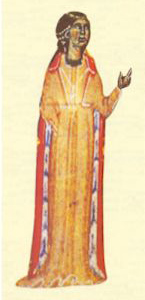
A medieval depiction of Comtessa de Diá The trobairitz (Occitan pronunciation:[tɾuβajˈɾits]) were Occitan female troubadours of the 12th and 13th centuries, active from around 1170 to approximately 1260. Trobairitz is both singular and plural.
The word trobairitz is first attested in the 13th-century romanceFlamenca. It comes from the Provençal word trobar, the literal meaning of which is "to find", and the technical meaning of which is "to compose". The word trobairitz is used very rarely in medieval Occitan, as it does not occur in lyrical poetry, grammatical treatises or in the biographies (vidas) of the trobairitz or troubadours. It does occur in the treatise Doctrina d'acort by Terramagnino da Pisa, written between 1282 and 1296. He uses it as an example of a word the plural and singular of which are the same. (Full article...)
Image 3
This harpsichord is the work of two celebrated makers: originally constructed by Andreas Ruckers in Antwerp (1646), it was later remodeled and expanded by Pascal Taskin in Paris (1780).
A harpsichord is a keyboard instrument that makes its sound by plucking a set of strings. In a harpsichord, depressing a key raises its back end within the instrument, which in turn lifts one or more jacks, each a thin strip of wood holding a small plectrum made from quill or plastic; each plectrum plucks a single string. The strings are under tension on a soundboard, which is mounted in a wooden case; the soundboard amplifies the vibrations from the strings so that the listeners can hear them. Harpsichord often include more than one choir of strings. Various devices are used to select which choir will sound when playing; these can include simple levers, or in more elaborate instruments the deployment of more than one keyboard.
The term denotes the whole family of similar plucked-keyboard instruments, including the smaller virginals, muselar, and spinet. The harpsichord was widely used in Renaissance and Baroque music, both for purposes of accompaniment and as a solo instrument. During the Baroque era, the harpsichord was a standard part of the continuo group. During the late 18th century, with the spread of the piano, the harpsichord gradually disappeared from the musical scene (except in opera, where it continued to be used to accompany recitative). In the 20th century, it made a resurgence, being used in historically informed performance of older music, in new compositions, and in certain styles of popular music. (Full article...)
Image 4
Historical instrumentsA musical instrument is a device created or adapted to make musical sounds. In principle, any object that produces sound can be considered a musical instrument—it is through purpose that the object becomes a musical instrument. A person who plays a musical instrument is known as an instrumentalist.
The history of musical instruments dates to the beginnings of human culture. Early musical instruments may have been used for rituals, such as a horn to signal success on the hunt, or a drum in a religious ceremony. Cultures eventually developed composition and performance of melodies for entertainment. Musical instruments evolved in step with changing applications and technologies. (Full article...)
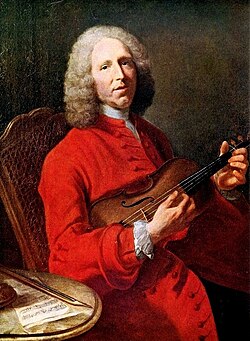
Little is known about Rameau's early years. It was not until the 1720s that he won fame as a major theorist of music with his Treatise on Harmony (1722) and also in the following years as a composer of masterpieces for the harpsichord, which circulated throughout Europe. He was almost 50 before he embarked on the operatic career on which his reputation chiefly rests today. His debut, Hippolyte et Aricie (1733), caused a great stir and was fiercely attacked by the supporters of Lully's style of music for its revolutionary use of harmony. (Full article...)
Image 7
Evensong rehearsal by Blue Coat CE School Choir, Coventry, in the quire of York Minster, showing carved choirstalls A choir (/kwaɪər/KWIRE), also known as a chorale or chorus (from Latin chorus, meaning 'a dance in a circle'), is a musical ensemble of singers. Choral music, in turn, is the music written specifically for such an ensemble to perform or in other words is the music performed by the ensemble. Choirs may perform music from the classical music repertoire, which spans from the medieval era to the present, or popular music repertoire. Most choirs are led by a conductor, who leads the performances with arm, hand, and facial gestures.
The term choir is very often applied to groups affiliated with a church (whether or not they actually occupy the quire), whereas a chorus performs in theatres or concert halls, but this distinction is not rigid. Choirs may sing without instruments, or accompanied by a piano, accordion, pipe organ, a small ensemble, or an orchestra. (Full article...)
Image 8
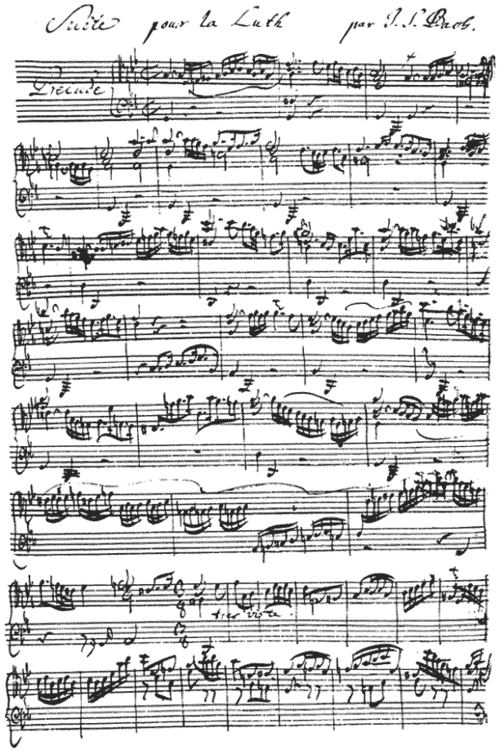
Hand-written musical notation by J. S. Bach (1685–1750). This is the beginning of the Prelude from the Suite for Lute in G minor, BWV 995 (transcription of Cello Suite No. 5 in C minor, BWV 1011). Musical notation is any system used to visually represent music. Systems of notation generally represent the elements of a piece of music that are considered important for its performance in the context of a given musical tradition. The process of interpreting musical notation is often referred to as reading music.
Distinct methods of notation have been invented throughout history by various cultures. Much information about ancient music notation is fragmentary. Even in the same time frames, different styles of music and different cultures use different music notation methods. (Full article...)
Image 9
Performance on period instruments is a key aspect of HIP, such as this baroque orchestra (Photo: Josetxu Obregón and the Spanish ensemble La Ritirata, 2013). Historically informed performance (also referred to as period performance, authentic performance, or HIP) is an approach to the performance of classical music which aims to be faithful to the approach, manner and style of the musical era in which a work was originally conceived.
It is based on two key aspects: the application of the stylistic and technical aspects of performance, known as performance practice; and the use of period instruments which may be reproductions of historical instruments that were in use at the time of the original composition, and which usually have different timbre and temperament from their modern equivalents. A further area of study, that of changing listener expectations, is increasingly under investigation. (Full article...)
Image 10
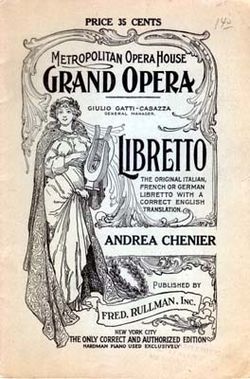
Cover of a 1921 libretto for Giordano's Andrea Chénier A libretto (from the Italian word libretto, lit.'booklet') is the text used in, or intended for, an extended musical work such as an opera, operetta, masque, oratorio, cantata or musical. The term libretto is also sometimes used to refer to the story line of a ballet or the texts of major liturgical works, such as the Mass, requiem, or sacred cantata.
The Italian word libretto (pronounced[liˈbretto], plurallibretti[liˈbretti]) is the diminutive of the word libro ("book"). Sometimes other-language equivalents are used for libretti in that language, livret for French works, Textbuch for German and libreto for Spanish. A libretto is distinct from a synopsis or scenario of the plot, in that the libretto contains all the words and stage directions, while a synopsis summarizes the plot. Some ballet historians also use the word libretto to refer to the 15- to 40-page books which were on sale to 19th century ballet audiences in Paris and contained a very detailed description of the ballet's story, scene by scene. (Full article...)
Clarinets comprise a family of instruments of differing sizes and pitches. The clarinet family is the largest woodwind family, ranging from the BB♭ contrabass to the A♭ piccolo. The B♭soprano clarinet is the most common type, and is the instrument usually indicated by the word "clarinet". (Full article...)
Image 3Portion of Du Fay's setting of Ave maris stella, in fauxbourdon. The top line is a paraphrase of the chant; the middle line, designated "fauxbourdon", (not written) follows the top line but exactly a perfect fourth below. The bottom line is often, but not always, a sixth below the top line; it is embellished, and reaches cadences on the octave.Play (from Renaissance music)
Image 12Musicians from 'Procession in honour of Our Lady of Sablon in Brussels.' Early 17th-century Flemish alta cappella. From left to right: bass dulcian, alto shawm, treble cornett, soprano shawm, alto shawm, tenor sackbut. (from Renaissance music)
Image 31A modern string quartet. In the 2000s, string quartets from the Classical era are the core of the chamber music literature. From left to right: violin 1, violin 2, cello, viola. (from Classical period (music))
Entries here consist of Good and Featured articles, which meet a core set of high editorial standards.
Image 1
Janáček in 1914
Leoš Janáček (Czech:[ˈlɛoʃˈjanaːtʃɛk]ⓘ; 3 July 1854 – 12 August 1928) was a Czech composer, music theorist, folklorist, publicist and teacher. He was inspired by Moravian and other Slavic music, including Eastern European folk music, to create an original, modern musical style.
Born in Hukvaldy, Janáček demonstrated musical talent at an early age and was educated in Brno, Prague, Leipzig, and Vienna. He then returned to live in Brno, where he married his pupil Zdenka Schulzová and devoted himself mainly to folkloristic research. His earlier musical output was influenced by contemporaries such as Antonín Dvořák, but around the turn of the century he began to incorporate his earlier studies of national folk music, as well as his transcriptions of "speech melodies" of spoken language, to create a modern, highly original synthesis. The death of his daughter Olga in 1903 had a profound effect on his musical output; these notable transformations were first evident in the opera Jenůfa (often called the "Moravian national opera"), which premiered in 1904 in Brno. (Full article...)
Image 2
Valerie Muriel Rodway (February 12, 1919 – August 1970) was a Guyanese composer of cultural and patriotic songs, inspired by the events leading up to Guyana's independence in 1966. She is best known for composing music to accompany Guyana national poetry, like Arise, Guyana, Kanaïma, and the Martin Carter's Guyanese Independence poem Let Freedom Awaken. For the next two decades, school children were taught the songs she and others composed to inspire patriotism and cultural affinity. She selected the poetry for her compositions based upon her principles and values, first developed among her parents and siblings.
She has been considered Guyana's greatest composer of patriotic and national music, and among the best composers from Guyana of the 20th century, generally and among composers of classical music. She was awarded the Wordsworth McAndrew Awardposthumously in 2002. In 2019, she was awarded the Cacique Crown of Honor, one of the highest honors of Guyana. The National Trust of Guyana building in Cummingsburg, Georgetown, has been renamed the Valerie Rodway House in her honor. (Full article...)
Image 3
The Garni valley, where Sahakdukht spent much of her life as an ascetic living in a cave.
Sahakdukht (Armenian: Սահակադուխտ, lit.'daughter of Sahak'; fl. early 8th century) was an Armenian hymnographer, poet and pedagogue who lived during the early 8th century. She is the first known woman of Armenian literature and music. Along with her slightly later contemporary Khosrovidukht, she is among the earliest woman composers in history.
Sahakdukht and her brother Stepanos Siunetsi [hy], who became a noted composer and music theorist, were educated in Dvin. She then spent her life as an ascetic, living in a cave (a grotto) of the Garni valley where she wrote and taught music. Though she is said to have written much Christian music, particularly for the Virgin Mary, only a single sharakan (canonical hymn) survives, the acrostic "Srbuhi Mariam" ("Saint Mary"). The work shows considerable stylistic connections to contemporaneous Byzantine theotokions and kanons. Though her piece did not join the general sharakan liturgy, Sahakdukht's oeuvre as a whole is thought to have exerted considerable influence on subsequent sharakans; they introduced certain phrases into popular use and according to ethnomusicologist Şahan Arzruni they "helped to shape the development of the genre during subsequent centuries". (Full article...)
Image 4
Philip Arnold Heseltine (30 October 1894 – 17 December 1930), known by the pseudonymPeter Warlock, was a British composer and music critic. The Warlock name, which reflects Heseltine's interest in occult practices, was used for all his published musical works. He is best known as a composer of songs and other vocal music; he also achieved notoriety in his lifetime through his unconventional and often scandalous lifestyle.
As a schoolboy at Eton College, Heseltine met the British composer Frederick Delius, with whom he formed a close friendship. After a failed student career in Oxford and London, Heseltine turned to musical journalism, while developing interests in folk-song and Elizabethan music. His first serious compositions date from around 1915. Following a period of inactivity, a positive and lasting influence on his work arose from his meeting in 1916 with the Dutch composer Bernard van Dieren; he also gained creative impetus from a year spent in Ireland, studying Celtic culture and language. On his return to England in 1918, Heseltine began composing songs in a distinctive, original style, while building a reputation as a combative and controversial music critic. During 1920–21 he edited the music magazine The Sackbut. His most prolific period as a composer came in the 1920s, when he lived first in Wales and later at Eynsford in Kent. (Full article...)
Image 5
Tristano, c. August 1947
Leonard Joseph Tristano (March 19, 1919 – November 18, 1978) was an American jazz pianist, composer, arranger, and teacher of jazz improvisation.
Tristano studied for bachelor's and master's degrees in music in Chicago before moving to New York City in 1946. He played with leading bebop musicians and formed his own small bands, which soon displayed some of his early interests – contrapuntal interaction of instruments, harmonic flexibility, and rhythmic complexity. His quintet in 1949 recorded the first free group improvisations. Tristano's innovations continued in 1951, with the first overdubbed, improvised jazz recordings, and two years later, when he recorded an atonal improvised solo piano piece that was based on the development of motifs rather than on harmonies. He developed further via polyrhythms and chromaticism into the 1960s, but his music was infrequently recorded. (Full article...)
Image 6
Shostakovich in 1942
Dmitri Dmitriyevich Shostakovich (25 September [O.S. 12 September] 1906 – 9 August 1975) was a Soviet-era Russian composer and pianist who became internationally known after the premiere of his First Symphony in 1926 and thereafter was regarded as a major composer.
Nobuo Uematsu (植松 伸夫, Uematsu Nobuo; born March 21, 1959) is a Japanese composer and keyboardist best known for his contributions to the Final Fantasy video game series by Square Enix. A self-taught musician, he began playing the piano at the age of twelve. Uematsu joined Square in 1986, where he first met Final Fantasy creator Hironobu Sakaguchi. The two later worked together on many games at the company, most notably in the Final Fantasy series. After nearly two decades with Square, Uematsu left in 2004 to create his own production company and music label, Dog Ear Records. He has since composed music as a freelancer for other games, including ones developed by Square Enix and Sakaguchi's studio Mistwalker.
Many soundtracks and arranged albums of Uematsu's game scores have been released. Pieces from his video game works have been performed in various Final Fantasy concerts, where he has worked with conductor Arnie Roth and Game Concerts producer Thomas Böcker on several of these performances. Uematsu was also the keyboardist in The Black Mages in the 2000s, which played various hard rock versions of his Final Fantasy compositions. He has since performed with the Earthbound Papas, which he formed as the successor to The Black Mages in 2011. Uematsu has made several listings in Britain's Classic FM Hall of Fame, with the station referring to him as the Beethoven of game music. (Full article...)
Born in Montbrison, in the Loire department of France, the son of an engineer, Boulez studied at the Conservatoire de Paris with Olivier Messiaen, and privately with Andrée Vaurabourg and René Leibowitz. He began his professional career in the late 1940s as music director of the Renaud-Barrault theatre company in Paris. He was a leading figure in avant-garde music, playing an important role in the development of integral serialism in the 1950s, controlled chance music in the 1960s and the electronic transformation of instrumental music in real time from the 1970s onwards. His tendency to revise earlier compositions meant that his body of work was relatively small, but it included pieces considered landmarks of twentieth-century music, such as Le Marteau sans maître, Pli selon pli and Répons. His uncompromising commitment to modernism and the trenchant, polemical tone in which he expressed his views on music led some to criticise him as a dogmatist. (Full article...)
Born and raised in Tbilisi (now the capital of Georgia), he moved to Moscow in 1921 following the Sovietization of the Caucasus. Without prior music training, he enrolled in the Gnessin Musical Institute, and subsequently studied at the Moscow Conservatory in the class of Nikolai Myaskovsky, among others. His first major work, the Piano Concerto (1936), popularized his name within and outside the Soviet Union. It was followed by the Violin Concerto (1940) and the Cello Concerto (1946). His other significant compositions include the Masquerade Suite (1941), the Anthem of the Armenian SSR (1944), three symphonies (1935, 1943, 1947), and around 25 film scores. Khachaturian is best known for his ballet music: Gayane (1942) and Spartacus (1954). His most popular piece, the "Sabre Dance" from Gayane, has been used extensively in popular culture and has been performed by a number of musicians worldwide. His style is "characterized by colorful harmonies, captivating rhythms, virtuosity, improvisations, and sensuous melodies". (Full article...)
Image 10
Alan Dudley Bush (22 December 1900 – 31 October 1995) was a British composer, pianist, conductor, teacher and political activist. A committed communist, his uncompromising political beliefs were often reflected in his music. He composed prolifically across a range of genres but struggled through his lifetime for recognition from the British musical establishment, which largely ignored his works.
From a prosperous middle-class background, Bush enjoyed considerable success as a student at the Royal Academy of Music (RAM) in the early 1920s and spent much of the decade furthering his compositional and piano-playing skills under distinguished tutors. A two-year period in Berlin from 1929 to 1931, early in the Nazi Party's rise to power, cemented Bush's political convictions and moved him from the mainstream Labour Party to the Communist Party of Great Britain, which he joined in 1935. He wrote several large-scale works in the 1930s and was heavily involved with workers' choirs, for whom he composed pageants, choruses and songs. His pro-Soviet stance led to the BBC temporarily banning his music in the early years of the Second World War, and his refusal to modify his position in the postwar Cold War era led to a more prolonged semi-ostracism of his music. As a result, the four major operas he wrote between 1950 and 1970 were all premiered in East Germany. (Full article...)
F. Andrieu (fl. late 14th century; possibly François or Franciscus Andrieu) was a French composer in the ars nova style of late medieval music. Nothing is known for certain about him except that he wrote Armes, amours/O flour des flours (Weapons, loves/O flower of flowers), a double balladedéploration, for the death of Guillaume de Machaut in 1377. The work has been widely praised and analyzed; it is notable for being one of two extant medieval double ballades for four voices, the only known contemporary musical setting of Eustache Deschamps and the earliest representative of the longstanding medieval and Renaissance lamentation tradition between composers.
Andrieu may be the same person as Magister Franciscus, although the scholarly consensus on this identification is unclear. With P. des Molins, Jehan Vaillant and Grimace, Andrieu was one of the "post-Machaut" generation whose pieces retain enough ars nova qualities to be differentiated from composers of ars subtilior. (Full article...)
Image 12
Delius, photographed in 1907
Frederick Theodore Albert Delius (born Fritz Theodor Albert Delius; /ˈdiːliəs/; 29 January 1862 – 10 June 1934) was an English composer. Born in Bradford in the north of England to a prosperous mercantile family, he resisted attempts to recruit him to commerce. He was sent to Florida in the United States in 1884 to manage an orange plantation. He soon neglected his managerial duties, and in 1886 returned to Europe.
Having been influenced by African-American music during his short stay in Florida, he began composing. After a brief period of formal musical study in Germany beginning in 1886, he embarked on a full-time career as a composer in Paris and then in nearby Grez-sur-Loing, where he and his wife Jelka lived for the rest of their lives, except during the First World War. (Full article...)
Image 13
Jane Marian Joseph (31 May 1894 – 9 March 1929) was an English composer, arranger, and music teacher. She was a pupil and later associate of the composer Gustav Holst, and was instrumental in the organisation and management of various of the music festivals which Holst sponsored. Many of her works were composed for performance at these festivals and similar occasions. Her early death at age 34, which prevented the full realisation of her talents, was considered by her contemporaries as a considerable loss to English music.
Holst first observed Joseph's potential when he was teaching her composition at St Paul's Girls' School. She began to act as his amanuensis in 1914, when he was composing The Planets, her special responsibility being the preparation of the score for the "Neptune" movement. She continued to assist Holst with transcriptions, arrangements and translations, and was his librettist for the choral ballet The Golden Goose. (Full article...)
The elder son of a provincial physician, Berlioz was expected to follow his father into medicine, and he attended a Parisian medical college before defying his family by taking up music as a profession. His independence of mind and refusal to follow traditional rules and formulas put him at odds with the conservative musical establishment of Paris. He briefly moderated his style sufficiently to win France's premier music prize – the Prix de Rome – in 1830, but he learned little from the academics of the Paris Conservatoire. Opinion was divided for many years between those who thought him an original genius and those who viewed his music as lacking in form and coherence. (Full article...)
Born in Lancashire, the son of a classical musician, Walton was a chorister and then an undergraduate at Christ Church, Oxford. On leaving the university, he was taken up by the literary Sitwell siblings, who provided him with a home and a cultural education. His earliest work of note was a collaboration with Edith Sitwell, Façade, which at first brought him notoriety as a modernist, but later became a popular ballet score. (Full article...)
... that WFMT classical music radio host Don Tait owned such a large collection of recordings that he had to buy a house and have its floor reinforced to accommodate the weight?
... that opera singer Charles Holland spent much of his career in Europe as opportunities in classical music for African Americans were limited?
Selected image
Image 1
Stradivarius is one of the violins, violas, cellos and other string instruments built by members of the Italian Stradivari family, particularly Antonio Stradivari.
The anatomy of a Périnet piston valve, this one taken from a B♭trumpet. When depressed, the valve diverts the air stream through additional tubing, thus lengthening the instrument and lowering the harmonic series on which the instrument is vibrating (i.e., it lowers the pitch). Trumpets generally use three valves, with some variations, such as a piccolo trumpet, having four. When used singly or in combination, the valves make the instrument fully chromatic, or capable of playing all twelve pitches of classical music. Trumpets may also use rotary valves instead.
Billy Strayhorn (November 29, 1915 – May 31, 1967) was an American jazz composer, pianist, lyricist, and arranger, best remembered for his long-time collaboration with bandleader and composer Duke Ellington that lasted nearly three decades. Though classical music was Strayhorn's first love, his ambition to become a classical composer went unrealized because of the harsh reality of a black man trying to make his way in the world of classical music, which at that time was almost completely white. He was introduced to the music of pianists like Art Tatum and Teddy Wilson at age 19, and the artistic influence of these musicians guided him into the realm of jazz, where he remained for the rest of his life. This photograph of Strayhorn was taken by William P. Gottlieb in the 1940s.
Sheet music for the Polonaise in A-flat major, Op. 53, a solo piano piece written by Frédéric Chopin in 1842. This work is one of Chopin's most admired compositions and has long been a favorite of the classical piano repertoire. The piece, which is very difficult, requires exceptional pianistic skills and great virtuosity to be interpreted. A typical performance of the polonaise lasts seven minutes.
Jules Massenet (12 May 1842 – 13 August 1912) was a French composer of the Romantic era, best known for his operas. Between 1867 and his death, he wrote more than forty stage works in a wide variety of styles, from opéra comique to grand depictions of classical myths, romantic comedies and lyric dramas, as well as oratorios, cantatas and ballets. Massenet had a good sense of the theatre and of what would succeed with the Parisian public. Despite some miscalculations, he produced a series of successes that made him the leading opera composer in France in the late 19th and early 20th centuries. By the time of his death, he was regarded as old-fashioned; his works, however, began to be favourably reassessed during the mid-20th century, and many have since been staged and recorded. This photograph of Massenet was taken by French photographer Eugène Pirou in 1875.
The Royal Albert Hall is a concert hall, seating a maximum of 5,272, on the northern edge of South Kensington, London. Constructed beginning in 1867, the hall was inaugurated on 29 March 1871. Since 1941 it has held The Proms, an eight-week summer season of daily orchestral classical music concerts and other events.
Johann Christian Bach (5 September 1735 – 1 January 1782) was a composer of the Classical era, the eighteenth child of Johann Sebastian Bach, and the youngest of his eleven sons. Bach was taught by his father and then, after the latter's death, by his half-brother C. P. E. Bach. Bach moved to Italy in 1754, and then to London in 1762, where he became known as the "London Bach". Bach's compositions include eleven operas, as well as chamber music, orchestral music and compositions for keyboard music. In 1764 Bach met Wolfgang Amadeus Mozart, who was eight at the time, and spent five months teaching him composition. He had considerable influence on Mozart, and was later described by scholars as his "only, true teacher".











_-_001.jpg)


 1875 oil painting of Franz Schubert by Wilhelm August Rieder, after his own 1825 watercolor portrait (from Classical period (music))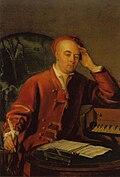
 Portion of Du Fay's setting of Ave maris stella, in fauxbourdon. The top line is a paraphrase of the chant; the middle line, designated "fauxbourdon", (not written) follows the top line but exactly a perfect fourth below. The bottom line is often, but not always, a sixth below the top line; it is embellished, and reaches cadences on the octave.Play (from Renaissance music)
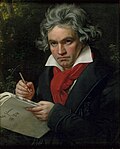 Portrait of Beethoven, 1820 (from Classical period (music))
 Hummel in 1814 (from Classical period (music))
 Gluck, detail of Portrait of Christoph Willibald Gluck by Joseph Duplessis, dated 1775 (Kunsthistorisches Museum, Vienna) (from Classical period (music))
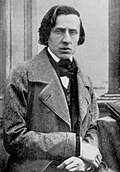 Daguerreotype of Chopin, c. 1849 (from Romantic music)
 Portrait of the Mozart Family, dated 1780–81 (from Classical period (music))
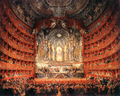 A large instrumental ensemble's performance in the lavish Teatro Argentina, as depicted by Panini (1747) (from Baroque music)
 Painting by Evaristo Baschenis of Baroque instruments, including a cittern, viola da gamba, violin, and two lutes (from Baroque music)
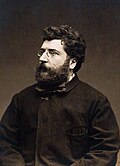 Bizet photographed by Étienne Carjat (1875) (from Romantic music)
 Musicians from 'Procession in honour of Our Lady of Sablon in Brussels.' Early 17th-century Flemish alta cappella. From left to right: bass dulcian, alto shawm, treble cornett, soprano shawm, alto shawm, tenor sackbut. (from Renaissance music)
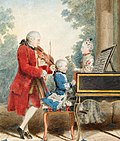 Wolfgang Amadeus Mozart, a representative composer of the Classical period, seated at a keyboard (from Classical period (music))
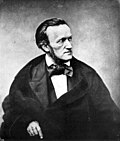 Richard Wagner in Paris, 1861
 Wolfgang Amadeus Mozart, posthumous painting by Barbara Krafft in 1819 (from Classical period (music))
 Fortepiano by Paul McNulty after Walter & Sohn, c. 1805 (from Classical period (music))
 An example of a guitar from the classical period (from Classical period (music))
 Gustav Mahler, photographed in 1907 by Moritz Nähr at the end of his period as director of the Vienna Hofoper (from Romantic music)
 Wanderer above the Sea of Fog, by Caspar David Friedrich, is an example of Romantic painting. (from Romantic music)
 Franz Liszt in 1858, by Franz Hanfstaengl (from Romantic music)
 Balakirev (top), Cui (upper left), Mussorgsky (upper right), Rimsky-Korsakov (lower left), and Borodin (lower right). (from Romantic music)
 Claudio Monteverdi in 1640 (from Baroque music)
 Bernhard Crusell, a Swedish-Finnish composer and clarinetist, in 1826 (from Classical period (music))
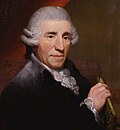 Haydn portrait by Thomas Hardy, 1792 (from Classical period (music))
 The opening bars of the Commendatore's aria in Mozart's opera Don Giovanni. The orchestra starts with a dissonant diminished seventh chord (G# dim7 with a B in the bass) moving to a dominant seventh chord (A7 with a C# in the bass) before resolving to the tonic chord (D minor) at the singer's entrance. (from Classical period (music))
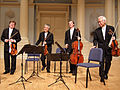 A modern string quartet. In the 2000s, string quartets from the Classical era are the core of the chamber music literature. From left to right: violin 1, violin 2, cello, viola. (from Classical period (music))
 Josef Danhauser's 1840 painting Liszt at the Piano featuring Franz Liszt at the piano surrounded by (from left to right) Alexandre Dumas, Hector Berlioz, George Sand, Niccolò Paganini, Gioachino Rossini and Marie d'Agoult, with a bust of Ludwig van Beethoven on the piano (from Romantic music)
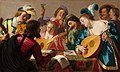 Gerard van Honthorst, The Concert (1623), National Gallery of Art, Washington D.C. (from Renaissance music)
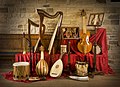 Selection of Renaissance instruments (from Renaissance music)
 View of Vienna in 1758, by Bernardo Bellotto (from Classical period (music))


_Google_Art_Project.jpg)


.jpg)




 Selected composers –


_(cropped).jpg)


.jpg)


.jpg)

.jpg)

 Stradivarius is one of the violins, violas, cellos and other string instruments built by members of the Italian Stradivari family, particularly Antonio Stradivari.
 Photo: Guillaume PiolleThe anatomy of a Périnet piston valve, this one taken from a B♭ trumpet. When depressed, the valve diverts the air stream through additional tubing, thus lengthening the instrument and lowering the harmonic series on which the instrument is vibrating (i.e., it lowers the pitch). Trumpets generally use three valves, with some variations, such as a piccolo trumpet, having four. When used singly or in combination, the valves make the instrument fully chromatic, or capable of playing all twelve pitches of classical music. Trumpets may also use rotary valves instead.
 Photograph credit: William P. Gottlieb; restored by Adam CuerdenBilly Strayhorn (November 29, 1915 – May 31, 1967) was an American jazz composer, pianist, lyricist, and arranger, best remembered for his long-time collaboration with bandleader and composer Duke Ellington that lasted nearly three decades. Though classical music was Strayhorn's first love, his ambition to become a classical composer went unrealized because of the harsh reality of a black man trying to make his way in the world of classical music, which at that time was almost completely white. He was introduced to the music of pianists like Art Tatum and Teddy Wilson at age 19, and the artistic influence of these musicians guided him into the realm of jazz, where he remained for the rest of his life. This photograph of Strayhorn was taken by William P. Gottlieb in the 1940s.
 The Teatro alla Scala (or La Scala, as it is known), in Milan, Italy, is one of the world's most famous opera houses. The theatre was inaugurated on 3 August 1778, under the name Nuovo Regio Ducal Teatro alla Scala with Salieri's Europa riconosciuta.
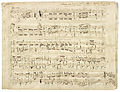 Sheet music for the Polonaise in A-flat major, Op. 53, a solo piano piece written by Frédéric Chopin in 1842. This work is one of Chopin's most admired compositions and has long been a favorite of the classical piano repertoire. The piece, which is very difficult, requires exceptional pianistic skills and great virtuosity to be interpreted. A typical performance of the polonaise lasts seven minutes.
 Photograph credit: Eugène Pirou; restored by Adam CuerdenJules Massenet (12 May 1842 – 13 August 1912) was a French composer of the Romantic era, best known for his operas. Between 1867 and his death, he wrote more than forty stage works in a wide variety of styles, from opéra comique to grand depictions of classical myths, romantic comedies and lyric dramas, as well as oratorios, cantatas and ballets. Massenet had a good sense of the theatre and of what would succeed with the Parisian public. Despite some miscalculations, he produced a series of successes that made him the leading opera composer in France in the late 19th and early 20th centuries. By the time of his death, he was regarded as old-fashioned; his works, however, began to be favourably reassessed during the mid-20th century, and many have since been staged and recorded. This photograph of Massenet was taken by French photographer Eugène Pirou in 1875.
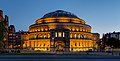 Photograph: David IliffThe Royal Albert Hall is a concert hall, seating a maximum of 5,272, on the northern edge of South Kensington, London. Constructed beginning in 1867, the hall was inaugurated on 29 March 1871. Since 1941 it has held The Proms, an eight-week summer season of daily orchestral classical music concerts and other events.
 Photo: W. J. Mayer; Restoration: Lise BroerA bust of the German composer and pianist Ludwig van Beethoven (1770–1827), made from his death mask. He was a crucial figure in the transitional period between the Classical and Romantic eras in Western classical music, and remains one of the most acclaimed and influential composers of all time. Born in Bonn, of the Electorate of Cologne and a part of the Holy Roman Empire of the German Nation in present-day Germany, he moved to Vienna in his early twenties and settled there, studying with Joseph Haydn and quickly gaining a reputation as a virtuoso pianist. His hearing began to deteriorate in the late 1790s, yet he continued to compose, conduct, and perform, even after becoming completely deaf.
 Ballet is a formalized form of dance with its origins in the French court, further developed in France and Russia as a concert dance form.
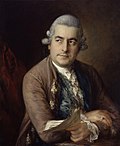 Painting: Thomas GainsboroughJohann Christian Bach (5 September 1735 – 1 January 1782) was a composer of the Classical era, the eighteenth child of Johann Sebastian Bach, and the youngest of his eleven sons. Bach was taught by his father and then, after the latter's death, by his half-brother C. P. E. Bach. Bach moved to Italy in 1754, and then to London in 1762, where he became known as the "London Bach". Bach's compositions include eleven operas, as well as chamber music, orchestral music and compositions for keyboard music. In 1764 Bach met Wolfgang Amadeus Mozart, who was eight at the time, and spent five months teaching him composition. He had considerable influence on Mozart, and was later described by scholars as his "only, true teacher".

.jpg)


 Commons
 Wikidata
 Wikiquote
 Wikisource
 Wikiversity
 Wiktionary


