


Portal:Amphibians

The Amphibian Portal


Amphibians are ectothermic, anamniotic, four-limbed vertebrate animals that constitute the class Amphibia. In its broadest sense, it is a paraphyletic group encompassing all tetrapods, but excluding the amniotes (tetrapods with an amniotic membrane, such as modern reptiles, birds and mammals). All extant (living) amphibians belong to the monophyletic subclass Lissamphibia, with three living orders: Anura (frogs and toads), Urodela (salamanders), and Gymnophiona (caecilians). Evolved to be mostly semiaquatic, amphibians have adapted to inhabit a wide variety of habitats, with most species living in freshwater, wetland or terrestrial ecosystems (such as riparian woodland, fossorial and even arboreal habitats). Their life cycle typically starts out as aquatic larvae with gills known as tadpoles, but some species have developed behavioural adaptations to bypass this.
Young amphibians generally undergo metamorphosis from an aquatic larval form with gills to an air-breathing adult form with lungs. Amphibians use their skin as a secondary respiratory interface, and some small terrestrial salamanders and frogs even lack lungs and rely entirely on their skin. They are superficially similar to reptiles like lizards, but unlike reptiles and other amniotes, require access to water bodies to breed. With their complex reproductive needs and permeable skins, amphibians are often ecological indicators to habitat conditions; in recent decades there has been a dramatic decline in amphibian populations for many species around the globe.
Contrary to a common misconception, adult amphibians generally cannot breathe underwater. Wildlife hospitals report that a frequent mistake made by people who bring frogs and toads for treatment is placing them in water-filled aquaria without providing a means of exit. As a result, they may drown. (Full article...)
Selected frog article

The Calyptocephalellidae are a family of toads (although not true members of the Bufonidae) found in Chile containing two living genera, Calyptocephalella and Telmatobufo.
The genus Calyptocephalella contains one living species, the helmeted water toad (C. gayi), which is very large and mostly aquatic. The genus Telmatobufo contains four species, T. australis, T. bullocki, T. ignotus, and T. venustus. All five living species within the family are considered threatened, with T. bullocki and T. venustus being classified as critically endangered.
The family has been present in southern South America since the Late Cretaceous and were present in the Antarctic Peninsula during the Eocene. While originally widespread in Patagonia east of the Andes, they later became extinct in this region after the Late Miocene, likely due to increasingly cold and arid conditions. A particularly large indeterminate fossil species is known from the Eocene of southern Chile. One extinct genus is known, Xerocephalella from the Paleocene aged Salamanca Formation of southern Patagonia. (Full article...)
Selected salamander article

Ambystomatidae is a family of salamanders belonging to the Suborder Salamandroidea in the class Amphibia. It contains two genera, Ambystoma (the mole salamanders) and Dicamptodon (the Pacific giant salamanders). Ambystoma contains 32 species and are distributed widely across North America, while Dicamptodon contains four species restricted to the Pacific Northwest. These salamanders are mostly terrestrial and eat invertebrates, although some species are known to eat smaller salamanders. They can be found throughout the US and some areas of Canada in damp forests or plains. This family contains some of the largest terrestrial salamanders in the world, the tiger salamander and the coastal giant salamander. Some species are toxic and can secrete poison from their bodies as protection against predators or infraspecific competition. Neoteny has been observed in several species in Ambystomatidae, and some of them like the axolotl live all of their lives under water in their larval stage. (Full article...)
List of selected salamander articles
|
|---|
Did you know? –

- ... that the African giant toad (pictured) resembles a dead leaf?
- ... that the tadpole of the Vampire flying frog Rhacophorus vampyrus has two fang-like hooks in its mouth?
- ... that Telmatobius ventriflavum (pictured) was not discovered until 2012, despite being located near a major highway?
Selected amphibian type
.jpg)
A frog is any member of a diverse and largely semiaquatic group of short-bodied, tailless amphibian vertebrates composing the order Anura (coming from the Ancient Greek ἀνούρα, literally 'without tail'). Frog species with rough skin texture due to wart-like parotoid glands tend to be called toads, but the distinction between frogs and toads is informal and purely cosmetic, and does not reflect taxonomy or evolutionary history.
Frogs are widely distributed, ranging from the tropics to subarctic regions, but the greatest concentration of species diversity is in tropical rainforest and associated wetlands. They account for around 88% of extant amphibian species, and are one of the five most diverse vertebrate orders. The oldest fossil "proto-frog" Triadobatrachus is known from the Early Triassic of Madagascar (250 million years ago), but molecular clock dating suggests their divergence from other amphibians may extend further back to the Permian, 265 million years ago.
Adult frogs have a stout body, protruding eyes, anteriorly-attached tongue, limbs folded underneath, and no tail (the "tail" of tailed frogs is an extension of the male cloaca). Frogs have glandular skin, with secretions ranging from distasteful to toxic. Their skin varies in colour from well-camouflaged dappled brown, grey and green, to vivid patterns of bright red or yellow and black to show toxicity and ward off predators. Adult frogs live in both fresh water and on dry land; some species are adapted for living underground or in trees. As their skin is semi-permeable, making them susceptible to dehydration, they either live in moist niches or have special adaptations to deal with drier habitats. Frogs produce a wide range of vocalisations, particularly in their breeding season, and exhibit many different kinds of complex behaviors to attract mates, to fend off predators and to generally survive. (Full article...)
List of selected amphibian type articles
|
|---|
Selected images
-
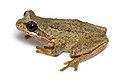 Photograph: JJ HarrisonThe southern brown tree frog (Litoria ewingii) is a species of tree frog native to Australia found in a wide range of habitats. Reaching 45 millimetres (1.8 in), this species is generally brown, but green and green-striped morphs are also recorded.
 -
 Photograph credit: RushenbWallace's flying frog (Rhacophorus nigropalmatus) is a moss frog found in tropical southeastern Asia. It is named after the British naturalist Alfred R. Wallace, who collected the first known specimen of the species. It lives almost exclusively in trees, and when threatened, or in search of prey, will leap from a branch and splay its four webbed feet; the membranes between its toes and the loose skin flaps on its sides catch the air as it falls, helping it to glide. This individual was photographed in Khao Sok National Park, Thailand.
 -
 Photograph credit: Charles J. SharpMantella baroni, commonly known as Baron's mantella, variegated golden frog or Madagascar poison frog, is a species of frog in the family Mantellidae. It is native to Madagascar and is seen here in Ranomafana National Park in the southeastern part of the country. The species was described in 1888 by George Albert Boulenger, who named it after its collector, Richard Baron. It has been classified as a least-concern species by the International Union for Conservation of Nature due to its relatively wide distribution, but is threatened by habitat loss. The frog's diet includes mites, which cause it to accumulate a high alkaloid concentration in its skin, making it toxic. The bright colours may serve as a warning sign to potential predators of the frog's toxicity.
 -
 The fire salamander (Salamandra salamandra) is a European salamander species with a long lifespan. These nocturnal animals generally eat various insects, spiders, earthworms and slugs, but they also occasionally eat newts and young frogs.
 -
 The emerald-eyed tree frog (Rana platanera) is a species of frog in the family Hylidae found in South America.
 -
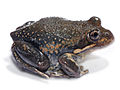 Photo credit: Fir0002The Eastern Banjo Frog (Limnodynastes dumerilli) is native to eastern Australia and has been introduced to New Zealand. The frog is also commonly called the pobblebonk after its distinctive "bonk" call, which is likened to a banjo string being plucked. Adults are roughly seven to eight cm long.
 -
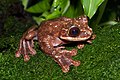 Photograph: Brian GratwickeRabbs' fringe-limbed treefrog (Ecnomiohyla rabborum) is a large species of frog originally found in the forest canopies of central Panama. Only discovered in 2005, the species is thought to be extinct in the wild; only one specimen, a male at the Atlanta Botanical Garden, survives.
 -
 A male Dendropsophus microcephalus frog, displaying its vocal sac—membranes of skin under the throat or on the corner of the mouth that distend to amplify its call. The species lives in moist areas in most of Central America and northern South America.
 -
 Photo: Charles H. Smith, USFWSThe golden toad (Bufo periglenes) is an extinct species of true toad that was once abundant in a small region of high-altitude cloud-covered tropical forests, about 30 km2 (12 sq mi) in area, above the city of Monteverde, Costa Rica. The last reported sighting of a golden toad was on 15 May 1989. Its sudden extinction may have been caused by chytrid fungus and extensive habitat loss.
 -
 The edible frog (Pelophylax kl. esculentus) is a fertile hybrid of the pool and marsh frogs which is commonly found in Europe. The species is commonly used in food, including the French delicacy frog legs.
 -
 Photo credit: Carey James BalboaThe Red-eyed Tree Frog (Agalychnis callidryas) is a small-sized tree frog, reaching lengths of about 5 to 7 centimeters (3 inches), native to Neotropical rainforests in Central America. They are not poisonous and rely on camouflage to protect them. During the day, they remain motionless with their colorful parts hidden. Thus, they appear almost completely green, and well hidden among the foliage.
 -
 Photograph: Benny TrappThe Iberian midwife toad (Alytes cisternasii) is a species of frog in the family Alytidae found in Portugal and western Spain. Its natural habitats are temperate forests and shrubland, Mediterranean-type shrubby vegetation, intermittent rivers and freshwater marshes, pastureland, and aquaculture ponds. The species is affected by habitat loss, and the IUCN lists it as being "Near Threatened".
 -
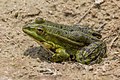 Photograph credit: Charles James SharpThe marsh frog (Pelophylax ridibundus) is a species of amphibian native to Europe and parts of Asia. It is the largest type of frog in most of its range, growing to a snout-to-vent length of around 100 mm (4 in); tadpoles can reach up to 190 mm (7.5 in) in length, but this usually occurs in places with long winters where the tadpole has time to grow. Marsh frogs hibernate during the winter, either underwater or in burrows, and are able to use the Earth's magnetic field to locate breeding ponds. This marsh frog was photographed in Kampinos National Park, Poland.
 -
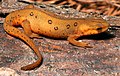 Photo credit: Patrick CoinA terrestrial subadult Eastern newt or red eft (Notophthalmus viridescens). Salamanders of the family Salamandridae with aquatic adult stages are called newts. Some newts, including the Eastern newt, have a juvenile terrestrial stage called the eft. The red eft has bright aposematic coloration to warn predators of its highly toxic skin.
 -
 Illustration credit: Ernst HaeckelA frog is an amphibian characterized by long hind legs, a short body, webbed digits, protruding eyes and the absence of a tail. Frogs are most noticeable through their call, which can be widely heard during the mating season. It is estimated that up to 20% of amphibian species may care for their young in one way or another, and there is a great diversity of parental behaviours. For example, frogs in the Gastrotheca genus (upper left) carry their eggs in a pouch, and females of the Eleutherodactylus lineatus species (center left) carry their young on their back.


_Ranomafana.jpg)


.jpg)


.jpg)

Selected toad article

Blythophryne is a monotypic genus of true toads. The sole species Blythophryne beryet is described from the Andaman Islands, in the Bay of Bengal, India. It is about 24 millimetres (0.94 in) long. (Full article...)
Selected caecilian article
._A._Lateral,_B._Dorsal_view_of_head,_C._Ventral_view_of_head,_D._Lateral_view_of_head,_E._Dorsal_view_of_body_terminus,_F._Ventral_view_of_body_terminus,_G._Lateral_vi.png)
Chikilidae is a family of Indian caecilians, the 10th and most recent (2012) family of caecilians (legless amphibians) to be identified, although the type species, Chikila fulleri (formerly Herpele fulleri) was first described in 1904. The discovery that this was a separate lineage resulted from genetic analyses of specimens collected during about 250 soil-digging expeditions over five years that covered every Northeast Indian state. A team of biologists led by University of Delhi herpetologist Sathyabhama Das Biju described the family as representing as many as seven species apparently endemic to the region. In September 2012, some of these species were also found in Lawachara National Park in the Sylhet region of northeastern Bangladesh. The family's lineage is believed to have originated in Africa, where their closest living relatives are found.
Chikilids grow to about 4 in (10 cm) in length. They have very limited eyesight and skulls adapted for burrowing. Their eggs hatch into adult caecilians, with no larval stage in between. The mothers stay wrapped around their developing eggs for two to three months, apparently not eating at all during this period.
Until this discovery, only nine families of caecilians were known from across the wet tropical regions of Southeast Asia, India, Sri Lanka, parts of East and West Africa, the Seychelles, Central America and northern and eastern parts of South America. From morphological and DNA analyses, the researchers concluded the new family had evolved independently of other caecilians since the time of the dinosaurs. (Full article...)
Need help?
Do you have a question about Amphibians that you can't find the answer to?
Consider asking it at the Wikipedia reference desk.
Topics
Subcategories

Related portals


Associated Wikimedia
The following Wikimedia Foundation sister projects provide more on this subject:
-
 Commons
Free media repository -
 Wikidata
Free knowledge base -
 Wikiquote
Collection of quotations -
 Wikisource
Free-content library -
 Wikiversity
Free learning tools -
 Wiktionary
Dictionary and thesaurus


