


Portal:American Civil War

 |
|
 |
 The American Civil War Portal


The American Civil War (1861–1865) was a sectional rebellion against the United States of America by the Confederate States, formed of eleven southern states' governments which moved to secede from the Union after the 1860 election of Abraham Lincoln as President of the United States. The Union's victory was eventually achieved by leveraging advantages in population, manufacturing and logistics and through a strategic naval blockade denying the Confederacy access to the world's markets.
In many ways, the conflict's central issues – the enslavement of African Americans, the role of constitutional federal government, and the rights of states – are still not completely resolved. Not surprisingly, the Confederate army's surrender at Appomattox on April 9,1865 did little to change many Americans' attitudes toward the potential powers of central government. The passage of the Thirteenth, Fourteenth and Fifteenth amendments to the Constitution in the years immediately following the war did not change the racial prejudice prevalent among Americans of the day; and the process of Reconstruction did not heal the deeply personal wounds inflicted by four brutal years of war and more than 970,000 casualties – 3 percent of the population, including approximately 560,000 deaths. As a result, controversies affected by the war's unresolved social, political, economic and racial tensions continue to shape contemporary American thought. The causes of the war, the reasons for the outcome, and even the name of the war itself are subjects of much discussion even today. (Full article)
Featured article

The Battle of Shiloh, also known as the Battle of Pittsburg Landing, was a major battle in the American Civil War fought on April 6–7, 1862. The fighting took place in southwestern Tennessee, which was part of the war's Western Theater. The battlefield is located between a small, undistinguished church named Shiloh and Pittsburg Landing on the Tennessee River. Two Union armies combined to defeat the Confederate Army of Mississippi. Major General Ulysses S. Grant was the Union commander, while General Albert Sidney Johnston was the Confederate commander until his battlefield death, when he was replaced by his second-in-command, General P. G. T. Beauregard.
The Confederate army hoped to defeat Grant's Army of the Tennessee before it could be reinforced and resupplied. Although it made considerable gains with a surprise attack on the first day of the battle, Johnston was mortally wounded and Grant's army was not eliminated. Overnight, Grant's Army of the Tennessee was reinforced by one of its divisions stationed farther north, and was also joined by portions of the Army of the Ohio, under the command of Major General Don Carlos Buell. The Union forces conducted an unexpected counterattack in the morning, which reversed the Confederate gains of the previous day. The exhausted Confederate army withdrew further south, and a modest Union pursuit started and ended on the next day. (Full article...)
Grand Parade of the States
Featured biography
.jpg)
John Cabell Breckinridge (January 16, 1821 – May 17, 1875) was an American politician who served as the 14th vice president of the United States, with President James Buchanan, from 1857 to 1861, and as a general in the Confederate Army during the American Civil War. Assuming office at the age of 36, Breckinridge is the youngest vice president in U.S. history. He was also the Southern Democratic candidate in the 1860 presidential election, losing to antislavery Republican candidate Abraham Lincoln.
Breckinridge was born near Lexington, Kentucky, to a prominent local family. After serving as a noncombatant during the Mexican–American War, he was elected as a Democrat to the Kentucky House of Representatives in 1849, where he took a pro-slavery stance. Elected to the U.S. House of Representatives in 1851, he allied with Stephen A. Douglas in support of the Kansas–Nebraska Act. After reapportionment in 1854 made his re-election unlikely, he declined to run for another term. He was nominated for vice president at the 1856 Democratic National Convention to balance a ticket headed by James Buchanan. The Democrats won the election, but Breckinridge had little influence with Buchanan, and as presiding officer of the Senate, could not express his opinions in debates. He joined Buchanan in supporting the proslavery Lecompton Constitution for Kansas, which led to a split in the Democratic Party. In 1859, he was elected to succeed Senator John J. Crittenden at the end of Crittenden's term in 1861. (Full article...)
WikiProjects
Featured picture
-

-
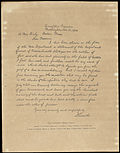 Lithographic facsimile of the Bixby letter, by Huber's Museum
 -
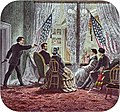
-
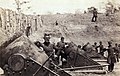 Siege of Yorktown, by James F. Gibson
 -
 Military execution of the conspirators in the Abraham Lincoln assassination
 -

-
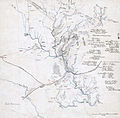
-

-
 The burning of Columbia at Columbia, South Carolina in the American Civil War, by William Waud
 -
 Daniel McCallum, by the Brady National Photographic Art Gallery
 -
 Allan Pinkerton, President Lincoln, and John A. McClernand in 1862 by Alexander Gardner
 -

-
 Confederate casualties at Chancellorsville during the American Civil War, by the National Archives and Records Administration
 -

-

-
 Andersonville survivor
 -
-
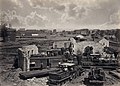 Atlanta roundhouse ruin at History of Atlanta, by George Barnard
 -

-

-

-

-
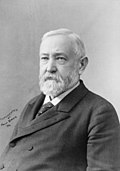 United States President (and former Brigadier-General) Benjamin Harrison
 -

-
 The print version of Sherman in South Carolina: The burning of McPhersonville at McPhersonville, South Carolina, by William Waud
 -
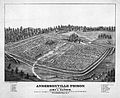 Andersonville Prison at Andersonville National Historic Site, by John L. Ransom
 -

-
 The original sketch of Sherman in South Carolina: The burning of McPhersonville, at and by William Waud
 -

-

-
 Francis B. Spinola, Brigadier General for the Union in the American Civil War, and Congressman from New York
 -
 Abraham Lincoln's private secretary and biographer John Hay
 -

-

-

-

-
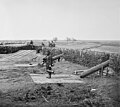 Quaker guns, by George Barnard and James F. Gibson
 -
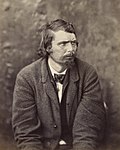
-
 The Chickahominy – Sumner's Upper Bridge at Peninsula campaign, by William McIlvaine
 -
 President Rutherford B. Hayes was the 19th President of the USA
 -

-

-

-
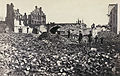 Richmond, Virginia after the American Civil War
 -
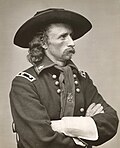 George Armstrong Custer, by George L. Andrews
 -


.jpg)


Did you know...
- ... that some Confederate bullets were sourced from a silver mine?
- ... that an African-American was appointed postmaster of Baynesville, Virginia, in 1893 in preference to a former Confederate soldier?
- ... that Dethloff Willrodt fought for the Union army on the first day of the Battle of Gettysburg on July 1, 1863, having previously been a soldier in the Confederate army?
- ... that singer Frank Croxton performed a duet with his father for the unveiling of a monument to a Confederate States Army general?
- ... that Benjamin Jackson was likely paid at least $300 to fight in the American Civil War as Lewis Saunders?
- ... that the only functioning secondary school in Mississippi during the American Civil War was founded by Thomas S. Gathright?
Subcategories
American Civil War topics

Related portals


Things you can do
- Attention needed
- ...to referencing and citation • ...to coverage and accuracy • ...to structure • ...to grammar • ...to supporting materials
- Popular pages
- Full list
- Cleanup needed
- The West Tennessee Raids
- Requested articles
- Benjamin D. Fearing • James B. Speers • Charles S. Steedman • Battle of Barton's Station • Lawrence P. Graham • Frederick S. Sturmbaugh • Mexico and the American Civil War • Savannah Campaign Confederate order of battle • Battle of Lafayette • Battle of Sunshine Church • Requested American Civil War Medal of Honor recipients • Battle of Tazewell • John T. Sprague
- Expansion needed
- Battle of Boonsborough • Battle of Guard Hill • Battle of Rice's Station • Battle of Simmon's Bluff • Battle of Summit Point • Charleston Arsenal • Edenton Bell Battery • First Battle of Dalton • Blackshear Prison • Edwin Forbes • Hiram B. Granbury • Henry Thomas Harrison • Louis Hébert (colonel) • Benjamin G. Humphreys • Hezekiah G. Spruill • Smith carbine • Edward C. Walthall • Confederate States Secretary of the Navy • Confederate States Secretary of the Treasury • David Henry Williams • Battle of Rome Cross Roads • Ironclad Board • United States Military Railroad • Kansas in the American Civil War • Rufus Daggett • Ebenezer Magoffin • Confederate Quartermaster-General's Department • First Corps, Army of Northern Virginia • Francis Laurens Vinton • Ambrose Dudley Mann • Patrick Neeson Lynch • Stone Fleet (add international reactions and diplomacy) • Other American Civil War battle stubs • Other American Civil War stubs
- Images needed
- Preston Pond, Jr. • Melancthon Smith
- Merging needed
- 1st Regiment New York Mounted Rifles and 7th Regiment New York Volunteer Cavalry
- Citations needed
- 4th Maine Battery • 33rd Ohio Infantry • 110th New York Volunteer Infantry • Battle of Hatcher's Run • Camp Dennison • Confederate colonies • CSS Resolute • Dakota War of 1862 • Florida in the American Civil War • Ethan A. Hitchcock (general) • Fort Harker (Alabama) • Gettysburg (1993 film) • Iowa in the American Civil War • Second Battle of Fort Sumter • Samuel Benton
- Translation needed
- Add an article here!
Associated Wikimedia
The following Wikimedia Foundation sister projects provide more on this subject:
-
 Commons
Free media repository -
 Wikidata
Free knowledge base -
 Wikiquote
Collection of quotations -
 Wikisource
Free-content library -
 Wikiversity
Free learning tools -
 Wikivoyage
Free travel guide -
 Wiktionary
Dictionary and thesaurus


- Shortcuts to this page: Portal:ACW • P:ACW