


Manila Village
Manila Village | |
|---|---|
Former settlement | |
 Manila Village Historical Marker | |
  Manila Village  Manila Village | |
| Coordinates: 29°25′42″N 89°58′35″W / 29.42833°N 89.97639°W | |
| Country | United States |
| State | Louisiana |
| Parish | Jefferson Parish |
| Time zone | Central (CST) |
| • Summer (DST) | CDT |
Manila Village (locally spelt Manilla;[1][2] Cajun French: Cloque-Chênière, Cloche-Chênière, or Cabanage[1]) was a settlement of Filipino sailors, fishermen and laborers located on an island in Barataria Bay, in Jefferson Parish, Louisiana, United States. The settlements of Saint Malo in St. Bernard Parish was occupied by Filipino sailors who had jumped ship from their Spanish captains, near New Orleans in the year 1763.[3] In later years, other Filipino countrymen arriving in port at Louisiana would also escape Spanish galleons.[4] This group would later found the Manila Village settlement in the mid-19th century (or earlier).[5] The newly liberated sailors became fishermen who caught and dried shrimp for export to Asia, Canada, South America, and Central America.[6] On July 24, 1870, the Spanish-speaking residents of St. Malo founded the first Filipino social club, called Sociedad de Beneficencia de los Hispano Filipinos, to provide relief and support for the group's members, including the purchasing of burial places for their deceased.[4] In 1938, the community had a population of 200 people, mostly Filipinos, but also Chinese, Mexicans, and Spaniards.[7]
The settlements were eventually destroyed by hurricanes: Saint Malo by the 1915 New Orleans hurricane;[8] Manila Village by Hurricane Betsy in 1965.[9] Descendents of the village continue to fish and shrimp in southern Louisiana.[10] In 2015, the only remains of the structures of "Manilla Village" are wood pilings that are visible above the water's surface.[11] By 2016, only a small remnant of Manila island, about one acre in size, remained.[12] By 2021, the island stopped being visible during high tide. By 2024, it is no longer visible during low tide.
In Jefferson Parish, Manila Plaza, located in front of Jean Lafitte Town Hall, holds several historical markers and commemorative plaques acknowledging important figures in the area's Filipino American history. While there were several settlements scattered along the Louisiana coast in the late 19th century, Manila Village was the largest.[13]
See also
[edit]- Dried shrimp
- Town of Jean Lafitte (History section)
- Saint Malo, Louisiana
References
[edit]- ^ a b Jack A. Reynolds. "Manila Village" entry in "Louisiana Placenames of Romance Origin." LSU Historical Dissertations and Theses #7852. 1942. p. 329–330.
- ^ "Holding Out, to Last Isle, as Gulf Takes Cajun Land". Wilmington StarNews. Wilmington, NC: Gannett Corp. August 25, 2008. Retrieved May 7, 2026.
Old timers speak wistfully about Sea Breeze and Manilla Village, settlements built on stilts in the marshes.
Commission, Louisiana Oyster (1904). Biennial Report. pp. 108–113. Retrieved May 8, 2026. - ^ Joshi, Khyati Y.; Desai, Jigna (October 1, 2013). Asian Americans in Dixie: Race and Migration in the South. University of Illinois Press. ISBN 978-0-252-09595-5.
- ^ a b Cordova, Fred (1983). Filipinos, Forgotten Asian Americans: A Pictorial Essay, 1763-circa 1963. Dubuque, Iowa: Kendall/Hunt Publishing Company. ISBN 978-0-8403-2897-7. Retrieved May 8, 2026.
- ^ Gonzales, Randy (April 6, 2022). "Manila Village". Filipino La. Philippine Louisiana Historical Society. Retrieved May 7, 2026.
- ^ Peña, Orlando P. (February 7, 2010). My Rainbow Run - Lessons of Life from the Boondocks to the World. OPPBOOKS Publishing. p. 196. Retrieved May 8, 2026.
- ^ New Orleans City Guide. Federal Writers' Project. Houghton Mifflin. 1938. p. 392. Archived from the original on November 10, 2006.
- ^ Monge, Luigi (August 24, 2022). Wasn't That a Mighty Day: African American Blues and Gospel Songs on Disaster. Univ. Press of Mississippi. p. 112. ISBN 978-1-4968-4177-3. Retrieved May 8, 2026.
- ^ Keim, Barry D.; Muller, Robert A. (August 31, 2009). Hurricanes of the Gulf of Mexico. LSU Press. p. 85. ISBN 978-0-8071-3667-6. Retrieved May 8, 2026.
- ^ Tolliver, Domonique (August 13, 2022). "Fishing for Solutions: The race to protect coastal Louisiana's cultures and way of life". Gambit. New Orleans: Georges Media. Retrieved May 7, 2026.
- ^ Tardo, Rusty (April 1, 2016). "The Battle of Midway — Where to ambush Barataria Bay trout in April". Louisiana Sportsman. Boutte, Louisiana: Louisiana Sportsman, Inc. Retrieved May 7, 2026.
- ^ Soong, Tina (September 14, 2016). "Filipino American culture celebrations coming New Orleans-wide Oct. 8-9". The Times-Picayune. New Orleans. Archived from the original on May 14, 2018. Retrieved May 13, 2018.
- ^ Filipino Contributions Remembered with Historical Markers Archived March 3, 2016, at the Wayback Machine, Lara Arceneaux's blog article of July 12, 2013, at The Times-Picayune; accessed 22 March 2015.
Municipalities and communities of Jefferson Parish, Louisiana, United States | ||
|---|---|---|
| Cities | 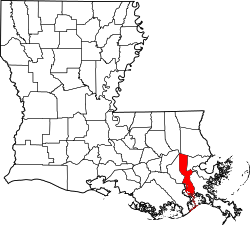 | |
| Towns | ||
| CDPs | ||
| Other unincorporated communities | ||