


Lily Lake, Illinois
Lily Lake, Illinois | |
|---|---|
 Welcome sign on Illinois Route 47 | |
 Location of Lily Lake in Kane County, Illinois | |
.svg) Location of Illinois in the United States | |
| Coordinates: 41°57′06″N 88°28′28″W / 41.95167°N 88.47444°W[1] | |
| Country | United States |
| State | Illinois |
| County | Kane |
| Township | Campton |
| Area | |
• Total | 2.72 sq mi (7.04 km2) |
| • Land | 2.72 sq mi (7.04 km2) |
| • Water | 0 sq mi (0.00 km2) |
| Elevation | 958 ft (292 m) |
| Population (2020) | |
• Total | 1,032 |
| • Density | 379.8/sq mi (146.66/km2) |
| Time zone | UTC-6 (CST) |
| • Summer (DST) | UTC-5 (CDT) |
| ZIP Code(s) | 60151 |
| Area code | 331 |
| FIPS code | 17-43406 |
| GNIS feature ID | 2398437[1] |
| Wikimedia Commons | Lily Lake, Illinois |
| Website | www |
Lily Lake is a village in Kane County, Illinois, United States. The town is 15 miles (24 km) southwest of Elgin and 50 miles (80 km) west of Chicago. The village is in the far western part the Chicago metro area. It was incorporated as a village on November 6, 1990. The population was 1,032 at the 2020 census,[3] up from 993 in 2010.
History
[edit]Lily Lake was originally called "Canada Corners" (after the large number of Canadians settled there) and was located further north. The settlement shifted its location when the railroad was built and changed its name to "Lily Lake", referring to a local lake.[4]
Geography
[edit]Lily Lake is located in west central Kane County in the western part of Campton Township. Neighboring villages are Campton Hills to the east and Virgil to the west.
According to the 2021 census gazetteer files, Lily Lake has a total area of 2.72 square miles (7.04 km2), of which 2.72 square miles (7.04 km2) (or 99.96%) is land and 0.00 square miles (0.00 km2) (or 0.04%) is water.[5]
Demographics
[edit]| Census | Pop. | Note | %± |
|---|---|---|---|
| 2000 | 825 | — | |
| 2010 | 993 | 20.4% | |
| 2020 | 1,032 | 3.9% | |
| U.S. Decennial Census[6] | |||
Racial and ethnic composition
[edit]| Race / Ethnicity (NH = Non-Hispanic) | Pop 2000[7] | Pop 2010[8] | Pop 2020[9] | % 2000 | % 2010 | % 2020 |
|---|---|---|---|---|---|---|
| White alone (NH) | 797 | 941 | 902 | 96.61% | 94.76% | 87.40% |
| Black or African American alone (NH) | 7 | 2 | 19 | 0.85% | 0.20% | 1.84% |
| Native American or Alaska Native alone (NH) | 0 | 0 | 1 | 0.00% | 0.00% | 0.10% |
| Asian alone (NH) | 2 | 2 | 7 | 0.24% | 0.20% | 0.68% |
| Native Hawaiian or Pacific Islander alone (NH) | 0 | 0 | 0 | 0.00% | 0.00% | 0.00% |
| Other race alone (NH) | 0 | 1 | 6 | 0.00% | 0.10% | 0.58% |
| Mixed race or Multiracial (NH) | 2 | 1 | 34 | 0.24% | 0.10% | 3.29% |
| Hispanic or Latino (any race) | 17 | 46 | 63 | 2.06% | 4.63% | 6.10% |
| Total | 825 | 993 | 1,032 | 100.00% | 100.00% | 100.00% |
2020 census
[edit]As of the 2020 census, Lily Lake had a population of 1,032. The median age was 43.4 years. 21.9% of residents were under the age of 18 and 15.5% were 65 years of age or older. For every 100 females, there were 102.4 males; for every 100 females age 18 and over, there were 104.6 males.[10][11]
75.1% of residents lived in urban areas, while 24.9% lived in rural areas.[12]
There were 347 households, of which 34.6% had children under the age of 18 living in them. Of all households, 79.8% were married-couple households, 6.1% had a male householder with no spouse or partner present, and 9.5% had a female householder with no spouse or partner present. About 8.0% of all households were made up of individuals, and 3.7% had someone living alone who was 65 years of age or older.[10]
There were 359 housing units, of which 3.3% were vacant. The homeowner vacancy rate was 0.6% and the rental vacancy rate was 4.8%. The population density was 379.69 inhabitants per square mile (146.60/km2). There were 359 housing units at an average density of 132.08 per square mile (51.00/km2).[13][10]
Income and poverty
[edit]The median income for a household in the village was $119,792, and the median income for a family was $127,778. Males had a median income of $66,731 versus $33,750 for females. The per capita income for the village was $49,711. No families and 0.8% of the population were below the poverty line, including none of those under age 18 and none of those age 65 or over.
References
[edit]- ^ a b c U.S. Geological Survey Geographic Names Information System: Lily Lake, Illinois
- ^ "2020 U.S. Gazetteer Files". United States Census Bureau. Retrieved March 15, 2022.
- ^ "Geographic Identifiers: 2010 Demographic Profile Data (G001): Lily Lake village, Illinois". American Factfinder. U.S. Census Bureau. Retrieved February 12, 2019.[dead link]
- ^ "Several Towns Named After Founders and Heroes". The Daily Herald. December 28, 1999. p. 220. Retrieved August 17, 2014 – via Newspapers.com.

- ^ US Census Bureau. "Gazetteer Files". Census.gov. Retrieved June 29, 2022.
- ^ "Census of Population and Housing". Census.gov. Retrieved June 4, 2015.
- ^ "P004: Hispanic or Latino, and Not Hispanic or Latino by Race – 2000: DEC Summary File 1 – Lily Lake village, Illinois". United States Census Bureau.
- ^ "P2: Hispanic or Latino, and Not Hispanic or Latino by Race – 2010: DEC Redistricting Data (PL 94-171) – Lily Lake village, Illinois". United States Census Bureau.
- ^ "P2: Hispanic or Latino, and Not Hispanic or Latino by Race – 2020: DEC Redistricting Data (PL 94-171) – Lily Lake village, Illinois". United States Census Bureau.
- ^ a b c "2020 Decennial Census Demographic Profile (DP1)". United States Census Bureau. 2021. Retrieved May 1, 2026.
- ^ "2020 Decennial Census Redistricting Data (Public Law 94-171)". United States Census Bureau. 2021. Retrieved May 1, 2026.
- ^ "2020 Decennial Census Demographic and Housing Characteristics (DHC)". United States Census Bureau. 2023. Retrieved May 1, 2026.
- ^ "Explore Census Data". data.census.gov. Retrieved June 28, 2022.

External links
[edit]Municipalities and communities of Kane County, Illinois, United States | ||
|---|---|---|
| Cities | 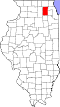 | |
| Villages | ||
| Townships | ||
| CDP | ||
| Other unincorporated communities | ||
| Footnotes | ‡This populated place also has portions in an adjacent county or counties | |
Places adjacent to Lily Lake, Illinois | ||||||||||||||||
|---|---|---|---|---|---|---|---|---|---|---|---|---|---|---|---|---|
| ||||||||||||||||


