


Karair
 | This article includes a list of general references, but it lacks sufficient corresponding inline citations. (November 2011) |
 | |||||||
 | |||||||
| Founded | 1947 | ||||||
|---|---|---|---|---|---|---|---|
Ceased operations | 1996 (merged into Finnair) | ||||||
| Hubs | Helsinki Airport | ||||||
| Parent company | Finnair (since 1963) | ||||||
| Headquarters | Helsinki, Finland | ||||||
| Key people | Niilo and Valto Karhumäki (founders) | ||||||
Karair Oy was an one of the oldest airlines of Finland. After having operated charter flights and then scheduled passenger flights, the company became a subsidiary of Finnair 1963, mainly focusing on holiday charter business and limited regional routes.
History
[edit]The origins
[edit]
Born in Multia, Finland in 1902 and 1905, respectively, brothers Niilo and Valto Karhumäki moved to Jyväskylä where, in late 1924, they estabilished 'Veljekset Karhumäki Oy (Karhumäki brothers), a company which during the 1930s dealt with aircraft maintenance, aerial photography, pilot training, aerial acrobatics. In 1929 high-wing, floats-equipped and two-seats Tiira monoplane was manufactured. In order to start a collaboration with the Finnish Air Force, the company headquarters were moved to Kuorevesi. During World War II the concern activities were merged into the Valtion Lentokonetehdas company, manufacturer of a number of military aircraft. After the war the two brothers designed the Karhumäki Karhu 48B light airplane, which was produced in a small number during the 1950s.
In June 1950 the company started flying a few domestic schedules. The fleet was limited in numbers and aircraft sizes: Airspeed AS.40, DeHavilland DH.89, Lockheed L-18. All these operations were halted in late 1950s as transferred to the sister company Karhumäki Airways O/Y.
Karhumäki Airways O/Y
[edit]This Veljekset Karhumäki subsidiary was estabilished in 1951 and started scheduled passenger flights between Helsinki and Joensuu, Jyväskylä, Vaasa and Sundsvall.[1] in June of that same year with aircraft made available by the parent company. Then the airline inherited the Lockheed L-18 and, in the second part of 1950s, added four more suitable Douglas DC-3 and later two more comfortable Convair CV-440 Metropolitan. The first international flight (to Stockholm) took place in that same year, followed by flights to Málaga in coincidence with holiday packages.
Kar-Air O/Y
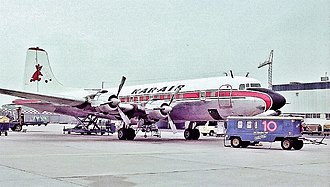
[edit]On 1st January 1957 the corporate name was changed to more modern Kar-Air O/Y.[1] A Swedish subsidiary was established, which from 1961 onwards operated a single Douglas DC-6 on charter flights to Southern Europe. On 1 November 1963 32% of the airline ownership was taken over by flag carrier Aero O/Y (Finnair from 1968).[2] Kar-Air encountered financial difficulties when its two CV 440s were damaged in hard landings and had to be taken out of service for a period in 1963. The ownership demanded Kar-Air to cease domestic flying, concentrating on charter flights (mainly to the Mediterranean) holiday resorts. For this purpose, Aero O/Y handed over two of its Douglas DC-6 aircraft, which Kar-Air also used for multiple stopover round-the-world flights. By 1965 all scheduled operations had been abandoned and the air carrier concentrated on charter business. Three DC-6s were already in the fleet and it was deliberated to convert one of them to swing-tail configuration. The work was accomplished by Sabena engineering department in Brussels. After the conversion the four-engined aircraft could carry loads of up to 18 metres long or six pallets 108x88, for a maximum payload of 11,5 tons. It flew several schedules to United Kingdom (London and Manchester) and to Germany (Frankfurt and Düsseldorf) on Finnair behalf. Two other Douglas DC 6s were frequently operated to transport Finnish contingent to UNO peace-keeping detachments while DC 3s mainly performed aerial survey works.
The DC-6s were the backbone of the passenger fleet until 1968, when the jet age arrived with the introduction of a 189-seat Douglas DC-8 series 62, instrumental in operating long haul flights. Also in 1968 a De Havilland of Canada DHC-6 Twin Otter was added to the fleet. In this same year, the airline underwent a rebranding, being known as Karair, also styled KarAir henceforth.[2] Over the following years, Karair reduced its fleet, because charter contracts with Finnair terminated.
The last years
[edit]In 1986, two Airbus A300 wide-body airliners joined the fleet,[citation needed] again leased from Finnair and intended exclusively for charter flights. Finnair's plans with the subsidiary changed from 1989, when the first of seven ATR 72 regional turboprop airliner was added to the fleet, and the A300s in turn left the following year.[citation needed] From then, scheduled passenger flights, both domestically and to the neighbour nations, on behalf of Finnair were operated.
On 3 February 1989, Finnair bought further shares to hold a total of 90% of the Karair ownership,[2] which was further increased to 97.6% in 1993. These times were characterized by financial problems because of the recession of the early 1990s, which led to Finnair announcing a full take-over of Karair in December 1995.[2] Karair had started integrating its operations into the flag carrier in September 1990. Karair fleet and operations were progressively merged into Finnair, a move which was fully accomplished in October 1996. In 2002, a court[which?] deemed the take-over illegal, and Finnair was forced to salvage the remaining Karair stocks.
Destinations
[edit]Between 1950 and 1963 (when Aero O/Y had not yet acquired the majority stake), Kar-Air operated scheduled flights to the following destinations, with further ones accessible on co-operative flights of SAS and Aero O/Y:[3]
- Finland
- Helsinki - Helsinki Airport (hub)
- Joensuu - Joensuu Airport
- Kauhava - Kauhava Airport
- Kokkola - Kokkola-Pietarsaari Airport
- Lappeenranta - Lappeenranta Airport
- Tampere - Tampere-Pirkkala Airport
- Vaasa - Vaasa Airport
- Luxemburg
- Spain
- Sweden
- Gothenburg - Gothenburg City Airport
- Stockholm - Stockholm-Bromma Airport (focus city)
- Sundsvall - Sundsvall-Härnösand Airport
Kar-Air was not only operating passenger and cargo services, but until also ore-finding flights using a Lockheed Lodestar (until 1972), a Douglas DC-3 (1972-1980), and after that a de Havilland Canada DHC-6 Twin Otter.
Fleet
[edit]Fleet of Veljekset Karhumäki and Karhumäki Airways O/Y
[edit]The fleet in years 1949–2002, according to Tervonen:[4]
| Aircraft type | Registration | Built | Commissioned | Decommissioned | Further information | Removed from Finnish register |
|---|---|---|---|---|---|---|
| Karhu -48/38b “Tavi” | OH-VKL/OH-KUA | 1949 | 1959 | 1961 (sold) | Currently in the Finnish Aviation Museum | 1973 |
| VL Viima II/IIB | OH-VKS/OH-VIA | 1951 | 1951 | 1959 | Sold | 1964 |
| Lockheed L-18-56 Lodestar | OH-VKU | 1940 | 1953 | 1972 | In the Finnish Aviation Museum | 1972 |
| Douglas C-53 Skytrooper | OH-VKA | 1941 | 1954 | 1957 | Transferred to Kar-Air | 1969 |
| Douglas DC-3A-214 | OH-VKB | 1945–46 | 1954 | 1957 | Transferred to Kar-Air | 1971 |
| Douglas DC-3D | OH-VKC | 1945–46 | 1954 | 1957 | Transferred to Kar-Air | 1971 |
| Piper PA-18A 150 Super Cub | OH-VKV | 1960 | 1960 | 1975 | Used as towing aircraft | |
| Lockheed L-18-56 Lodestar | — | 1940 | 1961 | 1961 | Used for spare parts | |
| Aero Commander S-2R-T34 Thrush Commander | OH-VKY | 1973 | 1973 | 1974 | Sold to Sweden | 1978 |
| Cessna A188B Agtruck | OH-VKZ | 1974 | 1974 | 1976 | Destroyed | 1977 |
| Cessna A188B Agtruck | OH-VKT/OH-CIX | 1975 | 1975 | 1976 | Sold to Finnaviation | 1985 |
| Cessna T188C AgHusky | OH-VKW | 1980 | 1981 | 1987 | Sold | |
| Piper PA-25-235 Pawnee B | OH-PDW | 1965 | 1984 | 1988 | Owned by the Finnish Sports Aviation School | |
| Piper PA-25-235 Pawnee B | OH-PDZ | 1966 | 1984 | 2002 (?) | 2004 (?) | |
| Cessna A188B Agtruck | OH-CIY | 1982 | 1989 | 1999 | 2001 |
Photographic gallery
[edit]-
 Karhumäki Karhu 48B currently in the Finnish Aviation Museum
 -
 VL Sääski II
 -

-

-
 Convair CV-440 in 1957, before delivery


Kar-Air Fleet
[edit]The fleet in years 1957–96, according to Tervonen (2004, 2007):[4]
| Aircraft type | Registration | Built | Commissioned | Decommissioned | Further information | Removed from Finnish register |
|---|---|---|---|---|---|---|
| Douglas C-53 Skytrooper | OH-VKA | 1941 | 1957 | 1969 | Sold to Norway | 1969 |
| Douglas DC-3A-214 | OH-VKB | 1945–46 | 1957 | 1979 | In Finnish Aviation Museum | 1971 |
| Douglas DC-3D | OH-VKC | 1945–46 | 1957 | 1964 | Sold to Sweden | 1971 |
| Convair CV-440-98 Metropolitan | OH-VKM | 1957 | 1957 | 1973 | Destroyed in 1995 | 1973 |
| Convair CV-440-98 Metropolitan | OH-VKN/OH-LRH | 1958 | 1958 | 1978 | Sold to Norway | 1977 |
| Douglas C-47-DL | OH-VKD | 1942 | 1960 | 1964 | Sold to Norway | 1969 |
| Douglas DC-6B | OH-KDC/SE-BDX | 1953 | 1961 | 1971 | Sold to Belgium | 1972 |
| Douglas DC-6B | OH-KDB | 1958 | 1965 | 1972 | Sold to Belgium | 1972 |
| Douglas DC-6B/D6BST | OH-KDA | 1957 | 1964 | 1981 | Destroyed in Alaska | 1982 |
| De Havilland of Canada DHC-6 Twin Otter | OH-KOA | 1968 | 1972 | 1973 | Scrapped | 1973 |
| Douglas DC-8-51 | OH-KDM | 1961 | 1972 | 1985 | Sold to Belgium | 1985 |
| De Havilland of Canada DHC-6 Twin Otter Mk. 300 | OH-KOG | 1979 | 1979 | 1996 | Transferred to Finnair | |
| Douglas DC-8-62 | OH-LFZ | 1968 | 1984 | 1987 | Sold to United States | 1987 |
| Airbus A300B4 | OH-LAA | 1984 | 1986 | 1994 | Transferred to Finnair | 1998 |
| Airbus A300B4 | OH-LAB | 1984 | 1987 | 1994 | Transferred to Finnair | 1998 |
| Aérospatiale ATR 72 | OH-KRA | 1989 | 1990 | 1996 | Transferred to Finnair | 2005 |
| Aérospatiale ATR 72 | OH-KRB | 1989 | 1990 | 1996 | Transferred to Finnair | 2005 |
| Aérospatiale ATR 72 | OH-KRC | 1989 | 1990 | 1996 | Transferred to Finnair | 2005 |
| Aérospatiale ATR 72 | OH-LTR/OH-KRD | 1990 | 1990 | 1996 | Transferred to Finnair, later to Aero Airlines |
2005 |
| Aérospatiale ATR 72 | OH-KRE | 1990 | 1990 | 1996 | Transferred to Finnair, later to Aero Airlines |
2005 |
| Aérospatiale ATR 72 | OH-LTE | 1987 | 1990 | 1990 | Sold to France | 1990 |
| Aérospatiale ATR 72 | OH-KRF | 1992 | 1992 | 1996 | Transferred to Finnair, later to Aero Airlines |
2005 |
Photographic gallery
[edit]-
 Douglas DC-6B with open swing tail at Düsseldorf Airport in 1976
 -
 Douglas DC-8 at Birmingham Airport in 1979
 -
 Douglas DC-8-62 in very simplified colors
 -
 Airbus A300 at Faro Airport in 1991
 -
 ATR 72 at Helsinki Airport in 1990

.jpg)


Former Kar-Air planes today
[edit]
The Finnish Aviation Museum near the Helsinki-Vantaa airport had on display two Kar-Air planes, Lockheed L-18 Lodestar OH-VKU, the “Golden Hoe”, and one of the oldest DC-3s in the world, the OH-VKB. A former Kar-Air DC-3 (OH-VKA), may be seen at the Munich airport in Germany, however in Swissair livery, although the plane never flew for that company. A former Kar-Air Convair Metropolitan is still flying in Haiti (HH-VAH).[5]
A sister plane of the OH-VKN has been painted in the original Kar-Air livery at Málaga Airport, for the 50th anniversary of the airport, since OH-VKN was the first plane ever to have landed there. This "replica" is owned by the Málaga Aviation Museum.[6]
Accidents
[edit]- On 13 March 1957 a Douglas DC-3D (OH-VKC) was damaged slightly, when a Pan Am Douglas DC-6B hit the plane's rudder. However, the plane was in use until 1964.[7]
- On 8 February 1960 flight KR-100 from Helsinki to Joensuu: a Douglas DC-53 Skytrooper (OH-VKA) stalled while take-off and was slightly damaged. The plane remained in use by the company until 1969.[8]
- On 19 August 1963 a Convair CV-440-98 Metropolitan (OH-VKM) was damaged during landing in Helsinki. The landing took place during a thunderstorm, and the plane bounced three times, and finally its nose landing gear gave in. The plane's nose dove, both propellers touched the ground, and the plane dragged on along the runway ca. 1 300 metres. The plane was repaired by the following January, and it was used by the company until 1973.[9]

- On 21 August 1963 a second Convair CV-440-98 Metropolitan (OH-VKN) was also damaged during landing in Helsinki. The plane bounced three times on the runway, and in the last bounce the nose landing gear suffered a fracture and the left wing was bent. The plane's nose dove and the propellers touched the ground, and finally it plane was dragged to the lawn left of the runway. One of the factors in both Convair Metropolitan accidents was the policy that the air traffic control employees had been forbidden to give a complete disclosure of the airport’s weather conditions to approaching aircraft. The information disclosed concerned only wind direction and speed, not e.g. possible thunderstorms. The pilot of OH-VKN lost sight of the runway at a critical moment due to torrential rain and a flash of lightning, due to which he could not see for a moment. The insurance company decided to buy the plane, but in the end it was repaired and commissioned again in January 1967, after it was “crossed” with a similar plane that was bought from Yugoslavia. The plane was used by the company until 1978.[10][11]
- On 7 November 1969 a Douglas DC-3A-214 (OH-VKB) was damaged due to stalling during take-off, when it was supposed to go on an inspection flight to check the ILS system. The left outer wing had to be repaired. The plane was used by the company until 1979.[12]
- On 5 February 1973 a De Havilland of Canada DHC-6 Twin Otter was damaged during an emergency landing at Iinattijärvi near Pudasjärvi. Both pilots and one passenger were injured. The right engine had broken due to incorrect maintenance job in Norway.[13][14]
- On 10 August 1974 a Piper PA-18A 150 Super Cub was damaged in Hirvivaara, Juuka due to engine failure during take-off. The plane was repaired and used by the company until 1978.[15]
- In September 1974, an Aero Commander S-2R-T34 Thrush Commander was badly damaged during an emergency landing in Hirvivaara, Juuka. The connecting rod of the engine had been broken.[16]
- On 14 November 1988, an Embraer EMB 110 Bandeirante the company had rented off to Wasawings was destroyed in a crash in Ilmajoki. The plane had two pilots and 10 passengers. The pilots and two passengers were killed. Wasawings had been breaking aviation rules repeatedly, and in the end their licence was revoked.[17][18]
- On 21 August 1996 an Estonian Air loader was killed, when the blade of a propeller of an ATR 72 (OH-KRC) hit his head.[19]
Legacy
[edit]Two aircraft formerly owned by Karair (a Lockheed Model 18 Lodestar and one of the oldest surviving Douglas DC-3s) are currently on display at the Finnish Aviation Museum in Vantaa. Another former Karair DC-3 is exhibited at Munich Airport, though painted in the colors of Swissair.
References
[edit]- ^ a b Endres, Gunter G (1982). World Airline Fleets 1983. Feltham: The Aviation Data Centre. p. 383. ISBN 0946141029.
- ^ a b c d Information about Karair at the Aero Transport Data Bank
- ^ Selection of Kar-Air timetables, at timetableimages.com
- ^ a b Tervonen 2004, p. 210–226, Tervonen 2007, p. 194–202.
- ^ "Kar-Airin entinen Convair Haitissa" [‘A former Kar-Air Convair in Haiti’]. 6 September 2019.
- ^ "Legendaarinen Kar-Air "palasi" Malagaan" [‘The legendary Kar-Air “returned” to Malaga’]. 26 May 2014.
- ^ Tervonen 2004, s. 213.
- ^ Tervonen 2004, s. 212.
- ^ Tervonen 2004, s. 94–95, 215.
- ^ Tervonen 2004, s. 94–96, 216.
- ^ "Suihkukone olisi vastaavassa tilanteessa syttynyt tuleen" [‘A jet aircraft would have caught fire in a similar situation’]. Helsingin Sanomat. 23 August 2013.
- ^ Tervonen 2004, p. 214.
- ^ Tervonen 2004, s. 222.
- ^ 1973 accident at the Aviation Safety Network
- ^ Tervonen 2004, s. 218.
- ^ Tervonen 2004, s. 224.
- ^ Tervonen 2007, s. 82, 204.
- ^ "Kar-Air Finland". Aviation Safety Network. Retrieved 2019-01-24.
- ^ Tervonen 2007, s. 200.
Sources
[edit]- Ismo Tervonen: Veljekset Karhumäki — Suomen ilmailun pioneereina 1924–1956. (Apali 2002) ISBN 952-5026-25-6
- Ismo Tervonen: Kar-Air — tilauslentoliikenteen edelläkävijänä 1957–1980. (Apali 2004) ISBN 952-5026-40-X
- Ismo Tervonen: Karair — matkustajalentoliikenteen perinteiden vaalijana 1980–1996. (Apali 2007) ISBN 978-952-5026-64-1
Further reading
[edit]- H. Calvert, "Last propliner into Heathrow", Airliner Quarterly magazine, 1979
External links
[edit]
