


Goodyera oblongifolia
| Goodyera oblongifolia | |
|---|---|

| |
Scientific classification 
| |
| Kingdom: | Plantae |
| Clade: | Embryophytes |
| Clade: | Tracheophytes |
| Clade: | Spermatophytes |
| Clade: | Angiosperms |
| Clade: | Monocots |
| Order: | Asparagales |
| Family: | Orchidaceae |
| Subfamily: | Orchidoideae |
| Tribe: | Cranichideae |
| Genus: | Goodyera |
| Species: | G. oblongifolia
|
| Binomial name | |
| Goodyera oblongifolia | |
| Synonyms | |
|
List
| |

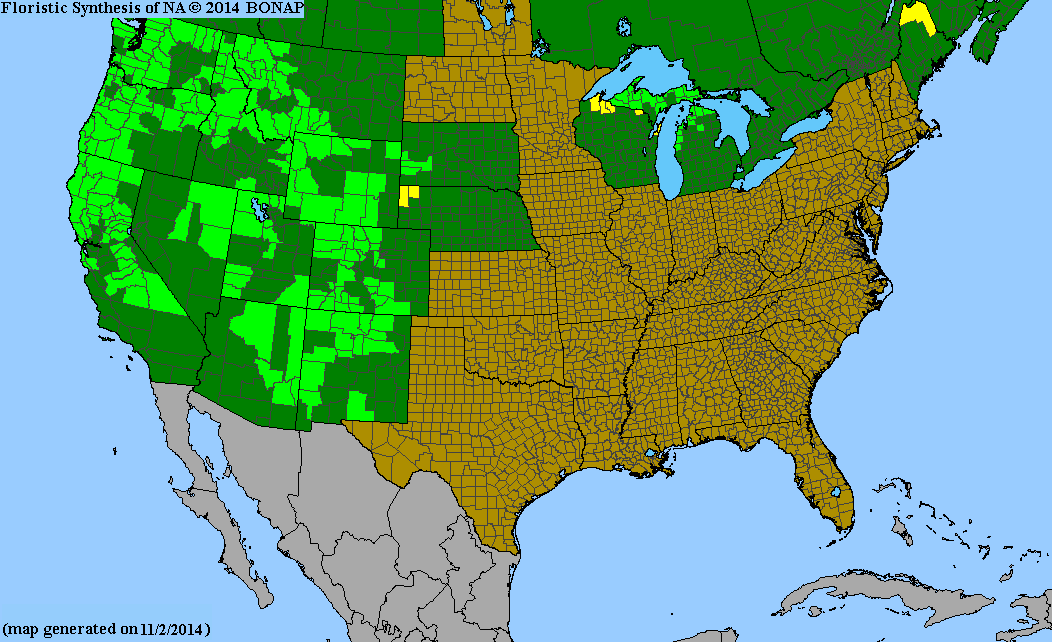
Goodyera oblongifolia is a species of orchid known by the common names western rattlesnake plantain and giant rattlesnake plantain. It is native to much of North America, particularly in the mountains of the western United States and Canada, from Alaska to northern Mexico, as well as in the Great Lakes region, Maine, Quebec and the Canadian Maritime Provinces.[2][3][4]
Goodyera oblongifolia is most commonly found in mountain forests, often in the understory of conifers. This orchid forms a patch of broad lance-shaped to oval-shaped leaves at the ground, each 4 to 9 centimeters long. The leaf is dark green and in this species the midrib is streaked with white. There is often also white netlike veining on the leaf. The plant produces an erect inflorescence up to about 30 centimeters tall. The top of the inflorescence has many white orchid flowers which may all face the same direction on the stalk, or be spirally arranged about it.[5][6][7]
The common name stems from the leaves, which have marks resembling snakeskin; the plant is also said to have been used to treat snakebites.[8]
Ecology
[edit]Goodyera oblongifolia inhabits shaded coniferous forests, including communities dominated by species such as Pinus contorta. It often forms dense colonies and can spread rapidly once established through vegetative reproduction.
The species reproduces both sexually and vegetatively via rhizomatous growth. Flowering individuals tend to produce significantly more new vegetative shoots than non-flowering plants, contributing to clonal expansion.
Flowering occurs over a period of approximately ten weeks, with individual flowers lasting around two weeks. Capsules mature within six to eight weeks following pollination.[9]
Like all orchids, Goodyera oblongifolia is dependent on mycorrhizal fungi during germination, as its seeds lack nutrient reserves. In adult plants, the species exhibits a mixed nutritional strategy.
Stable isotope studies indicate that G. oblongifolia is partially myco-heterotrophic, obtaining a portion of its carbon and nitrogen from associated fungi in addition to photosynthesis.[10] This nutritional mode allows the plant to persist in shaded forest understories where light availability is limited.
The degree of myco-heterotrophy in orchids is influenced by environmental factors, particularly light availability. In low-light conditions, individuals rely more heavily on fungal-derived nutrients, while higher light levels favor increased photosynthetic activity.[10]
Pollination
[edit]Goodyera oblongifolia is primarily pollinated by bumblebees (genus Bombus), including species such as Bombus occidentalis, Bombus vosnesenskii, and Bombus mixtus.[9]
The flowers produce nectar and are structured to facilitate pollination by visiting insects. When a bee probes the flower, the pollinia adhere to its mouthparts and are transferred to the stigma of subsequent flowers.
The species exhibits weak protandry, with flowers functioning first in a male phase before becoming receptive to pollen. This promotes outcrossing, although self-compatibility is present.[9]
Reproduction
[edit]Goodyera oblongifolia is self-compatible and capable of producing viable seeds through both cross-pollination and self-pollination.[9]
Experimental studies have shown that while some capsule formation can occur without pollinators, these are typically non-viable. In natural conditions, pollination by insects results in high seed fertility.
Vegetative reproduction through rhizomes plays a major role in population persistence, with clonal growth allowing colonies to expand even in the absence of frequent successful pollination events.[9]
Taxonomy
[edit]Goodyera oblongifolia was given its scientific name by Constantine Samuel Rafinesque in 1833. It is classified as part of the genus Goodyera within the family Orchidaceae. It has no accepted varieties, but the species has 10 heterotypic synonyms including one variety, one form, and eight species names.[11]
| Name | Year | Rank | Notes |
|---|---|---|---|
| Epipactis decipiens (Hook.) Ames | 1908 | species | |
| Goodyera decipiens (Hook.) F.T.Hubb. | 1923 | species | |
| Goodyera menziesii Lindl. | 1840 | species | nom. superfl. |
| Goodyera oblongifolia var. reticulata B.Boivin | 1951 | variety | |
| Goodyera oblongifolia f. reticulata (B.Boivin) P.M.Br. | 1995 | form | |
| Orchiodes decipiens (Hook.) Kuntze | 1891 | species | |
| Peramium decipiens (Hook.) Piper | 1906 | species | |
| Peramium menziesii Morong | 1894 | species | nom. superfl. |
| Spiranthes decipiens Hook. | 1839 | species | |
| Tussaca oblongifolia Raf. | 1833 | species |
References
[edit]- ^ NatureServe (3 October 2025). "Goodyera oblongifolia". NatureServe Explorer. Arlington, Virginia. Retrieved 16 October 2025.
- ^ "Goodyera oblongifolia". World Checklist of Selected Plant Families (WCSP). Royal Botanic Gardens, Kew. Archived from the original on February 27, 2022.
- ^ Kallunki, Jacquelyn A. (2002). "Goodyera oblongifolia". In Flora of North America Editorial Committee (ed.). Flora of North America North of Mexico (FNA). Vol. 26. New York and Oxford: Oxford University Press – via eFloras.org, Missouri Botanical Garden, St. Louis, MO & Harvard University Herbaria, Cambridge, MA.
- ^ Kartesz, John T. (2014). "Goodyera oblongifolia". County-level distribution map from the North American Plant Atlas (NAPA). Biota of North America Program (BONAP).
- ^ Gleason, H. A. & A.J. Cronquist. 1968. The Pteridophytoa, Gymnospermae and Monocotyledoneae. 1: 1–482. In H. A. Gleason New Britton and Brown Illustrated Flora of the Northeastern United States and Adjacent Canada (ed. 3). New York Botanical Garden, New York
- ^ Hickman, J. C. 1993. The Jepson Manual: Higher Plants of California 1–1400. University of California Press, Berkeley.
- ^ Cronquist, A.J., A. H. Holmgren, N. H. Holmgren & Reveal. 1977. Vascular Plants of the Intermountain West, U.S.A. 6: 1–584. In A.J. Cronquist, A. H. Holmgren, N. H. Holmgren, J. L. Reveal & P. K. Holmgren (eds.) Intermountain Flora, Hafner Pub. Co., New York.
- ^ Fagan, Damian (2019). Wildflowers of Oregon: A Field Guide to Over 400 Wildflowers, Trees, and Shrubs of the Coast, Cascades, and High Desert. Guilford, CT: FalconGuides. p. 65. ISBN 978-1-4930-3633-2. OCLC 1073035766.
- ^ a b c d e Ackerman, James D. (1975). "Reproductive biology of Goodyera oblongifolia (Orchidaceae)". Madroño. 23: 191–197.
- ^ a b Preiß, Katja (2009). Investigating the ecology of partial and full myco-heterotrophy among Orchidaceae and Ericaceae using the stable isotope natural abundance analysis approach (PhD dissertation). Bayreuth, Germany: University of Bayreuth.
- ^ "Goodyera oblongifolia Raf". Plants of the World Online. Royal Botanic Gardens, Kew. Retrieved 16 October 2025.
External links
[edit]- Jepson eFlora taxon page
- Goodyera oblongifolia in the CalPhotos photo database, University of California, Berkeley
- Fire Effects Information System
- Washington Native Orchid Society
- Portland Nursery Archived 2014-06-06 at the Wayback Machine
- Calflora, California Flora taxon report
- Plants For a Future
- Go Orchids, North American Orchid Conservation Center
- Go Botany, New England Wildflower Society
- E-flora BC, Electronic Atlas of the Flora of British Columbia
 | This Orchidoideae-related article is a stub. You can help Wikipedia by adding missing information. |