


Geographical centre
In geography, the centroid of the two-dimensional shape of a region of Earth's surface (projected radially to sea level or onto a geoid surface) is known as its geographic centre or geographical centre or (less commonly) gravitational centre. Informally, determining the centroid is often described as finding the point upon which the shape (cut from a uniform plane) would balance.[1] This method is also sometimes described as the "gravitational method".[2]
One example of a refined approach using an azimuthal equidistant projection, also potentially incorporating an iterative process, was described by Peter A. Rogerson in 2015.[3][4] The abstract says "the new method minimizes the sum of squared great circle distances from all points in the region to the center". However, as that property is also true of a centroid (of area), this aspect is effectively just different terminology for determining the centroid.
In 2019, New Zealand's GNS Science also used an iterative approach (and a variety of different projections) when determining a centre position for New Zealand's extended continental shelf.[5]
However, other methods have also been proposed or used to determine the centres of various countries and regions. These include:
- centroid of volume (incorporating elevations into calculations), instead of the more usual centroid of area as described above.[6]
- centre point of a bounding box completely enclosing the area. While relatively easy to determine, a centre point calculated using this method will generally also vary (relative to the shape of the landmass or region) depending on the orientation of the bounding box to the area under consideration. In this sense it is not a robust method.
- finding the longitude that divides the region into two equal area parts to the east and west, and then similarly the latitude that divides the region into two equal area parts to the north and south.[7] Like the bounding box approach described above this method would not generally locate precisely the same point if the same shaped region was oriented differently.
As noted in a United States Geological Survey document, "There is no generally accepted definition of geographic center, and no completely satisfactory method for determining it."[1]
In general, there is room for debate around various details such as whether or not to include islands and similarly, large bodies of water, how best to handle the curvature of the Earth (a more significant factor with larger regions) and closely related to that issue, which map projection to use.
Land surface
[edit].svg)
The geographical centre is the geometric centre of all land surfaces on Earth. Land is unevenly distributed across the planet's surface, making the calculation of the center a challenge that has been attempted through different geographic approaches, but hasn't produced widely agreed results and satisfying methods.
Throughout history many different places have been called centers of the world. Contemporarily scientific claims have identified points spaning Anatolia and Eastern Europe, from Tarnopol (Galicia, Ukraine) at 49°20′00″N 26°20′14″E / 49.33333°N 26.33722°E, by excluding Antarctic sea ice to Izmir (Turkey) at 38°25′00″N 27°25′00″E / 38.41667°N 27.41667°E, by including the Antarctic sea ice, with several calculations arriving somewhere along the Romanian Black Sea coast as far down as 43°31′00″N 28°20′00″E / 43.51667°N 28.33333°E, near the coastal town of Balchik (Bulgaria).[8][9]
Definition
[edit]According to the United States Geological Survey there is no generally agreed upon definition of a geographic center and no satisfying method to determine it,[10] while research into it and study of centrography is ongoing.[11] Generally centrography deals with point pattern analysis.[12][13]
Geometrically defined the central point of all land is the centroid of all land surfaces within the two dimensions of the Geoid surface which approximates the Earth's outer shape. The term centre of minimum distance[14] specifies the concept more precisely as the domain is the sphere surface without boundary and not the three-dimensional body.
Explained in a different way, it is the location on the surface of Earth where the sum of distances to all locations on land is the smallest. Assuming an airplane with infinite energy and resources, if one were to fly from one start location to any location on land and back again, and repeat this from the same start location to all possible destinations, the starting location where the total travel distance is the smallest would be the geographical centre of Earth.
Its distance definition follows the shortest path on the surface of Earth along the great circle (orthodrome).
Methods
[edit]The calculation method of the median point in centrography is an often applied one, but a sensitive one.[15][16] Refinement of the median point can be achieved by increasing the division of the area in quartilides, decilides and centrilides.[15]
Another method to determine a center is making use of the center of gravity of an area.[16]
History of the concept and calculations
[edit]Around the world throughout history many real and illusive places were identified as axis mundi or centers of the world.[17] Examples among many throughout history and across the world are Delphi (the "omphalos", the navel of the world)[17] Jerusalem,[18] Cusco, the Great Pyramid of Giza, Prayagraj (Allahabad, India).[19]
The modern study of centrography dates back to 1872, with the publishing of work on the issue by Julius Erasmus Hilgard.[20] By the 1930s it had developed into a broad field of combining cartography and statistical data.[21]
Scientific calculations of the median point of Earth's land area identified by 1944 points in Anatolia and Eastern Europe, from Tarnopol (Galicia, Ukraine) at 49°20′00″N 26°20′14″E / 49.33333°N 26.33722°E, by excluding Antarctic sea ice, to Izmir (Turkey) at 38°25′00″N 27°25′00″E / 38.41667°N 27.41667°E, by including the Antarctic sea ice. With the methode of the center of gravity a location for the center has been determined at 43°31′00″N 28°20′00″E / 43.51667°N 28.33333°E, near the Black Sea coastal town of Balchik (Bulgaria).[16]
Calculations from 2002 have again calculated the center of Earth's land somewhere along the Romanian Black Sea coast, depending on the amount of Antarctic ice taken into account. Additionally the center of the land hemisphere was also calculated, finding a central area spaning two focal areas around Brittany to the Mediterranean sea between the Balearic Islands and Catalonia.[8][9]
Giza
[edit]In 1864, Charles Piazzi Smyth, Astronomer Royal for Scotland, gave in his book Our Inheritance in the Great Pyramid the coordinates with 30°00′N 31°00′E / 30.000°N 31.000°E, the location of the Great Pyramid of Giza in Egypt.[22] He stated that this had been calculated by "carefully summing up all the dry land habitable by man all the wide world over".[22]
In October of that year, Smyth proposed to position the prime meridian at the longitude of the Great Pyramid because there it would "pass over more land than [at] any other [location]".[23] He also argued the cultural significance of the location and its vicinity to Jerusalem. The expert committee deciding the issue, however, voted for Greenwich because "so many ships used the port of London".
The claim of Giza being the center of all land tough persisted to some extend, such as among Freemasons in 1919.
Hemispheric
[edit]
In 2002 the center of the land hemisphere was calculated as a central area spanning two focal points around Brittany and the Mediterranean sea between the Balearic Islands and Catalonia.[24][25]
A determination from 1945 places the centre of the land hemisphere at (in the city of Nantes, France).[26] The centre of the water hemisphere is the antipode of the centre of the land hemisphere, and is therefore located at (near New Zealand's Bounty Islands in the Pacific Ocean). An alternative assignment from 1913 determines the centre of the land hemisphere to be at (in Île Dumet near Piriac-sur-Mer, France).[27][28] The corresponding centre of the water hemisphere is located at (near New Zealand's Bounty Islands in the Pacific Ocean).
Geophysic
[edit]Calculations based on three-dimensional objects, for example the Newtonian gravity centre of the whole Earth (physical barycentre) or the Newtonian gravity centre of only the continents as uniform thick three-dimensional objects. Those centres can be found inside Earth mostly near its core.[citation needed]
The center of gravity method of determining the geographic center of Earth's land has produced a point on Earth's surface near the Black Sea coastal town of Balchik (Bulgaria) at 43°31′00″N 28°20′00″E / 43.51667°N 28.33333°E.[16]
Cartographic
[edit]  Null Island The point of intersection of the prime meridian and the equator, in the Gulf of Guinea | |
| Geography | |
|---|---|
| Coordinates | 0°N 0°E / 0°N 0°E |

Null Island is the location at zero degrees latitude and zero degrees longitude (), i.e., where the prime meridian and the equator intersect in the Atlantic Ocean near the Gulf of Guinea. Since there is no landmass located at these coordinates, it is not an actual island. The name is often used in mapping software as a placeholder to help find and correct database entries that have erroneously been assigned the coordinates 0,0. Although "Null Island" started as a joke within the geospatial community, it has become a useful means of addressing a recurring issue in geographic information science.
Demographic
[edit]
In demographics, the center of population (or population center) of a region is a geographical point that describes a centerpoint of the region's population. There are several ways of defining such a "center point", leading to different geographical locations; these are often confused.[29]
Economic
[edit]
The gravity model of trade in international economics is a model that, in its traditional form, predicts bilateral trade flows based on the economic sizes and distance between two units.[31] Research shows that there is "overwhelming evidence that trade tends to fall with distance."[32]
The model was first introduced by Walter Isard in 1954,[33] who elaborated the concept of "income potential" within the framework of international economics, building upon John Quincy Stewart's earlier idea of demographic gravitation, which had been introduced in 1941. Similarly, Stewart's work on population potential from 1947 had a significant impact on Chauncy Harris,[34] who, in 1954, proposed the economic concept of market potential.
The basic model for trade between two countries (i and j) takes the form of
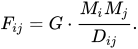
In this formula G is a constant, F stands for trade flow, D stands for the distance and M stands for the economic dimensions of the countries that are being measured. The equation can be changed into a linear form for the purpose of econometric analyses by employing logarithms. The model has been used by economists to analyse the determinants of bilateral trade flows such as common borders, common languages, common legal systems, common currencies, common colonial legacies, and it has been used to test the effectiveness of trade agreements and organizations such as the North American Free Trade Agreement (NAFTA) and the World Trade Organization (WTO) (Head and Mayer 2014). The model has also been used in international relations to evaluate the impact of treaties and alliances on trade (Head and Mayer).
The model has also been applied to other bilateral flow data (also known as "dyadic" data) such as migration, traffic, remittances and foreign direct investment.
Cultural
[edit]
In astronomy, axis mundi is the Latin term for the axis of Earth between the celestial poles. In a geocentric coordinate system, this is the axis of rotation of the celestial sphere. Consequently, in ancient Greco-Roman astronomy, the axis mundi[35] is the axis of rotation of the planetary spheres within the classical geocentric model of the cosmos.[36]
In 20th-century comparative mythology, the term axis mundi – also called the cosmic axis, world axis, world pillar, center of the world, or world tree – has been greatly extended to refer to any mythological concept representing "the connection between Heaven and Earth" or the "higher and lower realms".[37] Mircea Eliade introduced the concept in the 1950s.[38] Axis mundi closely relates to the mythological concept of the omphalos (navel) of the world or cosmos.[39][40][41] Items presented as examples of the axis mundi by comparative mythologists include plants (notably a tree but also other types of plants such as a vine or stalk), a mountain, a column of smoke or fire, or a product of human manufacture (such as a staff, a tower, a ladder, a staircase, a maypole, a cross, a steeple, a rope, a totem pole, a pillar, a spire). Its proximity to heaven may carry implications that are chiefly religious (pagoda, Temple Mount, minaret, church) or secular (obelisk, lighthouse, rocket, skyscraper). The image appears in religious and secular contexts.[42] The axis mundi symbol may be found in cultures utilizing shamanic practices or animist belief systems, in major world religions, and in technologically advanced "urban centers". In Mircea Eliade's opinion: "Every Microcosm, every inhabited region, has a Centre; that is to say, a place that is sacred above all."[43]
Specific examples of cosmic mountains or centers include one from Egyptian texts described as providing support for the sky,[44] Mount Mashu from the Epic of Gilgamesh,[45] Adam's Peak, which is a sacred mountain in Sri Lanka associated with Adam or Buddha in Islamic and Buddhist traditions respectively,[46] Mount Qaf in other Islamic and Arabic cosmologies,[47] the mountain Harā Bərəz in Zoroastrian cosmology,[48] Mount Meru in Hindu, Jain, and Buddhist cosmologies,[48] Mecca as a cosmic center in Sufi cosmology (with minority traditions placing it as Medina or Jerusalem),[49] and, in Tenrikyo, the Jiba at the Tenrikyo Church Headquarters in Tenri, Nara, Japan. In pre-Islamic Arabia, some central temples, including the Temple of Awwam, were cosmic centers.[50]
Pole of inaccessibility
[edit]
In geography, a pole of inaccessibility is the farthest (or the most difficult to reach) location in a given landmass, sea, or other topographical feature, starting from a given boundary, relative to a given criterion. A geographical criterion of inaccessibility marks a location that is the most challenging to reach according to that criterion. Often it refers to the most distant point from the coastline, implying the farthest point into a landmass from the shore, or the farthest point into a body of water from the shore. In these cases, a pole of inaccessibility is the center of a maximally large circle that can be drawn within an area of interest only touching but not crossing a coastline. Where a coast is imprecisely defined, the pole will be similarly imprecise.
Geographic centres in Africa
[edit]Geographic centres in Asia
[edit]- Geographical midpoints of Asia, in China or Russia
- Geographical centre of India[52]
- Geographic center of Iran
- Geographic centre of Sri Lanka
- Geographical centre of the Korean Peninsula
- Geographical centre of the Philippines
- Geographical centre of the Russian Federation
- Geographical centre of the Soviet Union
- Geographic center of Taiwan
Geographic centres in Europe
[edit]- Geographical midpoint of Europe
- Geographical centre of Austria
- Geographic center of Belarus
- Geographical centre of Belgium (Nil-Saint-Vincent-Saint-Martin)
- Geographical centre of Estonia (Paenasti)
- Geographical centre of Germany (Niederdorla)
- Geographical centre of Hungary (Pusztavacs)
- Geographical centre of Ireland
- Geographical centre of Lithuania (Ruoščiai)
- Geographical centre of Norway
- Geographical centre of Poland
- Geographical center of Romania (Făgăraș)
- Geographical centre of the Russian Federation (Lake Vivi)
- Geographical centre of Serbia (Drača)
- Geographical centre of Slovenia
- Geographical centre of the Soviet Union
- Geographical center of Spain (Cerro de los Ángeles)
- Geographical center of Sweden
- Geographical centre of Switzerland
- Centre points of the United Kingdom
- Geographical centre of Great Britain (Brennand Farm)
- Geographic centre of England
- Geographical centre of Scotland
- Geographic centre of Wales (Cwmystwyth)
Geographic centres in North America
[edit]- Geographic center of North America
- Geographic centre of Canada
- Geographic center of the United States
Geographic centres in Oceania
[edit]Geographic centres in South America
[edit]See also
[edit]References
[edit]- ^ a b "Geographic Centers of the United States". United States Geologic Survey: 4. 1964.
- ^ "Where is the centre of Great Britain?". Retrieved 1 September 2019.
- ^ Rogerson, Peter A. (2015-10-02). "A New Method for Finding Geographic Centers, with Application to U.S. States". The Professional Geographer. 67 (4): 686–694. doi:10.1080/00330124.2015.1062707. ISSN 0033-0124. S2CID 128954218.
- ^ "Where's your county seat? A modern mathematical method for calculating centers of geography".
- ^ "Art Meets Science: The Centre of New Zealand's Continental Shelf" (PDF).
- ^ "Clipping from Nelson Mail, 27 June 1962 edition, sourced from GNS library". Retrieved 12 March 2019.
- ^ "Geographic Center of South America".
- ^ a b Affholder, Jean-Georges (2002). "Une nouvelle détermination du pôle des terres émergées" (PDF). Le Monde des Cartes (in French) (173–174): 43–58.
- ^ a b Monmonier, Mark Stephen (2015). "C - Centrography". Cartography in the twentieth century. Vol. 6. Chicago: The University of Chicago press. p. 212-214. ISBN 978-0-226-53469-5.
- ^ Carpineti, Dr. Alfredo (2025-07-01). "Where Are The Real Geographical Centers Of All The Continents?". IFLScience. Retrieved 2026-06-07.
- ^ Rogerson, Peter A. (2015-10-02). "A New Method for Finding Geographic Centers, with Application to U.S. States". The Professional Geographer. 67 (4): 686–694. doi:10.1080/00330124.2015.1062707. ISSN 0033-0124. Retrieved 2026-06-07.
- ^ Developers, PySAL (2020-03-25). "centrography". PySAL. Retrieved 2026-06-08.
- ^ "Analyzing Geographic Distributions and Point Patterns". Spatial Analysis Methods and Practice. Cambridge University Press. 2020-05-31. p. 147–206. doi:10.1017/9781108614528.004. ISBN 978-1-108-61452-8.
- ^ "Geo mid point: Calculation Methods". 2022. Archived from the original on 9 February 2023. Retrieved 2022-09-16.
- ^ a b "What is Centrography?". Cartography and Geographic Information Systems Laboratory. Retrieved 2026-06-08.
- ^ a b c d Raisz, Erwin (1944). "Our Lopsided Earth". Journal of Geography. 43 (3): 81–91. doi:10.1080/00221344408986955. ISSN 0022-1341. Retrieved 2026-06-07.
- ^ a b Leeming, David A. (2014). "Axis Mundi". Encyclopedia of Psychology and Religion. Boston, MA: Springer US. p. 150–151. doi:10.1007/978-1-4614-6086-2_63. ISBN 978-1-4614-6085-5. Retrieved 2026-06-07.
A city or town can be the world center, as in the case of the Greek oracular center, Delphi, often called the world navel.
- ^ "VI. Jerusalem: The Center of the World". Osher Map Library. 2012-09-15. Retrieved 2026-06-07.
- ^ "GK: Where Is The Geographical Centre Of The Earth?". News18. 2025-11-20. Retrieved 2026-06-07.
- ^ Seymour, D. R. (1966). "THE DEVELOPMENT OF CENTROGRAPHY". Proceedings of the Pennsylvania Academy of Science. 39 (2). Penn State University Press: 214–219. ISSN 0096-9222. JSTOR 44110462. Retrieved 2026-06-07.
- ^ Sviatlovsky, E. E.; Eells, Walter Crosby (1937). "The Centrographical Method and Regional Analysis". Geographical Review. 27 (2): 240. doi:10.2307/210093. Retrieved 2026-06-07.
- ^ a b Smyth, Charles Piazzi (1864). Our inheritance in the Great Pyramid. London: W. Isbister & Co. pp. V, 55, 460.
- ^ Smyth, Charles Piazzi (1873). Royal Scottish Society of Arts (ed.). "On an Equal-Surface Projection for Maps of the World, and its Application to Certain Anthropological Questions". Transactions of the Royal Scottish Society of Arts. 8. Edinburgh: Neill & Company: 205–208, 213.
- ^ Affholder, Jean-Georges (2002). "Une nouvelle détermination du pôle des terres émergées" (PDF). Le Monde des Cartes (in French) (173–174): 43–58.
- ^ Monmonier, Mark Stephen (2015). "C - Centrography". Cartography in the twentieth century. Vol. 6. Chicago: The University of Chicago press. p. 212-214. ISBN 978-0-226-53469-5.
- ^ Boggs, Samuel Whittemore (December 1945). "This Hemisphere". Journal of Geography. 44 (9): 345–355. doi:10.1080/00221344508986498.
- ^ Berget, Alphonse (1913). "Répartition géographique des Océans (détermination du pôle continental)". Annales de l'Institut océanographique. 10 (in French). V.
- ^ "L'ILE DUMET: LE NOMBRIL DU MONDE". France Secret (in French). Archived from the original on 10 November 2013.
- ^ Kumler, Mark P.; Goodchild, Michael F. (1992). "The population center of Canada – Just north of Toronto?!?". In Janelle, Donald G. (ed.). Geographical snapshots of North America: commemorating the 27th Congress of the International Geographical Union and Assembly. pp. 275–279.
- ^ Quah, Danny (2011). "The Global Economy's Shifting Centre of Gravity". Global Policy. 2 (1). Wiley: 3–9. doi:10.1111/j.1758-5899.2010.00066.x. ISSN 1758-5880. S2CID 55154148.
- ^ Bergstrand, Jeffrey H.; Egger, Peter H.; Toubal, Farid (2024). "Introduction to the special issue on: Gravity at sixty". European Economic Review 104749. doi:10.1016/j.euroecorev.2024.104749. ISSN 0014-2921.
- ^ Carrère, Céline; Mrázová, Monika; Neary, J. Peter (2020). "Gravity without Apology: The Science of Elasticities, Distance, and Trade". The Economic Journal. 130 (628): 880–910. doi:10.1093/ej/ueaa034. hdl:10419/216556.
- ^ Isard, Walter (May 1954). "Location Theory and Trade Theory: Short-Run Analysis". Quarterly Journal of Economics. 68 (2): 305–320. doi:10.2307/1884452. JSTOR 1884452.
- ^ Capoani, L. (2024). "The gravity equation in international trade: an overview of the introduction of gravity to the study of economics and its systematic barriers". The European Journal of the History of Economic Thought. 31 (3): 487–520. doi:10.1080/09672567.2024.2329064.
- ^ as a declined form in Latin, plural axes mundorum
- ^ The term is used by Geminus in his Elementa, in early modern editions misattributed to Proclus as Commentarius in sphaeram. R. B. Todd, "The Manuscripts of the Pseudo-Proclan Sphaera", Revue d'histoire des textes 23 (1993), 57–71. The term continues to be used in modern astronomical works throughout the 18th century, e.g., Johann Samuel Traugott Gehler, Physikalisches Wörterbuch (1791), p. 688.
- ^ Mircea Eliade (tr. Philip Mairet). "Symbolism of the Centre". In Images and Symbols. Princeton, 1991. ISBN 0-691-02068-X. p.48–51
- ^ Mircea Eliade (tr. Philip Mairet). "Symbolism of the Centre". In Images and Symbols. Princeton, 1991. ISBN 0-691-02068-X. p.40
- ^ J. C. Cooper. An Illustrated Encyclopedia of Traditional Symbols. Thames and Hudson: New York, 1978. ISBN 0-500-27125-9.
- ^ Mircea Eliade (tr. Willard Trask). "Archetypes and Repetition". In The Myth of the Eternal Return. Princeton, 1971. ISBN 0-691-01777-8. p.16
- ^ Winther, Rasmus Grønfeldt (2014). "World Navels". Cartouche 89: 15–21.
- ^ Jean Chevalier and Alain Gheerbrandt. A Dictionary of Symbols. Penguin Books: London, 1996. ISBN 0-14-051254-3. pp.61–63, 173–175
- ^ Mircea Eliade (tr. Philip Mairet). "Symbolism of the Centre". In Images and Symbols. Princeton, 1991. ISBN 0-691-02068-X. p.39
- ^ Seely 1991, p. 233.
- ^ Bilić, Tomislav (2022-09-05). "Following in the Footsteps of the Sun: Gilgameš, Odysseus and Solar Movement". Annali Sezione Orientale. 82 (1–2): 3–37. doi:10.1163/24685631-12340126. ISSN 0393-3180.
- ^ Muhammad, Bilal (2018). "Sri Lanka: The Axis Mundi and the Cradle of Mankind" (PDF). Berkeley Institute for Islamic Studies: 3–6.
- ^ Lebling, Robert (30 July 2010). Legends of the Fire Spirits: Jinn and Genies from Arabia to Zanzibar. I.B.Tauris. pp. 24–28. ISBN 978-0-85773-063-3.
- ^ a b Panaino 2019, p. 24–25.
- ^ O'Meara, Simon (2022-12-14). "Mecca and Other Cosmological Centres in the Sufi Universe". Sufi Cosmology. Brill. pp. 205–233. doi:10.1163/9789004392618_012. ISBN 978-90-04-39261-8.
- ^ Maraqten 2015, p. 112.
- ^ Garcia-Castellanos, Daniel; Lombardo, Umberto (September 2007). "Poles of inaccessibility: A calculation algorithm for the remotest places on earth" (PDF). Scottish Geographical Journal. 123 (3): 227–233. Bibcode:2007ScGJ..123..227G. doi:10.1080/14702540801897809. S2CID 55876083. Archived from the original (PDF) on 29 June 2014. Retrieved 10 November 2016.
- ^ "Geographical Center of India" (PDF). Archived from the original (PDF) on 2013-06-13. Retrieved 2014-11-19.
External links
[edit] Media related to Geographical centres at Wikimedia Commons

If an internal link incorrectly led you here, you may wish to change the link to point directly to the intended article.