


Fire-tailed myzornis
| Fire-tailed myzornis | |
|---|---|

| |
| Male from Pangolakha Wildlife Sanctuary, Sikkim, India | |
Scientific classification 
| |
| Kingdom: | Animalia |
| Phylum: | Chordata |
| Class: | Aves |
| Order: | Passeriformes |
| Family: | Paradoxornithidae |
| Genus: | Myzornis Blyth, 1843 |
| Species: | M. pyrrhoura
|
| Binomial name | |
| Myzornis pyrrhoura Blyth, 1843
| |

The fire-tailed myzornis (Myzornis pyrrhoura) is a species of bird. Its genus Myzornis is monotypic, and has recently been transferred to the family Paradoxornithidae,[2] having formerly been treated in the family Timaliidae.[3]
Description
[edit]The fire-tailed myzornis is a small species of warbler-like bird, 11–13 cm (4.3–5.1 in) long and weighing 10–13 g (0.35–0.46 oz). It has bright green plumage with a black mask around the eyes and black scalloping on the crown. The wing is black and white with a streak of bright red and the sides of the tail are bright red. The bill is long, slightly curved and black.[3] It is usually silent, but has a high-pitched tsi-tsit call.[4]
Distribution and habitat
[edit]The species is found in the Himalaya in Bhutan, southwestern China (southeast Xizang, western Yunnan), northeastern India (Arunachal Pradesh, Sikkim, northernmost West Bengal), northern Myanmar, and Nepal. Its natural habitat is temperate to alpine moist montane forests. It is a common species in the upper ridges of the Sikkim and Arunachal Himalayas, between 1,600–4,300 metres according to climatic conditions and seasonal variation. It prefers bamboo thickets, rhododendrons, birches, and junipers.[1] There is some seasonal movement, occurring at (2,000–) 2,700–3,950 m or higher in summer, and descending to lower altitudes of 1,600–2,750 m in autumn and winter.[4][3]
Ecology
[edit]The fire-tailed myzornis feeds on insects, spiders and small arthropods, as well as consuming fruit, nectar (particularly from rhododendron flowers[4]) and sap from trees. The breeding season is mainly in April to June, but may be longer, as juveniles have been observed in mid-September in Bhutan.[3]
Gallery
[edit]-
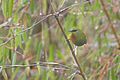 Bamboo stalks
 -
 Rhododendron
 -
 Birch
Birch -
 Oak
Oak -
 Rhododendron
 -
 Fire-tailed myzornis sunbathing beside Dirang Mandala Road at Eaglenest Wildlife Sanctuary


References
[edit]- ^ a b BirdLife International (2018). "Myzornis pyrrhoura". IUCN Red List of Threatened Species. 2018 e.T22716760A132113018. doi:10.2305/IUCN.UK.2018-2.RLTS.T22716760A132113018.en. Retrieved 25 September 2021.
- ^ Gelang, Magnus; Alice Cibois; Eric Pasquet; Urban Olsson; Per Alström; Per G. P. Ericson (2009). "Phylogeny of babblers (Aves, Passeriformes): major lineages, family limits and classification". Zoologica Scripta. 38 (3): 225–236. doi:10.1111/j.1463-6409.2008.00374.x. S2CID 21691730.
- ^ a b c d Collar, N. J.; Robson, C. (2007). "Family Timaliidae (Babblers)". In del Hoyo, J.; Elliott, A.; Christie, D.A. (eds.). Handbook of the Birds of the World. Vol. 12. Picathartes to Tits and Chickadees. Barcelona: Lynx Edicions. p. 280.
- ^ a b c Kazmierczak, Krys; Perlo, Ber van (2000). A Field Guide to the Birds of the Indian Subcontinent. New Haven: Yale University Press. p. 226. ISBN 0-300-07921-4.