


Ethenone
 | |
 | |
.jpg) | |
| Names | |
|---|---|
| Preferred IUPAC name
Ethenone[1] | |
Other names
| |
| Identifiers | |
3D model (JSmol)
|
|
| 1098282 | |
| ChEBI | |
| ChemSpider | |
| ECHA InfoCard | 100.006.671 |
| EC Number |
|
PubChem CID
|
|
| RTECS number |
|
| UNII | |
CompTox Dashboard (EPA)
|
|
| |
| |
| Properties[2] | |
| C2H2O | |
| Molar mass | 42.037 g·mol−1 |
| Appearance | Colourless gas |
| Odor | penetrating |
| Density | 1.93 g/cm3[citation needed] |
| Melting point | −151 °C (−240 °F; 122 K) |
| Boiling point | −49.7 °C (−57.5 °F; 223.5 K) |
| decomposes | |
| Solubility | Soluble in acetone and diethyl ether |
| Vapor pressure | 1 atm (100 kPa) (−50 °C (−58 °F))[2] |
Refractive index (nD)
|
1.4355[citation needed] |
| 1.422[2] | |
| Thermochemistry[2] | |
Heat capacity (C)
|
51.8 J⋅mol−1·K-1 |
Std molar
entropy (S⦵298) |
247.6 J⋅mol−1·K-1 |
Std enthalpy of
formation (ΔfH⦵298) |
−47.5 kJ⋅mol−1 |
Gibbs free energy (ΔfG⦵)
|
−48.3 kJ⋅mol−1 |
Std enthalpy of
combustion (ΔcH⦵298) |
1025 kJ⋅mol−1 |
| Hazards | |
| GHS labelling:[4] | |
   
| |
| Danger | |
| H220, H315, H318, H330, H335 | |
| P203, P210, P222, P260, P264, P264+P265, P271, P280, P284, P302+P352, P304+P340, P305+P354+P338, P316, P317, P319, P320, P321, P332+P317, P362+P364, P377, P381, P403, P403+P233, P405, P501 | |
| NFPA 704 (fire diamond) | |
| Flash point | −107 °C (−161 °F; 166 K) |
| Explosive limits | 5.5%–18% |
Threshold limit value (TLV)
|
0.5 ppm (TWA), 1.5 ppm[2] (STEL) |
| Lethal dose or concentration (LD, LC): | |
LD50 (median dose)
|
1300 mg/kg (oral, rat) |
LC50 (median concentration)
|
17 ppm (mouse, 10 min)[3] |
LCLo (lowest published)
|
|
| NIOSH (US health exposure limits):[5] | |
PEL (Permissible)
|
TWA 0.5 ppm (0.9 mg/m3) |
REL (Recommended)
|
|
IDLH (Immediate danger)
|
5 ppm |
| Safety data sheet (SDS) | External MSDS |
Except where otherwise noted, data are given for materials in their standard state (at 25 °C [77 °F], 100 kPa).
| |


Ethenone is the formal name for ketene, an organic compound with formula C2H2O or H2C=C=O. It is the simplest member of the ketene class. It is an important reagent for acetylations.[6][7]
Properties
[edit]Ethenone is a highly reactive gas (at standard conditions) and has a sharp, irritating odour. It is reasonably stable only at low temperatures (−80 °C (−112 °F)). It must therefore always be prepared for each use and processed immediately, otherwise a dimerization to diketene occurs, or polymers are formed that are difficult to handle. Its polymerization can be reduced by adding sulfur dioxide.[8] Because of its cumulative double bonds, it adds readily to H-acidic compounds, reacting with water, for example, to form acetic acid, and with primary or secondary amines to yield the corresponding acetamides.
Preparation
[edit]Ethenone is produced by thermal dehydration of acetic acid at 700–750 °C (1,292–1,382 °F) in the presence of triethyl phosphate as a catalyst:[9][10]
- CH3CO2H → CH2=C=O + H2O
It has also been produced on a laboratory scale by the thermolysis of acetone at 600–700 °C (1,112–1,292 °F).[11][12]
- CH3COCH3 → CH2=C=O + CH4
This reaction is called the Schmidlin ketene synthesis.[13]
On a laboratory scale it can be produced by the thermal decomposition of Meldrum's acid at temperatures greater than 200 °C (392 °F).[citation needed]
History
[edit]Ethenone was first produced in 1907 by N. T. M. Wilsmore through pyrolysis of acetone or acetic anhydride vapours over a hot platinum wire in an apparatus that was later developed by Charles D. Hurd into the "Hurd lamp" or "ketene lamp". This apparatus consists of a heated flask of acetone producing vapours which are pyrolyzed by a metal filament electrically heated to red heat, with a condenser to return unreacted acetone to the boiling flask. Other heating methods have been used and similar methods were used on a larger scale for the industrial production of ketene for acetic anhydride synthesis.[14][15][16]
Ethenone was discovered at the same time by Hermann Staudinger (by reaction of bromoacetyl bromide with metallic zinc)[17][18] The dehydration of acetic acid was reported in 1910.[19]

The thermal decomposition of acetic anhydride was also described.[20]


Natural occurrence
[edit]Ethenone has been observed to occur in space, in comets or in gas as part of the interstellar medium.[21]
Use
[edit]Ethenone is used to make acetic anhydride from acetic acid. Generally it is used for the acetylation of chemical compounds.[22]
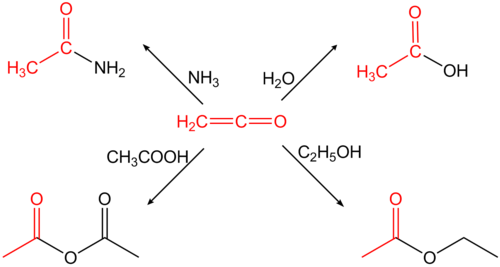
Reactions with ammonia, water, ethanol, and acetic acid


Mechanism of the above reactions

Ethenone reacts with formaldehyde in the presence of catalysts such as Lewis acids (AlCl3, ZnCl2 or BF3) to give β-propiolactone.[23][page needed] The technically most significant use of ethenone is the synthesis of sorbic acid by reaction with crotonaldehyde in toluene at about 50 °C (122 °F) in the presence of zinc salts of long-chain carboxylic acids. This produces a polyester of 3-hydroxy-4-hexenoic acid, which is thermally or hydrolytically depolymerized to sorbic acid.[citation needed]
Ethenone is very reactive, tending to react with nucleophiles to form an acetyl group. For example, it reacts with water to form acetic acid, with acetic acid to form acetic anhydride, with ammonia and amines to form ethanamides, and with dry hydrogen halides to form acetyl halides.[24]
The formation of acetic acid likely occurs by an initial formation of 1,1-dihydroxyethene, which then tautomerizes to give the final product.[25]
Ethenone will also react with itself via [2 + 2] photocycloadditions to form cyclic dimers known as diketenes. For this reason, it should not be stored for long periods.[26][page needed]
Ketene cycloadditions can be difficult to control; dichloroketene is typically used instead, followed by dehalogenation with zinc-copper couple.[27]

Hazards
[edit]Exposure to concentrated levels causes irritation of the eyes, nose, throat and lungs. Extended toxicity testing on mice, rats, guinea pigs and rabbits showed that ten-minute exposures to concentrations of freshly generated ethenone as low as 17 ppm may produce a high percentage of deaths in small animals.[3] These findings show ethenone is toxicologically identical to phosgene.[28][22]
The formation of ketene in the pyrolysis of vitamin E acetate, an additive of some e-liquid products, is one possible mechanism of the reported pulmonary damage[29] caused by electronic cigarette use.[30] A number of patents describe the catalytic formation of ketene from carboxylic acids and acetates, using a variety of metals or ceramics, some of which are known to occur in e-cigarette devices from patients with e-cigarette or vaping product-use associated lung injury (EVALI).[31][32][33]
Occupational exposure limits are set at 0.5 ppm (0.9 mg/m3) over an eight-hour time-weighted average.[34] An IDLH limit is set at 5 ppm, as this is the lowest concentration productive of a clinically relevant physiologic response in humans.[3]
References
[edit]- ^ "Front Matter". Nomenclature of Organic Chemistry : IUPAC Recommendations and Preferred Names 2013 (Blue Book). Cambridge: The Royal Society of Chemistry. 2014. p. 723. doi:10.1039/9781849733069-FP001. ISBN 978-0-85404-182-4.
- ^ a b c d e Haynes, William M., ed. (2016). CRC Handbook of Chemistry and Physics (97th ed.). Boca Raton, Florida: CRC Press. pp. 3–336, 5–24, 5–67, 6–113, 9–63, 16–39. ISBN 9781498754293.
- ^ a b c d "Ketene". Immediately Dangerous to Life or Health Concentrations. National Institute for Occupational Safety and Health.
- ^ PubChem. "Ketene". pubchem.ncbi.nlm.nih.gov. Retrieved 2026-01-28.
- ^ "NIOSH Pocket Guide to Chemical Hazards".
- ^ Miller, Raimund; Abaecherli, Claudio; Said, Adel; Jackson, Barry (2001). "Ketenes". Ullmann's Encyclopedia of Industrial Chemistry. Weinheim: Wiley-VCH. doi:10.1002/14356007.a15_063. ISBN 3527306730.
- ^ Mitzel, Thomas M.; Pigza, Julie A. (2009). "Ketene". Encyclopedia of Reagents for Organic Synthesis. doi:10.1002/047084289X.rk000.pub2. ISBN 978-0-471-93623-7.
- ^ EP 0377438, R. Bergamin et al., issued 1990-06-11, assigned to Lonza AG
- ^ Miller, Raimund; Abaecherli, Claudio; Said, Adel; Jackson, Barry (2001). "Ketenes". Ullmann's Encyclopedia of Industrial Chemistry. doi:10.1002/14356007.a15_063. ISBN 978-3-527-30385-4.
- ^ Arpe, Hans-Jürgen (2007), Industrielle organische Chemie: Bedeutende vor- und Zwischenprodukte (in German) (6th ed.), Weinheim: Wiley-VCH, pp. 200–201, ISBN 978-3-527-31540-6
- ^ Weygand C (1972). Hilgetag G, Martini A (eds.). Weygand/Hilgetag Preparative Organic Chemistry (4th ed.). New York: John Wiley & Sons, Inc. pp. 1031–1032. ISBN 978-0471937494.
- ^ Hurd CD, Kamm O (1941). "Ketene in Organic Syntheses". Organic Syntheses. Vol. Collective Vol. 1. p. 330.
- ^ Schmidlin J, Bergman M (1910). "Darstellung des Ketens aus Aceton" [Preparation of ketene from acetone]. Berichte der Deutschen Chemischen Gesellschaft (in German). 43 (3): 2821–2823. doi:10.1002/cber.19100430340.
- ^ Tidwell, Thomas T. (2005-09-12). "The First Century of Ketenes (1905–2005): The Birth of a Versatile Family of Reactive Intermediates". Angewandte Chemie International Edition. 44 (36): 5778–5785. doi:10.1002/anie.200500098. ISSN 1433-7851. PMID 16149113.
- ^ K.-H. Lautenschläger, W. Schröter, A. Wanninger, "Taschenbuch der Chemie", 20. Aufl. 2006, ISBN 978-3-8171-1761-1.
- ^ "Ketene". Organic Syntheses. doi:10.15227/orgsyn.004.0039.
- ^ Staudinger, H.; Klever, H. W. (January 1908). "Keten. Bemerkung zur Abhandlung zur Abhandlung der HHrn. V.T. Wilsmore und A. W. Stewart)". Berichte der deutschen chemischen Gesellschaft (in German). 41 (1): 1516–1517. doi:10.1002/cber.190804101275.
- ^ Tidwell, Thomas T. (12 September 2005). "Ein Jahrhundert Ketene (1905–2005): die Entdeckung einer vielseitigen Klasse reaktiver Intermediate". Angewandte Chemie (in German). 117 (36): 5926–5933. doi:10.1002/ange.200500098.
- ^ Schmidlin, Julius; Bergman, Maximilian (November 1910). "Darstellung des Ketens aus Aceton". Berichte der deutschen chemischen Gesellschaft (in German). 43 (3): 2821–2823. doi:10.1002/cber.19100430340.
- ^ Wilsmore, Norman Thomas Mortimer (1907). "CLXXXVIII.—Keten". J. Chem. Soc., Trans. 91 (0): 1938–1941. doi:10.1039/ct9079101938.
- ^ Hudson, Reggie L.; Loeffler, Mark J. (31 July 2013). "Ketene Formation in Interstellar Ices: A Laboratory Study". The Astrophysical Journal. 773 (2): 109. Bibcode:2013ApJ...773..109H. doi:10.1088/0004-637x/773/2/109. hdl:2060/20140010162. S2CID 37437108.
- ^ a b Entry on Diketen. at: Römpp Online. Georg Thieme Verlag, retrieved 16. Juni 2014.
- ^ Arpe, Hans-Jürgen (2007). Industrielle organische Chemie: bedeutende Vor- und Zwischenprodukte (6., vollst. überarb. Aufl ed.). Weinheim: Wiley-VCH. ISBN 978-3-527-31540-6.
- ^ Tidwell, Thomas T. (2006). Ketenes (2nd ed.). John Wiley & Sons. pp. 11, 560. ISBN 978-0-471-69282-9.
- ^ Nguyen, Minh Tho; Raspoet, Greet (1999). "The hydration mechanism of ketene: 15 years later". Can. J. Chem. 77 (5–6): 817–829. Bibcode:1999CaJCh..77..817N. doi:10.1139/v99-090.
- ^ Taeschler, Christoph (25 June 2010), "Ketenes, Ketene Dimers, and Related Substances", Kirk-Othmer Encyclopedia of Chemical Technology, New York: John Wiley, doi:10.1002/0471238961.1105200501020105.a01.pub2, ISBN 9780471238966
- ^ Mc Murry, John E.; Miller, Dennis D. (January 1983). "Synthesis of isocaryophyllene by titanium-induced keto ester cyclization". Tetrahedron Letters. 24 (18): 1885–8. doi:10.1016/S0040-4039(00)81797-9.
- ^ H. A. Wooster; C. C. Lushbaugh; C. E. Redeman (1946). "The Inhalation Toxicity of Ketene and of Ketene Dimer". J. Am. Chem. Soc. 68 (12): 2743. Bibcode:1946JAChS..68.2743W. doi:10.1021/ja01216a526.
- ^ "The Vaping-Related Lung Disease Outbreak May be Coming to an End". 20 December 2019. Archived from the original on 10 February 2020. Retrieved 29 March 2020.
- ^ Wu, Dan; O’Shea, Donal F. (24 March 2020). "Potential for release of pulmonary toxic ketene from vaping pyrolysis of vitamin E acetate". Proceedings of the National Academy of Sciences. 117 (12): 6349–6355. Bibcode:2020PNAS..117.6349W. doi:10.1073/pnas.1920925117. PMC 7104367. PMID 32156732.
- ^ Attfield, Kathleen R.; Chen, Wenhao; Cummings, Kristin J.; Jacob, Peyton; O’Shea, Donal F.; Wagner, Jeff; Wang, Ping; Fowles, Jefferson (15 October 2020). "Potential of Ethenone (Ketene) to Contribute to Electronic Cigarette, or Vaping, Product Use–associated Lung Injury". American Journal of Respiratory and Critical Care Medicine. 202 (8): 1187–1189. doi:10.1164/rccm.202003-0654LE. PMID 32551843. S2CID 219919028.
- ^ U.S. patent No. 5475144. Catalyst and process for synthesis of ketenes from carboxylic acids. Dec 12, 1995. https://patents.google.com/patent/US5475144A/en
- ^ US patent 5475144, Watson, P.C.; Libby, M.C. & Barteau, M.A., "Catalyst and process for synthesis of ketenes from carboxylic acids", published 1995-12-12, issued 1995-12-12, assigned to University of Delaware
- ^ NIOSH Pocket Guide to Chemical Hazards. "Ketene". National Institute for Occupational Safety and Health (NIOSH).
External links
[edit] Media related to Ethenone at Wikimedia Commons


