


Epona
| Epona | |
|---|---|
Gallo-Roman Horse Goddess | |
_wall_painting_in_the_Circus_of_Maxentius.jpg) Epona surrounded by four foals in the stables of a circus, engraved from a lost wall panting in the Circus of Maxentius | |
| Venerated in | Roman Empire |
| Symbols | Foal, patera, corn, fruit, cornucopia |
| Day | December 18 |
| Mount | Mare |
| Gender | Female |
| Ethnic group | Gauls |
In Gallo-Roman religion, Epona was the goddess of horses and ponies.[1] She was also a fertility[2][3] and mother goddess,[4][5] and was frequently depicted in art and sculptures either mounted on a horse, etc., (usually in sidesaddle position) or sitting on a throne with foals, or standing beside a foal.[6]
She is typically depicted holding a patera, cornucopia,[7][8][9][10] fruit,[11][1][7] bread, ears of corn (wheat,[8] grain);[12] or accompanied by a foal[7][13] or foals.[15][a]
She may have had a death goddess's aspect,[16] and it is speculated that She (and her horses[16][17]) might have been regarded as escorting souls to the world of the afterlife.[18][21][4][17]
Various scholars also point to the parallel between Epona and the Welsh legendary figure Rhiannon[3][22] (also closely associated with horses[3][23]), and in the first branch pf the Mabinogion (Pwyll Pendefig Dyfed), Rhiannon rides up to the tower to meet the title hero Pwyll who is not only lord of Dyfed, but the "Head of Annwn (the Ohterworld/Underworld)".[3][24][b]
Epona's worship as the patroness of cavalry was widespread in the Roman Empire between the 1st and 3rd centuries AD.[26][27] While adopted Celtic deities were usually only associated with specific localities, Epona was "the sole Celtic divinity ultimately worshipped in Rome itself."[28]
Etymology
[edit]The name Epona ('Great Mare') originates from Gaulish, an extinct Celtic language. It is derived from the reconstructed Proto-Indo-European word for horse: *éḱwos,[29] which appeared in the reconstructed Proto-Celtic language as *ekʷos ('horse'),[31] and later became the Celtic Gaulish epos ('horse').[32][8] The word is paired with the augmentative suffix -on which is frequently, although not exclusively, found in theonyms (ex. Sirona, Matrona) and the usual Gaulish feminine singular -a.[33] Alternately, scholars have suggested that the -ona (or -ana) suffix references sacred water, specifically springs or other water sources.[27][34][c]
Literary attestations
[edit]
A number of Roman writers allude to Epona's cult, and it is rare for a Celtic deity be found in so many instances of mention in classical literature,[36] though the amount of information that can be garnered is still scarce, despite the roster of authors.[37]
One of the earliest attestations to Epona as a goddess is the Satires (100–127 CE) of Juvenal, which links the worship and iconography of Epona to stables.[38] Epona is mentioned in The Golden Ass (2nd century CE) by Apuleius, where in a scene set in northern Greece (Thessaly, famed for horse-breeding[7]), an aedicular niche with her image on a pillar in a stable has been garlanded with freshly picked roses:[39]
Sic adfectus atque in solitudinem relegatus angulo stabuli concesseram. Dumque de insolentia collegarum meorum mecum cogito atque in alterum diem auxilio rosario Lucius demo futurus equi perfidy vindictam meditor, respicio pilae mediae, quae stabuli trabes sustinebat, in ipso fere meditullio Eponae deae simulacrum residens aediculae, quod accurate corollis roseis equidem recentibus fuerat ornatum.
As I stood in my lonely corner, banished from the society of my four-footed colleagues and deciding on a bitter revenge on them next morning as soon as I had eaten my roses and become Lucius again, I noticed a little shrine of [the Mare-headed Mother,] the Goddess Epona, standing in a niche of the post that supported the main beam of the stable. It was wreathed with freshly gathered roses....
As the two above literary instances suggest, Epona artefacts have been discovered at stable sites (cf. § pStable finds)
A euhemeristic account of Epona's origin is found in the Parallela Minora, attributed to Pseudo-Plutarch:
Fulvius Stellus hated women and used to consort with a mare and in due time the mare gave birth to a beautiful girl and they named her Epona. She is the goddess that is concerned with the protection of horses. So Agesilaüs in the third book of his Italian History.[42]
The tale was conveyed in Giambattista Della Porta's edition of Magia naturalis (1589), erroneously citing Plutarch's Life of Solon.[43] It may represent some recollection of ancient Indo-European horse sacrifice— such as the Vedic ashvamedha or the Irish ritual described by Giraldus Cambrensis— both of which are related to kingship. In the Celtic ritual, the king mates with a white mare thought to embody the goddess of sovereignty.[44][45]
Pausanias relates a similar Greek myth regarding Demeter Erinys ('Vengeful Demeter'), who, in the form of a mare, was raped by Poseidon in the form of a stallion.[46][47] Demeter was venerated as a mare at Lycosoura in Arcadia.
Functions and worship
[edit]Epona likely embodied the domesticated aspects of the horse— representing fertility, abundance, reproduction, and protection. She was likely also viewed as a protectress of not just horsemen (including cavalry soldiers, charioteers, muleteers), but of horse-breeding, and venerated by the related professions, such as stable hands, grooms, as well as anyone engaged in any sort of transit or commerce relating to horses,[2][48][49] including travellers on horseback.[51]
The attestation in the Roman work by Apuleius (cf. § Literary attestations) leads to the supposition that altars dedicated to the goddess were commonly placed in stables wherever in the Roman empire.[14][52][53][page needed] While she was later associated with the cavalry due to the circumstance of Gaul being subjugated under Rome (and many Celts were hired as cavalrymen for the auxilary[54]), iconography indicates that prior to Roman contact she was likely a peaceful divinity, associated with fertility and protection rather than war.[29]
Epona in Gaul
[edit]In regional cults in Roman-occupied Gaul, Epona was worshipped as a mother goddess who oversaw the welfare of horses, donkeys, mules, and their riders. Horses were a key component of Pre-Roman Gallic life; Gallic soldiers held their horses in high regard, as seen by Vercingetorix sending away his horses rather than letting them be captured or killed.[55]
Some objects dedicated to the goddess also suggest that she played a funerary role; additionally, horses were believed to guide the soul into the afterlife in some ancient cultures.[53][page needed] Fernand Benoît suggested that images of Epona, in addition to those of the serpent-tailed ("anguiforme") daemon, symbolized a theme of victory over death; he found both images to be manifestations of Mediterranean symbolism, which reached Gaul through contacts with Etruria and Magna Graecia.[56]
Roman Epona
[edit]When Romans came into contact with Celtic deities, they often interpreted the new deity through existing Roman models in a process known as interpretatio romana.[57] As Gaul was Romanized under the early Empire, Epona's sovereign role evolved into a protector of cavalry.[58] Local Gallic customs and Epona's cult were spread across the Roman Empire by the auxilia, alae, numeri, and equites singulares, military units that were primarily recruited from Gaul, Lower Germany, and Pannonia. Due to the modest nature of the goddess' extant offerings and inscriptions, scholars have suggested that Epona may have retained her rustic qualities and focus on healing and fertility even as she was adopted by the Romans.[59]
Epona's feast day in the Roman calendar was given as December 18 on a rustic calendar from Guidizzolo, Italy,[60] although this may have been only a local celebration. She was incorporated into the Roman imperial cult and invoked on behalf of the emperor as Epona Augusta or Epona Regina ('queen').[61][62]
Epona in Hispania
[edit]Evidence of Epona's cult has been found as far west as the Roman province of Hispania, in the Iberian Peninsula. The core of the cult was likely centered around Celtiberia, a region populated by Hispano-Celtic speakers that was later absorbed into the Empire. She is attested to in Cantabria and Palencia in modern-day Spain, where she was known as Epane.[63]
Generally, in art from this region, Epona is depicted riding a horse, standing among a herd of horses, or feeding foals. A small stone altar dedicated to the goddess was found in Andújar, Andalusia, likely dating to the late 1st or early 2nd centuries CE. The goddess herself is not depicted, but a mule is carved into the surface. The expansion of her cult outside of Celtiberia and into cities along the Sierra Morena is likely due to the vast network of copper mines in the region; her worshippers likely worked at or owned these mines.Hernández Guerra (2011), pp. 250–251
In Britain
[edit]In the West Country, specifically Padstow and Minehead, the tradition of May Day hobby-horse parades survived into the 20th century; at the end of the festivities in Padstow, the hobby-horse was formerly ritually submerged into the sea.[64][65] Folklorists have claimed the festival has roots in the ritual worship of Epona. However, there is no firm evidence of the festival existing before the 18th century. A southern Welsh folk ritual called Mari Lwyd (Grey Mare) is still undertaken in December. Some folklorists have likewise claimed the event descends from the veneration of Epona. However, there is no firm evidence to support this claim.[citation needed]
Rhiannon
[edit]In the medieval Welsh collection of stories known as the Mabinogion, the regal figure of Rhiannon rides a white horse, whose slow, effortless gait supernaturally outpaces all pursuit. Wrongly accused of killing her offspring, Rhiannon has to live as a horse for seven years as punishment, offering to carry travellers to the court and telling them her story; she also wears the work-collar of an ass.
She and her son, who is fathered by the sea-god (cf Romano-Greek Poseidon, god of horses and the sea), are sometimes described as mare and foal.[66] Ronald Hutton is skeptical of connections claimed between Epona and Rhiannon; the latter is a much later, literary creation, though it also draws on oral traditions now lost.[67]
Archaeological evidence
[edit]The majority of artifacts related to and dedicated to Epona have been found in what was eastern and northeastern Roman Gaul and around the Roman limes in the German Rhineland, which were garrisoned by cavalry.[27] The hHistorian Benoît claimed that the earliest Epona worship occurred in the Roman Danubian provinces, and asserted that she has been introduced to the Gallic limes by horsemen from the east; however, this suggestion is not widely accepted.[56] The extant evidence for Epona's cult and worship primarily consists of votive objects, inscriptions, and small statues typically created from stone or clay. Objects dedicated to Epona are often found around sacred water— specifically wells, springs, and the Moselle— indicating that she was likely seen as a healer.[68]

Although the name 'Epona' is Gaulish, dedicatory inscriptions to Epona are in Latin or, rarely, in Greek. They were made not only by Celts, but also by Germans and other inhabitants of the Roman Empire. One inscription dedicated to Epona from Mainz, Germany, identifies the dedicator as Syrian.[69] Most often, inscriptions were created by a single individual to honor a pledge or vow to the goddess; most individuals were non-high ranking members of the military— specifically the cavalry— and had Romanized names or Roman surnames.[70]
A long Latin inscription from the first century BCE— engraved on a lead sheet and accompanying the sacrifice of a filly and the votive gift of a cauldron— was found in 1887 at Rom, Deux-Sèvres (Roman settlement of Rauranum). Olmsted reads the inscription as invoking the goddess with an archaic profusion of epithets, including: Eponina ('dear little Epona'), Atanta ('horse-goddess'), Potia ('powerful mistress' (compare Greek Potnia)), Dibonia (Latin, the 'good goddess'), Catona ('of battle'), and Vovesia.[citation needed] However, Olmsted's interpretation has not been generally accepted by other scholars; Meid interprets the same inscription as an invocation of the goddess Dibona in vulgar Greek for aid in a romantic dispute.[71]
Two inscriptions mention a temple dedicated to Epona in modern-day Nièvre, France. The temple was apparently installed on the site where the Gallic chieftain Vercingetorix was defeated by Caesar in 52 CE during the Gallic Wars.[72][73] Evidence of potential cultic or temple sites have additionally been found in Asse and Elewijt in modern-day Belgium.[74]
Stable finds
[edit]Some Epona artefacts have been found at stable sites, e.g., the inscription at the praetorium of the governor of Apulum in Dacia (present-day Alba Iulia, Romania).[75] There is also the mural painting of a goddess riding sidesaddle on a donkey and carrying a child, in the lararium niche of a stable unearthed at Pompeii (site Regio IX, Ins. 2, nr. 24); she is tentatively identifiable as Epona.[e][77][78][79]Small images of Epona have been found in Roman sites of stables and barns over a wide territory[citation needed].
Example from Britain
[edit]A provincial, small (7.5 cm high) Roman bronze of a seated Epona, flanked by an "extremely small" mare and stallion, was found in England.[80] Lying on her lap and on the patera raised in her right hand are disproportionately large ears of grain; ears of grain also protrude from the mouths of the ponies, whose heads are turned toward the goddess. On her left arm she holds a yoke, which curves up above her shoulder, an attribute unique to this bronze statuette.[f]

Iconography
[edit]
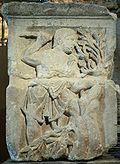
Sculptures of Epona fall into five types, as distinguished by Benoît: riding, standing or seated before a horse, standing or seated between two horses, a tamer of horses in the manner of potnia theron, and the symbolic mare and foal. Most commonly, statues are stone, bronze, or terracotta, and depict the goddess riding sidesaddle.[81][82] In the Equestrian type, common in Gaul, she is depicted sitting side-saddle on a horse or (rarely) lying on one; in the Imperial type (more common outside Gaul) she sits on a throne flanked by two or more horses or foals.[83][84]
In addition to horses, Epona is most frequently depicted holding a cornucopia, with bowls or dishes of fruit, bread, or corn also being common; the cornucopia may have been a Roman addition.[10] These objects are also paired with other goddesses of fertility and abundance such as Fortuna and the Matres. She is also sometimes associated with birds or dogs; the dog is a symbol of Sucellus, Gallic god of agriculture and wine.[82]
Reliefs and sculptures depicting the goddess have been found in Pannonia, Moesia Inferior, Dacia, and the central Balkans; she is often seated and flanked by two horses, wearing a long-sleeved tunic (chiton) with a belt and himation layered over it.[85] She is also represented on the handle of a silver patera holding a foal and wearing a corona muralis.[86] Her worshippers in this region may have primarily consisted of blacksmiths and miners from Gaul that worked in the area's silver and lead mines.[87] Additionally, Epona may be the unidentified goddess depicted interacting with— often blessing— the Thracian Horseman, an obscure deity worshipped in the region.[85]
In literature and art
[edit]In The Legend of Zelda franchise, the main character Link's horse is named Epona. The horse is always shown as a palomino or flaxen chestnut mare with a white mane.
Artist Enya's namesake album of 1987 contains a track titled Epona, as part of the soundtrack of the BBC documentary The Celts.[88]
Today
[edit]On Mackinac Island, Michigan, Epona is celebrated each June with stable tours, a blessing of the animals and the Epona and Barkus Parade. Mackinac Island does not permit personal automobiles; the primary source of transportation remains the horse, so celebrating Epona has special significance on this island in the upper midwest.[89] The "Feast of Epona" involves the blessing of horses and other animals by a local churchman.[90]
Epona is also worshipped today by neo-druids[91] and other pagans and polytheists.[92]
The Goddess name inspired the name of the EPONA (Energetic Particle Onset Admonitor) instrument on the Giotto spacecraft.[93]
See also
[edit]
Explanatory notes
[edit]- ^ Reinach (1898), p. 198 notes a bas relief example of Museum of Worms, "with basket or patera below her knees between two foals", of the type No. 64).
- ^ Hubert supposes that the Epono pedestal found at Waldfischbach in the Palatinate depicts the mounted goddess facing a tower, matching the Rhiannon episode in the Mabinogion.[25]
- ^ Reinach (1903) ventured a hypothesis that the goddess Epona signified "horse-spring" and was originally depicted in the form of a horse (""représentée par une cavale), and later altered by "les progrès de l'anthropomorphisme.[34][35]
- ^ In Robert Graves's translation of The Golden Ass, he has interposed an explanatory "the Mare-headed Mother" that does not appear in the Latin text; it would have linked Epona with the primitive mythology of Demeter, who was covered as a mare by Poseidon in stallion-form (see above); there is no justification for identifying Epona with Demeter, however.
- ^ Though not definitively identifiable as Epona, she may be Isis who is connected with asses, and figures in the Golden Ass.[76]
- ^ Identified as a yoke by Catherine Johns 1971; its misidentification as a serpent has led to misleading identification of a "chthonic" Epona.
References
[edit]Citations
[edit]- ^ a b Aldhouse-Green (1984), p. 146.
- ^ a b Loë, Alfred de, Baron (September 1930). "Statuette équestre d'Épona". Bulletin des Musées royaux d'art et d'histoire. 3ème série. 2 (5): 124–125.
- ^ a b c d e f g Aldhouse-Green, Miranda (2017). "9. Women and Goddesses in the Celtic World §The mistress of animals". In Sutcliffe, Steven J. (ed.). Religion: Empirical Studies. Lit. ISBN 9781351904810.
- ^ a b Eliade, Mircea (1978). A History of Religious Ideas: From Gautama Buddha to the triumph of Christianity. University of Chicago Press. p. 148.
Epona has been interpreted as a Mother Goddess and psychopomp
- ^ Aldhouse-Green (1984), pp. 146, 196.
- ^ Coulter, Charles Russell; Turner, Patricia, eds. (2013). "Epona". Encyclopedia of Ancient Deities. Routledge. ISBN 9781135963972.
- ^ a b c d Linduff (1979), p. 821.
- ^ a b c Monaghan, Patricia (2014) [2004]. "Historical Cycle". The encyclopedia of Celtic mythology and folklore. Facts on File. pp. 157–158. ISBN 9781438110370.
- ^ Reinach (1895), p. 194, Summary VIII, listing Nos. 2, 4, 28, 30 with both patera and cornucopia, other examples show one or the other.
- ^ a b Hernández Guerra (2011), pp. 247–248, 253.
- ^ Reinach (1895), p. 194.
- ^ Aldhouse-Green (1984), p. 146 and (2017)[3]
- ^ Reinach (1895), p. 195, Summary XI, listing Nos. 8, 9, 15, 26, 28 as examples with poulain..
- ^ a b Irby-Massie, Georgia (2018). Military Religion in Roman Britain. Brill. pp. 154–155. ISBN 9789004351226.
- ^ Aldhouse-Green (1984), p. 195: "On stelae dedicated to her, she is often depicted with mares and/or foals". Aldhouse-Green (2017) and Irby-Massie (2018) mention the § Example from Britain, the bronze statuette, British Museum. Epona with two ponies, also holding sheaf of corn-ears.[3][14]
- ^ a b Plisnier, Marie (2010). "Iron Age Oddity; Unusual Animal Remains". In Hily, Gaël; Lajoye, Patrice; Hascoët, Joël; Oudaer, Guillaume; Rose, Christian (eds.). Deuogdonion: mélanges offerts en l'honneur du professeur Claude Sterckx. Rennes: TIR. p. 539. ISBN 9782917681114.
Epona was a goddess of death. This would explain why the horse—as well as the dog, which was sometimes represented with Epona—would have been perceived as a psychopomp animal
- ^ a b Hernández Guerra (2011), pp. 247–248.
- ^ Aldhouse-Green (2017): "at the great cemetery of Horgne au Sablon.. Onon relief from this site Epona rides.. and behind them walks a human figure whom some have interpreted as the soul of a deceased believer being led to the otherworld".[3]
- ^ Forcey, Colin (1998). "Whatever Happened to the Heroes? Ancestral Cults and the Enigma of Romano-Celtic Temples". Theoretical Roman Archaeology Journal. 1997: 90.
- ^ Ross, Anne (1975). "A wooden statuette from Venta Belgarum". Antiquaries Journal. 55: 336.
guiding the souls of the departed to the otherworld of Celtic belief (quoted by Forcey)
- ^ Forcey (1998) identifying Epona as chthonic,[19] and quoting Ross (1975).[20]
- ^ Hubert, Henri (1925). "Le mythe d'Epona". Mélanges linguistiques offerts à M. J. Vendryes (in French). Paris: É. Champion. pp. 187–198. hdl:2027/yul.11164173_000_00.
- ^ Hernández Guerra (2011), p. 248.
- ^ Hubert (1925), p. 189.
- ^ Hubert (1925), pp. 188–189.
- ^ Berresford Ellis, Peter (1998). The Ancient World of the Celts. Great Britain: Constable & Robinson. p. 175. ISBN 0-7607-1716-8.
- ^ a b c Crumley, Carole (2013-10-24). Regional Dynamics Burgundian Landscapes in Historical Perspective. Elsevier. p. 295. ISBN 978-0-323-14402-5.
- ^ Phyllis Pray Bober, reviewing Réne Magnen, Epona, Déesse Gauloise des Chevaux, Protectrice des Cavaliers in American Journal of Archaeology 62.3 (July 1958, pp. 349–350) p. 349. Émile Thevenot contributed a corpus of 268 dedicatory inscriptions and representations.
- ^ a b Kazakevych, Gennadii (2021). "Horse-rider image on the coins of the eastern celts and the cult of celtic war goddess". Ukrayinsʹkyy Numizmatychnyy Shchorichnyk Український Нумізматичний Щорічник [Ukrainian Numismatic Yearbook]. 5: 81–92.
- ^ Schmidt, Karl Horst [in German] (1991). "Latin and Celtic: genetic relationship and areal contacts". The Bulletin of the Board of Celtic Studies. 38: 11.
- ^ Schmidt gives *eḱuos for a reconstructed ancestor[30] but does not clarify if this is PIE or proto-Celtic.
- ^ Gaidoz, Henri (June 1887). "The Religion of the Gauls". The Celtic Magazine. 12 (115): 361.
- ^ Delamarre, X. (2003). Dictionnaire de la langue gauloise. 2nd edition. Paris, Editions Errance. pp. 163–164
- ^ a b Reinach, Salomon (July–August 1903). "Nouvelles Eponas". Revue archéologique. 4ème serie. 2: 348–350.
- ^ Paton, James M. (1904). "American Journal of Archaeology". The Journal of the Archaeological Institute of America. Second Series. 8: 323.
- ^ Green, Miranda Jane (1996). Celtic Goddesses: Warriors, Virgins, and Mothers. G. Brazille. p. 184. ISBN 9780807614051.
- ^ Hernández Guerra (2011), pp. 248–249.
- ^ Satire VIII lines 155–57, where the narrator derides a consul for his inappropriate interest in horses:
interea, dum lanatas robumque iuuencum
more Numae caedit, Iouis ante altaria iurat
solam Eponam et facies olida ad praesepia pictas
- ^ a b Aldhouse-Green, Miranda (2017). An Archaeology of Images: Iconology and Cosmology in Iron Age and Roman Europe. Taylor & Francis. pp. 232–233. ISBN 9781134527779.
- ^ Quoted by Hernández Guerra (2011), p. 248, n6, followed by Spanish translation.
- ^ Graves (1950, p. 82. Quoted by Aldhouse-Green (2004).[39]
- ^ Pseudo-Plutarch, Parallela Minora 29, also found cited as 312e (= Agesilaus FGrHist F 1).
- ^ Giambattista Della Porta (1569). "Magia naturalis, sive De miraculis rerum naturalium". Lyon.[page needed]
- ^ M.L. West, Indo-European Poetry and Myth (Oxford University Press, 2007), p. 418.
- ^ Miriam Robbins Dexter, "Horse Goddess," in Encyclopedia of Indo-European Culture (Taylor & Francis, 1997), p. 280.
- ^ Pausanias, viii.25.5, 37.1 and 42.1 The myth was noted in Bibliotheke 3.77 and reflected also in a lost poem of Callimachus and in Ptolemy Hephaestion's New History.
- ^ Karl Kerenyi, The Gods of the Greeks (1951) pp 184ff "Demeter and Poseidon's stallion-marriages".
- ^ Green, Miranda Jane (1993). Celtic myths. University of Texas Press. pp. 60–61. ISBN 9780292727540.
- ^ Turcan, Robert (1996) The Cults of the Roman Empire, p. 23 apud Jovičić & Bogdanović (2017), p. 38
- ^ Gillespie, Caitlin C. (2018). Boudica: Warrior Woman of Roman Britain. Oxford University Press. p. 148. ISBN 9780190609078.
- ^ Gillespie (2018)[50] citing Linduff (1979); Aldhouse-Green (2003) "Poles apart ? Perceptions of gender in Gallo-British cult-iconography", pp. 102–106.
- ^ . Encyclopædia Britannica. Vol. 9 (11th ed.). 1911. p. 708.
- ^ a b Hernández Guerra (2011).
- ^ Mackintosh (1995), p. 30.
- ^ Linduff (1979), pp. 833, 836.
- ^ a b Benoît (1950).
- ^ Linduff (1979), p. 818.
- ^ Oaks 1986:79–81.
- ^ Crumley (2013).
- ^ Vaillant, 1951.
- ^ Spickermann, Wolfgang. "Keltische Götternamen als Individuelle Option?" Akten des 11. Internationalen Workshops "Fontes Epigraphici Religionum Celticarum Antiquarum" vom 19-21. Mai 2011 an der Universität Erfurt.
- ^ Crumley (2013), p. 300.
- ^ Simón, Francisco Marco (2005-03-10). "Religion and Religious Practices of the Ancient Celts of the Iberian Peninsula". e-Keltoi: The Celts in the Iberian Peninsula. 6. section 2.2.4.1 (pp. 287–345).
- ^ Theo Brown, "Tertullian and Horse-Cults in Britain" Folklore 61.1 (March 1950, pp. 31–34) p. 33.
- ^ Herbert Kille, "West Country hobby-horses and cognate customs" Proceedings of the Somerset Archaeological and Natural History Society 77 (1931) [1]
- ^ Ford, Patrick K., The Mabinogi and Other Medieval Welsh Tales, 2008, University of California Press, pp. 12, 26, 36, 75, isbn 9780520253964. See also Sioned Davies (translator), The Mabinogion, Oxford 2007, p. 231.
- ^ Hutton, Ronald (2014). Pagan Britain. Yale University Press. p. 366. ISBN 978-0300197716.
- ^ Linduff (1979), p. 834: "powers of Epona to regenerate life"; also cited by Jovičić & Bogdanović (2017), p. 38
- ^ CIL 13, 11801
- ^ Crumley (2013), p. 299.
- ^ Wolfgang Meid (2007). "Pseudogallische inschriften". In Lambert, Pierre-Yves; Pinault, Georges-Jean (eds.). Gaulois et celtique continental. Librairie Droz. pp. 277–290. ISBN 9782600013376.
- ^ Linduff (1979), p. 821: "temple in Nièvre and have been dated by epigraphy to the late first of early second century".
- ^ Jovičić & Bogdanović (2017), pp. 38–39.
- ^ De Laet, Sigfried J. (1951). "Survivances Du Culte d'Epona Dans Le Folklore Brabançon?". Latomus (in French). 10 (2): 177–180. JSTOR 41516887.
- ^ Husar, Adrian (1995). "The Celtic Gods in Roman Dacia" (PDF). Acta Musei Napocensis. 32: 89–90. (google)
- ^ Reinach (1895), p. 193.
- ^ Reinach (1895), p. 193 No. 60
- ^ Mackintosh (1995), p. 31.
- ^ Cf. IX.2.24 Pompeii. Stables and scuderia. Excavated 1870 (Part2). with archival photographs, e.g., in color by Stanley A. Jashemski (1961) and older photos showing frescos surrounding the recess.
- ^ Wiltshire is the presumed source of the find, and was added to the provenance "trouvée en Angleterre", after the piece had been described in the sale catalogue of the Ferencz Pulszky collection, Paris, 1868. It is conserved in the British Museum, and is described as "provincial, but not barbaric" in Catherine Johns, "A Roman Bronze Statuette of Epona", The British Museum Quarterly 36.1/2 (Autumn 1971:37–41).
- ^ Linduff (1979), p. 820.
- ^ a b Johns, Catherine (1971). "A Roman Bronze Statuette of Epona". The British Museum Quarterly. 36 (1/2): 37–41. JSTOR 4423098.
- ^ Nantonos, 2004.
- ^ Cf. the bronze found at La Madeleine, Ain department (near Bâgé-la-Ville), fig. no. 1, Reinach (1895), p. 165 described as reclining, though appears to be sidesaddle. German finds in stone and terracotta, Nos. 42, 45, 50–59, Reinach (1895), pp. 182–186 ride sidesaddle.
- ^ a b Plemić, Bojana (September 1930). "Contribution to the Study of the Danubian Horsemen Cult: Iconographic Syncretism of the Danubian Goddess and Celtic Fertility Deities". Archaeologia Bulgarica. 17 (2): 59–72.
- ^ Jovičić & Bogdanović (2017), p. 34 citing Popović (1994) cat. 203
- ^ Jovičić & Bogdanović (2017), pp. 34–35 citing Popović (1995), p. 153
- ^ Enya at Discogs.
- ^ "Mackinac Island Lilac Festival". mackinacislandlilacfestival.org. Archived from the original on February 2, 2015.
- ^ Caitlyn Kienitz (2008-06-21). "Animals Are Blessed During Feast of Epona". Town Crier (www.mackinacislandnews.com). Archived from the original on 2016-03-04. Retrieved 2015-06-29.
- ^ Cf. Potia (n.d.). "Epona". Order of Bards Ovates & Druids. Retrieved 2015-06-29.
- ^ Cf. Jane Raeburn (2001). Celtic Wicca: Ancient Wisdom for the 21st Century. Citadel Press. p. 54.
- ^ Calder, Nigel (1992). Giotto to the Comets. London: Presswork. p. 47. ISBN 0-9520115-0-6.
Bibliography
[edit]- Aldhouse-Green, Miranda Jane (1984). The Wheel as a Cult-symbol in the Romano-Celtic World: With Special Reference to Gaul and Britain. Latomus. pp. 145–146, 195–196. ISBN 9782870311233.
- Benoît, Fernand [in French] (1950). Les mythes de l'outre-tombe. Le cavalier à l'anguipède et l'écuyère Épona. Latomus.
- Evans, Dyfed Llwyd (2005–2007), Epona: a Gaulish and Brythonic goddess (Divine Horse)
- Green M. J. (1986), The Gods of the Celts, Stroud, Gloucestershire.
- Hernández Guerra, Liborio (2011). "La diosa Epona en la Península Ibérica: una revisión crítica". Hispania antiqua (in Spanish). 35: 247–248.
- Jovičić, Mladen; Bogdanović, Ana (2017). "New Evidence of the Cult of Epona in Viminacium". Archaeology and Science. 13: 33–45.
- Linduff, Katheryn M. (1979). "Epona: A Celt among the Romans". Latomus. 38 (4): 817–837. JSTOR 41531375.
- Mackintosh, Marjorie (1995). "4. Epona". The Divine Rider in the Art of the Western Roman Empire. BAR International Series 607. Tempus Reparatum/British Archaeological Reports. pp. 29–37. (alt url@google)
- Magnen, R. Epona (Delmas, 1953).
- Nantonos and Ceffyl (2004), Epona.net, a scholarly resource
- Oaks, L. S. (1986), "The goddess Epona", in M. Henig and A. King, Pagan Gods and Shrines of the Roman Empire (Oxford), pp 77–84.
- Reinach, Salomon (January–June 1895). "Épona". Revue archéologique. 26: 163–195.
- Reinach, Salomon (July–December 1898). "Encore Épona". Revue archéologique. 33: 187–200.
- Speidel, M. P. (1994). Riding for Caesar: the Roman Emperors' Horse Guards. Cambridge, Massachusetts, Harvard University Press.
- Thevenot, Emile 1949. "Les monuments et le culte d' Epona chez les Eduens," L'antiquité Classique 18 pp 385–400. Epona and the Aedui.
- Vaillant, Roger (1951), Epona-Rigatona, Ogam, Rennes, pp 190–205.
Further reading
[edit]- Euskirchen, Marion (1993). "Epona." Bericht der Römisch-Germanischen Kommission 74 pp. 607–838.
- Lajoye, Patrice (2016). "Note sur une source antique méconnue concernant le culte d'Epona en Cisalpine" [A note about a less known ancient source concerning Epona's cult in Cisalpine Gaul]. Études Celtiques. 42: 59–64. doi:10.3406/ecelt.2016.2469.
- Waddell, John. "The Ancestors of Epona." In: Myth and Materiality, 124-46. Oxford; Philadelphia: Oxbow Books, 2018. The Ancestors of Epona.
- Warmind, Morten (2016). "Once More the Celtic Horse-Goddess". Proceedings of the Harvard Celtic Colloquium. 36 (36): 231–40. JSTOR 26383351..

.JPG)
