


Annona
| Annona Temporal range: Late Cretaceous – present
| |
|---|---|

| |
| Annona squamosa | |

| |
| Annona muricata | |
Scientific classification 
| |
| Kingdom: | Plantae |
| Clade: | Embryophytes |
| Clade: | Tracheophytes |
| Clade: | Spermatophytes |
| Clade: | Angiosperms |
| Clade: | Magnoliids |
| Order: | Magnoliales |
| Family: | Annonaceae |
| Subfamily: | Annonoideae |
| Tribe: | Annoneae |
| Genus: | Annona L.[1] |
| Type species | |
| Annona muricata | |
| Species | |
|
Some 169 (see text) | |
| Synonyms[2] | |
| |
Annona or Anona (from Taíno annon) is a genus of flowering plants in the pawpaw/sugar apple family, Annonaceae. It is the second largest genus in the family after Guatteria,[3] containing approximately 166[4] species of mostly Neotropical and Afrotropical trees and shrubs.[5]
The generic name derives from anón, a Hispaniolan Taíno word for the fruit.[6] Paleoethnobotanical studies have dated Annona exploitation and cultivation in the Yautepec River region of Mexico to approximately 1000 BC.[7] Plants of the genus have several common names, including sugar-apple, soursop, anona, cherimoya and guanábana.
Currently, seven Annona species (A. cherimola, A. muricata, A. squamosa, A. reticulata, A. senegalensis, A. scleroderma, A. purpurea) and one hybrid (the atemoya) are cultivated for domestic or commercial use, mostly for the edible and nutritious fruits; several others such as A. crassiflora and A. salzmannii also produce edible fruits.[8] Many of the species are used in traditional medicines for the treatment of a variety of diseases, though their efficacy has yet to be validated scientifically. Several annonaceous species have been found to contain acetogenins, a class of natural compounds with a wide variety of biological activities.[9][10] The first complete genome for a species in this genus (Annona muricata) was published in 2021.[11] The earliest fossils have been found in the Lance Formation dating to the Late Cretaceous.[12]
Description
[edit]Annona species are taprooted, evergreen or semideciduous, tropical trees or shrubs.[5] The plants typically grow in areas where air temperature does not drop below 28 °F (−2 °C), especially Cuba, Jamaica, Central America, India the Philippines and Calabria (southern Italy). However, they have also been known to grow in certain parts of the Andes mountains in South America and in Florida.
The woody trunks have thin bark that has broad and shallow depressions or fissures which join together and are scaly, giving rise to slender, stiff, cylindrical, and tapering shoots with raised pores and naked buds.[5] Leaf blades can be leathery or thin and rather soft or pliable, bald or hairy.[5]
The flowering stalks rise from axils, or occasionally from axillary buds on main stems or older stems, or as solitary flowers or small bundles of flowers. Usually, the three or four deciduous sepals are smaller than the outer petals that do not overlap while in bud. Six to eight fleshy petals are arranged in two whorls—the petals of the outer whorl are larger and do not overlap; inner petals are ascending and distinctively smaller, and nectar glands are darker pigmented. The numerous stamens are ball-shaped, club-shaped, or curved and hooded or pointed beyond anther sac. Numerous pistils, attached directly to the base, are partially united to various degrees with a distinct stigma, with one or two ovules per pistil; the style and stigma are club-shaped or narrowly conic.[5]
One fleshy, ovate to spherical fruit is produced per flower. Each fruit consists of many individual small fruits or syncarps, with one syncarp and seed per pistil. Seeds are bean-like with tough coats; the seed kernels are toxic.[5]
Pollination occurs via Dynastid scarab beetles, which appear to be basic generalists within the genus Annona. Those species of Annona which are more morphologically derived, as well as all Rollinia spp., possess reduced floral chambers and attract small beetles such as Nitidulidae or Staphylinidae.[13]
Toxicology
[edit]
The compound annonacin and dozens of other acetogenins contained in the seeds and fruit of some members of Annonaceae such as Annona muricata (soursop) are neurotoxins and are one of the causes of a Parkinson-like neurodegenerative disease.[14] The only group of people known to be affected by this disease live on the Caribbean island of Guadeloupe and the problem presumably occurs with the consumption of plants containing annonacin. The disorder is a so-called tauopathy associated with a pathologic accumulation of tau protein in the brain. Experimental results published in 2007 demonstrated for the first time that the plant neurotoxin annonacin is responsible for this accumulation.[15]
Selected species
[edit]There are 169 accepted Annona species, as of April 2021, according to Plants of the World Online.[2]
- Annona acuminata
- Annona acutiflora
- Annona ambotay
- Annona angustifolia
- Annona asplundiana
- Annona atabapensis
- Annona aurantiaca
- Annona bullata
- Annona cacans – araticum-cagão
- Annona cascarilloides
- Annona cherimola – cherimoya
- Annona chrysophylla – graines
- Annona conica
- Annona cordifolia
- Annona coriacea
- Annona cornifolia
- Annona crassiflora – araticum do cerrado, marolo
- Annona crassivenia
- Annona cristalensis
- Annona cubensis
- Annona deceptrix
- Annona deminuta
- Annona dioica
- Annona diversifolia
- Annona dolichophylla
- Annona ecuadorensis
- Annona ekmanii
- Annona foetida
- Annona fosteri
- Annona glabra – pond apple, alligator apple, monkey apple
- Annona globiflora
- Annona haematantha
- Annona haitiensis
- Annona hypoglauca
- Annona hystricoides
- Annona jahnii
- Annona jamaicensis
- Annona longiflora
- Annona macrocarpa auct.
- Annona macroprophyllata
- Annona manabiensis
- Annona moaensis
- Annona montana Macfad. – mountain soursop
- Annona muricata – soursop, graviola
- Annona nitida
- Annona nutans
- Annona oligocarpa
- Annona paludosa
- Annona papilionella
- Annona pittieri
- Annona praetermissa
- Annona purpurea – soncoya
- Annona reticulata – custard apple, bullock's heart
- Annona rigida
- Annona rosei[16]
- Annona salzmannii – beach sugar apple
- Annona scleroderma – poshe-te, cawesh, wild red custard apple
- Annona sclerophylla
- Annona senegalensis – African custard apple
- Annona sericea
- Annona spraguei
- Annona squamosa – sugar apple, sweetsop
- Annona stenophylla
- Annona tenuiflora
- Annona tomentosa
- Annona trunciflora
Hybrids
[edit]- Annona × atemoya – atemoya
Insects and diseases
[edit]Annona species are generally disease-free. They are susceptible to some fungi and wilt. Ants may also be a problem, since they promote mealybugs on the fruit.[17]
- Insects
- Braephratiloides cubense (annona seed borer)
- Bepratelloides cubense (annona seed borer)[18][19]
- Morganella longispina (plumose scale)
- Philephedra n.sp. (Philephedra scale)
- Pseudococcus sp. (mealybugs)
- Xyleborus sp. (ambrosia beetles)[18]
- Ammiscus polygrophoides
- Anastrepha atrox
- Anastrepha barandianae
- Anastrepha bistrigata
- Anastrepha chiclayae
- Anastrepha disticta
- Anastrepha extensa
- Anastrepha fraterculus
- Anastrepha oblicua
- Anastrepha serpentina
- Anastrepha striata
- Anastrepha suspensa
- Apate monachus
- Bactrocera spp.
- Bephrata maculicollis
- Brevipalpus spp.
- Ceratitis capitata
- Cerconota anonella
- Coccoidea spp.
- Coccus viridis (green scale)
- Emanadia flavipennis
- Gelwchiidae spp.
- Heliothrips haemorphoidalis
- Leosynodes elegantales
- Lyonetia spp.
- Oiketicus kirby
- Orthezia olivicola
- Phyllocnistis spp.
- Pinnaspis aspidistrae
- Planococcus citri
- Saissetia nigra
- Talponia spp.
- Tenuipalpidae
- Tetranynchus spp.
- Thrips[20]
- Fungi
- Armillaria (oak root fungus)
- Ascochyta cherimolaer
- Athelia rolfsii
- Botryodiplodia theobromae
- Cercospora annonaceae
- Cladosporium carpophilum
- Colletotrichium spp
- Colletotrichium annonicola
- Colletotrichum gloeosporioides
- Diplodia natalensis (dry fruit rot)
- Erythricium salmonicolor
- Fumagina spp
- Fusarium solani
- Gloeosporium spp
- Glomerella cingulata
- Isariopsis anonarum
- Monilia spp
- Nectria episphaeria
- Oidium spp
- Phakopsora cherimolae
- Phomopsis spp
- Phomopsis annonacearum
- Phyllosticta spp
- Phythium spp
- Phytophtora palmivora
- Phytophtora parasitica
- Rhizoctonia noxia
- Rhizoctonia solani
- Rhizoctonia spp
- Rhizopus nigricans
- Rhizopus stolonifer
- Salssetia oleare
- Uredo cherimola
- Verticillium spp (wilt)
- Zignoella annonicola[17][20]
- Nematodes
- Cephalobidae spp.
- Dorylaimidae spp.
- Gracilacus spp.
- Helicotylenchus spp.
- Hemicycliophora spp.
- Hoplolaimidae spp.
- Meloidogyne incognita spp.
- Pratylenchus spp.
- Paratylenchus micoletzky. Rhabditis spp.
- Tylenchorhynchus spp.
- Xiphinema americanum[20]
- Algae
- Diseases
- Fruit rot[18]
References
[edit]- ^ Natural Resources Conservation Service (NRCS). "PLANTS Profile, Annona L." The PLANTS Database. United States Department of Agriculture. Archived from the original on 5 October 2008. Retrieved 16 April 2008.
- ^ a b "Annona L." Plants of the World Online. Royal Botanic Gardens, Kew. Archived from the original on 24 March 2023. Retrieved 9 April 2021.
- ^ "Annona". Integrated Taxonomic Information System. Retrieved 16 April 2008.
- ^ Species of Annona Archived 3 July 2013 at the Wayback Machine on The Plant List. Retrieved 28 May 2013.
- ^ a b c d e f Flora of North America. "1. Annona Linnaeus, Sp. Pl. 1: 536. 1753; Gen. Pl. ed. 5, 241, 1754". 3. Archived from the original on 23 August 2006. Retrieved 20 April 2008.
{{cite journal}}: Cite journal requires|journal=(help) - ^ Austin, Daniel F. (2004). Florida Ethnobotany. CRC Press. p. 95. ISBN 978-0-8493-2332-4.
- ^ Warrington, Ian J. Warrington (2003). "Annonaceae". Apples: Botany, Production and Uses. CABI Publishing. ISBN 0-85199-592-6. Retrieved 20 April 2008.
- ^ University of Southampton (March 2002). "Factsheet No. 5. Annona" (PDF). Fruits for the Future. Department for International Development, International Centre for Underutilised Crops. Archived from the original (PDF) on 20 July 2011. Retrieved 20 April 2008.
- ^ Pilar Rauter, Amélia; A. F. Dos Santos; A. E. G. Santana (2002). "Toxicity of Some species of Annona Toward Artemia salina Leach and Biomphalaria glabrata Say". Natural Products in the New Millennium: Prospects and Industrial Application. Springer Science+Business Media. pp. 540 pages. ISBN 1-4020-1047-8. Retrieved 20 April 2008.
- ^ Esposti, M Degli; A Ghelli; M Ratta; D Cortes; E Estornell (1 July 1994). "Natural substances (acetogenins) from the family Annonaceae are powerful inhibitors of mitochondrial NADH dehydrogenase (Complex I)". The Biochemical Journal. 301 (Pt 1). The Biochemical Society: 161–7. doi:10.1042/bj3010161. PMC 1137156. PMID 8037664.
- ^ Strijk, Joeri S.; Hinsinger, Damien D.; Roeder, Mareike M.; Chatrou, Lars W.; Couvreur, Thomas L. P.; Erkens, Roy H. J.; Sauquet, Hervé; Pirie, Michael D.; Thomas, Daniel C.; Cao, Kunfang (2021). "Chromosome-level reference genome of the soursop (Annona muricata): A new resource for Magnoliid research and tropical pomology". Molecular Ecology Resources. 21 (5): 1608–1619. Bibcode:2021MolER..21.1608S. doi:10.1111/1755-0998.13353. ISSN 1755-0998. PMC 8251617. PMID 33569882.
- ^ "P3855 (Cretaceous of the United States)". PBDB.org. Archived from the original on 12 August 2024. Retrieved 12 August 2024.
- ^ Gottsberger, Gerhard (28 April 1988). "Comments on flower evolution and beetle pollination in the genera Annona and Rollinia (Annonaceae)". Plant Systematics and Evolution. 167 (3–4). Springer Science+Business Media: 189–194. doi:10.1007/BF00936405. S2CID 40889017.
- ^ de Langavant, LC (10 October 2022). "Annonaceae Consumption Worsens Disease Severity and Cognitive Deficits in Degenerative Parkinsonism". Movement Disorders. 37 (12): 2355–2366. doi:10.1002/mds.29222.
- ^ Informationsdienst Wissenschaft: Tauopathie durch pflanzliches Nervengift Archived 13 June 2007 at the Wayback Machine, 4. Mai 2007
- ^ Timyan, J. (2020). "Annona rosei". IUCN Red List of Threatened Species. 2020 e.T141033297A176438833. doi:10.2305/IUCN.UK.2020-3.RLTS.T141033297A176438833.en. Retrieved 7 April 2022.
- ^ a b Robert Vieth. "Cherimoya". Minor subtropicals. Ventura County Cooperative Extension. Archived from the original on 6 August 2007. Retrieved 20 April 2008.
- ^ a b c Jorge Pena; Freddie Johnson (October 1993). "Insect Pests of Annona Crops" (PDF). Other Fruits With Insecticides Known to Have Labels for Use. Department of Entomology, University of Florida. Archived (PDF) from the original on 20 January 2010. Retrieved 19 April 2008.
- ^ Jonathan H. Crane; Carlos F. Balerdi; Ian Maguire (April 1994). "Sugar Apple Growing in the Florida Home Landscape". Fact Sheet HS38. Institute of Food and Agricultural Sciences, University of Florida. Archived from the original on 11 April 2008. Retrieved 19 April 2008.
- ^ a b c d Bridg, Hannia (3 May 2001). Micropropagation and Determination of the in vitro Stability of Annona cherimola Mill. and Annona muricata L. (Thesis). Zertifizierter Dokumentenserver der Humboldt-Universität zu Berlin. doi:10.18452/14481. Archived from the original on 24 April 2008. Retrieved 20 April 2008.
External links
[edit] Media related to Annona at Wikimedia Commons
 Data related to Annona at Wikispecies
- Type Collections of Neotropical Annonaceae – Annona – has pictures and details on these and other Annona species


Images
[edit]-
 Atemoya (A. cherimola × A. squamosa)
 -
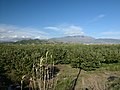 Cherimoya (A. cherimola) plantation
 -

-

-
 Sugar apple (A. squamosa) interior
 -
 Sugar apple interior
 -
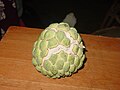 Sugar apple exterior
 -
 Annona muricata
 -
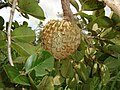 A. crassiflora fruit
 -
 The fruit of A. salzmannii
 -
 Annona squamosa flower and leaves in Hyderabad, India
 -
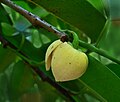 Annona glabra fruit.
 -
 Annona cherimola fruit, Pedra Bela, Brazil
 -
 Halved annona fruit
 -
 Annona tree, Mérida, Yucatán, Mexico
 -
 Annona fruit
.jpg)


_flower_in_Hyderabad_W_IMG_7408.jpg)


