


Iași: Difference between revisions
Biruitorul (talk | contribs) the thing is, that estimate is now present in a bunch of articles, so removing it from just one is arbitrary |
Rescuing 14 sources and tagging 0 as dead. #IABot (v1.6.1) (Balon Greyjoy) |
||
| Line 7: | Line 7: | ||
| image_caption = From top left: [[Palace of Culture (Iași)|Palace of Culture]], [[Vasile Alecsandri]] Statue in front of the [[Iași National Theatre|National Theatre]], [[Alexandru Ioan Cuza University]], [[Golia Monastery|Golia Tower]], [[Metropolitan Cathedral, Iași|Metropolitan Cathedral]], and the [[Iași Botanical Garden|Botanical Garden]] |
| image_caption = From top left: [[Palace of Culture (Iași)|Palace of Culture]], [[Vasile Alecsandri]] Statue in front of the [[Iași National Theatre|National Theatre]], [[Alexandru Ioan Cuza University]], [[Golia Monastery|Golia Tower]], [[Metropolitan Cathedral, Iași|Metropolitan Cathedral]], and the [[Iași Botanical Garden|Botanical Garden]] |
||
| image_shield = Actual_Iasi_CoA.png |
| image_shield = Actual_Iasi_CoA.png |
||
| nickname = The Cultural Capital of Romania, The City of Great Loves, The City of the Famous Destinies, The City of Great Ideas, The City of the Three Unions, The City on Seven Hills<ref>{{cite web|url=http://romaniancoins.org/1000leiu1918.html|title=1000 lei 1998 – 80th anniversary of the Great Union of 1918|publisher=Romanian Coins.org|access-date=24 September 2016|language=[[English language|English]]}}</ref><ref>{{cite web|url=http://www.iasi.djc.ro/|title=Iași, the cultural city|accessdate=24 September 2016|language=[[Romanian language|Romanian]]}}</ref><ref>{{cite web|url=http://www.laiasi.ro/despreiasi.htm|title=About Iaşi|publisher=La Iaşi|accessdate=24 September 2016|date=2002|language=[[Romanian language|Romanian]]}}</ref><ref>{{cite web|url=http://www.tarom.ro/tarom-tours/turism-intern/cazare-oras/|title=Romanian Cities|publisher=[[Tarom]]|language=[[Romanian language|Romanian]]}}</ref> |
| nickname = The Cultural Capital of Romania, The City of Great Loves, The City of the Famous Destinies, The City of Great Ideas, The City of the Three Unions, The City on Seven Hills<ref>{{cite web|url=http://romaniancoins.org/1000leiu1918.html|title=1000 lei 1998 – 80th anniversary of the Great Union of 1918|publisher=Romanian Coins.org|access-date=24 September 2016|language=[[English language|English]]}}</ref><ref>{{cite web|url=http://www.iasi.djc.ro/|title=Iași, the cultural city|accessdate=24 September 2016|language=[[Romanian language|Romanian]]|deadurl=yes|archiveurl=https://archive.is/20120802105002/http://www.iasi.djc.ro/|archivedate=2 August 2012|df=}}</ref><ref>{{cite web|url=http://www.laiasi.ro/despreiasi.htm|title=About Iaşi|publisher=La Iaşi|accessdate=24 September 2016|date=2002|language=[[Romanian language|Romanian]]}}</ref><ref>{{cite web|url=http://www.tarom.ro/tarom-tours/turism-intern/cazare-oras/|title=Romanian Cities|publisher=[[Tarom]]|language=[[Romanian language|Romanian]]|deadurl=yes|archiveurl=https://web.archive.org/web/20110305051216/http://www.tarom.ro/tarom-tours/turism-intern/cazare-oras/|archivedate=2011-03-05|df=}}</ref> |
||
| mapsize = 200px |
| mapsize = 200px |
||
| map_caption = Location of Iași within [[Romania]] (in red) |
| map_caption = Location of Iași within [[Romania]] (in red) |
||
| Line 57: | Line 57: | ||
'''Iași''' ({{IPA-ro|jaʃʲ||Audio Iasi.ogg}}; also referred to as '''Jassy''' or '''Iassy''')<ref>[https://www.jewishvirtuallibrary.org/jsource/judaica/ejud_0002_0011_0_10012.html JASSY] at jewishvirtuallibrary.org</ref><ref name="SaurerLanzinger2006">{{cite book|author1=Edith Saurer|author2=Margareth Lanzinger|author3=Elisabeth Frysak|title=Women's Movements: Networks and Debates in Post-communist Countries in the 19th and 20th Centuries|url=https://books.google.com/books?id=j7ePIpI9qVgC&pg=PA443|year=2006|publisher=Böhlau Verlag Köln Weimar|isbn=978-3-412-32205-2|pages=443–}}</ref> is the second-largest city in [[Romania]]<ref name="INSSER2016"/>, after the national capital [[Bucharest]], and the seat of [[Iași County]]. Located in the historical region of [[Moldavia]], Iași has traditionally been one of the leading centres of Romanian social, cultural, academic and artistic life. The city was the capital of the [[Principality of Moldavia]] from 1564 to 1859, then of the [[United Principalities]] from 1859 to 1862, and the capital of [[Kingdom of Romania|Romania]] from 1916 to 1918. |
'''Iași''' ({{IPA-ro|jaʃʲ||Audio Iasi.ogg}}; also referred to as '''Jassy''' or '''Iassy''')<ref>[https://www.jewishvirtuallibrary.org/jsource/judaica/ejud_0002_0011_0_10012.html JASSY] at jewishvirtuallibrary.org</ref><ref name="SaurerLanzinger2006">{{cite book|author1=Edith Saurer|author2=Margareth Lanzinger|author3=Elisabeth Frysak|title=Women's Movements: Networks and Debates in Post-communist Countries in the 19th and 20th Centuries|url=https://books.google.com/books?id=j7ePIpI9qVgC&pg=PA443|year=2006|publisher=Böhlau Verlag Köln Weimar|isbn=978-3-412-32205-2|pages=443–}}</ref> is the second-largest city in [[Romania]]<ref name="INSSER2016"/>, after the national capital [[Bucharest]], and the seat of [[Iași County]]. Located in the historical region of [[Moldavia]], Iași has traditionally been one of the leading centres of Romanian social, cultural, academic and artistic life. The city was the capital of the [[Principality of Moldavia]] from 1564 to 1859, then of the [[United Principalities]] from 1859 to 1862, and the capital of [[Kingdom of Romania|Romania]] from 1916 to 1918. |
||
Known as ''The Cultural Capital of Romania'', Iași is a symbol in Romanian history. The historian [[Nicolae Iorga]] said "There should be no Romanian who does not know of it".<ref>[http://www.feaa.uaic.ro/geba/Tourism.html Tourism – About Iași]</ref> Still referred to as ''The Moldavian Capital'', Iași is the main economic and business centre of the [[Western Moldavia|Moldavian region]] of Romania.<ref>[http://www.primaria-iasi.ro/content.aspx?item=1612&lang=EN About Iași City]</ref> |
Known as ''The Cultural Capital of Romania'', Iași is a symbol in Romanian history. The historian [[Nicolae Iorga]] said "There should be no Romanian who does not know of it".<ref>[http://www.feaa.uaic.ro/geba/Tourism.html Tourism – About Iași]</ref> Still referred to as ''The Moldavian Capital'', Iași is the main economic and business centre of the [[Western Moldavia|Moldavian region]] of Romania.<ref>[http://www.primaria-iasi.ro/content.aspx?item=1612&lang=EN About Iași City] {{webarchive|url=https://web.archive.org/web/20110715232455/http://www.primaria-iasi.ro/content.aspx?item=1612&lang=EN |date=2011-07-15 }}</ref> |
||
At the 2011 census, the city proper had a population of 290,422 (making it the fourth [[Cities in Romania|most populous]] in Romania at the time). With 474,035 residents ({{As of|2015|lc=y}}), the Iași [[larger urban zone|urban area]] is the second most populous in Romania (after Bucharest),<ref name="luz"/> whereas more than 500,000 people live within its [[peri-urbanisation|peri-urban area]].<ref name="INSSER"/><ref name="periurban">{{cite web |
At the 2011 census, the city proper had a population of 290,422 (making it the fourth [[Cities in Romania|most populous]] in Romania at the time). With 474,035 residents ({{As of|2015|lc=y}}), the Iași [[larger urban zone|urban area]] is the second most populous in Romania (after Bucharest),<ref name="luz"/> whereas more than 500,000 people live within its [[peri-urbanisation|peri-urban area]].<ref name="INSSER"/><ref name="periurban">{{cite web |
||
| Line 83: | Line 83: | ||
Scholars have different theories on the origin of the name "Iași".<ref>[http://www.ziaruldeiasi.ro/local/inceputurile-iasului-o-incursiune-in-istoria-timpurie-a-orasului~ni4i2v The beginnings of Iași] {{Ro icon}}</ref> Some argue that the name originates with the [[Sarmatians|Sarmatian]] tribe [[Iazyges]] (of Iranian origin), one mentioned by [[Ovid]] as {{lang-la|"Ipse vides onerata ferox ut ducata '''Iasyx'''/ Per media Histri plaustra bubulcus aquas" and "'''Iazyges''' et Colchi Metereaque turba Getaque/ Danubii mediis vix prohibentur aquis"}}.<ref>{{cite book|author=[[Ovid]]|title=Ovid: Tristia Book III|url=https://books.google.com/books?id=qmZEAAAAIAAJ&pg=PA60|page=60|edition=2nd, rev.|location=Oxford|publisher=Clarendon Press|year=1893|editor=Sidney George Owen|origyear=c. 8 a.d.}}</ref> |
Scholars have different theories on the origin of the name "Iași".<ref>[http://www.ziaruldeiasi.ro/local/inceputurile-iasului-o-incursiune-in-istoria-timpurie-a-orasului~ni4i2v The beginnings of Iași] {{Ro icon}}</ref> Some argue that the name originates with the [[Sarmatians|Sarmatian]] tribe [[Iazyges]] (of Iranian origin), one mentioned by [[Ovid]] as {{lang-la|"Ipse vides onerata ferox ut ducata '''Iasyx'''/ Per media Histri plaustra bubulcus aquas" and "'''Iazyges''' et Colchi Metereaque turba Getaque/ Danubii mediis vix prohibentur aquis"}}.<ref>{{cite book|author=[[Ovid]]|title=Ovid: Tristia Book III|url=https://books.google.com/books?id=qmZEAAAAIAAJ&pg=PA60|page=60|edition=2nd, rev.|location=Oxford|publisher=Clarendon Press|year=1893|editor=Sidney George Owen|origyear=c. 8 a.d.}}</ref> |
||
A now lost inscription on a [[Roman Empire|Roman]] milestone<ref>Museum Documentation Center Croatia, [http://www.mdc.hr/osijek/eng/10-zavicaj/10-01zavicaj.html A Tractate on the Roman Milestone Discovered near Osijek]</ref> found near [[Osijek]], [[Croatia]] by [[Matija Petar Katančić]] in the 18th century, mentions the existence of a [[Municipium Iasorum|Jassiorum municipium]],<ref>{{Cite book |contribution=Jassium |url=http://www.columbia.edu/acis/ets/Graesse/orblatij.html#Jassium |last=Grässe |first=J. G. Th. |authorlink=Johann Georg Theodor Grässe |title=Orbis latinus; oder, Verzeichnis der wichtigsten lateinischen Orts- und Ländernamen |origyear=1861 |location=Berlin |year=1909 |edition=2nd |publisher=Schmidt |oclc=1301238 |via=Columbia University |language=German }}</ref> or ''Municipium Dacorum-Iassiorum'' from other sources.<ref name="Mono">[https://books.google.com/books?id=0W35ew1Xr-EC&pg=PA11&lpg=PA11&dq=Iassiorum&source=bl&ots=57FDxIt-0n&sig=NB2BxDSf1SI6J5owy0_T-8uHu0w&hl=en&ei=eVPDSqm_AsqHsAasspWuBA&sa=X&oi=book_result&ct=result&resnum=9&ved=0CCgQ6AEwCA#v=onepage&q=Iassiorum&f=false Orașul Iași: monografie istorică și socială] {{Ro icon}}</ref> |
A now lost inscription on a [[Roman Empire|Roman]] milestone<ref>Museum Documentation Center Croatia, [http://www.mdc.hr/osijek/eng/10-zavicaj/10-01zavicaj.html A Tractate on the Roman Milestone Discovered near Osijek] {{webarchive|url=https://web.archive.org/web/20041107052608/http://www.mdc.hr/osijek/eng/10-zavicaj/10-01zavicaj.html |date=2004-11-07 }}</ref> found near [[Osijek]], [[Croatia]] by [[Matija Petar Katančić]] in the 18th century, mentions the existence of a [[Municipium Iasorum|Jassiorum municipium]],<ref>{{Cite book |contribution=Jassium |url=http://www.columbia.edu/acis/ets/Graesse/orblatij.html#Jassium |last=Grässe |first=J. G. Th. |authorlink=Johann Georg Theodor Grässe |title=Orbis latinus; oder, Verzeichnis der wichtigsten lateinischen Orts- und Ländernamen |origyear=1861 |location=Berlin |year=1909 |edition=2nd |publisher=Schmidt |oclc=1301238 |via=Columbia University |language=German }}</ref> or ''Municipium Dacorum-Iassiorum'' from other sources.<ref name="Mono">[https://books.google.com/books?id=0W35ew1Xr-EC&pg=PA11&lpg=PA11&dq=Iassiorum&source=bl&ots=57FDxIt-0n&sig=NB2BxDSf1SI6J5owy0_T-8uHu0w&hl=en&ei=eVPDSqm_AsqHsAasspWuBA&sa=X&oi=book_result&ct=result&resnum=9&ved=0CCgQ6AEwCA#v=onepage&q=Iassiorum&f=false Orașul Iași: monografie istorică și socială] {{Ro icon}}</ref> |
||
Other explanations show that the name originated from the Iranian [[Alans|Alanic]] tribe of '''Jassi''', having same origin with Yazyges tribes [[Jassic people]]. The Prut river was known as ''Alanus fluvius'' and the city as ''Forum Philistinorum''.<ref>Alexandru I. Gonța, Românii și hoarda de aur, Editura Demiurg, Iași, 2010, p. 102</ref><ref>C.C. Giurescu, Târguri sau orașe și cetăti moldovene, București, 1967, p.242-245</ref><ref>Gh. Ghibănescu, Originile Iașilor, în "Arhiva", Iași,1904, p.42-46</ref> From this population derived the plural of town name, "Iașii". |
Other explanations show that the name originated from the Iranian [[Alans|Alanic]] tribe of '''Jassi''', having same origin with Yazyges tribes [[Jassic people]]. The Prut river was known as ''Alanus fluvius'' and the city as ''Forum Philistinorum''.<ref>Alexandru I. Gonța, Românii și hoarda de aur, Editura Demiurg, Iași, 2010, p. 102</ref><ref>C.C. Giurescu, Târguri sau orașe și cetăti moldovene, București, 1967, p.242-245</ref><ref>Gh. Ghibănescu, Originile Iașilor, în "Arhiva", Iași,1904, p.42-46</ref> From this population derived the plural of town name, "Iașii". |
||
| Line 135: | Line 135: | ||
During the war, while the full scale of [[the Holocaust]] remained generally unknown to the [[Allies of World War II|Allied Powers]], the [[Iaşi pogrom|Iași pogrom]] stood as one of the known examples of [[Axis Powers|Axis]] brutality toward the Jews. |
During the war, while the full scale of [[the Holocaust]] remained generally unknown to the [[Allies of World War II|Allied Powers]], the [[Iaşi pogrom|Iași pogrom]] stood as one of the known examples of [[Axis Powers|Axis]] brutality toward the Jews. |
||
The pogrom lasted from 29 June to 6 July 1941, and over 13,266 people,<ref name="Iasipogrom">[http://www.jewishgen.org/databases/holocaust/0099_Iasi.html Jewishgen]<br/>[http://www.rri.ro/art.shtml?lang=1&sec=9&art=149652 The Iași Pogrom] at Radio Romania International<br/>[http://www.zionism-israel.com/dic/iasi_pogrom.htm Iași Pogrom] quotes 13,266 or 14,850 Jews killed.</ref> or one third of the Jewish population, were massacred in the pogrom itself or in its aftermath, and many were deported. |
The pogrom lasted from 29 June to 6 July 1941, and over 13,266 people,<ref name="Iasipogrom">[http://www.jewishgen.org/databases/holocaust/0099_Iasi.html Jewishgen]<br/>[http://www.rri.ro/art.shtml?lang=1&sec=9&art=149652 The Iași Pogrom] {{webarchive|url=https://web.archive.org/web/20120518231651/http://www.rri.ro/art.shtml?lang=1&sec=9&art=149652 |date=2012-05-18 }} at Radio Romania International<br/>[http://www.zionism-israel.com/dic/iasi_pogrom.htm Iași Pogrom] quotes 13,266 or 14,850 Jews killed.</ref> or one third of the Jewish population, were massacred in the pogrom itself or in its aftermath, and many were deported. |
||
{{Main article|First Jassy-Kishinev Offensive|Jassy–Kishinev Offensive (August 1944)}} |
{{Main article|First Jassy-Kishinev Offensive|Jassy–Kishinev Offensive (August 1944)}} |
||
| Line 144: | Line 144: | ||
TRADITION AND TRENDS" by O. Stoleriu and C. Stoleriu</ref> |
TRADITION AND TRENDS" by O. Stoleriu and C. Stoleriu</ref> |
||
By 1989, Iași had become highly industrialised, with 108,000 employees (representing 47% of the total workforce) active in 46 large [[state-owned enterprise]]s, in various industries: chemical, pharmaceutical, metallurgical, heavy equipment, electronics, textile, food, energy, building materials, furniture.<ref>{{cite web|url=http://bioge.ubbcluj.ro/maegs16/volume/6%20urban%20geology%20and%20impact%20of%20geohazards.pdf |title=Microsoft Word - 6 urban geology and impact of geohazards.doc |format=PDF |date= |accessdate=2013-03-26}}</ref><ref name="industria">[http://www.ziaruldeiasi.ro/stiri/metalurgica-tepro-sau-delphi-cum-s-a-transformat-industria-din-iasi-fata-de-1989--84145.html Studiu comparativ de caz despre industria ieșeană] {{Ro icon}}</ref> |
By 1989, Iași had become highly industrialised, with 108,000 employees (representing 47% of the total workforce) active in 46 large [[state-owned enterprise]]s, in various industries: chemical, pharmaceutical, metallurgical, heavy equipment, electronics, textile, food, energy, building materials, furniture.<ref>{{cite web |url=http://bioge.ubbcluj.ro/maegs16/volume/6%20urban%20geology%20and%20impact%20of%20geohazards.pdf |title=Microsoft Word - 6 urban geology and impact of geohazards.doc |format=PDF |date= |accessdate=2013-03-26 |deadurl=yes |archiveurl=https://web.archive.org/web/20150508144635/http://bioge.ubbcluj.ro/maegs16/volume/6%20urban%20geology%20and%20impact%20of%20geohazards.pdf |archivedate=2015-05-08 |df= }}</ref><ref name="industria">[http://www.ziaruldeiasi.ro/stiri/metalurgica-tepro-sau-delphi-cum-s-a-transformat-industria-din-iasi-fata-de-1989--84145.html Studiu comparativ de caz despre industria ieșeană] {{Ro icon}}</ref> |
||
<!-- to be continued --> |
<!-- to be continued --> |
||
| Line 422: | Line 422: | ||
At the [[Demographic history of Romania|2011 census]], Iași was the fourth most populous [[List of cities and towns in Romania|Romanian city]] with a population of 290,422.<ref name="INSSER"/> The [[Iași metropolitan area|metropolitan area association]] (which includes Iași and 13 other nearby communities) had a population of 382,484, while [[Iași County]], with its 772,348 inhabitants, was the [[List of Romanian counties by population|most populous county]] in Romania (after the Municipality of Bucharest). Additionally there were 60,000 more residents (mostly students) and thousands of daily commuters. |
At the [[Demographic history of Romania|2011 census]], Iași was the fourth most populous [[List of cities and towns in Romania|Romanian city]] with a population of 290,422.<ref name="INSSER"/> The [[Iași metropolitan area|metropolitan area association]] (which includes Iași and 13 other nearby communities) had a population of 382,484, while [[Iași County]], with its 772,348 inhabitants, was the [[List of Romanian counties by population|most populous county]] in Romania (after the Municipality of Bucharest). Additionally there were 60,000 more residents (mostly students) and thousands of daily commuters. |
||
According to the 2002 census, in Iași there were 109,357 housing units and 320,888 people living within the city proper. Of this population, 98.5% were ethnic [[Romanians]], while 0.59% were ethnic [[Romani people in Romania|Romani]], 0.13% [[Jews]], 0.13% [[Greeks]], 0.13% [[Lipovans]], 0.08% [[Hungarians]], 0.05% [[Ethnic German|Germans]] and 0.39% others.<ref name="census">{{cite web | url = http://www.edrc.ro/recensamant.jsp?regiune_id=1&judet_id=163&localitate_id=164 | title = Ethno-demographic Structure of Romania | accessdate = January 2, 2011 | publisher = The Ethnocultural Diversity Resource Center }}</ref> In terms of religion, 92.5% of the population were [[Eastern Orthodox Church|Christian Orthodox]], 4.9% [[Roman Catholic]], other religious groups 2.6%. There are currently almost 10,000 Roman Catholics living in Iași.<ref>{{cite web|url=http://recensamant.referinte.transindex.ro/?pg=3&id=1494 |title=Recensământ 2002 |publisher=Recensamant.referinte.transindex.ro |date= |accessdate=2009-06-25}}</ref> There is a debate between historians as to whether the Catholics are originally of Romanian or Hungarian descent.<ref>{{cite web|url=http://www.paxromana.org/node/258 |title=Mother, teacher, nurse. The role of women in society and church according to Hungarian-speaking young Catholics in Romania | Pax Romana ICMICA/MIIC |publisher=Web.archive.org |date=2007-10-14 |accessdate=2009-07-26 |archiveurl = https://web.archive.org/web/20071014011053/http://www.paxromana.org/node/258 |archivedate = 2007-10-14}}</ref> |
According to the 2002 census, in Iași there were 109,357 housing units and 320,888 people living within the city proper. Of this population, 98.5% were ethnic [[Romanians]], while 0.59% were ethnic [[Romani people in Romania|Romani]], 0.13% [[Jews]], 0.13% [[Greeks]], 0.13% [[Lipovans]], 0.08% [[Hungarians]], 0.05% [[Ethnic German|Germans]] and 0.39% others.<ref name="census">{{cite web | url = http://www.edrc.ro/recensamant.jsp?regiune_id=1&judet_id=163&localitate_id=164 | title = Ethno-demographic Structure of Romania | accessdate = January 2, 2011 | publisher = The Ethnocultural Diversity Resource Center }}</ref> In terms of religion, 92.5% of the population were [[Eastern Orthodox Church|Christian Orthodox]], 4.9% [[Roman Catholic]], other religious groups 2.6%. There are currently almost 10,000 Roman Catholics living in Iași.<ref>{{cite web |url=http://recensamant.referinte.transindex.ro/?pg=3&id=1494 |title=Recensământ 2002 |publisher=Recensamant.referinte.transindex.ro |date= |accessdate=2009-06-25 |deadurl=yes |archiveurl=https://web.archive.org/web/20090226161319/http://recensamant.referinte.transindex.ro/?pg=3&id=1494 |archivedate=2009-02-26 |df= }}</ref> There is a debate between historians as to whether the Catholics are originally of Romanian or Hungarian descent.<ref>{{cite web|url=http://www.paxromana.org/node/258 |title=Mother, teacher, nurse. The role of women in society and church according to Hungarian-speaking young Catholics in Romania | Pax Romana ICMICA/MIIC |publisher=Web.archive.org |date=2007-10-14 |accessdate=2009-07-26 |archiveurl = https://web.archive.org/web/20071014011053/http://www.paxromana.org/node/258 |archivedate = 2007-10-14}}</ref> |
||
==Economy== |
==Economy== |
||
| Line 429: | Line 429: | ||
Iași is an important economic centre in Romania. The local and regional economy relies on [[industry]] and [[Tertiary sector of the economy|service sector]] institutions and establishments. The most important service sectors are related to education, health care, banking, research, culture, government and tourism. |
Iași is an important economic centre in Romania. The local and regional economy relies on [[industry]] and [[Tertiary sector of the economy|service sector]] institutions and establishments. The most important service sectors are related to education, health care, banking, research, culture, government and tourism. |
||
The city is an important [[information technology]] sector centre, with the presence of several large multinational companies ([[Amazon.com|Amazon]], [[Oracle Corporation|Oracle]], [[Continental AG|Continental]], [[Xerox]], [[Accenture]], [[Capgemini]]) and many other local and foreign companies such as [[Bentley Systems]], [[Bitdefender]], [[Comodo Group|Comodo]], Endava, [[Ness Technologies|Ness]], [[Pentalog]], [[SCC (Specialist Computer Centres)|SCC]] or [[TiVo Inc.|TiVo]] (to name a few),<ref>[http://www.realitatea.net/hitech-ia-i-sau-cum-devine-ia-ul-un-magnet-pentru-investi-iile-din-it-c_884851.html HITECH Iași sau cum devine Iașul un magnet pentru investițiile din IT&C] {{Ro icon}}</ref> as well as two universities which offer specific degree programs. Industry forecasts expect the Iași ITC workforce to grow from the current 16,000 (end of 2016) employees to more than 33,000, by 2030.<ref name="fum">[http://www.ziaruldeiasi.ro/stiri/exclusiv-a-exploziea-in-industria-fara-fum-din-iasi-numarul-de-angajati-a-crescut-cu-30--166865.html Numărul de angajaţi ai industriei IT&Outsourcing din Iaşi] {{Ro icon}}</ref> |
The city is an important [[information technology]] sector centre, with the presence of several large multinational companies ([[Amazon.com|Amazon]], [[Oracle Corporation|Oracle]], [[Continental AG|Continental]], [[Xerox]], [[Accenture]], [[Capgemini]]) and many other local and foreign companies such as [[Bentley Systems]], [[Bitdefender]], [[Comodo Group|Comodo]], Endava, [[Ness Technologies|Ness]], [[Pentalog]], [[SCC (Specialist Computer Centres)|SCC]] or [[TiVo Inc.|TiVo]] (to name a few),<ref>[http://www.realitatea.net/hitech-ia-i-sau-cum-devine-ia-ul-un-magnet-pentru-investi-iile-din-it-c_884851.html HITECH Iași sau cum devine Iașul un magnet pentru investițiile din IT&C] {{webarchive|url=https://web.archive.org/web/20120411155220/http://www.realitatea.net/hitech-ia-i-sau-cum-devine-ia-ul-un-magnet-pentru-investi-iile-din-it-c_884851.html |date=2012-04-11 }} {{Ro icon}}</ref> as well as two universities which offer specific degree programs. Industry forecasts expect the Iași ITC workforce to grow from the current 16,000 (end of 2016) employees to more than 33,000, by 2030.<ref name="fum">[http://www.ziaruldeiasi.ro/stiri/exclusiv-a-exploziea-in-industria-fara-fum-din-iasi-numarul-de-angajati-a-crescut-cu-30--166865.html Numărul de angajaţi ai industriei IT&Outsourcing din Iaşi] {{Ro icon}}</ref> |
||
An estimated workforce of more than 35,000 employees is active in Iași's [[Manufacturing|industrial manufacturing]] sector,<ref>[http://www.primaria-iasi.ro/content.aspx?item=1679&lang=RO Fişa localității Municipiului Iași] {{Ro icon}}</ref> particularly in automotive ([[Delphi Corporation|Delphi]], [[Lear Corporation|Lear]], Tess Conex), pharmaceutical industry ([[Antibiotice Iași]], Fiterman Pharma, Ircon SRL), metallurgical production ([[ArcelorMittal]], Technosteel LBR), aerospace ([[IGW|BMT Aerospace]]), industrial equipment (Agmus, ASAM, Fortus), energy ([[E.ON|E.ON Moldova Distribuție]], [[Veolia|Veolia Energie]]), textiles and clothing ([[Benetton Group|Benetton]], Iași Conf, Iașitex), home appliances (Tehnoton), building materials (Brikston, Build Corp), food (Compan, Panifcom, Zeelandia).<ref name="industria"/><ref>[http://www.zf.ro/companii/benetton-a-inchis-toate-magazinele-proprii-din-romania-dar-ramane-cu-fabrica-de-la-iasi-6825048 Benetton closes all the shops in Romania, but maintains the production facility in Iasi] {{Ro icon}}</ref> |
An estimated workforce of more than 35,000 employees is active in Iași's [[Manufacturing|industrial manufacturing]] sector,<ref>[http://www.primaria-iasi.ro/content.aspx?item=1679&lang=RO Fişa localității Municipiului Iași] {{webarchive|url=https://web.archive.org/web/20160127071216/http://www.primaria-iasi.ro/content.aspx?item=1679&lang=RO |date=2016-01-27 }} {{Ro icon}}</ref> particularly in automotive ([[Delphi Corporation|Delphi]], [[Lear Corporation|Lear]], Tess Conex), pharmaceutical industry ([[Antibiotice Iași]], Fiterman Pharma, Ircon SRL), metallurgical production ([[ArcelorMittal]], Technosteel LBR), aerospace ([[IGW|BMT Aerospace]]), industrial equipment (Agmus, ASAM, Fortus), energy ([[E.ON|E.ON Moldova Distribuție]], [[Veolia|Veolia Energie]]), textiles and clothing ([[Benetton Group|Benetton]], Iași Conf, Iașitex), home appliances (Tehnoton), building materials (Brikston, Build Corp), food (Compan, Panifcom, Zeelandia).<ref name="industria"/><ref>[http://www.zf.ro/companii/benetton-a-inchis-toate-magazinele-proprii-din-romania-dar-ramane-cu-fabrica-de-la-iasi-6825048 Benetton closes all the shops in Romania, but maintains the production facility in Iasi] {{Ro icon}}</ref> |
||
Located in an area recognised for its vineyards and wines, Iași is part of a traditional [[Romanian wine|wine region]] with viticultural centres surrounding the city: Copou, Bucium, Uricani, Comarna, Plugari, and Probota. Iași County is also home to renowned [[Cotnari]] and [[Busuioacă de Bohotin|Bohotin]] vineyards.<ref>[http://www.vinromania.ro/eng/vinurile_moldovei.php Moldavian Wines]</ref><ref>[http://www.eatglobe.com/products/drinks/wine/romania/moldova/4610-cotnari-cotnari.html Iasi-Cotnari vineyards]</ref> |
Located in an area recognised for its vineyards and wines, Iași is part of a traditional [[Romanian wine|wine region]] with viticultural centres surrounding the city: Copou, Bucium, Uricani, Comarna, Plugari, and Probota. Iași County is also home to renowned [[Cotnari]] and [[Busuioacă de Bohotin|Bohotin]] vineyards.<ref>[http://www.vinromania.ro/eng/vinurile_moldovei.php Moldavian Wines]</ref><ref>[http://www.eatglobe.com/products/drinks/wine/romania/moldova/4610-cotnari-cotnari.html Iasi-Cotnari vineyards] {{webarchive|url=https://web.archive.org/web/20160630060036/http://www.eatglobe.com/products/drinks/wine/romania/moldova/4610-cotnari-cotnari.html |date=2016-06-30 }}</ref> |
||
With large shopping malls and commercial centres located in the area, Iași also has a well-developed [[retail]] business. |
With large shopping malls and commercial centres located in the area, Iași also has a well-developed [[retail]] business. |
||
| Line 492: | Line 492: | ||
[[File:Iaşi , Memorial House „Mihai Codreanu“ (Sonnet Villa)1.1.jpg|thumb|right|Mihai Codreanu Memorial House]] |
[[File:Iaşi , Memorial House „Mihai Codreanu“ (Sonnet Villa)1.1.jpg|thumb|right|Mihai Codreanu Memorial House]] |
||
Iași is home to many museums, memorial houses, art galleries.<br/> |
Iași is home to many museums, memorial houses, art galleries.<br/> |
||
First memorial museum from Romania opened in Iași in 1918, as the [[Ion Creangă]] Memorial House, and today the [http://www.muzeulliteraturiiiasi.ro/muzee/ Iași Romanian Literature Museum] owns fourteen memorial houses. The [[Mihai Eminescu]] Museum, situated in [[Copou Park]], is dedicated to the great poet’s life and creation; other museums are dedicated to: [[Dosoftei]], [[Mihail Kogălniceanu]], [[Vasile Pogor]], [[Nicolae Gane]], [[Petru Poni]], [[Mihai Codreanu]], [[Mihail Sadoveanu]], [[George Topîrceanu]], [[Otilia Cazimir]], [[Radu Cernătescu]], [[Cezar Petrescu]], [[Dimitrie Anghel]]. |
First memorial museum from Romania opened in Iași in 1918, as the [[Ion Creangă]] Memorial House, and today the [https://web.archive.org/web/20160212034024/http://www.muzeulliteraturiiiasi.ro/muzee/ Iași Romanian Literature Museum] owns fourteen memorial houses. The [[Mihai Eminescu]] Museum, situated in [[Copou Park]], is dedicated to the great poet’s life and creation; other museums are dedicated to: [[Dosoftei]], [[Mihail Kogălniceanu]], [[Vasile Pogor]], [[Nicolae Gane]], [[Petru Poni]], [[Mihai Codreanu]], [[Mihail Sadoveanu]], [[George Topîrceanu]], [[Otilia Cazimir]], [[Radu Cernătescu]], [[Cezar Petrescu]], [[Dimitrie Anghel]]. |
||
The [[Theatre Museum (Iaşi)|Theatre Museum]], opened in 1976, at the celebration of 160 years since the first theatrical performance in Romanian, illustrates the development of the theatrical phenomenon since the beginning, important moments of the history of Iași National Theatre, the foundation, in 1840, of the Philharmonic-dramatic Conservatoire, prestigious figures that have contributed to the development of the Romanian theatre. |
The [[Theatre Museum (Iaşi)|Theatre Museum]], opened in 1976, at the celebration of 160 years since the first theatrical performance in Romanian, illustrates the development of the theatrical phenomenon since the beginning, important moments of the history of Iași National Theatre, the foundation, in 1840, of the Philharmonic-dramatic Conservatoire, prestigious figures that have contributed to the development of the Romanian theatre. |
||
| Line 511: | Line 511: | ||
[http://www.filit-iasi.ro/?lang=en FILIT] (International Festival of Literature and Translation Iași) is an international yearly literature and translation festival organised in Iași, Romania by the Iaşi County Council through the Iaşi Museum of Romanian Literature. Three editions have taken place so far and the festival is recognised as one of the leading Central and Eastern European events of its kind.<ref>{{Cite web|title = Culisele unei investiții de 56,7 milioane de euro {{!}} Evenimentul|url = http://www.ziarulevenimentul.ro/stiri/dosar/culisele-unei-investitii-de-56-7-milioane-de-euro--217242189.html|website = www.ziarulevenimentul.ro|accessdate = 2015-11-23}}</ref> [http://www.fieiasi.eu FIE] (International Education Festival) is a yearly arts festival organised in Iași, Romania by the City Hall. Three editions have taken place thus far. |
[http://www.filit-iasi.ro/?lang=en FILIT] (International Festival of Literature and Translation Iași) is an international yearly literature and translation festival organised in Iași, Romania by the Iaşi County Council through the Iaşi Museum of Romanian Literature. Three editions have taken place so far and the festival is recognised as one of the leading Central and Eastern European events of its kind.<ref>{{Cite web|title = Culisele unei investiții de 56,7 milioane de euro {{!}} Evenimentul|url = http://www.ziarulevenimentul.ro/stiri/dosar/culisele-unei-investitii-de-56-7-milioane-de-euro--217242189.html|website = www.ziarulevenimentul.ro|accessdate = 2015-11-23}}</ref> [http://www.fieiasi.eu FIE] (International Education Festival) is a yearly arts festival organised in Iași, Romania by the City Hall. Three editions have taken place thus far. |
||
The [[Romanian National Opera, Iași|Iași National Opera]] organises the [http://www.operaiasi.ro/gala-premiilor-operelor-nationale-editia-a-iii-a/ Romanian Gala of National Operas], with the third edition taking place in 2015. A rock festival, [http://www.rockniasi.ro/ Rock'n'Iași] takes place in October. [http://gardenerjazz.ro Gardner Jazz Festival] is a local festival that started in 2014 and had its second edition in 2015. An aeronautics and art festival called [http://hangariada.ro/despre-festival/ Hangariada] is organised each year in May. |
The [[Romanian National Opera, Iași|Iași National Opera]] organises the [http://www.operaiasi.ro/gala-premiilor-operelor-nationale-editia-a-iii-a/ Romanian Gala of National Operas], with the third edition taking place in 2015. A rock festival, [http://www.rockniasi.ro/ Rock'n'Iași] takes place in October. [http://gardenerjazz.ro Gardner Jazz Festival] is a local festival that started in 2014 and had its second edition in 2015. An aeronautics and art festival called [https://web.archive.org/web/20160409004441/http://hangariada.ro/despre-festival/ Hangariada] is organised each year in May. |
||
Live music and various other artistic events (poetry nights, readings) are a habitual occurrence in the various bars and coffee shops the city has to offer. |
Live music and various other artistic events (poetry nights, readings) are a habitual occurrence in the various bars and coffee shops the city has to offer. |
||
| Line 538: | Line 538: | ||
* [[Ion Ionescu de la Brad University of Agricultural Sciences and Veterinary Medicine of Iaşi|Ion Ionescu de la Brad University of Agricultural Sciences and Veterinary Medicine]] – one of the oldest schools of its kind. |
* [[Ion Ionescu de la Brad University of Agricultural Sciences and Veterinary Medicine of Iaşi|Ion Ionescu de la Brad University of Agricultural Sciences and Veterinary Medicine]] – one of the oldest schools of its kind. |
||
There are also some private higher education institutions including [[Petre Andrei University of Iași|Petre Andrei University]], the largest private university in the historical region of Moldavia.<ref>[http://www.iasi4all.ro/item/universitatea-petre-andrei-din-iasi/ About UPA] {{Ro icon}}</ref> |
There are also some private higher education institutions including [[Petre Andrei University of Iași|Petre Andrei University]], the largest private university in the historical region of Moldavia.<ref>[http://www.iasi4all.ro/item/universitatea-petre-andrei-din-iasi/ About UPA] {{webarchive|url=https://archive.is/20150118191427/http://www.iasi4all.ro/item/universitatea-petre-andrei-din-iasi/ |date=2015-01-18 }} {{Ro icon}}</ref> |
||
The [[Central University Library of Iaşi|Central University Library of Iași]], where the chief records of Romanian history are preserved, is the oldest and the second largest in Romania. |
The [[Central University Library of Iaşi|Central University Library of Iași]], where the chief records of Romanian history are preserved, is the oldest and the second largest in Romania. |
||
| Line 734: | Line 734: | ||
<!-- Other relevant sites --> |
<!-- Other relevant sites --> |
||
* [http://www.123iasi.ro Iași] |
* [http://www.123iasi.ro Iași] |
||
* [http://www.map2web.cc/map4/index.php?fpnr=273&lang=en Street Map of Iași, as commissioned by the City Hall] |
* [https://web.archive.org/web/20090218000458/http://www.map2web.cc/map4/index.php?fpnr=273&lang=en Street Map of Iași, as commissioned by the City Hall] |
||
* [http://www.altiasi.ro Cultural events in Iași] |
* [http://www.altiasi.ro Cultural events in Iași] |
||
* [http://www.turism-iasi.ro/index.php?id=101 Iași city Tourism] |
* [http://www.turism-iasi.ro/index.php?id=101 Iași city Tourism] |
||
Revision as of 13:33, 9 December 2017
Iași | |
|---|---|
City | |
.jpg) From top left: Palace of Culture, Vasile Alecsandri Statue in front of the National Theatre, Alexandru Ioan Cuza University, Golia Tower, Metropolitan Cathedral, and the Botanical Garden | |
| Nickname(s): | |
  Iași Location of Iași within Romania (in red) | |
| Coordinates: 47°09′25″N 27°35′25″E / 47.15694°N 27.59028°E | |
| Country |  Romania Romania |
| County | Template:RO-IS |
| Status | Municipality |
| Settled | Before 14th century |
| First official record | 1408 |
| Government | |
| • Mayor | Mihai Chirica (PSD) |
| Area | |
• City | 93.9 km2 (36.3 sq mi) |
| • Metro | 808 km2 (312 sq mi) |
| Elevation | 60 m (200 ft) |
| Population (2011 census)[6] | |
• City | 290,422 |
• Estimate (2016)[7] | 362,142 |
| • Density | 3,092/km2 (8,010/sq mi) |
| • Metro | 474,035[5] |
| Time zone | UTC+2 (EET) |
| • Summer (DST) | UTC+3 (EEST) |
| Postal Code | 700xxx |
| Area code | +40 x32 |
| Car Plates | IS |
| Climate | Dfb |
| Website | www |

Iași (Template:IPA-ro; also referred to as Jassy or Iassy)[8][9] is the second-largest city in Romania[7], after the national capital Bucharest, and the seat of Iași County. Located in the historical region of Moldavia, Iași has traditionally been one of the leading centres of Romanian social, cultural, academic and artistic life. The city was the capital of the Principality of Moldavia from 1564 to 1859, then of the United Principalities from 1859 to 1862, and the capital of Romania from 1916 to 1918.
Known as The Cultural Capital of Romania, Iași is a symbol in Romanian history. The historian Nicolae Iorga said "There should be no Romanian who does not know of it".[10] Still referred to as The Moldavian Capital, Iași is the main economic and business centre of the Moldavian region of Romania.[11]
At the 2011 census, the city proper had a population of 290,422 (making it the fourth most populous in Romania at the time). With 474,035 residents (as of 2015[update]), the Iași urban area is the second most populous in Romania (after Bucharest),[5] whereas more than 500,000 people live within its peri-urban area.[6][12]
Home to the oldest Romanian university and to the first engineering school, Iași is one of the most important education and research centres of the country, and accommodates over 60,000 students in 5 public universities.[13][14] The social and cultural life revolves around the Vasile Alecsandri National Theater (the oldest in Romania), the Moldova State Philharmonic, the Opera House, the Iași Athenaeum, a famous Botanical Garden (the oldest and largest in Romania), the Central University Library (the oldest in Romania), the high quality cultural centres and festivals, an array of museums, memorial houses, religious and historical monuments. The city is also known as the site of the largest Romanian pilgrimage which take place each year, in October.[15]
Etymology and names
The city is historically referred to as:
- Template:Lang-bg
- English, Polish: Jassy
- Template:Lang-fr
- German: Jassy, Jassenmarkt
- Template:Lang-el
- Template:Lang-he
- Template:Lang-hu
- Template:Lang-it
- Russian: Яссы, Yassy
- Template:Lang-sr
- Template:Lang-tr
- Template:Lang-uk
- Template:Lang-yi

Scholars have different theories on the origin of the name "Iași".[16] Some argue that the name originates with the Sarmatian tribe Iazyges (of Iranian origin), one mentioned by Ovid as Template:Lang-la.[17]
A now lost inscription on a Roman milestone[18] found near Osijek, Croatia by Matija Petar Katančić in the 18th century, mentions the existence of a Jassiorum municipium,[19] or Municipium Dacorum-Iassiorum from other sources.[20]
Other explanations show that the name originated from the Iranian Alanic tribe of Jassi, having same origin with Yazyges tribes Jassic people. The Prut river was known as Alanus fluvius and the city as Forum Philistinorum.[21][22][23] From this population derived the plural of town name, "Iașii".
Another historian wrote that the Iasians lived among the Cumans and that they left the Caucasus after the first Mongolian campaign in the West, settling temporarily near the Prut. He asserts that the ethnic name of Jasz which is given to Iasians by Hungarians has been erroneously identified with the Jazyges; also he shows that the word jasz is a Slavic loan word.[24] The Hungarian name of the city (Jászvásár) literally means "Jassic Market"; the antiquated Romanian name, Târgul Ieșilor (and the once-favoured Iașii), and the German Jassenmarkt, may indicate the same meaning.
History

Ancient times
Archaeological investigations attest to the presence of human communities on the present territory of the city and around it as far back as the prehistoric age.[20] Later settlements included those of the Cucuteni-Trypillian culture, a late Neolithic archaeological culture.
There is archaeological evidence of human settlements in the area of Iași dating from the 6th to 7th centuries (Curtea Domnească) and 7th to 10th centuries; these settlements contained rectangular houses with semicircular ovens.[25] Also, many of the vessels (9th–11th centuries) found in Iaşi had a cross, potentially indicating that the inhabitants were Christians.[26]
Early development
The name of the city is first found in a document from 1408. This is a grant of certain commercial privileges by the Moldavian Prince Alexander to the Polish merchants of Lvov. However, as buildings older than 1408 still exist, e.g. the Armenian Church believed to be originally built in 1395, it is certain that the city existed before its first surviving written mention.
Capital of Moldavia
Around 1564, Prince Alexandru Lăpușneanu moved the Moldavian capital from Suceava to Iași. Between 1561 and 1563, a school and a Lutheran church were founded by the Greek adventurer Prince, Ioan Iacob Heraclid.
.jpg)


In 1640, Vasile Lupu established the first school in which the Romanian language replaced Greek, and set up a printing press in the Byzantine Trei Ierarhi Monastery (Monastery of the Three Hierarchs; built 1635–39). Between 15 September - 27 October 1642, the city hosted the Synod of Jassy (also referred to as the Council of Jassy). In 1643, the first volume ever printed in Moldavia was published in Iași.
The city was burned down by the Tatars in 1513, by the Ottomans in 1538, and by Imperial Russian troops in 1686. In 1734, it was hit by the plague.
It was through the Peace of Iași that the sixth Russo-Turkish War was brought to a close in 1792. A Greek revolutionary manoeuvre and occupation under Alexander Ypsilanti (Αλέξανδρος Υψηλάντης) and the Filiki Eteria (Φιλική Εταιρία) (1821, at the beginning of the Greek War of Independence) led to the storming of the city by the Turks in 1822. In 1844 a severe fire affected much of the city.
Mid–19th century to 20th century


Between 1564 and 1859, the city was the capital of Moldavia; then, between 1859 and 1862, both Iași and Bucharest were de facto capitals of the United Principalities of Moldavia and Wallachia. In 1862, when the union of the two principalities was recognised under the name of Romania, the national capital was established in Bucharest. For the loss caused to the city in 1861 by the removal of the seat of government to Bucharest the constituent assembly voted 148,150 lei to be paid in ten annual instalments, but no payment was ever made.[citation needed]
During World War I, Iași was the capital of a much reduced Romania for two years, following the Central Powers' occupation of Bucharest on 6 December 1916. The capital was returned to Bucharest after the defeat of Imperial Germany and its allies in November 1918. In November–December 1918 Iași hosted the Jassy Conference.
Jewish community
Iași also figures prominently in Jewish history, with the first documented presence of Sephardi Jews from the late 16th century. The oldest tomb inscription in the local cemetery probably dates to 1610.[27] By the mid-19th century, owing to widespread Russian Jewish and Galician Jewish immigration into Moldavia, the city was at least one-third Jewish.

In 1855, Iași was the home of the first-ever Yiddish-language newspaper, Korot Haitim, and, in 1876, the site of what was arguably the first-ever professional Yiddish theatre performance, established by Avraham Goldfaden. The words of HaTikvah, the national anthem of Israel, were written in Iași by Naftali Herz Imber. Jewish musicians in Iași played an important role as preservers of Yiddish folklore, as performers and composers.
According to the 1930 census, with a population of 34,662 (some 34% of the city's population), Jews were the second largest ethnic group in Iași. There were over 127 synagogues. After World War II, in 1947, there were about 38,000 Jews living in Iași. Because of massive emigration to Israel, in 1975 there were about 3,000 Jews living in Iași and four synagogues were active.[27]
Currently, Iași has a dwindling Jewish population of ca. 300 to 600 members and two working synagogues, one of which, the 1671 Great Synagogue, is the oldest surviving synagogue in Romania.[28]
World War II
During the war, while the full scale of the Holocaust remained generally unknown to the Allied Powers, the Iași pogrom stood as one of the known examples of Axis brutality toward the Jews.
The pogrom lasted from 29 June to 6 July 1941, and over 13,266 people,[29] or one third of the Jewish population, were massacred in the pogrom itself or in its aftermath, and many were deported.
In May 1944, the Iași area became the scene of ferocious fighting between Romanian-German forces and the advancing Soviet Red Army and the city was partially destroyed. The German Panzergrenadier Division Großdeutschland won a defensive victory at the Battle of Târgu Frumos, near Iași, which was the object of several NATO studies during the Cold War. By 20 August, Iași had been taken by Soviet forces.[30]
Post-World War II era
Iași experienced a major wave of industrialisation, in 1955–1975.[31] During this period of time, it received numerous migrants from rural regions, and the urban area expanded.[32] The socialist period saw a growth of 235% in population and 69% in area in Iași; however, the urban planning was sometimes arbitrary and followed by dysfunctions.[33]
By 1989, Iași had become highly industrialised, with 108,000 employees (representing 47% of the total workforce) active in 46 large state-owned enterprises, in various industries: chemical, pharmaceutical, metallurgical, heavy equipment, electronics, textile, food, energy, building materials, furniture.[34][35]
Geography
Topography

Located in the North-East of Romania, between the Iași Ridge (Template:Lang-ro) (the northern-most hill formation of the Bârlad Plateau) and the Jijia Plain, Iași used to be the crossroads place of the commercial routes that passed through Moldavia coming from Kingdom of Poland, Habsburg Monarchy, Tsardom of Russia and Constantinople.
The city lies on the Bahlui River, a tributary of the Jijia (tributary of the Prut). The surrounding country is one of uplands and woods, featuring monasteries and parks. Iași itself stands amid vineyards and gardens, partly on hills, partly in the in-between valley.
It is a common belief that Iași is built on seven hills (Template:Lang-ro): Cetățuia, Galata, Copou-Aurora, Bucium-Păun, Șorogari, Repedea and Breazu, thus triggering comparisons with Rome.
Climate
| Climate data for Iași, Romania (1981–2010) | |||||||||||||
|---|---|---|---|---|---|---|---|---|---|---|---|---|---|
| Month | Jan | Feb | Mar | Apr | May | Jun | Jul | Aug | Sep | Oct | Nov | Dec | Year |
| Record high °C (°F) | 16.7 (62.1) |
22.5 (72.5) |
27.0 (80.6) |
31.8 (89.2) |
36.4 (97.5) |
38.0 (100.4) |
40.1 (104.2) |
39.7 (103.5) |
38.0 (100.4) |
33.9 (93.0) |
29.0 (84.2) |
19.5 (67.1) |
40.1 (104.2) |
| Mean daily maximum °C (°F) | 1.1 (34.0) |
3.3 (37.9) |
9.3 (48.7) |
16.7 (62.1) |
23.1 (73.6) |
26.1 (79.0) |
28.1 (82.6) |
27.8 (82.0) |
22.4 (72.3) |
16.1 (61.0) |
8.1 (46.6) |
2.3 (36.1) |
15.4 (59.7) |
| Daily mean °C (°F) | −2.3 (27.9) |
−0.9 (30.4) |
3.9 (39.0) |
10.5 (50.9) |
16.7 (62.1) |
19.9 (67.8) |
21.7 (71.1) |
20.9 (69.6) |
15.9 (60.6) |
10.2 (50.4) |
4.0 (39.2) |
−0.9 (30.4) |
10.0 (50.0) |
| Mean daily minimum °C (°F) | −5.2 (22.6) |
−4.2 (24.4) |
−0.1 (31.8) |
5.4 (41.7) |
10.6 (51.1) |
14.2 (57.6) |
15.9 (60.6) |
15.2 (59.4) |
10.8 (51.4) |
5.9 (42.6) |
0.9 (33.6) |
−3.7 (25.3) |
5.5 (41.9) |
| Record low °C (°F) | −30.6 (−23.1) |
−36.3 (−33.3) |
−22.7 (−8.9) |
−9.4 (15.1) |
−3.0 (26.6) |
3.5 (38.3) |
6.3 (43.3) |
4.6 (40.3) |
−3.5 (25.7) |
−9.6 (14.7) |
−21.1 (−6.0) |
−29.5 (−21.1) |
−36.3 (−33.3) |
| Average precipitation mm (inches) | 27.9 (1.10) |
25.9 (1.02) |
30.8 (1.21) |
46.1 (1.81) |
55.2 (2.17) |
88.2 (3.47) |
74.9 (2.95) |
54.9 (2.16) |
54.9 (2.16) |
37.0 (1.46) |
34.3 (1.35) |
31.6 (1.24) |
561.7 (22.11) |
| Average snowfall cm (inches) | 11.3 (4.4) |
14.3 (5.6) |
11.9 (4.7) |
6.9 (2.7) |
0.0 (0.0) |
0.0 (0.0) |
0.0 (0.0) |
0.0 (0.0) |
0.0 (0.0) |
0.7 (0.3) |
10.4 (4.1) |
6.3 (2.5) |
61.8 (24.3) |
| Average precipitation days (≥ 0.1 mm) | 12.6 | 11.2 | 11.6 | 11.4 | 12.1 | 12.3 | 11.0 | 8.5 | 8.7 | 8.1 | 10.1 | 12.6 | 130.2 |
| Average relative humidity (%) | 82 | 80 | 71 | 62 | 61 | 62 | 60 | 63 | 66 | 73 | 79 | 83 | 70 |
| Mean monthly sunshine hours | 67 | 91 | 136 | 180 | 256 | 260 | 288 | 275 | 200 | 153 | 79 | 61 | 2,046 |
| Source 1: World Meteorological Organization,[36] Ogimet (mean temperatures and sun 1981–2010)[37] | |||||||||||||
| Source 2: Romanian National Statistic Institute (extremes 1901–2000),[38] NOAA (sunshine and snowfall 1961–1990),[39] Deutscher Wetterdienst (extremes, 1896–2015 and humidity, 1896–1960)[40] | |||||||||||||
Iași has a humid, continental-type climate (Köppen climate classification "Dfb" — summer wetter than winter, European subtype) with four distinct seasons. Summers are warm with temperatures sometimes exceeding 35 °C (95 °F) while winters are cold and windy with moderate snowfall and temperatures at night sometimes dropping below −15 °C (5 °F). Average monthly precipitation ranges from about 25 mm (1.0 in) in October to 100 mm (3.9 in)in June.
Cityscape
Architecture


Iaşi features historical monuments, 500-year-old churches and monasteries, contemporary architecture, many of them listed on the National Register of Historic Monuments. Notable architecture includes the Trei Ierarhi Monastery, part of the tentative list of UNESCO World Heritage Site, or the neo-Gothic Palace of Culture, built on the old ruins of the mediaeval Princely Court of Moldavia.
During World War II and the Communist era many historical buildings in the old city centre (around Union Square area) were destroyed or demolished, and replaced by International style buildings and also a new mainly Mid-Century modern style Civic Centre was built around the Old Market Square (The Central Hall).[31]
The mid-1990s to early-2000s brought the first non-industrial glass curtain walled buildings (Romtelecom, Hotel Europa), while in 2012, in close proximity to the Palace of Culture, the Palas shopping mall and office complex was inaugurated.


Other significant buildings include:
- Alexandru Ioan Cuza University main building (1897), a mixture of the Neoclassical and Baroque styles, houses the famous Hall of the Lost Footsteps where one can admire the works of the painter Sabin Bălașa;
- "Vasile Alecsandri" National Theatre, built between 1894 and 1896 in Neoclassic style with Baroque and Rococo inspired painted and sculpted ornaments;
- Dosoftei House, a building from the second half of the 17th century in which in 1679, the metropolitan bishop Dosoftei settled the second typography in Moldavia. With three façades, arched and right-angled windows, the edifice was restored between 1966 and 1969. It houses the department of old literature of the Romanian Literature Museum;
- Roznovanu Palace (The City Hall), second half of the 18th century, rebuilt between 1830 and 1833, during World War I, it hosted the Romanian government;
- Union Museum, 1806, Empire style, the palace served as the royal residence of Prince Alexandru Ioan Cuza between 1859 and 1862 and in 1917–1918, during World War I, as the royal residence of king Ferdinand;
- Pogor House, 1850, a meeting place for the city intellectuals, the headquarters of Literary Society Junimea (1863) and of the Convorbiri Literare (Literary Interlocutions) magazine (1867), houses the Romanian Literature Museum;
- Luceafărul Theatre, 1987, a unique modern building in Romania;
- Central University Library, 1934, incorporates Greek Revival elements;
- Great Railway Station, 1870, inspired by Venetian Doge's Palace.
Religious buildings
Iași is the seat of the Romanian Orthodox Metropolitan of Moldavia and Bukovina, and of the Roman Catholic Bishop of Iași. The city and the surrounding area house more than 10 monasteries and 100 historical churches.[41] Among the oldest is Princely Saint Nicholas (1491), dating from the reign of Stephen the Great, and the Metropolitan Cathedral is the largest of its kind in Romania. The Trei Ierarhi Monastery, a unique monument, considered to be an architectural masterpiece,[42] was erected in 1635–1639 by Vasile Lupu, and adorned with gilded carvings on its outer walls and twin towers.
- Metropolitan Cathedral (1839/1886), the largest Orthodox church in Romania, a late Renaissance style, with Baroque elements and Gheorghe Tattarescu paintings;[41]
- Golia Monastery, 1564, rebuilt in 1650 in late-Renaissance style with Byzantine frescoes and intricately carved doorways, is a monumental construction, a monastery in the middle of the city, surrounded by tall walls, with corner turrets, and a 30 m (98.43 ft) height bell tower;
- Old Catholic Cathedral, 1782, in Baroque style, and New Catholic Cathedral, 2005;
- Armenian Church, built in 1395, testifies the existence of an important Armenian community in these parts of Romania;
- Great Synagogue, in late Baroque style, built in 1657–1671, is the oldest surviving synagogue in Romania and one of the oldest in Europe.[41]
Other examples of historic churches and monasteries (some of them surrounded by defence walls and towers) include: Socola (1562), Galata (1582), Saint Sava (1583), Hlincea (1587), Aroneanu (1594), Bârnova (1603), Barnovschi (1627), Golia (1650), Cetățuia (1668), Frumoasa (1726), Saint Spiridon (1747), Old Metropolitan Cathedral (1761), Bărboi (1843 with 18th-century bell tower), Bucium (1853).[43]
-

-
 Barnovschi Church
 -
 Golia Church architectural elements
 -
 Moldavian princely palace at Cetățuia Monastery
 -

-
 St. George Church (Old Metropolitan Cathedral)


Pilgrimage
The city has became a major Christian pilgrimage site since the early modern period. In 1641, the relics of Saint Parascheva were brought to Iași. Each year, around 14 October, hundreds of thousands of pilgrims gather to commemorate Saint Parascheva, while the city itself established its Celebration Days at the same time.[44] The October pilgrimage is one of the largest in Europe, drawing people all over Romania as well as from neighbouring Orthodox countries.[15]
During the entire year, pilgrimages to Iași can also involve visits to a large number of religious sites, both within and around the city.
Gardens, parks and natural landmarks

Iași has a diverse array of public spaces, from city squares to public parks.

Begun in 1833, at the time when Iași was the capital of Moldavia, by Prince Mihail Sturdza and under the plans of Gheorghe Asachi and Mihail Singurov, Copou Park was integrated into the city and marks one of the first Romanian coordinated public parks. The oldest monument in Romania stands in the middle of the park, the Obelisk of Lions (1834), a 13.5 m (44.29 ft) tall obelisk, dedicated to the Law of Organic Rules, the first law on political, administrative and juridical organisation in Romanian Principalities.[45]
Founded in 1856, the Botanical Garden of Iași, the first botanical garden in Romania, has an area of over 100 hectares, and more than 10,000 species of plants.
Iași Exhibition Park was opened in 1923 and built under the co-ordination of the architect N. Ghica Budești.
The Ciric Park, located in the north-eastern part of Iași is another complex which consists into the park and four lakes.
Eminescu's Linden Tree (Template:Lang-ro) is a 500 year old silver lime (Tilia tomentosa Moench) situated in the Copou Public Garden. Mihai Eminescu reportedly wrote some of his best works underneath this lime, rendering the tree one of Romania's most important natural monuments and a notable Iași landmark.[46] The Odd Poplers Alley, in Bucium neighbourhood, is another spot where Mihai Eminescu sought inspiration (the poem "Down Where the Lonely Poplars Grow"). In 1973, the 15 white poplars still left (with the age ranges between 233 and 371 years) were declared natural monuments.
Iași County has 387 centuries-old trees, of which 224 were declared monument trees and 160 got the Romanian Academy's approval and are proposed for such a classification. Most of them are oak or linden trees. The oldest tree in the county is the 675-year-old hybrid lime tree located in the courtyard of Bârnova Monastery, in the vicinity of Iași. When the lime was about 57 years old and had about 14 cm (5.5 in) in diameter, Iași was mentioned as an urban settlement, during the reign of Prince Alexander the Good (1408).[47]
Demographics
| Year | Pop. | ±% |
|---|---|---|
| 18th century | 30,000 | — |
| 1831 | 59,880 | +99.6% |
| 1851 | 70,000 | +16.9% |
| 1859 | 65,745 | −6.1% |
| 1900 | 78,067 | +18.7% |
| 1912 | 75,229 | −3.6% |
| 1930 | 102,872 | +36.7% |
| 1948 | 96,075 | −6.6% |
| 1956 | 112,977 | +17.6% |
| 1966 | 161,023 | +42.5% |
| 1977 | 265,002 | +64.6% |
| 1992 | 344,425 | +30.0% |
| 2002 | 320,888 | −6.8% |
| 2011 | 290,422 | −9.5% |
| Sources: 18th century, 1831, 1859:,[48] 1851:,[49] 1900:,[50] 1912 Census:,[51] 1930–2011: Censuses. | ||

As of 1 January 2016[update], Iași is the country's second most populous city after Bucharest with 362,142 residents registered within the city limits,[7] and with a population of 465,477 residents, the Iași urban area is also the second largest in Romania.[5]
At the 2011 census, Iași was the fourth most populous Romanian city with a population of 290,422.[6] The metropolitan area association (which includes Iași and 13 other nearby communities) had a population of 382,484, while Iași County, with its 772,348 inhabitants, was the most populous county in Romania (after the Municipality of Bucharest). Additionally there were 60,000 more residents (mostly students) and thousands of daily commuters.
According to the 2002 census, in Iași there were 109,357 housing units and 320,888 people living within the city proper. Of this population, 98.5% were ethnic Romanians, while 0.59% were ethnic Romani, 0.13% Jews, 0.13% Greeks, 0.13% Lipovans, 0.08% Hungarians, 0.05% Germans and 0.39% others.[52] In terms of religion, 92.5% of the population were Christian Orthodox, 4.9% Roman Catholic, other religious groups 2.6%. There are currently almost 10,000 Roman Catholics living in Iași.[53] There is a debate between historians as to whether the Catholics are originally of Romanian or Hungarian descent.[54]
Economy


Iași is an important economic centre in Romania. The local and regional economy relies on industry and service sector institutions and establishments. The most important service sectors are related to education, health care, banking, research, culture, government and tourism.
The city is an important information technology sector centre, with the presence of several large multinational companies (Amazon, Oracle, Continental, Xerox, Accenture, Capgemini) and many other local and foreign companies such as Bentley Systems, Bitdefender, Comodo, Endava, Ness, Pentalog, SCC or TiVo (to name a few),[55] as well as two universities which offer specific degree programs. Industry forecasts expect the Iași ITC workforce to grow from the current 16,000 (end of 2016) employees to more than 33,000, by 2030.[56]
An estimated workforce of more than 35,000 employees is active in Iași's industrial manufacturing sector,[57] particularly in automotive (Delphi, Lear, Tess Conex), pharmaceutical industry (Antibiotice Iași, Fiterman Pharma, Ircon SRL), metallurgical production (ArcelorMittal, Technosteel LBR), aerospace (BMT Aerospace), industrial equipment (Agmus, ASAM, Fortus), energy (E.ON Moldova Distribuție, Veolia Energie), textiles and clothing (Benetton, Iași Conf, Iașitex), home appliances (Tehnoton), building materials (Brikston, Build Corp), food (Compan, Panifcom, Zeelandia).[35][58]
Located in an area recognised for its vineyards and wines, Iași is part of a traditional wine region with viticultural centres surrounding the city: Copou, Bucium, Uricani, Comarna, Plugari, and Probota. Iași County is also home to renowned Cotnari and Bohotin vineyards.[59][60]
With large shopping malls and commercial centres located in the area, Iași also has a well-developed retail business.
Largest employers
| Company | Industry | Employees |
|---|---|---|
| Sf. Spiridon University Hospital | Health care | 2,944 |
| Alexandru Ioan Cuza University | High education | 2,021 |
| Conduent | IT services | 1,876 |
| Delphi Diesel Systems | Automotive industry | 1,724 |
| Gheorghe Asachi Technical University | High education | 1,710 |
| Continental Automotive Romania | Automotive Engineering | 1,600 |
| Antibiotice Iași | Pharmaceutical industry | 1,458 |
| RATP | Public transport | 1,349 |
| St. Maria Clinic Children's Hospital | Health care | 1,256 |
| University of Medicine and Pharmacy | High Education | 1,230 |
Culture
_9.JPG)

Major events in the political and cultural history of Moldavia are connected with the name of the city of Iași. The great scholars of the 17th century, Grigore Ureche, Miron Costin and later Ion Neculce, wrote most of their works in the city or not far from it and the famous scholar Dimitrie Cantemir known throughout all Europe also linked his name to the capital of Moldavia.
The first newspaper in Romanian language was published in 1829 in Iași and it is in Iași where, in 1867, appeared under literary society Junimea, the Convorbiri Literare review in which Ion Creangă’s Childhood Memories and the best poems by Mihai Eminescu were published. The reviews Contemporanul and Viața Românească appeared in 1871, respectively in 1906 with great contributions to promoting Romanian national cultural values.
Many great personalities of Romanian culture are connected to Iași: the chronicler Nicolae Milescu, the historians and politicians Mihail Kogălniceanu and Simion Bărnuțiu, the poets Vasile Alecsandri and George Topârceanu, the writers Mihail Sadoveanu, Alecu Russo, and Ionel Teodoreanu, the literary critic Titu Maiorescu, the historian A.D. Xenopol, the philosophers Vasile Conta and Petre Andrei, the sociologist Dimitrie Gusti, the geographer Emil Racoviță and the painter Octav Băncilă, only to name a few.
Theatres and orchestras


The "Vasile Alecsandri" National Theatre, opened in 1840, is the first National Theatre in Romania. The building, designed according to the plans of the Viennese architects Hermann Helmer and Ferdinand Fellner, was raised between 1894 and 1896, and also hosts, starting 1956, the Iași Romanian National Opera.
Iași is also home to:
- Moldova State Philharmonic Orchestra
- Luceafărul Theatre
- Iași Athenaeum (also known as Tătărași Athenaeum)
- Ludic Student Theatre
- Teatru Fix [1]
Museums

1.1.jpg)
Iași is home to many museums, memorial houses, art galleries.
First memorial museum from Romania opened in Iași in 1918, as the Ion Creangă Memorial House, and today the Iași Romanian Literature Museum owns fourteen memorial houses. The Mihai Eminescu Museum, situated in Copou Park, is dedicated to the great poet’s life and creation; other museums are dedicated to: Dosoftei, Mihail Kogălniceanu, Vasile Pogor, Nicolae Gane, Petru Poni, Mihai Codreanu, Mihail Sadoveanu, George Topîrceanu, Otilia Cazimir, Radu Cernătescu, Cezar Petrescu, Dimitrie Anghel.
The Theatre Museum, opened in 1976, at the celebration of 160 years since the first theatrical performance in Romanian, illustrates the development of the theatrical phenomenon since the beginning, important moments of the history of Iași National Theatre, the foundation, in 1840, of the Philharmonic-dramatic Conservatoire, prestigious figures that have contributed to the development of the Romanian theatre.
The Union Museum, includes original pieces and documents which belonged to prince Al. I. Cuza and his family.
The Natural History Museum, founded on 4 February 1834, is the first museum of this kind in Romania with over 300,000 items, the most valuable being the collections of insects, mollusc, amphibians, reptiles, birds, plants and minerals.
Four other museums are located in the Palace of Culture: with its roots dating back to 1860, the Iași Art Museum is the oldest of its kind in Romania,[63] and, with more than 8,700 works (many of them belonging to the universal patrimony), has the largest art collection in the country; the Moldavia's History Museum, offers more than 48,000 objects from various fields, archaeology, numismatics, decorative art, ancient books, documents; the Ethnographic Museum of Moldavia owns more than 13,000 objects depicting the Romanian advance through the ages; the Science and Technology Museum's collection has more than 11,200 objects in five distinct sections and one memorial house.[64]
Foreign culture centres

Iași hosts six cultural centres: French, German, British, Latin American & Caribbean, Hellenic, and Arab.
Cultural events and festivals
Periferic is an international biennial of contemporary art organised in Iași, Romania by the Vector Association. Eight editions have taken place thus far.
FILIT (International Festival of Literature and Translation Iași) is an international yearly literature and translation festival organised in Iași, Romania by the Iaşi County Council through the Iaşi Museum of Romanian Literature. Three editions have taken place so far and the festival is recognised as one of the leading Central and Eastern European events of its kind.[65] FIE (International Education Festival) is a yearly arts festival organised in Iași, Romania by the City Hall. Three editions have taken place thus far.
The Iași National Opera organises the Romanian Gala of National Operas, with the third edition taking place in 2015. A rock festival, Rock'n'Iași takes place in October. Gardner Jazz Festival is a local festival that started in 2014 and had its second edition in 2015. An aeronautics and art festival called Hangariada is organised each year in May.
Live music and various other artistic events (poetry nights, readings) are a habitual occurrence in the various bars and coffee shops the city has to offer.
Education


The first institute of higher learning that functioned on the territory of Romania was Academia Vasiliană (1640) founded by Prince Vasile Lupu as a "higher school for Latin and Slavonic languages", followed by the Princely Academy in 1707.
The first high education structure in Romanian language was established in the autumn of 1813, when engineer Gheorghe Asachi laid the foundations of a class of engineers, its activities taking place within the Greek Princely Academy.
After 1813, other moments marked the development of higher education in Romanian language, regarding both humanities and the technical science. In 1835, Academia Mihăileană founded by Prince Mihail Sturdza is considered first Romanian superior institute in the country.

In 1860, three faculties part of the Academia Mihăileană formed the nucleus for the newly established University of Iași, the first Romanian university.
The Physicians and Naturalists Society, founded in Iași, has existed since the early part of the 19th century, and a number of periodicals are published. One of the oldest medical universities in Romania, founded in 1879, is located in Iași. It is now known as the Grigore T. Popa University of Medicine and Pharmacy.
In 1937, the two applied science sections of the University of Iași became departments of the newly created Gheorghe Asachi Polytechnic School. In the period before and after World War II, the later (renamed Polytechnic Institute in 1948) extended its domain of activity, especially in the field of engineering, and became known as Gheorghe Asachi Technical University in 1993.
Public universities include:

- Alexandru Ioan Cuza University- situated in Copou, is the oldest higher education institution in Romania;
- Gheorghe Asachi Technical University – the school with the oldest engineering tradition in Romania;
- Grigore T. Popa University of Medicine and Pharmacy – one of the oldest medicine schools in Romania;
- George Enescu National University of Arts – the oldest tradition in music and arts education in Romania;
- Ion Ionescu de la Brad University of Agricultural Sciences and Veterinary Medicine – one of the oldest schools of its kind.
There are also some private higher education institutions including Petre Andrei University, the largest private university in the historical region of Moldavia.[66]
The Central University Library of Iași, where the chief records of Romanian history are preserved, is the oldest and the second largest in Romania.
As of 2016[update], Iași has 74 public schools, coordinated by the Iași County School Inspectorate. The city is also home to 19 private schools.[67]
Notable high schools:
- Iași National College (1828)
- Costache Negruzzi National College (1895)
- Mihai Eminescu National College (1865)
- Vasile Lupu Pedagogical High School (1855)
Iași Science Festival is a week long festival organised every year in April (starting 2013) for high school and grade school students to get be able to observe and take part in scientific experiments and be given detailed tours of the scientific and technical universities and research labs in Iași. Over 200 experiments were performed and over 10,000 students took part in the 2014 edition, from throughout the Moldavia region.[68]
Media
Sports
![[icon]](/proxy/https://en.wikipedia.org/wiki/File:Wiki_letter_w_cropped.svg) | This section needs expansion. You can help by adding missing information. (May 2012) |
In 2012, Iași was selected as one of the European Cities of Sport.[69]
Current teams

| Sport | League | Club | Founded | Venue |
|---|---|---|---|---|
| Basketball | Men's Divizia A | Politehnica Iași | Sala Polivalentă | |
| Basketball | Women's Divizia A | Politehnica Național Iași | Sala Polivalentă | |
| Football | Liga I | CSM Studențesc Iași (as the informal successor to Politehnica Iași) | 16 August 2010 | Emil Alexandrescu Stadium |
| Handball | Women's Liga Națională | Terom Iași | Sala Polivalentă | |
| Rugby | SuperLiga | Poli Agro Unirea Iași | 1964 | Agronomia Stadium |
| Volleyball | Women's Divizia A2 | ACS Penicilina Iași | Sala Polivalentă |
Former teams
- FC Politehnica Iași of the Romanian Football League from 1945–2010.
Transport
Public transport
Iași's public transportation system is served by the CTP Iași which operates an extensive network using 150 trams (electric trams began operating in Iași in 1900) and 150 buses. In 2014, the CTP (former RATP) carried 50,358,000 passengers, an average of 140,000 passengers per day.[70]
Air

Iași is served by the Iași International Airport (IAS) located 8 km (5.0 mi) east of the city centre. The airport is the 4th busiest in Romania and offers direct domestic, European, and Middle Eastern scheduled or charter connections. After extensive modernisation works, the number of connections and traffic volumes have seen a significant increase, in 2015.[71]
Rail

Iași-Pașcani railway was opened on 1 June [O.S. 20 May] 1870, Iași-Ungheni on 1 August 1874 and Iași-Chișinău railway was opened on 1 June 1875 by the Russian Empire in preparation for the Russo-Turkish War (1877–1878).
Nowadays, three railway stations, Great Railway Station, Nicolina International Rail Station and Socola Rail Station serve the city and are operated by Romanian Railways (CFR). Moldovan railway also serves these stations for travel into Moldova.
The Great Railway Station, located about 1 km (0.6 mi) from the city centre, provides direct rail connections to all the major Romanian cities and to Chișinău. The rail stations are very well connected to all the parts of the city by the trams and buses of the local public transport companies.
Road
Iași is connected by European routes E583/E85 with Bucharest through a four lane road, by European route E58 with Central Europe and Chișinău in Moldova, and by DN National Roads with all major cities of Romania. A planned East–West freeway would connect the city to the A3 Transylvania Motorway.
The Iași Coach Station is used by several private transport companies to provide coach connections from Iași to a large number of locations from all over the country.
Health care
Iași is home to at least 15 hospitals, including the St. Spiridon Hospital, the second largest and one of the oldest in Romania (1755),[72] St. Maria Clinic Children's Hospital, Institute of Cardiovascular Diseases, Regional Oncology Institute, and Socola Psychiatric Institute (1905 – first psychiatric hospital in Romania).
Air pollution concerns
Iași has the second-worse air quality in Romania, after Bucharest.[73] In 2014, the European Commission started environmental law infringement procedures against Romania, citing Bucharest, Iași, and Brașov cases as examples.[74] In 2015, atmospheric particulate matter has repeatedly reached and exceeded legal thresholds for PM10. Pollution from vehicular traffic, construction works, and a lack of green spaces (the city only has about 11 m2 (118 sq ft) of public green spaces per capita) make up some of the reasons behind these problems.[73]
Monuments and history
-

-

-

-
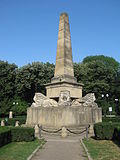
 Grigore III Ghica Monument
 -

-
-

-

-
-

-
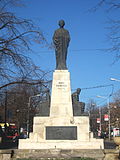
 Independence Monument
 -
-

-
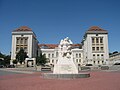
 Victims of Communism Memorial


Twin towns/sister cities
Iași is twinned with:
|
|


Consulates in Iași
Honorary Consulates:
People
References and sources
- References
- ^ "1000 lei 1998 – 80th anniversary of the Great Union of 1918" (in English). Romanian Coins.org. Retrieved 24 September 2016.
{{cite web}}: CS1 maint: unrecognized language (link) - ^ "Iași, the cultural city" (in Romanian). Retrieved 24 September 2016.
{{cite web}}: Unknown parameter|deadurl=ignored (|url-status=suggested) (help)CS1 maint: deprecated archival service (link) CS1 maint: unrecognized language (link) - ^ "About Iaşi" (in Romanian). La Iaşi. 2002. Retrieved 24 September 2016.
{{cite web}}: CS1 maint: unrecognized language (link) - ^ "Romanian Cities" (in Romanian). Tarom. Archived from the original on 2011-03-05.
{{cite web}}: Unknown parameter|deadurl=ignored (|url-status=suggested) (help)CS1 maint: unrecognized language (link) - ^ a b c "Population on 1 January by age groups and sex - functional urban areas". Eurostat. Retrieved 29 October 2017.
- ^ a b c "Population at 20 October 2011" (in Romanian). INSSE. 5 July 2013. Retrieved 4 May 2015.
{{cite web}}: CS1 maint: unrecognized language (link) - ^ a b c "Populaţia României pe localitati la 1 ianuarie 2016" (in Romanian). INSSE. 6 June 2016. Retrieved 27 October 2017.
{{cite web}}: CS1 maint: unrecognized language (link) - ^ JASSY at jewishvirtuallibrary.org
- ^ Edith Saurer; Margareth Lanzinger; Elisabeth Frysak (2006). Women's Movements: Networks and Debates in Post-communist Countries in the 19th and 20th Centuries. Böhlau Verlag Köln Weimar. pp. 443–. ISBN 978-3-412-32205-2.
- ^ Tourism – About Iași
- ^ About Iași City Archived 2011-07-15 at the Wayback Machine
- ^ "The Economy of a Regional Metropolis. Case-study: Iași, Romania". Transylvanian Review of Administrative Sciences. Retrieved 2012-02-08.
- ^ History of Education in Romania
- ^ Metropolitan Area Iași Template:Ro icon
- ^ a b Romanian Pilgrims Flock to Saint's Shrine
- ^ The beginnings of Iași Template:Ro icon
- ^ Ovid (1893) [c. 8 a.d.]. Sidney George Owen (ed.). Ovid: Tristia Book III (2nd, rev. ed.). Oxford: Clarendon Press. p. 60.
- ^ Museum Documentation Center Croatia, A Tractate on the Roman Milestone Discovered near Osijek Archived 2004-11-07 at the Wayback Machine
- ^ Grässe, J. G. Th. (1909) [1861]. "Jassium". Orbis latinus; oder, Verzeichnis der wichtigsten lateinischen Orts- und Ländernamen (in German) (2nd ed.). Berlin: Schmidt. OCLC 1301238 – via Columbia University.
- ^ a b Orașul Iași: monografie istorică și socială Template:Ro icon
- ^ Alexandru I. Gonța, Românii și hoarda de aur, Editura Demiurg, Iași, 2010, p. 102
- ^ C.C. Giurescu, Târguri sau orașe și cetăti moldovene, București, 1967, p.242-245
- ^ Gh. Ghibănescu, Originile Iașilor, în "Arhiva", Iași,1904, p.42-46
- ^ A.P. Horvath, Pechenegs, Cumans, Iașians, Hereditas, Budapest, 1989, p. 64
- ^ C. Cihodaru, G. Platon, Istoria orașului Iași, Editura Junimea, 1980, pp 30–50
- ^ Dan Gh. Teodor, Creștinismul la est de Carpați, Editura Mitopoliei Moldovei și Bucovinei, Iași, 1984, p.91,93,136
- ^ a b Iași – YIVO Encyclopedia of Jews in Eastern Europe
- ^ Great Synagogue of Iași at wmf.org
- ^ Jewishgen
The Iași Pogrom Archived 2012-05-18 at the Wayback Machine at Radio Romania International
Iași Pogrom quotes 13,266 or 14,850 Jews killed. - ^ The last day of the war in Iași Template:Ro icon
- ^ a b General View-The historical and architectural Iași Template:Ro icon
- ^ http://www.humangeographies.org.ro/articles/51/5_1_11_9_paftala.pdf
- ^ "THE SPATIAL EVOLUTION OF IAȘI CITY: TRADITION AND TRENDS" by O. Stoleriu and C. Stoleriu
- ^ "Microsoft Word - 6 urban geology and impact of geohazards.doc" (PDF). Archived from the original (PDF) on 2015-05-08. Retrieved 2013-03-26.
{{cite web}}: Unknown parameter|deadurl=ignored (|url-status=suggested) (help) - ^ a b Studiu comparativ de caz despre industria ieșeană Template:Ro icon
- ^ "World Weather Information Service – Iasi". World Meteorological Organization. Archived from the original on July 25, 2017. Retrieved July 25, 2017.
{{cite web}}: Unknown parameter|deadurl=ignored (|url-status=suggested) (help) - ^ "CLIMAT summary for 15090: Iasi (Romania) – Section 2: Monthly Normals". CLIMAT monthly weather summaries. Ogimet. Retrieved July 25, 2017.
- ^ "AIR TEMPERATURE (monthly and yearly absolute maximum and absolute minimum)" (PDF). Romanian Statistical Yearbook: Geography, Meteorology, and Environment. Romanian National Statistic Institute. 2007. Retrieved February 10, 2016.
- ^ "Iași Climate Normals 1961–1990". National Oceanic and Atmospheric Administration. Retrieved March 21, 2015.
- ^ "Klimatafel von Iasi (Jassy), Moldau (Bessarabien) / Rumänien" (PDF). Baseline climate means (1961–1990) from stations all over the world (in German). Deutscher Wetterdienst. Retrieved November 23, 2016.
- ^ a b c St. Paraskeve Pilgrimage Centre Archived 2010-09-29 at the Wayback Machine
- ^ Church of the Three Hierarchs Overview at mydestination.com
- ^ Churches & monasteries
- ^ Iasul istoric – Pelerinaj la Sfânta, în Iaşii de odinioară
- ^ The oldest monument in Romania
- ^ Pettersen, L. & Baker, M. . Romania. Lonely Planet Travel Guide. p. 262.
- ^ Iași – the county of centuries-old trees
- ^ [Universitatea Al.I.Cuza Iași Ed. Litera, București 1971, pag.9–10]Template:Ro icon
- ^ 1860 Chambers's encyclopaedia
- ^ Encyclopædia Britannica Eleventh Edition
- ^ A Handbook of Roumania
- ^ "Ethno-demographic Structure of Romania". The Ethnocultural Diversity Resource Center. Retrieved January 2, 2011.
- ^ "Recensământ 2002". Recensamant.referinte.transindex.ro. Archived from the original on 2009-02-26. Retrieved 2009-06-25.
{{cite web}}: Unknown parameter|deadurl=ignored (|url-status=suggested) (help) - ^ "Mother, teacher, nurse. The role of women in society and church according to Hungarian-speaking young Catholics in Romania | Pax Romana ICMICA/MIIC". Web.archive.org. 2007-10-14. Archived from the original on 2007-10-14. Retrieved 2009-07-26.
- ^ HITECH Iași sau cum devine Iașul un magnet pentru investițiile din IT&C Archived 2012-04-11 at the Wayback Machine Template:Ro icon
- ^ a b Numărul de angajaţi ai industriei IT&Outsourcing din Iaşi Template:Ro icon
- ^ Fişa localității Municipiului Iași Archived 2016-01-27 at the Wayback Machine Template:Ro icon
- ^ Benetton closes all the shops in Romania, but maintains the production facility in Iasi Template:Ro icon
- ^ Moldavian Wines
- ^ Iasi-Cotnari vineyards Archived 2016-06-30 at the Wayback Machine
- ^ Surprizele din topul firmelor ieşene Template:Ro icon
- ^ Top angajatori Template:Ro icon
- ^ 155 de ani de la înființarea în Iași a primei Pinacoteci din România
- ^ Complexul Muzeal National Moldova Iași-Raport de activitate (pg.810) Archived 2015-11-24 at the Wayback Machine Template:Ro icon
- ^ "Culisele unei investiții de 56,7 milioane de euro | Evenimentul". www.ziarulevenimentul.ro. Retrieved 2015-11-23.
- ^ About UPA Deprecated link archived 2015-01-18 at archive.today Template:Ro icon
- ^ "Rețeaua unităților de învățământ preuniversitar". September 2016.
- ^ "Iași Science Festival – Studii de caz – ABplus Events". www.abplus.ro. Retrieved 2015-11-23.
- ^ European Capitals and Cities of Sport List Archived 2012-04-10 at the Wayback Machine at aces-europa.eu
- ^ Tot mai puțini ieșeni merg cu RATP-ul Template:Ro icon
- ^ Aeroportul Iasi doboara un nou record propriu Template:Ro icon
- ^ St. Spiridon Hospital History Archived 2008-12-12 at the Wayback Machine Template:Ro icon
- ^ a b "Iaşul este al doilea cel mai poluat oraş din România. Nu se pot amenaja noi spaţii verzi, dar se cheltuie bani pe studii de calitate a aerului", Romania Curata, retrieved 13 May 2016
- ^ http://www.gandul.info/stiri/comisia-europeana-lanseaza-un-infringement-impotriva-romaniei-pentru-ca-nu-isi-protejeaza-cetatenii-de-poluare-13346370
- ^ "Orașe înfrățite (Twin cities of Minsk) [via WaybackMachine.com]" (in Romanian). Primăria Municipiului Chișinău. Archived from the original on 3 September 2012. Retrieved 2013-07-21.
- ^ "Netanya – Twin Cities". Netanya Municipality. Archived from the original on 2013-02-01. Retrieved 2013-08-01.
- Sources
- This article incorporates text from a publication now in the public domain: Chisholm, Hugh, ed. (1911). Encyclopædia Britannica (11th ed.). Cambridge University Press.
{{cite encyclopedia}}: Missing or empty|title=(help) - National Institute of Statistics: http://www.insse.ro

Bibliography
External links
 Definitions from Wiktionary
 Media from Commons
 Texts from Wikisource
 Textbooks from Wikibooks
 Travel information from Wikivoyage


- Iași City Hall website
- Iași at romaniatourism.com
- Iași
- Street Map of Iași, as commissioned by the City Hall
- Cultural events in Iași
- Iași city Tourism
- Iași City Portal
- Events in Iași
- I like Iași

County seats of Romania (alphabetical order by county) | ||
|---|---|---|
|  | |
| International | |
|---|---|
| National | |
| Geographic | |
| Other | |
