


Compton wavelength
The Compton wavelength is defined as the wavelength of a photon whose energy is the same as the rest energy of that particle.[1]: 237 The wavelength sets the minimum space required for a free relativistic particle,[2] and it is used as a dividing line between the combinations of mass and size that require quantum mechanics and those that can be described with classical theories.[3]
It was introduced by Arthur Compton in 1923 in his explanation of the scattering of photons by electrons (a process known as Compton scattering). The wavelength of the outgoing photon wavelength, , is shifted from the incident photon wavelength,, by an amount given by with , where h is the Planck constant and c is the speed of light.[1]


Reduced Compton wavelength
[edit]The reduced Compton wavelength ƛ (barred lambda) of a particle is defined as its Compton wavelength divided by 2π: where ħ is the reduced Planck constant. The reduced Compton wavelength is a natural representation of mass on the quantum scale and is used in equations that pertain to inertial mass, such as the Klein–Gordon and Schrödinger equations.[4]

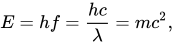
Equations that pertain to the wavelengths of photons interacting with mass use the non-reduced Compton wavelength. A particle of mass m has a rest energy of E = mc2. The Compton wavelength for this particle is the wavelength of a photon of the same energy. For photons of frequency f, energy is given by which yields the Compton wavelength formula if solved for λ.
Role in equations for massive particles
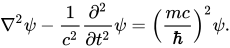
[edit]The inverse reduced Compton wavelength is a natural representation for mass on the quantum scale, and as such, it appears in fundamental equations of quantum mechanics. The reduced Compton wavelength appears in the relativistic Klein–Gordon equation for a free particle:
It appears in the Dirac equation (the following is an explicitly covariant form employing the Einstein summation convention):

The reduced Compton wavelength is also present in the Schrödinger equation for an electron in a hydrogen-like atom, although this is not readily apparent in traditional representations of the equation. The following is the traditional representation of the Schrödinger equation:

Dividing through by ħc and rewriting in terms of the fine-structure constant, one obtains:

Table of values
[edit]| Particle | Compton wavelength | Reduced Compton wavelength |
|---|---|---|
| electron | 2.42631023538(76)×10−12 m[5] | 3.8615926744(12)×10−13 m[6] |
| muon | 1.173444110(26)×10−14 m[7] | 1.867594306(42)×10−15 m[8] |
| tau | 6.97771(47)×10−16 m[9] | 1.110538(75)×10−16 m[10] |
Relationship to other constants
[edit]
Typical atomic lengths, wave numbers, and areas in physics can be related to the reduced Compton wavelength for the electron () and the electromagnetic fine-structure constant ().


The classical electron radius is about 3 times larger than the proton radius, and is written:

The Bohr radius is related to the Compton wavelength by:

The angular wavenumber of a photon with one hartree (the atomic unit of energy , where is the Rydberg constant), being (approximately) the negative potential energy of the electron in the hydrogen atom, and twice the energy needed to ionize it, is:


This yields the sequence:

For fermions, the classical (electromagnetic) radius sets the cross-section of electromagnetic interactions of a particle. For example, the cross-section for Thomson scattering of a photon from an electron is equal to which is roughly the same as the cross-sectional area of an iron-56 nucleus.

Geometrical interpretation
[edit]A geometrical origin of the Compton wavelength has been demonstrated using semiclassical equations describing the motion of a wavepacket.[11] In this case, the Compton wavelength is equal to the square root of the quantum metric, a metric describing the quantum space: .

See also
[edit]References
[edit]- ^ a b Evans, Robley D. (2012) [1st pub. 1958], "Compton Effect", in Flügge, S. (ed.), Corpuscles and Radiation in Matter II / Korpuskeln und Strahlung in Materie II, vol. 6 / 34, Berlin, Heidelberg: Springer Berlin Heidelberg, pp. 218–298, doi:10.1007/978-3-642-45898-9_6, ISBN 978-3-642-45900-9, retrieved 2026-06-10
- ^ Greiner, Walter (1990). Relativistic Quantum Mechanics: Wave Equations. Berlin, Heidelberg: Springer Berlin Heidelberg. ISBN 978-3-642-88082-7.
- ^ Carr, Bernard J. (2016), "The Black Hole Uncertainty Principle Correspondence", in Nicolini, Piero; Kaminski, Matthias; Mureika, Jonas; Bleicher, Marcus (eds.), 1st Karl Schwarzschild Meeting on Gravitational Physics, vol. 170, Cham: Springer International Publishing, pp. 159–167, doi:10.1007/978-3-319-20046-0_19, ISBN 978-3-319-20045-3, retrieved 2026-06-11
- ^ Greiner, W. (1990). Relativistic Quantum Mechanics: Wave Equations. Berlin/Heidelberg: Springer. pp. 18–22.
- ^ "2022 CODATA Value: Compton wavelength". The NIST Reference on Constants, Units, and Uncertainty. NIST. May 2024. Retrieved 2024-05-18.
- ^ "2022 CODATA Value: reduced Compton wavelength". The NIST Reference on Constants, Units, and Uncertainty. NIST. May 2024. Retrieved 2024-05-18.
- ^ "2022 CODATA Value: muon Compton wavelength". The NIST Reference on Constants, Units, and Uncertainty. NIST. May 2024. Retrieved 2024-05-18.
- ^ "2022 CODATA Value: reduced muon Compton wavelength". The NIST Reference on Constants, Units, and Uncertainty. NIST. May 2024. Retrieved 2024-05-18.
- ^ "2022 CODATA Value: tau Compton wavelength". The NIST Reference on Constants, Units, and Uncertainty. NIST. May 2024. Retrieved 2024-05-18.
- ^ "2022 CODATA Value: reduced tau Compton wavelength". The NIST Reference on Constants, Units, and Uncertainty. NIST. May 2024. Retrieved 2024-05-18.
- ^ Leblanc, C.; Malpuech, G.; Solnyshkov, D. D. (2021-10-26). "Universal semiclassical equations based on the quantum metric for a two-band system". Physical Review B. 104 (13) 134312. arXiv:2106.12383. Bibcode:2021PhRvB.104m4312L. doi:10.1103/PhysRevB.104.134312. ISSN 2469-9950. S2CID 235606464.