Operation on differential forms
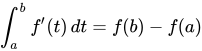
On a differentiable manifold , the exterior derivative extends the concept of the differential of a function to differential forms of higher degree. The exterior derivative was first described in its current form by Élie Cartan in 1899. The resulting calculus, known as exterior calculus , allows for a natural, metric-independent generalization of Stokes' theorem , Gauss's theorem , and Green's theorem from vector calculus.
If a differential
k
{\displaystyle k}
flux through an infinitesimal
k
{\displaystyle k}
parallelotope at each point of the manifold, then its exterior derivative can be thought of as measuring the net flux through the boundary of a
(
k
+
1
)
{\displaystyle (k+1)}
The exterior derivative of a differential form of degree
k
{\displaystyle k}
k
{\displaystyle k}
k
{\displaystyle k}
k
+
1
{\displaystyle k+1}
If
f
{\displaystyle f}
smooth function (a
0
{\displaystyle 0}
f
{\displaystyle f}
differential of
f
{\displaystyle f}
d
f
{\displaystyle df}
1 -formvector field
X
{\displaystyle X}
d
f
(
X
)
=
d
X
f
{\displaystyle df(X)=d_{X}f}
d
X
f
{\displaystyle d_{X}f}
directional derivative of
f
{\displaystyle f}
X
{\displaystyle X}
The exterior product of differential forms (denoted with the same symbol
∧
{\displaystyle \wedge }
pointwise exterior product .
There are a variety of equivalent definitions of the exterior derivative of a general
k
{\displaystyle k}
The exterior derivative
d
{\displaystyle d}
R
{\displaystyle \mathbb {R} }
k
{\displaystyle k}
(
k
+
1
)
{\displaystyle (k+1)}
The operator
d
{\displaystyle d}
0
{\displaystyle 0}
f
{\displaystyle f}
d
f
{\displaystyle df}
f
{\displaystyle f}
If
α
{\displaystyle \alpha }
β
{\displaystyle \beta }
k
{\displaystyle k}
d
(
a
α
+
b
β
)
=
a
d
α
+
b
d
β
{\displaystyle d(a\alpha +b\beta )=ad\alpha +bd\beta }
a
,
b
{\displaystyle a,b}
If
α
{\displaystyle \alpha }
k
{\displaystyle k}
β
{\displaystyle \beta }
ℓ
{\displaystyle \ell }
d
(
α
∧
β
)
=
d
α
∧
β
+
(
−
1
)
k
α
∧
d
β
{\displaystyle d(\alpha \wedge \beta )=d\alpha \wedge \beta +(-1)^{k}\alpha \wedge d\beta }
graded product rule
If
α
{\displaystyle \alpha }
k
{\displaystyle k}
d
(
d
α
)
=
0
{\displaystyle d(d\alpha )=0}
If
f
{\displaystyle f}
g
{\displaystyle g}
0
{\displaystyle 0}
d
(
f
∧
g
)
{\displaystyle d(f\wedge g)}
d
(
f
g
)
{\displaystyle d(fg)}
d
(
f
g
)
=
g
d
f
+
f
d
g
{\displaystyle d(fg)=g\,df+f\,dg}
α
{\displaystyle \alpha }
k
{\displaystyle k}
β
{\displaystyle \beta }
ℓ
{\displaystyle \ell }
γ
{\displaystyle \gamma }
m
{\displaystyle m}
d
(
α
∧
β
∧
γ
)
=
d
α
∧
β
∧
γ
+
(
−
1
)
k
α
∧
d
β
∧
γ
+
(
−
1
)
k
+
ℓ
α
∧
β
∧
d
γ
.
{\displaystyle d(\alpha \wedge \beta \wedge \gamma )=d\alpha \wedge \beta \wedge \gamma +(-1)^{k}\alpha \wedge d\beta \wedge \gamma +(-1)^{k+\ell }\alpha \wedge \beta \wedge d\gamma .}
In terms of local coordinates [ edit ] Alternatively, one can work entirely in a local coordinate system
(
x
1
,
…
,
x
n
)
{\displaystyle (x^{1},\ldots ,x^{n})}
d
x
1
,
…
,
d
x
n
{\displaystyle {\text{d}}x^{1},\ldots ,{\text{d}}x^{n}}
multi-index
I
=
(
i
1
,
…
,
i
k
)
{\displaystyle I=(i_{1},\ldots ,i_{k})}
1
≤
i
p
≤
n
{\displaystyle 1\leq i_{p}\leq n}
1
≤
p
≤
k
{\displaystyle 1\leq p\leq k}
d
x
i
1
∧
⋯
∧
d
x
i
k
{\displaystyle {\text{d}}x^{i_{1}}\wedge \cdots \wedge {\text{d}}x^{i_{k}}}
d
x
I
{\displaystyle {\text{d}}x^{I}}
k
{\displaystyle k}
φ
=
g
d
x
I
=
g
d
x
i
1
∧
d
x
i
2
∧
⋯
∧
d
x
i
k
{\displaystyle \varphi =g\,dx^{I}=g\,dx^{i_{1}}\wedge dx^{i_{2}}\wedge \cdots \wedge dx^{i_{k}}}
R
n
{\displaystyle \mathbb {R} ^{n}}
d
φ
=
d
g
∧
d
x
i
1
∧
d
x
i
2
∧
⋯
∧
d
x
i
k
=
∂
g
∂
x
j
d
x
j
∧
d
x
i
1
∧
d
x
i
2
∧
⋯
∧
d
x
i
k
{\displaystyle d{\varphi }=dg\wedge dx^{i_{1}}\wedge dx^{i_{2}}\wedge \cdots \wedge dx^{i_{k}}={\frac {\partial g}{\partial x^{j}}}\,dx^{j}\wedge \,dx^{i_{1}}\wedge dx^{i_{2}}\wedge \cdots \wedge dx^{i_{k}}}
Einstein summation convention ). The definition of the exterior derivative is extended linearly to a general
k
{\displaystyle k}
k
{\displaystyle k}
ω
=
f
I
d
x
I
,
{\displaystyle \omega =f_{I}\,dx^{I},}
I
{\displaystyle I}
{
1
,
…
,
n
}
{\displaystyle \{1,\ldots ,n\}}
j
{\displaystyle j}
I
{\displaystyle I}
d
x
j
∧
d
x
I
=
0
{\displaystyle {\text{d}}x^{j}\wedge {\text{d}}x^{I}=0}
Exterior product
The definition of the exterior derivative in local coordinates follows from the preceding definition in terms of axioms . Indeed, with the
k
{\displaystyle k}
φ
{\displaystyle \varphi }
d
φ
=
d
(
g
d
x
i
1
∧
⋯
∧
d
x
i
k
)
=
d
g
∧
(
d
x
i
1
∧
⋯
∧
d
x
i
k
)
+
g
d
(
d
x
i
1
∧
⋯
∧
d
x
i
k
)
=
d
g
∧
d
x
i
1
∧
⋯
∧
d
x
i
k
+
g
∑
p
=
1
k
(
−
1
)
p
−
1
d
x
i
1
∧
⋯
∧
d
x
i
p
−
1
∧
d
2
x
i
p
∧
d
x
i
p
+
1
∧
⋯
∧
d
x
i
k
=
d
g
∧
d
x
i
1
∧
⋯
∧
d
x
i
k
=
∂
g
∂
x
i
d
x
i
∧
d
x
i
1
∧
⋯
∧
d
x
i
k
{\displaystyle {\begin{aligned}d{\varphi }&=d\left(g\,dx^{i_{1}}\wedge \cdots \wedge dx^{i_{k}}\right)\\&=dg\wedge \left(dx^{i_{1}}\wedge \cdots \wedge dx^{i_{k}}\right)+g\,d\left(dx^{i_{1}}\wedge \cdots \wedge dx^{i_{k}}\right)\\&=dg\wedge dx^{i_{1}}\wedge \cdots \wedge dx^{i_{k}}+g\sum _{p=1}^{k}(-1)^{p-1}\,dx^{i_{1}}\wedge \cdots \wedge dx^{i_{p-1}}\wedge d^{2}x^{i_{p}}\wedge dx^{i_{p+1}}\wedge \cdots \wedge dx^{i_{k}}\\&=dg\wedge dx^{i_{1}}\wedge \cdots \wedge dx^{i_{k}}\\&={\frac {\partial g}{\partial x^{i}}}\,dx^{i}\wedge dx^{i_{1}}\wedge \cdots \wedge dx^{i_{k}}\end{aligned}}}
Here, we have interpreted
g
{\displaystyle g}
0
{\displaystyle 0}
This result extends directly to the general
k
{\displaystyle k}
ω
{\displaystyle \omega }
d
ω
=
∂
f
I
∂
x
i
d
x
i
∧
d
x
I
.
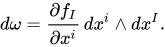
{\displaystyle d\omega ={\frac {\partial f_{I}}{\partial x^{i}}}\,dx^{i}\wedge dx^{I}.}
In particular, for a
1
{\displaystyle 1}
ω
{\displaystyle \omega }
d
ω
{\displaystyle d\omega }
local coordinates are
(
d
ω
)
i
j
=
∂
i
ω
j
−
∂
j
ω
i
.
{\displaystyle (d\omega )_{ij}=\partial _{i}\omega _{j}-\partial _{j}\omega _{i}.}
Caution : There are two conventions regarding the meaning of
d
x
i
1
∧
⋯
∧
d
x
i
k
{\displaystyle dx^{i_{1}}\wedge \cdots \wedge dx^{i_{k}}}
[citation needed have the convention that
(
d
x
i
1
∧
⋯
∧
d
x
i
k
)
(
∂
∂
x
i
1
,
…
,
∂
∂
x
i
k
)
=
1.
{\displaystyle \left(dx^{i_{1}}\wedge \cdots \wedge dx^{i_{k}}\right)\left({\frac {\partial }{\partial x^{i_{1}}}},\ldots ,{\frac {\partial }{\partial x^{i_{k}}}}\right)=1.}
(
d
x
i
1
∧
⋯
∧
d
x
i
k
)
(
∂
∂
x
i
1
,
…
,
∂
∂
x
i
k
)
=
1
k
!
.
{\displaystyle \left(dx^{i_{1}}\wedge \cdots \wedge dx^{i_{k}}\right)\left({\frac {\partial }{\partial x^{i_{1}}}},\ldots ,{\frac {\partial }{\partial x^{i_{k}}}}\right)={\frac {1}{k!}}.}
Alternatively, an explicit formula can be given for the exterior derivative of a
k
{\displaystyle k}
ω
{\displaystyle \omega }
k
+
1
{\displaystyle k+1}
vector fields
V
0
,
V
1
,
…
,
V
k
{\displaystyle V_{0},V_{1},\ldots ,V_{k}}
d
ω
(
V
0
,
…
,
V
k
)
=
∑
i
(
−
1
)
i
V
i
(
ω
(
V
0
,
…
,
V
^
i
,
…
,
V
k
)
)
+
∑
i
<
j
(
−
1
)
i
+
j
ω
(
[
V
i
,
V
j
]
,
V
0
,
…
,
V
^
i
,
…
,
V
^
j
,
…
,
V
k
)
{\displaystyle d\omega (V_{0},\ldots ,V_{k})=\sum _{i}(-1)^{i}V_{i}(\omega (V_{0},\ldots ,{\widehat {V}}_{i},\ldots ,V_{k}))+\sum _{i<j}(-1)^{i+j}\omega ([V_{i},V_{j}],V_{0},\ldots ,{\widehat {V}}_{i},\ldots ,{\widehat {V}}_{j},\ldots ,V_{k})}
where
[
V
i
,
V
j
]
{\displaystyle [V_{i},V_{j}]}
Lie bracket and a hat denotes the omission of that element:
ω
(
V
0
,
…
,
V
^
i
,
…
,
V
k
)
=
ω
(
V
0
,
…
,
V
i
−
1
,
V
i
+
1
,
…
,
V
k
)
.
{\displaystyle \omega (V_{0},\ldots ,{\widehat {V}}_{i},\ldots ,V_{k})=\omega (V_{0},\ldots ,V_{i-1},V_{i+1},\ldots ,V_{k}).}
In particular, when
ω
{\displaystyle \omega }
1
{\displaystyle 1}
(
d
ω
)
(
X
,
Y
)
=
L
X
(
ω
(
Y
)
)
−
L
Y
(
ω
(
X
)
)
−
ω
(
[
X
,
Y
]
)
{\displaystyle (d\omega )(X,Y)={\mathcal {L}}_{X}(\omega (Y))-{\mathcal {L}}_{Y}(\omega (X))-\omega ([X,Y])}
Note: With the conventions of e.g., Kobayashi–Nomizu and Helgason the formula differs by a factor of
1
k
+
1
{\textstyle {\frac {1}{k+1}}}
d
ω
(
V
0
,
…
,
V
k
)
=
1
k
+
1
(
∑
i
(
−
1
)
i
V
i
(
ω
(
V
0
,
…
,
V
^
i
,
…
,
V
k
)
)
+
∑
i
<
j
(
−
1
)
i
+
j
ω
(
[
V
i
,
V
j
]
,
V
0
,
…
,
V
^
i
,
…
,
V
^
j
,
…
,
V
k
)
)
.
{\displaystyle d\omega (V_{0},\ldots ,V_{k})={\frac {1}{k+1}}\left(\sum _{i}(-1)^{i}V_{i}(\omega (V_{0},\ldots ,{\widehat {V}}_{i},\ldots ,V_{k}))+\sum _{i<j}(-1)^{i+j}\omega ([V_{i},V_{j}],V_{0},\ldots ,{\widehat {V}}_{i},\ldots ,{\widehat {V}}_{j},\ldots ,V_{k})\right).}
Consider
σ
=
u
d
x
1
∧
d
x
2
{\displaystyle \sigma =u\ {\text{d}}x^{1}\wedge {\text{d}}x^{2}}
1
{\displaystyle 1}
d
x
1
,
…
,
d
x
n
{\displaystyle {\text{d}}x^{1},\ldots ,{\text{d}}x^{n}}
u
{\displaystyle u}
d
σ
=
d
u
∧
d
x
1
∧
d
x
2
=
(
∑
i
=
1
n
∂
u
∂
x
i
d
x
i
)
∧
d
x
1
∧
d
x
2
=
∑
i
=
3
n
(
∂
u
∂
x
i
d
x
i
∧
d
x
1
∧
d
x
2
)
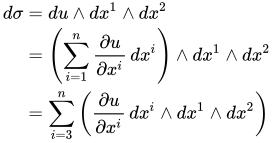
{\displaystyle {\begin{aligned}d\sigma &=du\wedge dx^{1}\wedge dx^{2}\\&=\left(\sum _{i=1}^{n}{\frac {\partial u}{\partial x^{i}}}\,dx^{i}\right)\wedge dx^{1}\wedge dx^{2}\\&=\sum _{i=3}^{n}\left({\frac {\partial u}{\partial x^{i}}}\,dx^{i}\wedge dx^{1}\wedge dx^{2}\right)\end{aligned}}}
The last formula, where summation starts at
i
=
3
{\displaystyle i=3}
exterior product . Namely,
d
x
i
∧
d
x
i
=
0
{\displaystyle {\text{d}}x^{i}\wedge {\text{d}}x^{i}=0}
Let
σ
=
u
d
x
+
v
d
y
{\displaystyle \sigma =u\ {\text{d}}x+v\ {\text{d}}y}
1
{\displaystyle 1}
R
2
{\displaystyle \mathbb {R} ^{2}}
x
1
=
x
{\displaystyle x^{1}=x}
x
2
=
y
{\displaystyle x^{2}=y}
d
σ
=
(
∑
i
=
1
2
∂
u
∂
x
i
d
x
i
∧
d
x
)
+
(
∑
i
=
1
2
∂
v
∂
x
i
d
x
i
∧
d
y
)
=
(
∂
u
∂
x
d
x
∧
d
x
+
∂
u
∂
y
d
y
∧
d
x
)
+
(
∂
v
∂
x
d
x
∧
d
y
+
∂
v
∂
y
d
y
∧
d
y
)
=
0
−
∂
u
∂
y
d
x
∧
d
y
+
∂
v
∂
x
d
x
∧
d
y
+
0
=
(
∂
v
∂
x
−
∂
u
∂
y
)
d
x
∧
d
y
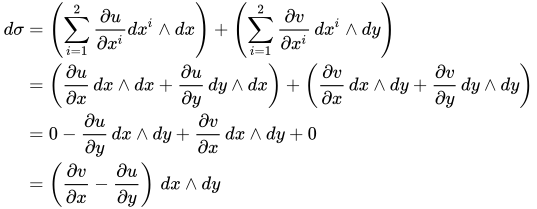
{\displaystyle {\begin{aligned}d\sigma &=\left(\sum _{i=1}^{2}{\frac {\partial u}{\partial x^{i}}}dx^{i}\wedge dx\right)+\left(\sum _{i=1}^{2}{\frac {\partial v}{\partial x^{i}}}\,dx^{i}\wedge dy\right)\\&=\left({\frac {\partial {u}}{\partial {x}}}\,dx\wedge dx+{\frac {\partial {u}}{\partial {y}}}\,dy\wedge dx\right)+\left({\frac {\partial {v}}{\partial {x}}}\,dx\wedge dy+{\frac {\partial {v}}{\partial {y}}}\,dy\wedge dy\right)\\&=0-{\frac {\partial {u}}{\partial {y}}}\,dx\wedge dy+{\frac {\partial {v}}{\partial {x}}}\,dx\wedge dy+0\\&=\left({\frac {\partial {v}}{\partial {x}}}-{\frac {\partial {u}}{\partial {y}}}\right)\,dx\wedge dy\end{aligned}}}
[ edit ] If
M
{\displaystyle M}
n
{\displaystyle n}
ω
{\displaystyle \omega }
(
n
−
1
)
{\displaystyle (n-1)}
M
{\displaystyle M}
the generalized form of Stokes' theorem states that
∫
M
d
ω
=
∫
∂
M
ω
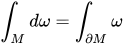
{\displaystyle \int _{M}d\omega =\int _{\partial {M}}\omega }
Intuitively, if one thinks of
M
{\displaystyle M}
M
{\displaystyle M}
A
k
{\displaystyle k}
ω
{\displaystyle \omega }
closed if
d
ω
=
0
{\displaystyle d\omega =0}
kernel of
d
{\displaystyle d}
ω
{\displaystyle \omega }
exact if
ω
=
d
α
{\displaystyle \omega =d\alpha }
(
k
−
1
)
{\displaystyle (k-1)}
α
{\displaystyle \alpha }
image of
d
{\displaystyle d}
d
2
=
0
{\displaystyle d^{2}=0}
Poincaré lemma states that in a contractible region, the converse is true.
Because the exterior derivative
d
{\displaystyle d}
d
2
=
0
{\displaystyle d^{2}=0}
differential (coboundary) to define de Rham cohomology on a manifold. The
k
{\displaystyle k}
k
{\displaystyle k}
k
{\displaystyle k}
k
>
0
{\displaystyle k>0}
smooth manifolds , integration of forms gives a natural homomorphism from the de Rham cohomology to the singular cohomology over
R
{\displaystyle \mathbb {R} }
boundary map on singular simplices.
The exterior derivative is natural in the technical sense: if
f
:
M
→
N
{\displaystyle f:M\rightarrow N}
Ω
k
{\displaystyle \Omega ^{k}}
functor that assigns to each manifold the space of
k
{\displaystyle k}
so
d
(
f
∗
ω
)
=
f
∗
d
ω
{\displaystyle d(f^{*}\omega )=f^{*}d\omega }
f
∗
{\displaystyle f^{*}}
pullback of
f
{\displaystyle f}
f
∗
ω
(
⋅
)
{\displaystyle f^{*}\omega (\cdot )}
ω
(
f
∗
(
⋅
)
)
{\displaystyle \omega (f_{*}(\cdot ))}
f
∗
{\displaystyle f_{*}}
pushforward of
f
{\displaystyle f}
d
{\displaystyle d}
natural transformation from
Ω
k
{\displaystyle \Omega ^{k}}
Ω
k
+
1
{\displaystyle \Omega ^{k+1}}
Exterior derivative in vector calculus [ edit ] Most vector calculus operators are special cases of, or have close relationships to, the notion of exterior differentiation.
A smooth function
f
:
M
→
R
{\displaystyle f:M\rightarrow \mathbb {R} }
M
{\displaystyle M}
0
{\displaystyle 0}
0
{\displaystyle 0}
1
{\displaystyle 1}
d
f
{\displaystyle df}
When an inner product
⟨
⋅
,
⋅
⟩
{\displaystyle \langle \cdot ,\cdot \rangle }
gradient
∇
f
{\displaystyle \nabla f}
f
{\displaystyle f}
V
{\displaystyle V}
V
{\displaystyle V}
f
{\displaystyle f}
⟨
∇
f
,
⋅
⟩
=
d
f
=
∑
i
=
1
n
∂
f
∂
x
i
d
x
i
.
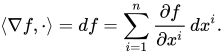
{\displaystyle \langle \nabla f,\cdot \rangle =df=\sum _{i=1}^{n}{\frac {\partial f}{\partial x^{i}}}\,dx^{i}.}
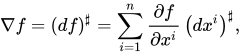
That is,
∇
f
=
(
d
f
)
♯
=
∑
i
=
1
n
∂
f
∂
x
i
(
d
x
i
)
♯
,
{\displaystyle \nabla f=(df)^{\sharp }=\sum _{i=1}^{n}{\frac {\partial f}{\partial x^{i}}}\,\left(dx^{i}\right)^{\sharp },}
♯
{\displaystyle \sharp }
musical isomorphism
♯
:
V
∗
→
V
{\displaystyle \sharp :V^{*}\rightarrow V}
The
1
{\displaystyle 1}
d
f
{\displaystyle df}
cotangent bundle , that gives a local linear approximation to
f
{\displaystyle f}
A vector field
V
=
(
v
1
,
v
2
,
…
,
v
n
)
{\displaystyle V=(v_{1},v_{2},\ldots ,v_{n})}
R
n
{\displaystyle \mathbb {R} ^{n}}
(
n
−
1
)
{\displaystyle (n-1)}
ω
V
=
v
1
(
d
x
2
∧
⋯
∧
d
x
n
)
−
v
2
(
d
x
1
∧
d
x
3
∧
⋯
∧
d
x
n
)
+
⋯
+
(
−
1
)
n
−
1
v
n
(
d
x
1
∧
⋯
∧
d
x
n
−
1
)
=
∑
i
=
1
n
(
−
1
)
(
i
−
1
)
v
i
(
d
x
1
∧
⋯
∧
d
x
i
−
1
∧
d
x
i
^
∧
d
x
i
+
1
∧
⋯
∧
d
x
n
)
{\displaystyle {\begin{aligned}\omega _{V}&=v_{1}\left(dx^{2}\wedge \cdots \wedge dx^{n}\right)-v_{2}\left(dx^{1}\wedge dx^{3}\wedge \cdots \wedge dx^{n}\right)+\cdots +(-1)^{n-1}v_{n}\left(dx^{1}\wedge \cdots \wedge dx^{n-1}\right)\\&=\sum _{i=1}^{n}(-1)^{(i-1)}v_{i}\left(dx^{1}\wedge \cdots \wedge dx^{i-1}\wedge {\widehat {dx^{i}}}\wedge dx^{i+1}\wedge \cdots \wedge dx^{n}\right)\end{aligned}}}
d
x
i
^
{\displaystyle {\widehat {dx^{i}}}}
(For instance, when
n
=
3
{\displaystyle n=3}
2
{\displaystyle 2}
ω
V
{\displaystyle \omega _{V}}
scalar triple product with
V
{\displaystyle V}
ω
V
{\displaystyle \omega _{V}}
flux of
V
{\displaystyle V}
The exterior derivative of this
(
n
−
1
)
{\displaystyle (n-1)}
n
{\displaystyle n}
d
ω
V
=
div
V
(
d
x
1
∧
d
x
2
∧
⋯
∧
d
x
n
)
.
{\displaystyle d\omega _{V}=\operatorname {div} V\left(dx^{1}\wedge dx^{2}\wedge \cdots \wedge dx^{n}\right).}
A vector field
V
{\displaystyle V}
R
n
{\displaystyle \mathbb {R} ^{n}}
1
{\displaystyle 1}
η
V
=
v
1
d
x
1
+
v
2
d
x
2
+
⋯
+
v
n
d
x
n
.
{\displaystyle \eta _{V}=v_{1}\,dx^{1}+v_{2}\,dx^{2}+\cdots +v_{n}\,dx^{n}.}
Locally,
η
V
{\displaystyle \eta _{V}}
dot product with
V
{\displaystyle V}
η
V
{\displaystyle \eta _{V}}
work done against
−
V
{\displaystyle -V}
When
n
=
3
{\displaystyle n=3}
1
{\displaystyle 1}
η
V
{\displaystyle \eta _{V}}
2
{\displaystyle 2}
d
η
V
=
ω
curl
V
.
{\displaystyle d\eta _{V}=\omega _{\operatorname {curl} V}.}
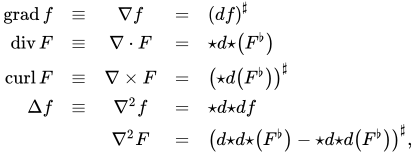
The standard vector calculus operators can be generalized for any pseudo-Riemannian manifold , and written in coordinate-free notation as follows:
grad
f
≡
∇
f
=
(
d
f
)
♯
div
F
≡
∇
⋅
F
=
⋆
d
⋆
(
F
♭
)
curl
F
≡
∇
×
F
=
(
⋆
d
(
F
♭
)
)
♯
Δ
f
≡
∇
2
f
=
⋆
d
⋆
d
f
∇
2
F
=
(
d
⋆
d
⋆
(
F
♭
)
−
⋆
d
⋆
d
(
F
♭
)
)
♯
,
{\displaystyle {\begin{array}{rcccl}\operatorname {grad} f&\equiv &\nabla f&=&\left(df\right)^{\sharp }\\\operatorname {div} F&\equiv &\nabla \cdot F&=&{\star d{\star }{\mathord {\left(F^{\flat }\right)}}}\\\operatorname {curl} F&\equiv &\nabla \times F&=&\left({\star }d{\mathord {\left(F^{\flat }\right)}}\right)^{\sharp }\\\Delta f&\equiv &\nabla ^{2}f&=&{\star }d{\star }df\\&&\nabla ^{2}F&=&\left(d{\star }d{\star }{\mathord {\left(F^{\flat }\right)}}-{\star }d{\star }d{\mathord {\left(F^{\flat }\right)}}\right)^{\sharp },\\\end{array}}}
⋆
{\displaystyle \star }
Hodge star operator ,
♭
{\displaystyle \flat }
♯
{\displaystyle \sharp }
musical isomorphisms ,
f
{\displaystyle f}
scalar field and
F
{\displaystyle F}
vector field .
Note that the expression for
curl
{\displaystyle \operatorname {curl} }
♯
{\displaystyle \sharp }
⋆
d
(
F
♭
)
{\displaystyle \star d(F^{\flat })}
n
−
2
{\displaystyle n-2}
♯
{\displaystyle \sharp }
k
{\displaystyle k}
n
{\displaystyle n}
Cartan, Élie (1899), "Sur certaines expressions différentielles et le problème de Pfaff" , Annales Scientifiques de l'École Normale Supérieure , Série 3 (in French), 16 , Paris: Gauthier-Villars: 239– 332, doi :10.24033/asens.467 ISSN 0012-9593 , JFM 30.0313.04 , retrieved 2 February 2016 Conlon, Lawrence (2001), Differentiable Manifolds , Boston: Birkhäuser, p. 239, ISBN 9780817641344 Darling, R. W. R. (1994), Differential forms and connections , Cambridge, UK: Cambridge University Press, p. 35, ISBN 9780521462594 Flanders, Harley (1989), Differential forms with applications to the physical sciences , Mineola, New York: Dover Publications, p. 20, ISBN 9780486661698 Loomis, Lynn Harold; Sternberg, Shlomo Zvi; Hood, Susan (2014), Advanced Calculus (Revised Edition) ISBN 9789814583947 Ramanan, S. (2005), Global calculus , Providence, Rhode Island: American Mathematical Society, p. 54, ISBN 9780821837023 Spivak, Michael (1971), Calculus on Manifolds ISBN 9780805390216 Spivak, Michael (1970), A Comprehensive Introduction to Differential Geometry , vol. 1, Boston, MA: Publish or Perish, Inc, ISBN 9780914098003 Warner, Frank W. (1983), Foundations of differentiable manifolds and Lie groups , Graduate Texts in Mathematics, vol. 94, Springer, ISBN 9780387908946

























![{\displaystyle d\omega (V_{0},\ldots ,V_{k})=\sum _{i}(-1)^{i}V_{i}(\omega (V_{0},\ldots ,{\widehat {V}}_{i},\ldots ,V_{k}))+\sum _{i<j}(-1)^{i+j}\omega ([V_{i},V_{j}],V_{0},\ldots ,{\widehat {V}}_{i},\ldots ,{\widehat {V}}_{j},\ldots ,V_{k})}](https://wikimedia.org/api/rest_v1/media/math/render/svg/f97e58ff8e6f8ba4c1e1c782e48e96865dcd416c)
![{\displaystyle [V_{i},V_{j}]}](https://wikimedia.org/api/rest_v1/media/math/render/svg/dc4fa9d94f308bfbc9f34693c9e83a16de3f50f5)

![{\displaystyle (d\omega )(X,Y)={\mathcal {L}}_{X}(\omega (Y))-{\mathcal {L}}_{Y}(\omega (X))-\omega ([X,Y])}](https://wikimedia.org/api/rest_v1/media/math/render/svg/259e947cc72dc5a1bfb2e78cd5c31eafa6a69ad8)

![{\displaystyle d\omega (V_{0},\ldots ,V_{k})={\frac {1}{k+1}}\left(\sum _{i}(-1)^{i}V_{i}(\omega (V_{0},\ldots ,{\widehat {V}}_{i},\ldots ,V_{k}))+\sum _{i<j}(-1)^{i+j}\omega ([V_{i},V_{j}],V_{0},\ldots ,{\widehat {V}}_{i},\ldots ,{\widehat {V}}_{j},\ldots ,V_{k})\right).}](https://wikimedia.org/api/rest_v1/media/math/render/svg/01578b4b4317d0f5c3e77818def7c3e54b379e6c)