This article is currently slated for merging. There is consensus to merge Tail value at risk into this article. You can carry out the merge by following the resolution at the AfD discussion and the merging instructions. (May 2026) Do not remove this notice until the merge is carried out.
Risk measure estimating the average loss in the worst tail of the distribution
Expected shortfall (ES) is a risk measure—a concept used in the field of financial risk measurement to evaluate the market risk or credit risk of a portfolio. The "expected shortfall at q% level" is the expected return on the portfolio in the worst of cases. ES is an alternative to value at risk that is more sensitive to the shape of the tail of the loss distribution.
Expected shortfall is also called conditional value at risk (CVaR), average value at risk (AVaR), tail value at risk (TVaR), conditional tail expectation (CTE), expected tail loss (ETL), and superquantile.[1][2] These names are often used interchangeably, although several definitions exist in the literature. These definitions coincide in many cases, but may differ for certain types of loss distributions.[3]
Risk measures are used both in mathematical finance and in actuarial science, and the value-at-risk and expected shortfall measures are often expressed using different sign conventions and tail conventions in these disciplines. The discussion that follows takes the mathematical finance point of view.
In mathematical finance, risk measures arise when considering the profit/loss distribution, i.e., payoff, for a financial portfolio, modeled as a random variable . This can take positive or negative values, and downside risk corresponds to quantiles with close to 0. A risk threshold is selected, and is defined to be the absolute value of the quantile of (ignoring some technicalities). This is also the quantile of . The expected shortfall at level is then defined as the average value of for in the interval , i.e., it is the average VaR over all levels below .
Expected shortfall is often considered preferable to VaR because it accounts for the severity of the failure, not only the chance of failure. Further, it is a coherentspectral measure of financial portfolio risk, while VaR is not. This is a collection of mathematical properties, one of which ensures that diversification of a portfolio never leads to a higher measure of risk. Viewing the value produced by a risk measure as a capital reserve requirement, ES at level is always more conservative than VaR at the same level, i.e., ES is always at least as big as VaR at the same level.
Several other definitions appear in the literature under the names ES, TVaR, AVaR, CTE, and CVaR. The formulation above as an integral of VaR values is coherent and well-defined in the general case. Other definitions typically coincide under common assumptions such as continuity of the loss distribution, but may differ for distributions with atoms.
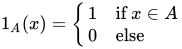
Some authors define expected shortfall, tail conditional expectation, or related quantities directly as a conditional expectation beyond the relevant quantile,[4][5][6][7]
This formulation agrees with the general definition above when the distribution is continuous at , but may differ for distributions having atoms at the quantile. Indeed, the second term in the formula just preceding this one vanishes for random variables with continuous distribution functions, and this conditional expectation formula follows.
Some variation in definitions arise from the differing conventions used between, say, financial mathematics and actuarial science, where things written with one set of conventions can be translated into a context with different ones. But there is further inconsistency, with some cases of substantively different definitions used for the same term. For instance, Sweeting defines TVaR as the tail conditional expectation, whereas he defines expected shortfall as the scaled version .[8]
There are a number of related, but subtly different, formulations for TVaR in the literature. A common case in literature is to define TVaR and average value at risk as the same measure.[9] Under some formulations, it is only equivalent to expected shortfall when the underlying distribution function is continuous at , the value at risk of level .
Expected shortfall can be generalized to a general class of coherent risk measures on spaces (Lp space) with a corresponding dual characterization in the corresponding dual space. The domain can be extended for more general Orlicz Hearts.[11]
If the underlying distribution for is a continuous distribution then the expected shortfall is equivalent to the tail conditional expectation defined by .[12]
Informally, and non-rigorously, this equation amounts to saying "in case of losses so severe that they occur only alpha percent of the time, what is our average loss".
Example 1. If we believe our average loss on the worst 5% of the possible outcomes for our portfolio is EUR 1000, then we could say our expected shortfall is EUR 1000 for the 5% tail.
Example 2. Consider a portfolio that will have the following possible values at the end of the period:
probability of event
ending value of the portfolio
10%
0
30%
80
40%
100
20%
150
Now assume that we paid 100 at the beginning of the period for this portfolio. Then the profit in each case is (ending value−100) or:
probability of event
profit
10%
−100
30%
−20
40%
0
20%
50
From this table let us calculate the expected shortfall for a few values of :
expected shortfall
5%
100
10%
100
20%
60
30%
46.6
40%
40
50%
32
60%
26.6
80%
20
90%
12.2
100%
6
To see how these values were calculated, consider the calculation of , the expectation in the worst 5% of cases. These cases belong to (are a subset of) row 1 in the profit table, which have a profit of −100 (total loss of the 100 invested). The expected profit for these cases is −100.
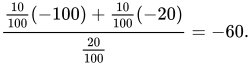
Now consider the calculation of , the expectation in the worst 20 out of 100 cases. These cases are as follows: 10 cases from row one, and 10 cases from row two (note that 10+10 equals the desired 20 cases). For row 1 there is a profit of −100, while for row 2 a profit of −20. Using the expected value formula we get
Similarly for any value of . We select as many rows starting from the top as are necessary to give a cumulative probability of and then calculate an expectation over those cases. In general, the last row selected may not be fully used (for example in calculating we used only 10 of the 30 cases per 100 provided by row 2).
As a final example, calculate . This is the expectation over all cases, or
The value at risk (VaR) is given below for comparison.
Expected shortfall, in its standard form, is known to lead to a generally non-convex optimization problem. However, it is possible to transform the problem into a linear program and find the global solution.[15] This property makes expected shortfall a cornerstone of alternatives to mean-varianceportfolio optimization, which account for the higher moments (e.g., skewness and kurtosis) of a return distribution.
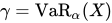
Suppose that we want to minimize the expected shortfall of a portfolio. The key contribution of Rockafellar and Uryasev in their 2000 paper is to introduce the auxiliary function for the expected shortfall:Where and is a loss function for a set of portfolio weights to be applied to the returns. Rockafellar/Uryasev proved that is convex with respect to and is equivalent to the expected shortfall at the minimum point. To numerically compute the expected shortfall for a set of portfolio returns, it is necessary to generate simulations of the portfolio constituents; this is often done using copulas. With these simulations in hand, the auxiliary function may be approximated by:This is equivalent to the formulation: Finally, choosing a linear loss function turns the optimization problem into a linear program. Using standard methods, it is then easy to find the portfolio that minimizes expected shortfall.
Closed-form formulas exist for calculating the expected shortfall when the payoff of a portfolio or a corresponding loss follows a specific continuous distribution. In the former case, the expected shortfall corresponds to the opposite number of the left-tail conditional expectation below :
Typical values of in this case are 5% and 1%.
For engineering or actuarial applications it is more common to consider the distribution of losses , the expected shortfall in this case corresponds to the right-tail conditional expectation above and the typical values of are 95% and 99%:
Since some formulas below were derived for the left-tail case and some for the right-tail case, the following reconciliations can be useful:
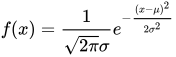
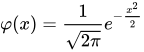
If the payoff of a portfolio follows the normal (Gaussian) distribution with p.d.f. then the expected shortfall is equal to , where is the standard normal p.d.f., is the standard normal c.d.f., so is the standard normal quantile.[16]
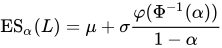
If the loss of a portfolio follows the normal distribution, the expected shortfall is equal to .[17]
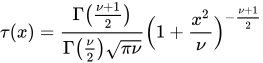
If the payoff of a portfolio follows the generalized Student's t-distribution with p.d.f. then the expected shortfall is equal to , where is the standard t-distribution p.d.f., is the standard t-distribution c.d.f., so is the standard t-distribution quantile.[16]
If the loss of a portfolio follows generalized Student's t-distribution, the expected shortfall is equal to .[17]
If the payoff of a portfolio follows the GHS distribution with p.d.f. and the c.d.f. then the expected shortfall is equal to , where is the dilogarithm and is the imaginary unit.[18]
If the payoff of a portfolio follows Johnson's SU-distribution with the c.d.f. then the expected shortfall is equal to , where is the c.d.f. of the standard normal distribution.[19]
If the payoff of a portfolio follows lognormal distribution, i.e. the random variable follows the normal distribution with p.d.f. , then the expected shortfall is equal to , where is the standard normal c.d.f., so is the standard normal quantile.[20]
As the incomplete beta function is defined only for positive arguments, for a more generic case the expected shortfall can be expressed with the hypergeometric function: .[20]
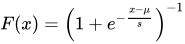
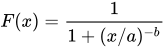
If the loss of a portfolio follows log-logistic distribution with p.d.f. and c.d.f. , then the expected shortfall is equal to , where is the incomplete beta function.[17]
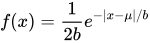
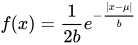
If the payoff of a portfolio follows log-Laplace distribution, i.e. the random variable follows the Laplace distribution the p.d.f. , then the expected shortfall is equal to
If the payoff of a portfolio follows log-GHS distribution, i.e. the random variable follows the GHS distribution with p.d.f. , then the expected shortfall is equal to
Methods of statistical estimation of VaR and ES can be found in Embrechts et al.[24] and Novak.[25] When forecasting VaR and ES, or optimizing portfolios to minimize tail risk, it is important to account for asymmetric dependence and non-normalities in the distribution of stock returns such as auto-regression, asymmetric volatility, skewness, and kurtosis.[26]
^ abcdKhokhlov, Valentyn (2016). "Conditional Value-at-Risk for Elliptical Distributions". Evropský časopis Ekonomiky a Managementu. 2 (6): 70–79.
^ abcdefghijNorton, Matthew; Khokhlov, Valentyn; Uryasev, Stan (2018-11-27). "Calculating CVaR and bPOE for Common Probability Distributions With Application to Portfolio Optimization and Density Estimation". arXiv:1811.11301 [q-fin.RM].





![{\displaystyle \alpha \in [0,1]}](https://wikimedia.org/api/rest_v1/media/math/render/svg/daf3c62599ea71319c85f715c9e590d2bab2d036)


![{\displaystyle [0,\alpha ]}](https://wikimedia.org/api/rest_v1/media/math/render/svg/fe67ac673f6464193d5ee8c6e721963a55702b97)


![{\displaystyle \operatorname {ES} _{\alpha }(X)=-{\frac {1}{\alpha }}\left(\operatorname {E} [X\ 1_{\{X\leq x_{\alpha }\}}]+x_{\alpha }(\alpha -P[X\leq x_{\alpha }])\right)}](https://wikimedia.org/api/rest_v1/media/math/render/svg/4b3aaa61637c82ae386cdac3fbccc3a96432eb94)

![{\displaystyle \operatorname {ES} _{\alpha }(X)=-E[X|X<x_{\alpha }]}](https://wikimedia.org/api/rest_v1/media/math/render/svg/e2c582e65bdea57e480c7f86781e4427a24d46b4)


![{\displaystyle \operatorname {ES} _{\alpha }(X)=\inf _{Q\in {\mathcal {Q}}_{\alpha }}E^{Q}[X]}](https://wikimedia.org/api/rest_v1/media/math/render/svg/10ae29b404213dc3ca11c18bd04acd98c6db1558)


![{\displaystyle \operatorname {TCE} _{\alpha }(X)=E[-X\mid X\leq -\operatorname {VaR} _{\alpha }(X)]}](https://wikimedia.org/api/rest_v1/media/math/render/svg/4f2e31467cc3e105f118448bb98a91f2d20898c4)











![{\displaystyle F_{\alpha }(w,\gamma )=\gamma +{1 \over {1-\alpha }}\int _{\ell (w,x)\geq \gamma }\left[\ell (w,x)-\gamma \right]_{+}p(x)\,dx}](https://wikimedia.org/api/rest_v1/media/math/render/svg/47c333469bb086740e6079f6e3bb99f6ea453ab6)


![{\displaystyle {\widetilde {F}}_{\alpha }(w,\gamma )=\gamma +{1 \over {(1-\alpha )J}}\sum _{j=1}^{J}[\ell (w,x_{j})-\gamma ]_{+}}](https://wikimedia.org/api/rest_v1/media/math/render/svg/e64bb51899eb5feb3302a32b44cfe1aa419a232e)




![{\displaystyle \operatorname {ES} _{\alpha }(X)=E[-X\mid X\leq -\operatorname {VaR} _{\alpha }(X)]=-{\frac {1}{\alpha }}\int _{0}^{\alpha }\operatorname {VaR} _{\gamma }(X)\,d\gamma =-{\frac {1}{\alpha }}\int _{-\infty }^{-\operatorname {VaR} _{\alpha }(X)}xf(x)\,dx.}](https://wikimedia.org/api/rest_v1/media/math/render/svg/b27d5a69ce9afd5b0b7ddc51ec4c19aa7b3daea8)


![{\displaystyle \operatorname {ES} _{\alpha }(L)=\operatorname {E} [L\mid L\geq \operatorname {VaR} _{\alpha }(L)]={\frac {1}{1-\alpha }}\int _{\alpha }^{1}\operatorname {VaR} _{\gamma }(L)\,d\gamma ={\frac {1}{1-\alpha }}\int _{\operatorname {VaR} _{\alpha }(L)}^{+\infty }yf(y)\,dy.}](https://wikimedia.org/api/rest_v1/media/math/render/svg/fbc45340ee7d389f415b65a94d1c0358b677a40f)
![{\displaystyle \operatorname {ES} _{\alpha }(X)=-{\frac {1}{\alpha }}\operatorname {E} [X]+{\frac {1-\alpha }{\alpha }}\operatorname {ES} _{\alpha }(L){\text{ and }}\operatorname {ES} _{\alpha }(L)={\frac {1}{1-\alpha }}\operatorname {E} [L]+{\frac {\alpha }{1-\alpha }}\operatorname {ES} _{\alpha }(X).}](https://wikimedia.org/api/rest_v1/media/math/render/svg/c592f4db6c9c77e3b74e4c34ea60597b565e9edb)








![{\displaystyle F(x)={\begin{cases}1-{\frac {1}{2}}e^{-(x-\mu )/b}&{\text{if }}x\geq \mu ,\\[4pt]{\frac {1}{2}}e^{(x-\mu )/b}&{\text{if }}x<\mu .\end{cases}}}](https://wikimedia.org/api/rest_v1/media/math/render/svg/5bc74653846f1e6243ac2db148976eee1393f69e)


![{\displaystyle \operatorname {ES} _{\alpha }(L)={\begin{cases}\mu +b{\frac {\alpha }{1-\alpha }}(1-\ln 2\alpha )&{\text{if }}\alpha <0.5,\\[4pt]\mu +b[1-\ln(2(1-\alpha ))]&{\text{if }}\alpha \geq 0.5.\end{cases}}}](https://wikimedia.org/api/rest_v1/media/math/render/svg/d84aa79aa5d69bffbaf45a3a9bbaa69ef8869cfa)



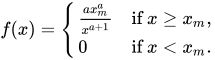


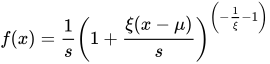
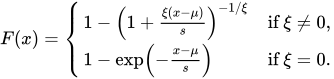
![{\displaystyle \operatorname {ES} _{\alpha }(L)={\begin{cases}\mu +s\left[{\frac {(1-\alpha )^{-\xi }}{1-\xi }}+{\frac {(1-\alpha )^{-\xi }-1}{\xi }}\right]&{\text{if }}\xi \neq 0,\\\mu +s\left[1-\ln(1-\alpha )\right]&{\text{if }}\xi =0,\end{cases}}}](https://wikimedia.org/api/rest_v1/media/math/render/svg/0828a7a99120dab1446bec19bb757238104c3aca)

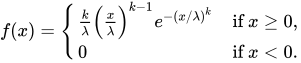



![{\displaystyle f(x)={\begin{cases}{\frac {1}{\sigma }}\left(1+\xi {\frac {x-\mu }{\sigma }}\right)^{-{\frac {1}{\xi }}-1}\exp \left[-\left(1+\xi {\frac {x-\mu }{\sigma }}\right)^{-{1}/{\xi }}\right]&{\text{if }}\xi \neq 0,\\{\frac {1}{\sigma }}e^{-{\frac {x-\mu }{\sigma }}}e^{-e^{-{\frac {x-\mu }{\sigma }}}}&{\text{if }}\xi =0.\end{cases}}}](https://wikimedia.org/api/rest_v1/media/math/render/svg/79cbe26f052efc3c54b8f6d02b8aa5afd4ef078b)
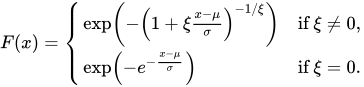
![{\displaystyle \operatorname {ES} _{\alpha }(X)={\begin{cases}-\mu -{\frac {\sigma }{\alpha \xi }}{\big [}\Gamma (1-\xi ,-\ln \alpha )-\alpha {\big ]}&{\text{if }}\xi \neq 0,\\-\mu -{\frac {\sigma }{\alpha }}{\big [}{\text{li}}(\alpha )-\alpha \ln(-\ln \alpha ){\big ]}&{\text{if }}\xi =0.\end{cases}}}](https://wikimedia.org/api/rest_v1/media/math/render/svg/21061bead9239e58dbcc0e54072d89bcdd3952da)
![{\displaystyle \operatorname {VaR} _{\alpha }(X)={\begin{cases}-\mu -{\frac {\sigma }{\xi }}\left[(-\ln \alpha )^{-\xi }-1\right]&{\text{if }}\xi \neq 0,\\-\mu +\sigma \ln(-\ln \alpha )&{\text{if }}\xi =0.\end{cases}}}](https://wikimedia.org/api/rest_v1/media/math/render/svg/f10aba4a9f218313a0c650da068975d6d04f6bb8)

![{\displaystyle \operatorname {ES} _{\alpha }(X)={\begin{cases}\mu +{\frac {\sigma }{(1-\alpha )\xi }}{\bigl [}\gamma (1-\xi ,-\ln \alpha )-(1-\alpha ){\bigr ]}&{\text{if }}\xi \neq 0,\\\mu +{\frac {\sigma }{1-\alpha }}{\bigl [}y-{\text{li}}(\alpha )+\alpha \ln(-\ln \alpha ){\bigr ]}&{\text{if }}\xi =0.\end{cases}}}](https://wikimedia.org/api/rest_v1/media/math/render/svg/a2dba415ffd035b872dd7d1b9fc8c7c263a04112)


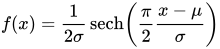
![{\displaystyle F(x)={\frac {2}{\pi }}\arctan \left[\exp \left({\frac {\pi }{2}}{\frac {x-\mu }{\sigma }}\right)\right]}](https://wikimedia.org/api/rest_v1/media/math/render/svg/40e0860eb7b66ecfc89b2e501511351c1615ffc5)
![{\displaystyle \operatorname {ES} _{\alpha }(X)=-\mu -{\frac {2\sigma }{\pi }}\ln \left(\tan {\frac {\pi \alpha }{2}}\right)-{\frac {2\sigma }{\pi ^{2}\alpha }}i\left[\operatorname {Li} _{2}\left(-i\tan {\frac {\pi \alpha }{2}}\right)-\operatorname {Li} _{2}\left(i\tan {\frac {\pi \alpha }{2}}\right)\right]}](https://wikimedia.org/api/rest_v1/media/math/render/svg/8d2f3cf358635c87055b57e48c565b31950f5731)


![{\displaystyle F(x)=\Phi \left[\gamma +\delta \sinh ^{-1}\left({\frac {x-\xi }{\lambda }}\right)\right]}](https://wikimedia.org/api/rest_v1/media/math/render/svg/bc71f4b7428dc370287f5ef90249a0bd2eb86b75)
![{\displaystyle \operatorname {ES} _{\alpha }(X)=-\xi -{\frac {\lambda }{2\alpha }}\left[\exp \left({\frac {1-2\gamma \delta }{2\delta ^{2}}}\right)\;\Phi \left(\Phi ^{-1}(\alpha )-{\frac {1}{\delta }}\right)-\exp \left({\frac {1+2\gamma \delta }{2\delta ^{2}}}\right)\;\Phi \left(\Phi ^{-1}(\alpha )+{\frac {1}{\delta }}\right)\right]}](https://wikimedia.org/api/rest_v1/media/math/render/svg/4e6020b35cc8398cc34e1d60602e16c607e06d60)

![{\displaystyle f(x)={\frac {ck}{\beta }}\left({\frac {x-\gamma }{\beta }}\right)^{c-1}\left[1+\left({\frac {x-\gamma }{\beta }}\right)^{c}\right]^{-k-1}}](https://wikimedia.org/api/rest_v1/media/math/render/svg/016c07ff59be5fcb9e0118727745b0a82f5883ea)
![{\displaystyle F(x)=1-\left[1+\left({\frac {x-\gamma }{\beta }}\right)^{c}\right]^{-k}}](https://wikimedia.org/api/rest_v1/media/math/render/svg/3aa018db567f5b024ee135f816c3fb735527c9e7)
![{\displaystyle \operatorname {ES} _{\alpha }(X)=-\gamma -{\frac {\beta }{\alpha }}\left((1-\alpha )^{-1/k}-1\right)^{1/c}\left[\alpha -1+{_{2}F_{1}}\left({\frac {1}{c}},k;1+{\frac {1}{c}};1-(1-\alpha )^{-1/k}\right)\right]}](https://wikimedia.org/api/rest_v1/media/math/render/svg/91683a8cdde99bac106695c9bdb270ce5d056296)


![{\displaystyle f(x)={\frac {ck}{\beta }}\left({\frac {x-\gamma }{\beta }}\right)^{ck-1}\left[1+\left({\frac {x-\gamma }{\beta }}\right)^{c}\right]^{-k-1}}](https://wikimedia.org/api/rest_v1/media/math/render/svg/2156ace29c273bacd1a301ff8dea896df993e187)
![{\displaystyle F(x)=\left[1+\left({\frac {x-\gamma }{\beta }}\right)^{-c}\right]^{-k}}](https://wikimedia.org/api/rest_v1/media/math/render/svg/fcaf5ae59f211cffd7eb9303a8f050ed551700d4)





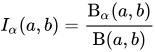

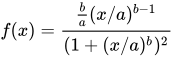
![{\displaystyle \operatorname {ES} _{\alpha }(L)={\frac {a}{1-\alpha }}\left[{\frac {\pi }{b}}\csc \left({\frac {\pi }{b}}\right)-\mathrm {B} _{\alpha }\left({\frac {1}{b}}+1,1-{\frac {1}{b}}\right)\right]}](https://wikimedia.org/api/rest_v1/media/math/render/svg/187489f78049d447826f6c7da5a49b7f54bdd4c2)

![{\displaystyle \operatorname {ES} _{\alpha }(X)={\begin{cases}1-{\frac {e^{\mu }(2\alpha )^{b}}{b+1}}&{\text{if }}\alpha \leq 0.5,\\1-{\frac {e^{\mu }2^{-b}}{\alpha (b-1)}}\left[(1-\alpha )^{(1-b)}-1\right]&{\text{if }}\alpha >0.5.\end{cases}}}](https://wikimedia.org/api/rest_v1/media/math/render/svg/b7b484d9d7dc9a5719e04ed634fd9d49f934c819)

![{\displaystyle \operatorname {ES} _{\alpha }^{t}(X)=\operatorname {ess\sup } _{Q\in {\mathcal {Q}}_{\alpha }^{t}}E^{Q}[-X\mid {\mathcal {F}}_{t}]}](https://wikimedia.org/api/rest_v1/media/math/render/svg/0987e7687617fddd3dd4319ba647d4edab3306d5)

![{\displaystyle \rho _{\alpha }^{t}(X)=\operatorname {ess\sup } _{Q\in {\tilde {\mathcal {Q}}}_{\alpha }^{t}}E^{Q}[-X\mid {\mathcal {F}}_{t}]}](https://wikimedia.org/api/rest_v1/media/math/render/svg/eb5535550562e8131fb6f5a5a429e81b01c67b8c)
![{\displaystyle {\tilde {\mathcal {Q}}}_{\alpha }^{t}=\left\{Q\ll P:\operatorname {E} \left[{\frac {dQ}{dP}}\mid {\mathcal {F}}_{\tau +1}\right]\leq \alpha _{t}^{-1}\operatorname {E} \left[{\frac {dQ}{dP}}\mid {\mathcal {F}}_{\tau }\right]\;\forall \tau \geq t{\text{ a.s.}}\right\}.}](https://wikimedia.org/api/rest_v1/media/math/render/svg/1e138fe00e7a6f9a28f21275aa95b520cb312e7c)